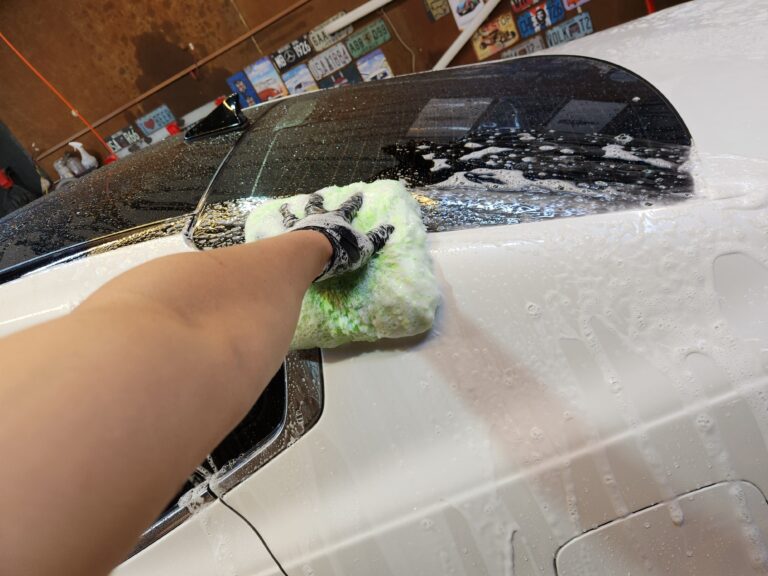
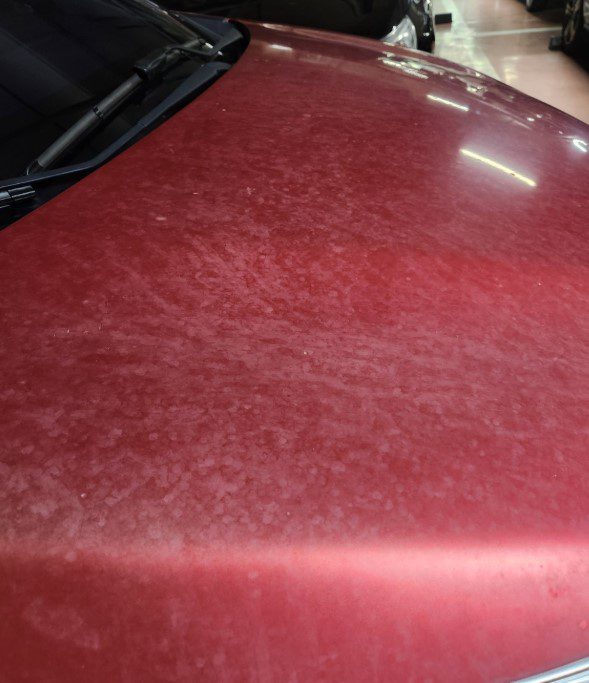
Understanding car detailing physics is crucial to reducing scratches and swirl marks during washing, drying, and buffing.
Proper car detailing is never just about making a vehicle look clean. It is a form of paint management.
It is a form of paint management.
Every wash involves repeated physical contact with the clear coat. A water-filled wash mitt moves across the panel. A drying towel absorbs the remaining moisture. A microfiber towel removes wax, sealant, polish, or coating residue.
Each tool serves a different purpose, but once it touches and moves across the paint, the same physical principles begin to apply.
To reduce scratches and swirl marks, it is not enough to memorize familiar rules such as “wipe in straight lines” or “use the two-bucket method.”
Those methods can be useful, but they are only parts of a larger system.
The more important question is:
Why do scratches form during washing, drying, and buffing?
The answer lies in how contamination, force, pressure, friction, and movement interact with the clear coat.
The Real Conflict: Abrasive Contamination vs. Clear Coat
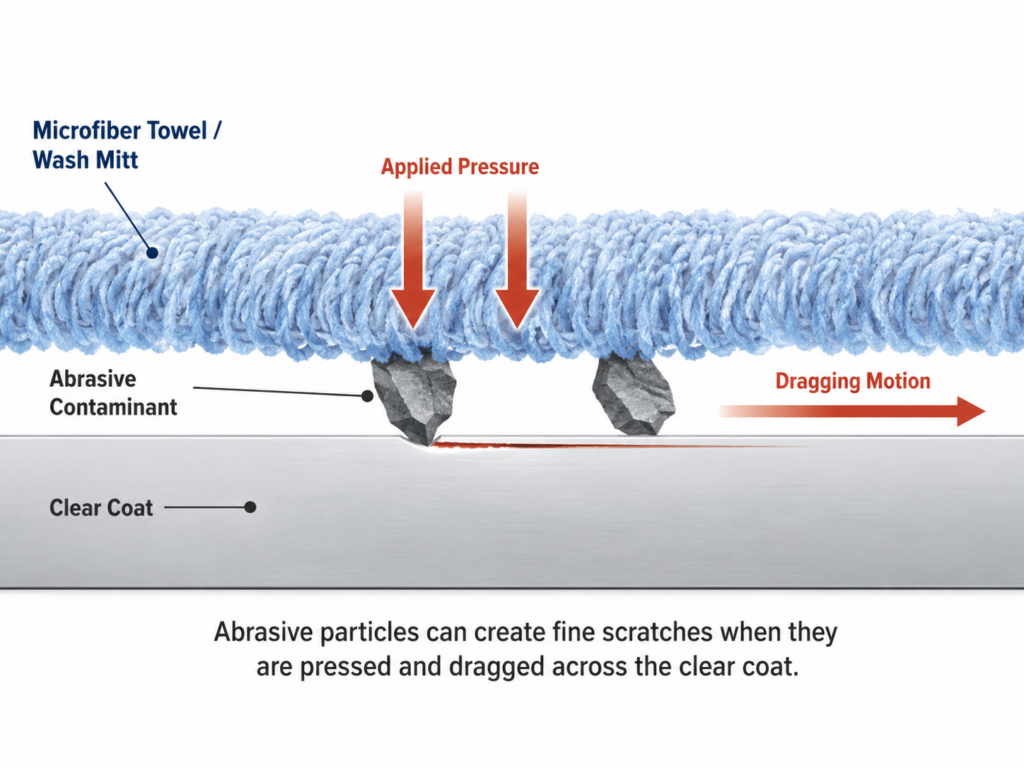
Before looking at the equations, we need to understand what actually creates a wash-induced scratch.
Automotive clear coat is durable enough to protect the paint beneath it, but it is not immune to abrasion.
Some common contaminants—especially mineral dust, road grit, silica-rich particles, and industrial fallout—can be harder and sharper than the clear coat itself.
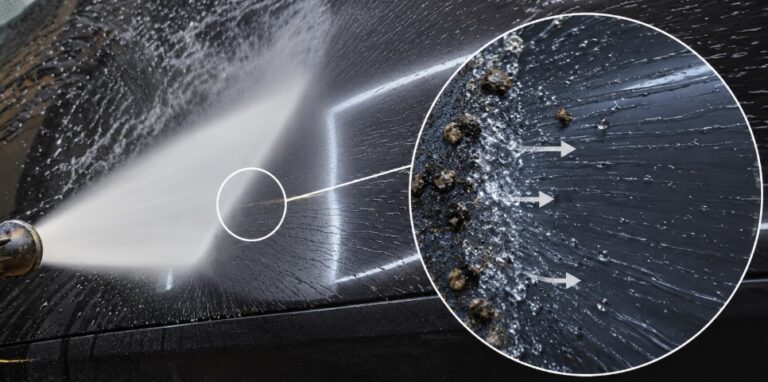
When these particles are pressed and dragged across the surface, they can leave fine scratches.
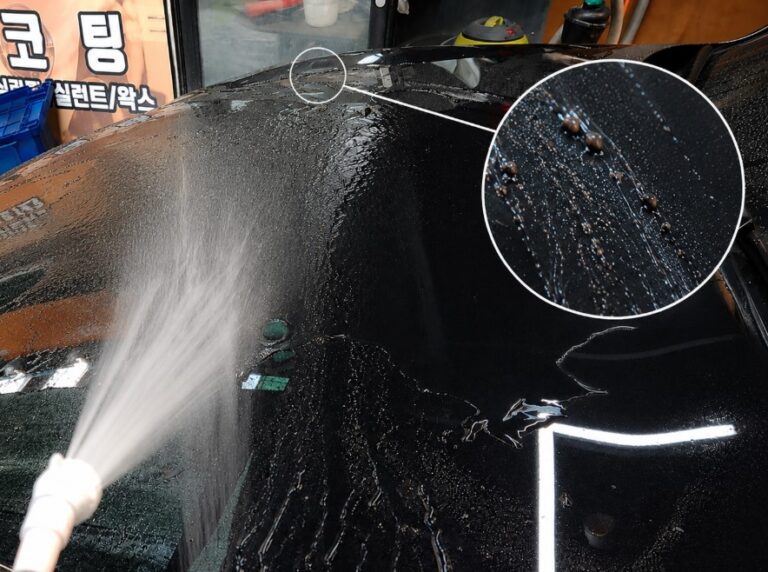
A towel or wash mitt does not necessarily scratch the paint simply because it touches the surface. The risk increases when an abrasive particle becomes trapped between the tool and the clear coat.
At that point, the particle can act like a tiny cutting point.
The harder it is pressed and the farther it is dragged, the greater the possibility of damage.
This is why aggressive wiping is dangerous.
The problem is not only the dirt itself. It is the physical environment created around that dirt.
Since we cannot instantly change the hardness or shape of every contaminant, we must control the variables surrounding it:
- How much force is applied
- How concentrated that force becomes
- How much friction exists at the contact surface
- How abruptly the mitt or towel changes speed and direction
Once washing, drying, and buffing are viewed through these four factors, detailing becomes more than a collection of techniques.
It becomes a process of managing physical risk.
1. Force: The Tool Already Has Weight Before You Press
The force acting on the paint does not come only from your hand.
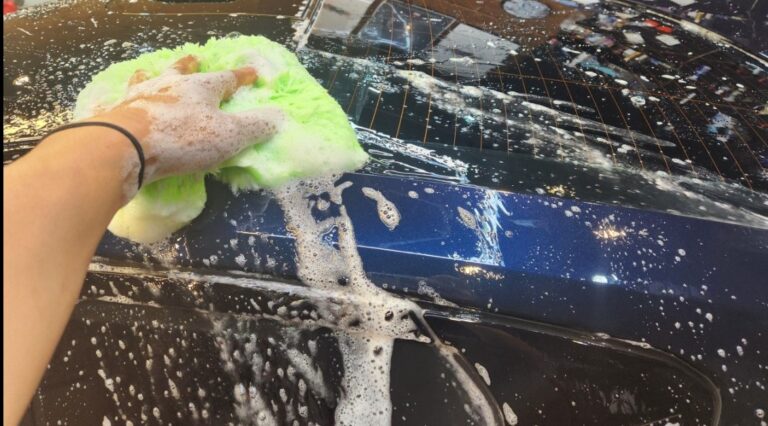
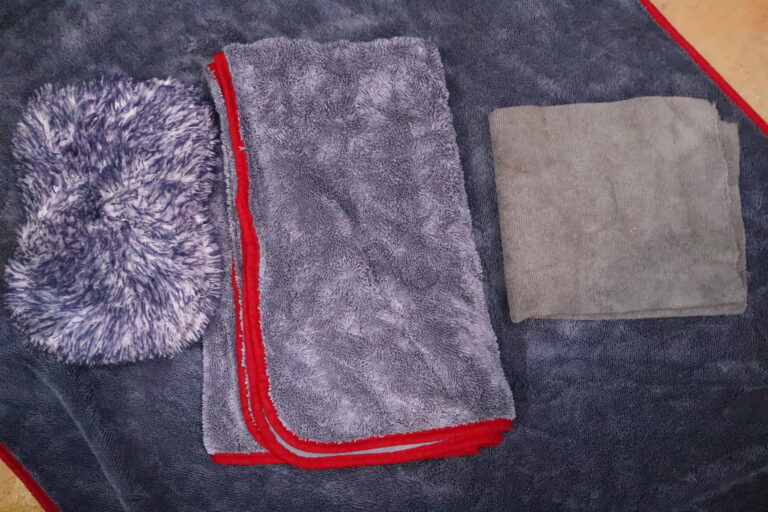
A wash mitt filled with water and shampoo already has mass. A drying towel becomes heavier as it absorbs water. A buffing towel also creates a contact load as it rests and moves across the panel.
The practical contact load can be understood as:
Contact load = load created by the tool + force added by the operator
The load created by the tool changes depending on its size, material, water content, and position on the panel.
A wet wash mitt may already carry a noticeable amount of weight. A large drying towel can become significantly heavier after absorbing water from several panels.
Why Hand Pressure Matters
The force added by the hand is different.
It is not unavoidable. It is a variable the operator controls.
This is the real meaning behind the familiar instruction:
Let the mitt do the work.
It is not merely a vague reminder to be gentle.
It means that the tool already has enough weight to maintain contact with the paint. The hand should mainly guide its direction and keep it stable.
On horizontal panels such as the hood, roof, and trunk, part of the tool’s weight acts directly toward the surface.
On vertical panels such as doors and fenders, gravity pulls the tool downward rather than directly into the paint. The operator therefore applies inward force to maintain contact.
In both cases, unnecessary hand pressure increases the load carried by the clear coat.
When More Pressure Is the Wrong Response
This becomes especially dangerous when contamination remains beneath the tool.
The moment you press harder because a mark is not disappearing, you may be forcing abrasive particles more firmly against the paint.
More pressure does not always mean more cleaning.
Sometimes the correct response is to stop and ask:
- Is the contamination fully loosened?
- Does the area need another chemical treatment?
- Has the mitt become contaminated?
- Has the towel lost its clean working surface?
- Has the product dried too far?
A stubborn contaminant should not automatically be treated as an invitation to press harder.
2. Pressure: A Small Force Can Become Aggressive When Concentrated
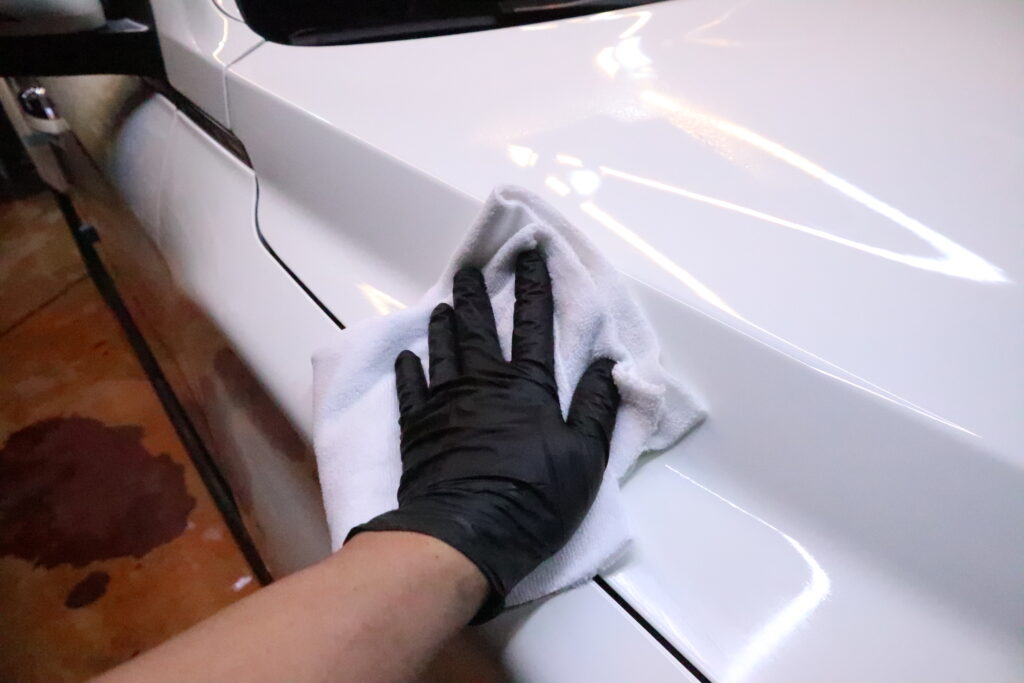
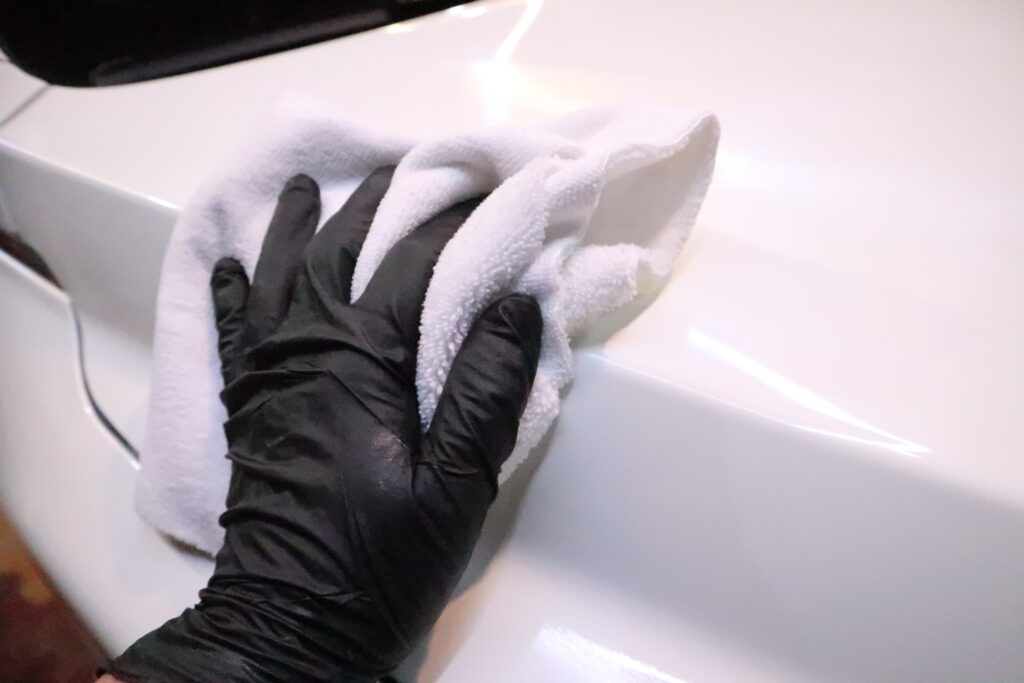
The same hand force creates different pressure depending on how widely it is distributed across the towel.
Reducing total force is only the first step.
We must also consider how that force is distributed.
Pressure is expressed as:
P = F / A
Pressure = Force ÷ Contact area
Here, F represents the force applied to the surface, while A represents the area over which that force is distributed.
As force increases, pressure increases.
However, pressure can also rise when the contact area becomes smaller, even if the total force remains relatively low.
Why Fingertip Pressure Creates More Risk
This is why fingertip pressure is more dangerous than it feels.
When a towel is pushed through two or three fingertips, the hand’s force is concentrated into a very small area.
A single abrasive particle trapped beneath that point receives a much higher local load than it would beneath a broad, evenly supported towel.
The person performing the work may honestly believe:
“I was not pressing very hard.”
But the issue is not only how much force was used.
The issue is where that force went.
Spread the Load Across a Wider Area
By contrast, when the broad face of a wash mitt rests evenly against the panel, the load is spread across a larger area.
The same principle applies to drying and buffing towels.
A towel should not be twisted into a hard ball and pressed into the paint through a narrow section of the hand. It should be folded or spread so that a broad, stable section of microfiber remains in contact with the surface.
A larger contact area does not eliminate pressure, but it reduces the amount concentrated at any single point.
This gives us a simple rule:
Do not only reduce force. Spread it.
During contact washing, guide the mitt with the palm instead of pressing through individual fingers.
During drying, allow a broad section of the towel to absorb water rather than rubbing through one corner.
During buffing, keep the towel flat and refold it frequently so that pressure and residue remain evenly distributed.
The risk of scratching is shaped not only by how hard you press, but also by how narrowly that pressure is focused.
3. Friction: Lubrication Changes Throughout the Detail


Lubrication is generally highest during washing, while drying and buffing require closer control of towel condition and hand pressure.
Whenever two surfaces touch and move against each other, friction is created.
A simplified friction model is:
Friction force = μ × N
Here, μ is the coefficient of friction, while N is the normal force pressing the two surfaces together.
In practical detailing terms:
- More contact force can increase friction
- Less lubrication can increase resistance
- A contaminated or saturated towel can increase drag
- A grabby surface makes smooth control more difficult
The coefficient of friction describes how easily or reluctantly two surfaces slide against each other.
When lubrication is sufficient, the mitt or towel moves more freely.
When lubrication decreases, the surface begins to feel resistant or grabby.
The detailing process naturally moves through several different friction conditions.
Contact Washing
During contact washing, lubrication is generally at its highest.
Water and shampoo solution remain between the wash mitt and the paint, helping the tool move across the surface with less resistance.
The shampoo solution also helps loosen contamination and allows loosened particles to move away from the immediate contact area
However, this does not mean contact washing is automatically the safest stage.
Remaining contamination may still be present on the panel. If excessive pressure is added, those particles can be trapped and dragged beneath the mitt.
Lubrication reduces friction, but it does not replace proper pre-washing, rinsing, mitt cleaning, or pressure control.
The wash stage combines two opposing conditions:
- Relatively high lubrication
- Relatively high contamination risk
This is why the mitt must remain saturated, clean, and lightly guided.
Drying
The physical condition changes during drying.
Water is being removed from the surface, so the lubricating layer gradually disappears.
At the same time, the towel becomes heavier as it absorbs moisture.
A drying towel that moved easily across the first wet panel may begin to drag after absorbing water from several sections.
This creates an unfavorable combination:
- The towel gains mass
- The paint loses surface water
- Friction begins to increase
Continuing to pull an overloaded towel across an increasingly dry surface can place more stress on the clear coat.
This is why drying should not be treated as a careless final step.
A drying towel must have sufficient absorption capacity, but it must also be replaced, repositioned, or refolded before it becomes too saturated.
Once an area is dry, repeatedly rubbing it provides little benefit and increases unnecessary contact.
Buffing
Buffing may involve even less free lubrication.
Wax, sealant, polish, or coating residue can initially provide some slip. But as the product flashes, cures, dries, or becomes unevenly distributed, the towel may begin to feel grabby.
A dirty or product-saturated buffing towel can also increase resistance.
When residue becomes difficult to remove, the instinctive response is often to press harder.
That is usually the wrong first response.
A better response is to:
- Refold the towel to a clean section
- Replace it with a fresh towel
- Work in a smaller area
- Adjust the product amount
- Remove the product at the correct time
- Use the manufacturer’s recommended removal method
As lubrication decreases, hand pressure should not increase to compensate.
It should become more controlled.
The later the contact stage, the more important it becomes to manage towel condition, product residue, and movement.
Why Slickness Is More Than a Pleasant Feeling
Slickness is often discussed as a cosmetic quality.
A slick surface feels smooth and refined after applying a wax, sealant, or coating.
But slickness also has a practical role.
When a towel moves across a slick surface, it meets less resistance. Lower resistance makes it easier to maintain smooth, controlled movement.
This does not mean a slick coating makes careless wiping safe.
A dirty towel, excessive pressure, or trapped contamination can still create scratches.
However, when the other conditions are controlled, useful surface slickness can reduce friction during drying and maintenance.
This is why evaluating a protection product only by gloss or water beading can be limiting.
Slickness affects how the surface behaves during future contact.
It can make drying easier, reduce towel drag, and help the operator recognize changes in resistance more quickly.
Slickness is therefore not just a satisfying tactile effect.
It is part of the friction-management system.
4. Acceleration: The Hidden Risk of Abrupt Movement
Fast wiping often looks efficient.
The hand moves quickly, the towel covers more area, and the work appears to progress faster.
But speed alone is not the main issue.
The greater problem is what happens at the beginning, end, and reversal of each stroke.
This is where Newton’s second law becomes relevant:
F = ma
Force = Mass × Acceleration
In physics, acceleration is not simply high speed.
It describes how quickly velocity changes:
a = Δv / Δt
Acceleration = Change in velocity ÷ Time
What Happens When the Towel Changes Direction
A towel moving across a panel must eventually slow down or stop.
If it immediately reverses direction, it must accelerate again in the opposite direction.
When this change happens over a very short time, a greater force is required to alter the motion.
This does not mean every quick movement automatically creates a scratch.
It means that abrupt stops and rapid reversals make contact pressure harder to control.
Why Abrupt Reversals Reduce Control
At the end of a fast stroke:
- The wrist may tighten
- The towel may bunch or twist
- Fingertip pressure may increase
- The contact area may become smaller
- A dry section may be crossed unexpectedly
- A trapped particle may be dragged under unstable pressure
This is why aggressive back-and-forth wiping can become risky even when the movement follows a straight line.
The issue is not simply the direction of the stroke.
The issue is the repeated cycle of fast acceleration, abrupt stopping, and immediate reversal.
Use Smooth and Predictable Strokes
The safer approach is not to move unrealistically slowly.
It is to use smooth, controlled, and predictable strokes.
Move slowly enough to feel changes in resistance.
Keep the movement controlled enough to hold the towel flat.
Keep the hand relaxed enough to avoid pushing through the fingertips.
At the end of each stroke, allow the movement to decelerate naturally instead of snapping the towel back in the opposite direction.
The goal is not merely to reduce speed.
It is to reduce sudden changes in movement and the unstable forces they create.
Straight Lines Are Not a Complete Safety System
Wiping in straight lines is often recommended because any fine marks that occur may appear less visually concentrated than circular marks under direct lighting.
However, straight-line movement should not be treated as a guarantee against scratches.
A towel can still damage the paint while moving in a straight line if:
- Contamination is trapped underneath
- Too much force is applied
- Pressure is concentrated through the fingertips
- Lubrication is insufficient
- The towel is dirty or saturated
- The movement is too fast and abrupt
Direction is only one variable.
A straight stroke performed with high pressure and poor lubrication is not safer simply because it is straight.
The complete contact condition matters more than the shape of the movement.
Detailing Is Risk Management, Not Damage Control
When scratches or swirl marks become visible, many vehicle owners immediately think about compounding or machine polishing.
Polishing can improve the surface by leveling a microscopic portion of the clear coat around the defect.
But clear coat thickness is limited.
Paint correction is a useful corrective process, not an unlimited solution that should replace proper maintenance.
Good detailing is not based on repeatedly removing damage after it appears.
It is based on reducing the physical conditions that create that damage.
To reduce wash-induced scratches and swirl marks:
- Do not add unnecessary hand force to the existing load of the tool
- Do not concentrate pressure through fingertips or small contact points
- Do not allow the mitt or towel to become overloaded or contaminated
- Do not continue wiping after lubrication has disappeared
- Do not compensate for difficult residue by pressing harder
- Do not use abrupt, uncontrolled back-and-forth movements
- Refold or replace towels when resistance increases
- Stop and identify the cause whenever the surface begins to feel unusually grabby
Scratch risk rarely comes from one mistake alone.
It increases when several conditions overlap:
- Abrasive contamination
- Excessive contact force
- Concentrated pressure
- Reduced lubrication
- Rising friction
- Saturated tools
- Sudden changes in movement
The real skill in detailing is recognizing these conditions before they combine.
The Real Purpose of Detailing
Professional detailing is not defined by how many products are used or how complicated the process appears.
It is defined by how carefully every point of contact is controlled.
A wash mitt, drying towel, or buffing towel is only a tool.
The risk begins when contamination, force, pressure, friction, and uncontrolled movement come together.
Understanding the physics of contact provides a more reliable standard than simply memorizing individual techniques.
The goal is not to make every wash completely risk-free. That is unrealistic whenever physical contact occurs.
The goal is to control the variables that can be controlled:
- Reduce unnecessary force
- Spread pressure over a larger area
- Maintain adequate lubrication
- Keep tools clean
- Replace saturated towels
- Use smooth and predictable movements
True paint care is not only about correcting swirl marks after they appear.
It is about reducing the physical conditions that allow them to form.
That is the real value of understanding detailing through F = ma.