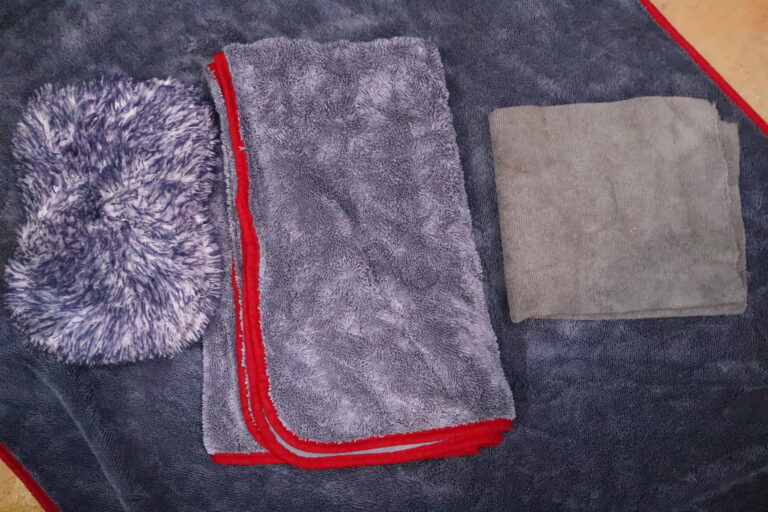
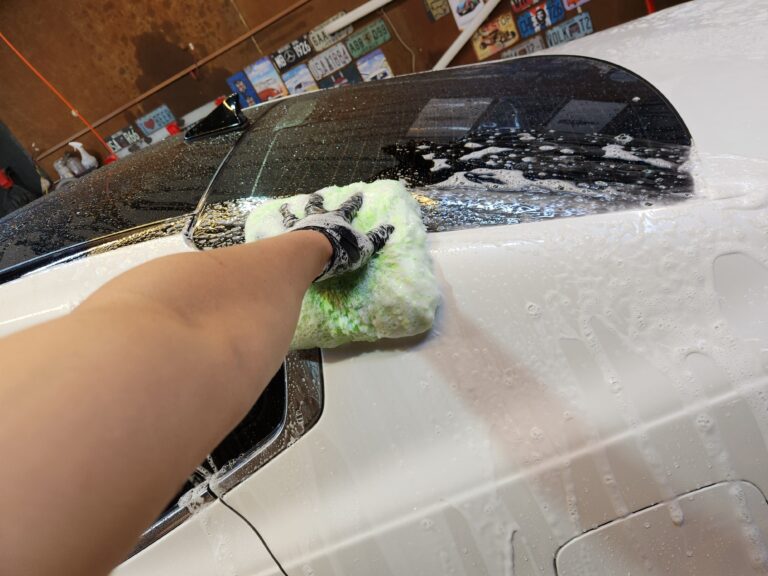
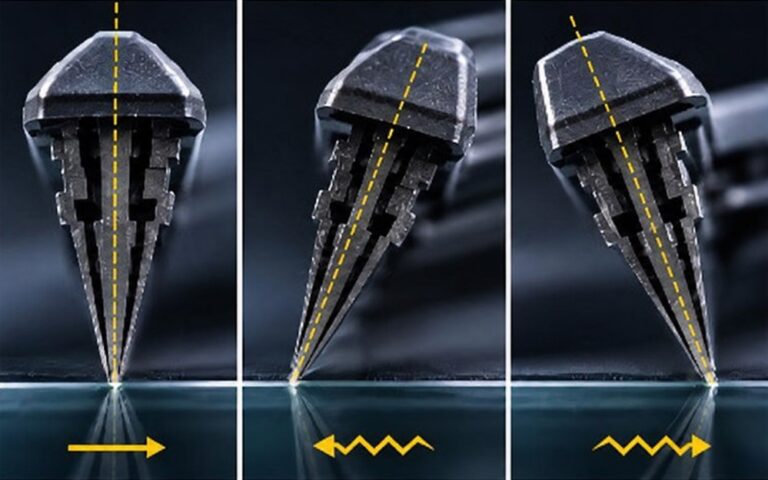
Understanding car detailing scratch risk requires more than learning a few standard rules.
Every time a wash mitt, drying towel, or buffing towel touches the clear coat, the surface is exposed to physical contact. The amount of force, the distribution of pressure, the available lubrication, and the condition of the tool all influence what happens at that contact point.
But those conditions do not remain the same throughout the detailing process.
At the beginning of a wash, contamination is at its highest, while water and car shampoo provide the greatest amount of lubrication. As the vehicle becomes cleaner, that lubricating layer gradually decreases, making towel drag and surface resistance more important.
The danger does not disappear when the car becomes clean.
It changes its identity.
The process begins as a problem of contamination control and gradually becomes a problem of friction management.
Managing car detailing scratch risk therefore requires a different response at each stage of the process.
The Risk Does Not Disappear—It Changes
It is easy to assume that the most dangerous moment occurs when the vehicle is visibly dirty.
That is only partly true.
During contact washing, dust, road grit, mineral particles, and bonded grime may become trapped between the wash mitt and the clear coat.
Later, much of that contamination has been removed. But the water and shampoo that helped the mitt move smoothly have also been rinsed away.
The surface becomes cleaner, but it also becomes less lubricated.
This creates a clear transition:
| Stage | Main Risk | Contact Condition | Best Response |
|---|---|---|---|
| Contact Washing | Abrasive contamination | High lubrication and high contamination | Use light pressure, keep the mitt clean, and rinse it frequently |
| Drying | Increasing towel load and drag | Surface water decreases as the towel becomes heavier | Refold or replace the towel and avoid repeated wiping |
| Buffing | Product residue and surface resistance | Low free lubrication | Use a clean towel face and remove the product at the correct time |
This is why car detailing scratch risk cannot be judged only by how dirty or clean the vehicle appears.
A clean panel is not automatically a safe panel.
Paint can still be scratched when a towel is overloaded, contaminated, or pressed too firmly against a high-resistance surface.
The same wiping technique should not be applied blindly to every stage.
Contact Rules That Apply at Every Stage
Although the condition of the surface changes, several contact principles remain constant.
Reduce Unnecessary Contact Force
The mitt or towel already creates a load against the paint.
A wet wash mitt carries water and shampoo. A drying towel becomes heavier as it absorbs moisture. A buffing towel develops more resistance as it collects product residue.
The goal is not zero pressure. Physical contact always involves some pressure.
The goal is to avoid adding more force than the task requires.
When contamination or residue does not move easily, additional pressure should not be the automatic response.
Spread Pressure Across a Broad Area
Force becomes more aggressive when it is concentrated.
Pressing through the fingertips or using a bunched-up section of towel focuses the load into a narrow contact point.
A broad and stable contact area distributes that force more evenly.
This is why a wash mitt should be guided with the palm and why a towel should be folded or spread rather than twisted into a hard ball.
Do not only reduce force. Spread it.
Keep Movement Smooth and Controlled
Fast wiping is not automatically harmful.
The greater problem is the abrupt stopping and immediate reversal that often occur at the end of a fast stroke.
At that moment, the wrist may tighten, the towel may bunch, and fingertip pressure may increase.
The safer standard remains:
Minimal added pressure, a broad contact area, and smooth, predictable movement.
What changes from one stage to the next is the type of risk that deserves the greatest attention.deserves the greatest attention.
Phase 1: Contact Washing—The Contamination Control Stage
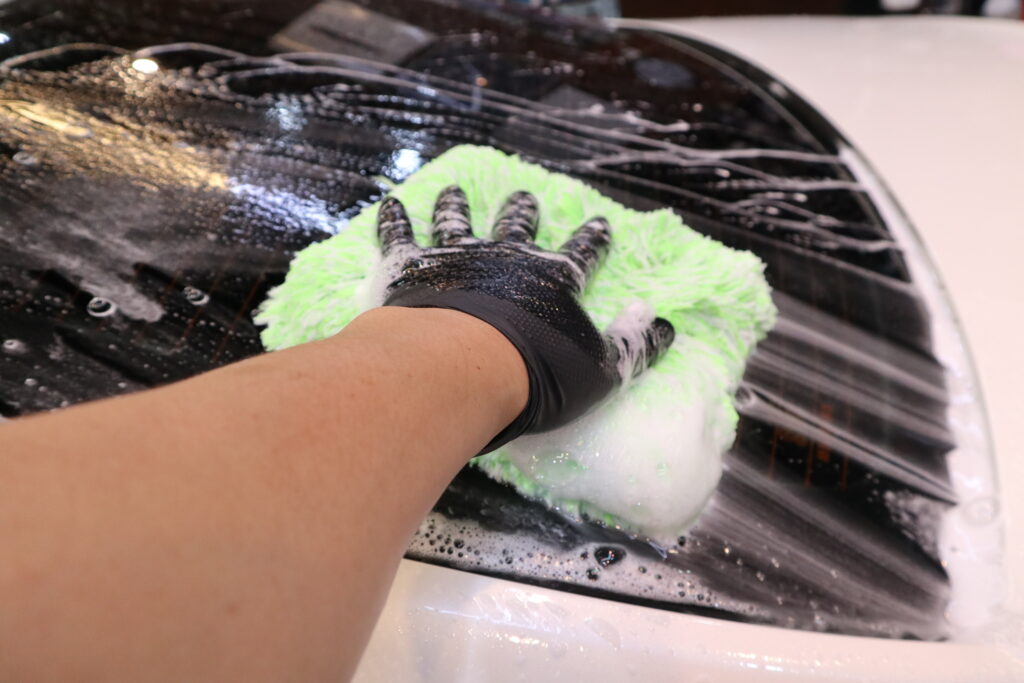
Even after a thorough pre-wash and high-pressure rinse, some contamination may remain on the clear coat.
During contact washing, these remaining particles are the primary threat.
What Remains After Pre-Washing?
Remaining contamination may include:
- Fine mineral dust
- Road film
- Small grit particles
- Insect residue
- Oily traffic contamination
- Bonded material that did not release during rinsing
These particles may be difficult to see, but they can still create fine scratches when pressed and dragged beneath the wash mitt.
The surface may look cleaner after pre-washing, but it should not be assumed to be completely free of abrasive material.
Why Does the Wash Mitt Matter for Scratch Prevention?
The purpose of a wash mitt is not to scrub contamination into submission.
Its job is to loosen remaining dirt while creating enough internal space for particles to move away from the direct contact zone.
A suitable wash mitt must therefore do more than hold a large quantity of shampoo solution.
It should also allow water, cleaning solution, and loosened contamination to move through its fibers.
If the fibers become tightly matted or cannot release dirty solution, contamination may remain concentrated near the paint.
The mitt may feel soft in the hand, but softness alone does not guarantee safe contact.
High Lubrication Does Not Remove Contamination Risk
Contact washing normally provides the greatest amount of lubrication.
Water and shampoo help the mitt move across the surface with less resistance. They also help loosened contamination move away from the immediate contact area.
But lubrication does not make contact washing harmless.
Scratch risk can still increase when:
- Too much hand pressure is applied
- The mitt is not rinsed properly
- The fibers become loaded with contamination
- A heavily soiled section is washed too early
- The panel begins to dry
- The same mitt face is used for too long
During contact washing, car detailing scratch risk is driven mainly by abrasive contamination remaining beneath the mitt.
This stage combines two opposing conditions:
High lubrication and high contamination risk.
The slipperiness of the shampoo does not remove the hardness of the particles beneath the mitt.
Phase 2: Drying—When Water Leaves, Friction Moves In

AfteAfter rinsing, the vehicle appears much safer.
Most loose contamination has been removed, and the surface is visibly clean.
But another change has already begun.
The shampoo solution is gone, the remaining water is being removed, and the drying towel is becoming progressively heavier.
Why Does My Drying Towel Start Dragging?
Drying creates a difficult combination:
- The surface loses water
- The towel gains water
- The towel becomes heavier
- The lubricating layer becomes thinner
A fresh drying towel may move easily across a wet panel.
After several sections, that same towel can begin to feel heavier and more resistant.
The tool gains mass while the surface loses lubrication.
This is why drying should not be treated as a careless final step.
Dragging Is a Warning
When a drying towel begins to drag, the instinctive response is often to press harder.
That is precisely when pressure should not increase.
When a drying towel starts to fight the surface, more force is not the solution. It is a warning.
The towel may need to be:
- Repositioned
- Refolded
- Replaced
- Wrung out, when appropriate for its structure and intended use
A drying aid may also help reduce surface resistance, while blotting can limit unnecessary lateral movement on sensitive areas.
The correct response is to improve the contact condition, not overpower it.
Avoid Repeated Wiping on Dry Paint
Once an area is dry, additional rubbing provides little benefit.
The towel is no longer moving over a water-rich surface. It is now moving against the protection layer or clear coat with much less free lubrication.
Repeated wiping increases contact without improving water removal.
At this stage, car detailing scratch risk shifts away from heavy contamination and toward friction on a nearly dry panel.
The vehicle is cleaner, but the contact condition has become less forgiving.
Phase 3: Buffing—Clean Paint Can Still Fight Back
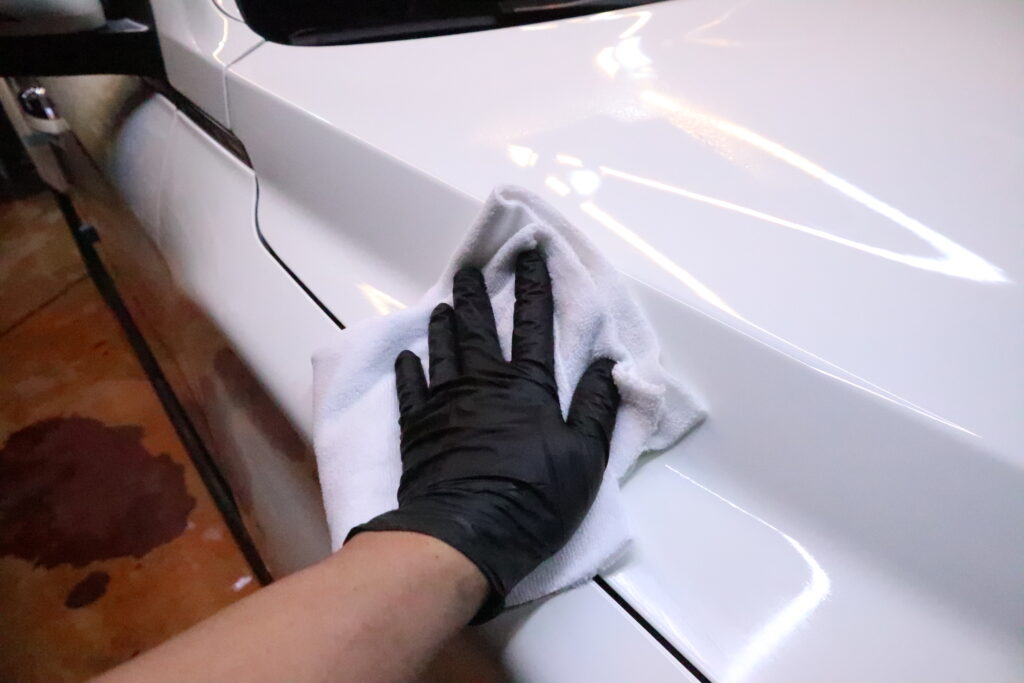
Buffing appears gentle because the surface is already clean.
There is no visible road grit, and the towel may be removing only a thin layer of wax, sealant, polish, or coating residue.
Yet buffing can produce some of the highest perceived resistance in the entire process.
Why Product Residue Becomes Grabby
Product residue changes as it sits on the paint.
It may begin slick and easy to remove, then become tacky as solvents evaporate or the product begins to cure.
The towel also changes during use.
As it collects residue, its working surface becomes less uniform. Product can build up in the fibers, causing the towel to push residue rather than remove it.
The surface is clean, but the contact condition is not necessarily easy.
Low contamination does not always mean low friction.
A Fresh Towel Often Works Better Than More Pressure
When residue becomes difficult to remove, the problem may be:
- Too much product
- An oversized working section
- Incorrect removal timing
- A towel saturated with residue
- The wrong towel face
- Unsuitable surface or product temperature
Pressing harder may move the residue temporarily, but it also increases friction against a surface with very little free lubrication.
A fresh towel often solves more than additional pressure ever will.
Change the contact condition before increasing the force.
Why Tool Design Must Change with the Surface
The surface moves from wet and contaminated to clean and increasingly dry.
The tools used at each stage must reflect that change.
Using the same towel structure and wiping habit throughout the entire detail ignores the changing physical condition of the paint.
Wash Mitts: Create Space for Contamination
A wash mitt needs:
- Sufficient softness
- Internal space for loosened particles
- Good solution retention
- Reliable liquid release
- Fibers that remain open rather than tightly matted
- Easy rinsing in clean water or against a grit guard
The objective is not simply to hold as much water as possible.
A mitt must also release solution during movement and allow contamination to leave the immediate contact area.
A mitt that holds liquid but keeps dirty solution close to the paint may look plush while performing poorly where it matters.
Retention and release must work together.
Drying Towels: Absorb Water Without Becoming a Dragging Weight
A drying towel needs:
- High and consistent absorption
- A broad usable surface
- Stable contact with the paint
- Enough capacity for the vehicle
- Easy repositioning before saturation
- Minimal added pressure
The towel should remove water through absorption, not aggressive wiping.
Its broad surface also helps distribute contact load more evenly.
But even the best drying towel has a limit.
Once overloaded, its weight and drag increase. Continuing to use it only extends the contact under worse conditions.
Buffing Towels: Maintain a Clean Working Face
A buffing towel needs a working surface suited to the product and residue.
Some products respond well to a shorter pile. Others are easier to level with a medium-pile or dual-sided towel.
There is no single pile length that is correct for every wax, sealant, polish, or coating.
The more important requirements are:
- A clean working face
- Uniform contact
- Frequent refolding
- Timely towel replacement
- Compatibility with the residue being removed
A towel that worked perfectly on the first panel may become the source of drag on the next.
Slickness Is More Than a Cosmetic Feeling
Slickness is often treated as a luxury.
People touch the paint, feel how smoothly the hand moves, and associate that sensation with a freshly protected vehicle.
But slickness also has a practical function.
How Slickness Changes Towel Resistance
A slick surface offers less resistance during later drying and maintenance.
Lower resistance makes it easier to keep the towel flat, the movement smooth, and the hand relaxed.
The relationship can be understood simply:
Higher useful slickness → Lower towel resistance → Easier contact control → Lower scratch risk
This is why a protection product should not be evaluated only by gloss or water beading.
It also changes how the surface responds to future contact.
Slickness Does Not Make Paint Scratch-Proof
Slickness does not eliminate scratch risk.
A contaminated towel, excessive hand pressure, or poor washing technique can still create defects.
The effect is also not permanent.
Slickness gradually decreases through washing, weather exposure, contamination, and chemical cleaning.
A wax, sealant, or coating does not guarantee a scratch-free wash.
It simply creates better conditions for controlling friction.
The Most Dangerous Response Is to Press Harder
Across all three stages, one reaction repeatedly increases risk.
The tool begins to resist, so the hand adds more force.
During washing, this can push remaining contamination against the clear coat.
During drying, it can force a heavier towel against a surface with less water.
During buffing, it can increase friction against tacky residue and nearly dry paint.
The resistance feels different at each stage, but the warning is the same:
When the tool stops moving freely, stop forcing it. Find out why.
The solution may be more lubrication, a cleaner mitt, a fresh towel face, a smaller working section, or different removal timing.
Extra pressure hides the problem without correcting it.
Detailing Is the Management of Changing Risk
Understanding car detailing scratch risk means recognizing that the dominant threat changes throughout the process.
The wash begins with contamination control and ends with friction management.
As the surface becomes cleaner, lubrication decreases. The correct response is not more pressure, but better control: keep the tool clean, spread the load, maintain lubrication, and stop whenever resistance increases.
Understanding this transition is what turns repeated wiping into controlled paint care. Transition is what turns detailing from repeated wiping into controlled paint care.
To fully grasp this transition, it helps to understand how force, pressure, friction, and acceleration affect paint contact, which we covered in our [Car Detailing Physics: How F=ma Helps Reduce Swirl Marks] guide.