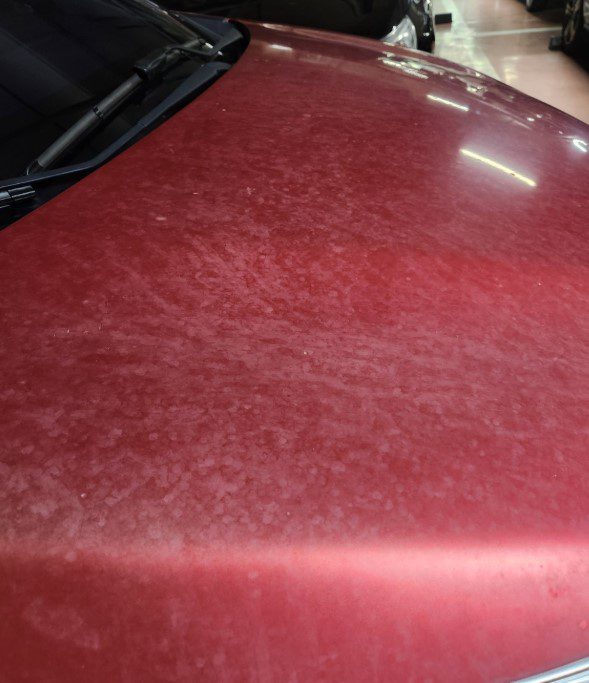
Using Water More Forcefully Is Not the Same as Using It Effectively
How effectively water separates and removes contamination during a car wash depends on how you use water pressure and flow rate.
In Part 1, we looked at the complete role of water—from weakening contamination to separating it and carrying it off the vehicle. In Part 2, we saw that the amount of work water can do depends on the type and condition of the contamination.
In Part 3, we will focus on water’s most direct physical roles: detachment and removal.
Two factors are especially important when using water to remove contamination:
- Pressure creates impact and shear forces at the surface, helping detach contamination that still clings to the paint.
- Flow rate determines how much water reaches the surface over time, helping dilute, transport, and carry detached contamination away.
Both always work together, but their relative importance changes depending on the condition of the contamination.
After pre-washing, when the cleaner has weakened the contamination but some of it still clings to the paint, pressure plays a larger role.
After the contact wash, when the wash mitt has already physically detached much of the contamination, flow rate becomes more important.
In practice, especially at a self-service car wash, you usually cannot freely change the pump pressure or flow rate.
The goal, therefore, is not simply to increase pressure or use more water.
The important point is to use the pressure and flow rate available from the equipment effectively for the condition of the contamination.
Key Takeaways
- Pressure: Helps detach attached contamination through impact and shear forces.
- Flow rate: Supplies enough water to dilute, transport, and remove detached contamination.
- The key: Instead of always using the strongest possible spray, adjust how you use pressure and flow according to whether the contamination still clings to the surface or has already come loose.
For the complete role of water from pre-wash through final rinsing, see Role of Water in Car Washing: How Water Works from Pre-Wash to Rinsing.
Table of Contents
- Water Pressure and Flow Rate Have Different Roles
- First Rinse After Pre-Wash — Detach as Much Contamination as Water Can Safely Remove
- Water Pressure Alone Cannot Detach Every Contaminant
- Contact Wash — Direct Contact Detaches Contamination While Water Reduces Friction
- Final Rinse — Removal Becomes More Important Than Detachment
- Why the Two Rinse Stages Are Different
- Frequently Asked Questions
- Conclusion
1. Water Pressure and Flow Rate Have Different Roles
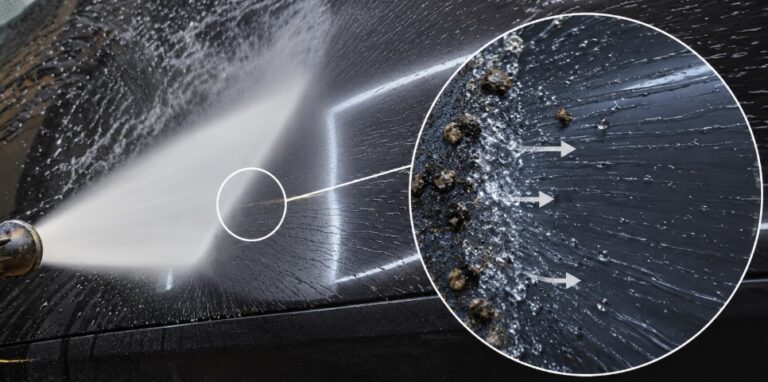
In a pressure washer, the pressure difference generated by the pump forces water through the nozzle at high velocity.
When this fast-moving water strikes contamination, it transfers force to the surface.
The resulting impact and shear forces play an important role in detaching contamination that still clings to the paint.
Flow rate, on the other hand, describes how much water the equipment delivers over a given period of time.
Once water detaches the contamination from the surface, a continuous water supply helps dilute it, move it across the panel, and ultimately carry it off the vehicle.
This means that neither pressure nor flow rate is always more important.
Their relative importance changes according to the wash stage and how strongly the contamination still clings to the surface.
2. First Rinse After Pre-Wash — Detach as Much Contamination as Water Can Safely Remove
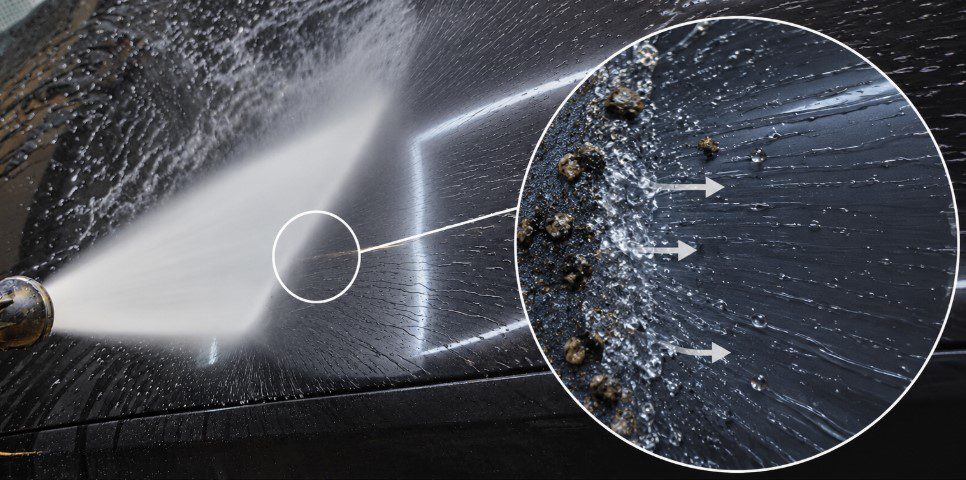
The pre-wash cleaner weakens the contamination, but the contamination may still remain on the surface.
Particulate contamination such as soil, sand, and larger debris may still remain attached to the paint.
For this reason, the rinse after pre-washing is not simply a step for washing away the cleaner.
It is also the stage where you detach as much particulate contamination as possible before the wash mitt touches the paint.
Reducing contamination before contact is one of the main reasons pre-washing matters. The principle is explained further in Why Pre-Wash Before a Contact Wash?.
Flow rate is still important at this stage.
However, because some contamination remains physically attached, effectively delivering the force generated by the pressure washer to the contamination is particularly important.
Distance Determines How Effectively Water Impact Reaches the Surface
A pressure-washer jet does not maintain exactly the same shape after leaving the nozzle.
As it travels through the air, the spray spreads and begins to break into smaller streams and droplets. As the distance increases, the spreading spray distributes its force across a wider area.
If the nozzle is too far from the paint, less impact reaches the surface even when the pressure washer itself has not changed.
This can make contamination detachment less efficient.
Moving too close creates the opposite problem.
Moving too close concentrates the force over a smaller area, so you need extra care around damaged paint, PPF edges, trim, and other vulnerable areas.
Equipment pressure and nozzle design vary, but approximately 30–50 cm (12–20 in) provides a practical starting range for typical self-service washing.
Then adjust the distance according to how effectively the contamination is actually moving.
Distance controls how effectively the water’s energy is delivered to the surface.
Spray Angle Determines the Direction in Which That Force Is Used
Once sufficient force reaches the contamination, the next question is where that force should go.
When the spray strikes the surface at a near-perpendicular angle, more of the water’s momentum acts directly toward the surface.
This can provide strong direct impact, but it contributes less to sweeping contamination in a particular direction.
When you angle the spray, part of the water’s force acts along the surface.
This surface-directed flow creates shear along the contamination boundary and helps both detach pre-wash-weakened contamination and move it in a controlled direction.
In practice, start with a spray angle of approximately 45–60°, then adjust it according to the contamination and panel shape..
Distance determines how effectively force reaches the surface. Spray angle determines the direction in which that force is used.
Practical Starting Points: Distance & Spray Angle
- Nozzle distance: approximately 30–50 cm (12–20 in)
Too close can concentrate force on paint, PPF edges, and trim. Too far away allows the jet to spread and lose effective impact. - Spray angle: approximately 45–60°
An angled spray creates a surface-directed component that helps shear weakened contamination away and move it toward an exit path.
The goal of the first rinse is therefore not simply to use the strongest possible spray.
It is to deliver sufficient force to contamination weakened by pre-washing while creating a path for that contamination to leave the panel.
3. Water Pressure Alone Cannot Detach Every Contaminant
Pre-washing and the first pressure rinse can remove a substantial amount of particulate contamination.
But water impact alone cannot detach every contaminant.
A thin layer of road film or residual contamination closely attached to the paint may remain even after thorough pressure rinsing.
Simply moving the nozzle closer and concentrating more force does not mean cleaning performance will continue increasing.
Beyond a certain point, additional force may increase stress on the surface without producing a meaningful improvement in contamination removal.
There is a limit to what water can safely detach by itself.
This is why the contact wash follows the pre-wash and first rinse.
When water impact alone cannot safely detach contamination, controlled contact with a wash mitt provides the additional physical force needed to remove it.
This is also why even a thorough pre-wash and pressure rinse do not automatically eliminate the need for a contact wash.
4. Contact Wash — Direct Contact Detaches Contamination While Water Reduces Friction
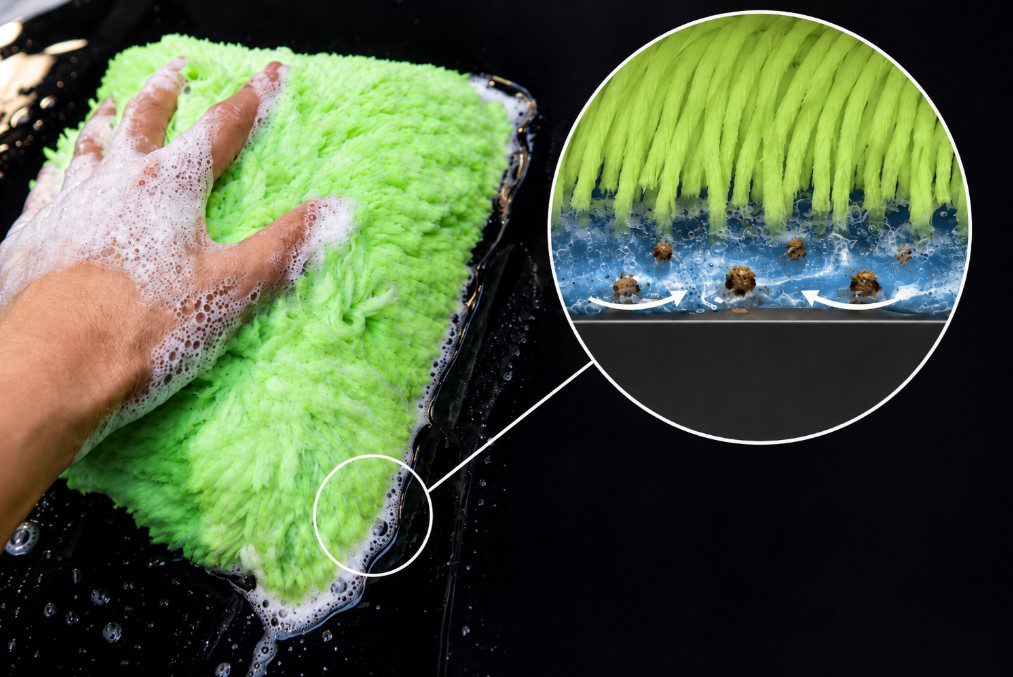
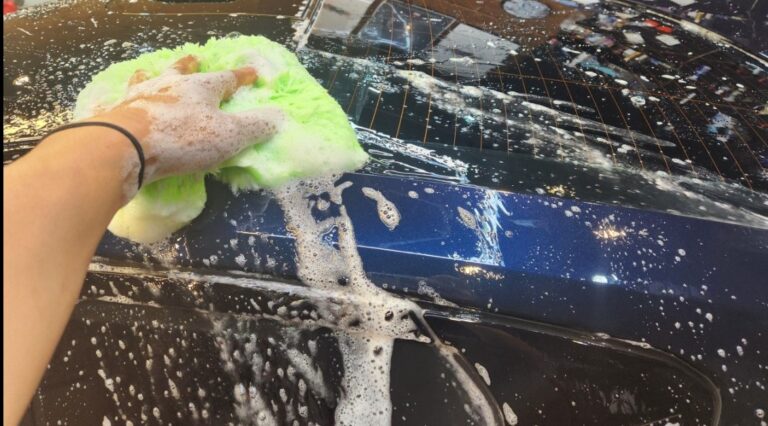
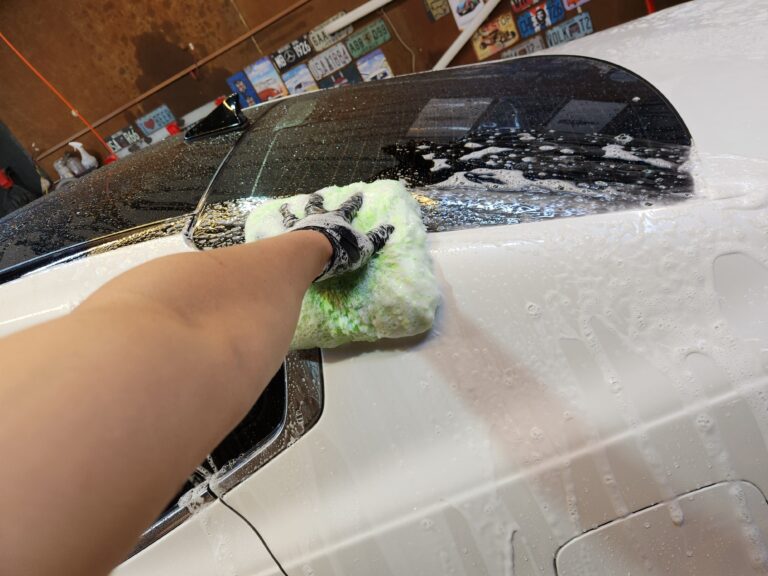
During the contact wash, the wash mitt directly contacts the paint and physically detaches contamination that remains after pre-washing.
However, direct contact does two things at the same time.
It provides the physical force needed to remove contamination, but it also creates friction against the paint.
For this reason, when residual particulate contamination remains after pre-washing and rinsing, controlling friction during contact becomes important.
This is where water again becomes central.
Water forms a liquid layer between the wash mitt and paint, helping reduce direct friction.
But as the mitt moves, it continually disrupts the liquid film, so the wash solution must keep replenishing it.
The wash solution must continually replenish the liquid film.
That is where flushing becomes important.
Flushing Replenishes the Water Film and Moves Detached Contamination Out of the Contact Zone
A wash mitt saturated with solution continuously releases water through and between its fibers.
That ongoing supply replenishes the liquid layer between the mitt and the paint.
At the same time, it helps move contamination physically detached by the mitt away from the immediate contact area and into the flowing wash solution.
Flushing during the contact wash therefore means more than simply watching dirty water run down the panel.
Flushing is the continuous movement of water that replenishes the liquid film, helps control contact friction, and moves detached contamination out of the immediate interface between the mitt and paint.
The reason a wash mitt should hold and deliver plenty of wash solution is explained in more detail in Why Use a Wash Mitt? 5 Features That Reduce Scratches.
Car Shampoo Supports Lubrication and Helps Sustain Flushing
Water and car shampoo perform related but different roles during contact washing.
- Water film & flushing: Continually replenish the liquid layer between the mitt and paint, reduce contact friction, and help move detached particles away from the contact zone.
- Car shampoo: Its surfactant system and lubricating properties help support wetting, dispersion, lubrication, and the continuity of the wash solution during contact.
The liquid held inside the wash mitt continuously drains through the fibers as washing progresses.
Unlike plain water, shampoo solution contains surfactants and, depending on the formulation, may also contain viscosity modifiers, polymers, foam stabilizers, and other ingredients that affect lubrication and liquid behavior.
These characteristics can influence how the solution is retained and released from the mitt.
Instead of all the liquid leaving the mitt immediately, an appropriate wash solution can help maintain a more continuous supply during movement.
At the same time, the shampoo formulation supports wetting and dispersion of contamination while improving the friction conditions between the mitt and paint.
Car shampoo therefore does not replace the role of water.
It helps create conditions in which water can continue supplying the liquid film and flushing action while adding lubrication during direct contact.
For a deeper comparison of these roles, see Snow Foam vs Car Shampoo: Differences, Uses, and How to Choose.
However, flushing during the contact wash does not mean that the contamination has completely left the vehicle.
Detached particles may still be suspended in solution on the panel or remain in lower areas.
The contamination and shampoo residue therefore need to be carried completely off the vehicle during the final rinse before they dry.
5. Final Rinse — Removal Becomes More Important Than Detachment
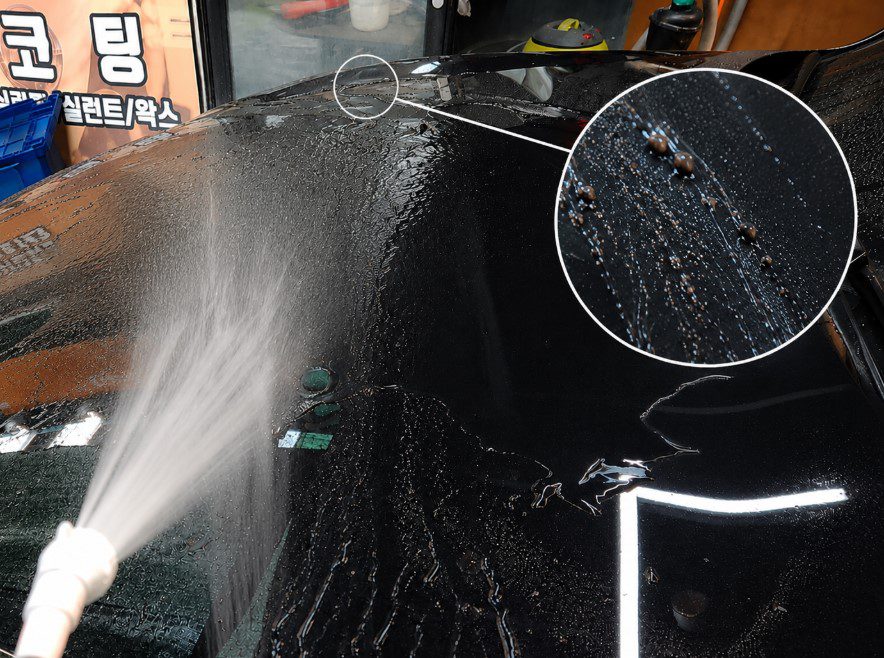
After the contact wash, the contamination is in a different condition from what it was after pre-washing.
Direct contact from the wash mitt has already physically detached much of the contamination, or left it only weakly associated with the surface.
At this stage, applying another strong impact to detach contamination is less important than supplying enough water to carry the already-detached contamination and shampoo residue completely off the vehicle.
Here, flow rate and continuous water movement become more important relative to pressure.
Movement Speed Determines How Much Water Reaches Each Area
Even with the same flow rate, moving the rinse stream too quickly reduces the amount of water delivered to each area.
As a result, detached contamination and shampoo residue may not be carried away completely and some may remain on the panel.
The important point is to watch the water actually move contamination and residue, then maintain a controlled speed rather than rushing across the panel.
If you cannot change the equipment’s flow rate, adjust your movement speed so enough water reaches each area.
Overlap Helps Deliver Enough Water Across the Entire Panel
A rinse stream does not cover the entire panel at once.
It moves across the surface in a band of limited width.
If each pass is separated from the next, the boundaries between passes may receive less water, producing uneven removal.
For this reason, each rinse path should partially overlap the previous one.
Depending on the spray width and equipment, approximately 30–50% overlap can be used as a practical starting point.
Practical Final-Rinse Technique: Speed & Overlap
- Movement speed: Move slowly and consistently enough for the water to carry detached contamination and residue away.
- Overlap: approximately 30–50%: Partially overlap each rinse path to avoid areas that receive insufficient water.
Movement speed controls how much water reaches each area. Overlap controls whether that water reaches the entire panel consistently.
Because contamination has already been substantially detached during the contact wash, high pressure is not always necessary during the final rinse if sufficient flow is available.
Low-pressure water with a high enough flow rate can also be an effective final-rinse method.
This is why a high-flow shower nozzle can work well at this stage.
The important factor is not the pressure number itself.
The goal is to maintain enough continuous water flow to carry detached contamination and cleaning residue completely off the vehicle.
6. Why the Two Rinse Stages Are Different
The rinse after pre-washing and the final rinse after contact washing both use water, but they do not have exactly the same purpose.
The reason is simple:
The contamination is in a different bonding state at each stage.
| First Rinse After Pre-Wash | Final Rinse After Contact Wash | |
|---|---|---|
| Contamination state | Chemically weakened but still attached | Physically detached or only weakly associated |
| Main action | Pressure + flow rate | Flow-rate dominant |
| Practical control | Distance + spray angle | Movement speed + overlap |
| Primary purpose | Further detachment + initial removal | Final removal |
This does not mean that only pressure acts during the first rinse or only flow rate acts during the final rinse.
Pressure and flow always work together.
What changes is the relative importance of each factor according to how strongly the contamination remains attached.
The two rinse stages require different techniques not because the equipment must be different, but because the chemical and physical bonding state of the contamination has changed.
Frequently Asked Questions
Is the rinse after pre-washing only for removing the cleaner?
No.
The pre-wash weakens the bond between contamination and the surface.
The first rinse then uses water impact and flow to detach as much of that weakened particulate contamination as possible before the wash mitt touches the paint.
Reducing contamination at this point also reduces the amount of particulate material the wash mitt must handle during the contact wash.
Does holding a pressure-washer nozzle closer always improve cleaning?
No.
If the nozzle is too far away, the water jet spreads and breaks up, reducing the effective impact delivered to the surface.
But closer is not always better either.
Moving excessively close concentrates force over a smaller area and can increase risk around damaged paint, PPF edges, trim, and other vulnerable areas.
For many self-service pressure-washer setups, approximately 30–50 cm (12–20 in) is a useful starting range.
Adjust according to the equipment, nozzle, surface, and contamination.
Why spray pressure water at an angle?
A spray directed close to perpendicular transfers more momentum directly toward the surface.
An angled spray redirects part of that force along the panel.
This surface-directed component helps create shear at the contamination boundary while also moving weakened contamination in a chosen direction.
Approximately 45–60° can be used as a starting range and adjusted according to the panel shape and contamination.
Why use so much water during the contact wash?
A wash mitt removes contamination through direct contact, so friction is unavoidable.
Abundant wash solution continually replenishes the liquid film between the mitt and paint.
It also supports flushing, which moves detached particles out of the immediate contact area.
Water during the contact wash is therefore not simply an ingredient used to dilute car shampoo.
It is an important part of controlling friction and moving contamination.
For a broader explanation of how contamination and friction change scratch risk during washing, drying, and buffing, see How to Prevent Car Scratches: The Ultimate Detailing Guide.
Does flushing during the contact wash eliminate the need for a final rinse?
No.
Flushing replenishes the liquid film and moves contamination detached by the wash mitt out of the immediate contact zone.
But that does not mean the contamination has completely left the vehicle.
Detached particles and shampoo solution can still remain on the panel or collect in lower areas.
They should be removed with a thorough final rinse before the solution dries.
Does the final rinse always require high-pressure water?
Not necessarily.
After the contact wash, much of the contamination has already been physically detached or weakened to the point that it is only lightly associated with the surface.
At this stage, sufficient flow rate and continuous water movement are more important than strong impact.
If enough flow is available, low-pressure water can also be an effective final-rinse method.
A shower nozzle is a good example: it does not rely on concentrated pressure to detach contamination. Instead, it supplies a broad, continuous volume of water that carries already-detached particles and shampoo residue off the vehicle.
Conclusion
After pre-washing, the cleaner weakens the contamination, but some of it may still cling to the paint.
At this point, sufficient impact and shear need to reach the contamination to help detach it.
When water alone cannot safely remove the remaining contamination, the wash mitt provides the physical contact needed for further detachment.
During this stage, water forms and continually replenishes the liquid film, while flushing helps move detached particles away from the immediate contact zone.
After the contact wash, the situation changes again.
The wash mitt has already detached much of the contamination, so stronger impact is no longer the main priority.
Instead, sufficient flow rate carries detached contamination and shampoo residue completely off the vehicle.
Ultimately, effective water use in car washing is not about making the water as powerful as possible.
While contamination still clings to the surface, use the available water force effectively for detachment. Once the contamination comes loose, use sufficient continuous water flow to carry it completely off the vehicle.
Final Takeaway
Effective rinsing is not simply about spraying harder: use pressure effectively through distance and spray angle while contamination still clings to the surface, then use flow rate effectively through movement speed and overlap once the contamination comes loose.
Previous: Part 2 — How Water Removes Different Types of Contamination from Car Paint.