Contamination Rarely Has Only One Characteristic
Water removes contamination from car paint through several different mechanisms. It dissolves some substances, rehydrates dried deposits, and creates the liquid environment in which cleaners can wet the surface and react.
Once weakened, contamination is separated by water impact and flow and carried off the vehicle.
Real contamination on automotive paint rarely has only one characteristic.
Bug remains and bird droppings need rehydration and also contain mixtures of organic and inorganic material. Road film is closer to a composite layer in which oily, water-resistant material traps road dust and fine particles.
Tree resin and road tar can also remain as sticky organic contamination with particles embedded in the surface.
Most real-world contamination is therefore composite contamination. Removing it may require rehydration, wetting, chemical weakening, physical separation and final recovery.
This changes the question we need to ask.
Instead of looking for one action that removes a contaminant, ask: How far can water carry the process, and when must suitable chemistry or controlled contact take over?
Water’s share of the work changes with the contaminant and the stage of cleaning.
At one stage, water is the direct agent that changes the condition of contamination. At another, it becomes the reaction medium that allows cleaning ingredients to move and work.
During contact washing, it forms a lubricating film and acts as a friction regulator. During rinsing, it becomes the carrier that removes loosened contamination and cleaner residue from the vehicle.
This guide examines five common types of automotive contamination from that perspective. The table below shows how water removes contamination in each case and where chemistry or controlled contact must take over.
Table of Contents
- Dried Organic Contamination: From Rehydration to Removal
- Loose Particle Contamination: Flow and Water-Film Control
- Hydrophobic Film Contamination: Wetting and Oil Dispersion
- Sticky Organic Contamination: Solvents and Physical Separation
- Bonded Mineral Contamination: Reaction Medium and Etching
- How Water’s Role Changes by Contaminant
- Frequently Asked Questions
| Contamination type | Combined characteristics | Water’s main role |
|---|---|---|
| Dried organic contamination (bugs and bird droppings) | Rehydration + weakening mixed residue + physical separation | Direct agent → reaction medium → carrier |
| Loose particle contamination (dust and dry soil) | Flow-driven movement + friction risk during contact | Driving force → friction regulator → carrier |
| Hydrophobic film contamination (road film and fresh oily residue) | Wetting requirement + dispersion and emulsification | Reaction medium → carrier |
| Sticky organic contamination (tree resin and road tar) | Stickiness + low affinity for water + embedded particles | Limited direct action → formulation-dependent medium → carrier |
| Bonded mineral contamination (water spots and mineral deposits) | Surface deposition + chemical bonding + possible etching | Reaction medium → carrier |
1. Dried Organic Contamination: Water Changes from Direct Agent to Medium and Carrier

Bug remains and bird droppings are both organic contaminants that lose moisture and harden, but their detailed compositions are different.
Bug residue may contain proteins, lipids, sugars, salts, tissue and exoskeleton fragments. Bird droppings can also contain a mixture of organic and inorganic material.
The common feature is that both shrink as they dry and become more closely attached to the paint.
Three Connected Actions Remove Dried Organic Contamination
- Rehydration and swelling: Water enters the dried structure and makes it softer and more flexible.
- Cleaning action: Surfactants and suitable cleaners disperse and weaken mixed organic residue.
- Separation and recovery: Pressure water and continuous flow detach the loosened material and carry it away.
With dried organic residue, water removes contamination by first changing its physical condition. During rehydration, water is the direct agent. As water moves into the contamination, the hardened structure absorbs moisture, swells and becomes more flexible.
Alkaline cleaners and surfactants help water contact the deposit more evenly. They also help disperse and weaken residues containing proteins, lipids, sugars and other mixed material.
At this point, water’s role expands into that of a reaction medium. It keeps cleaning ingredients mobile and maintains the liquid environment needed for them to work across the contamination.
Because bug remains and bird droppings have different compositions, they may not respond identically to the same cleaning chemistry.
Once the contamination has weakened, water becomes a separating force and carrier. The momentum of pressure water breaks the weakened contact with the paint, while continuous flow carries the detached residue and cleaner away from the vehicle.
Softening contamination and completely removing it from the vehicle are two different stages.
Longer exposure can increase the time needed for water to penetrate a dried deposit. Contaminant composition, panel temperature and clear-coat condition also affect whether an outline, gloss change or etching remains after cleaning.
Soaking helps separate hardened contamination more safely. It does not reverse clear-coat etching that has already occurred.
For a practical removal sequence and a guide to distinguishing residue from etching, see How to Remove Bird Poop From Car Paint | Soak It Before You Wipe.
2. Loose Particle Contamination: From Driving Force to Friction Regulator
Loose dust and dry soil particles respond more directly to water flow than the other contamination types discussed here.
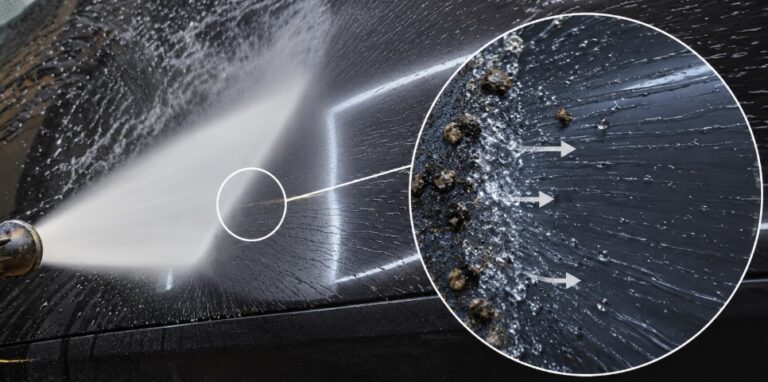
Particles that are not strongly bonded can move under the momentum of pressure water and the shear force created as water flows across the surface.
Water removes contamination mainly through flow in this stage.
The actual removal rate depends on particle size and shape, the force holding the particle to the surface, water velocity, spray distance and the volume of water moving across the panel.
Mud that has dried after rain is already in a different condition. It needs time to absorb water and loosen. Soil trapped in road film also requires the underlying organic film to be weakened first.
Here, loose particle contamination means dry dust and soil resting lightly on the surface.
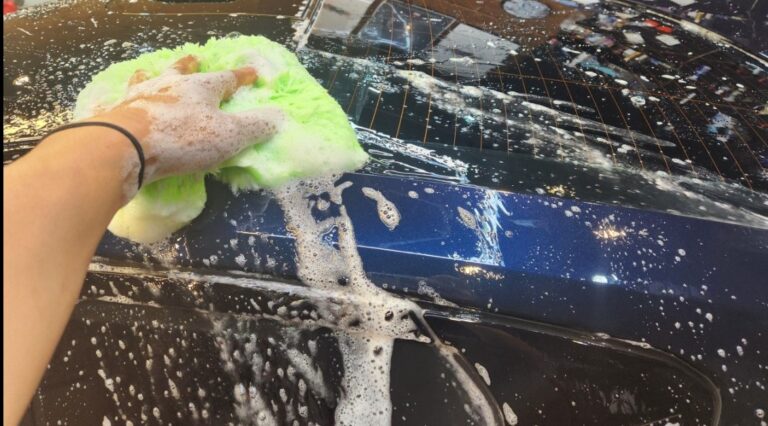
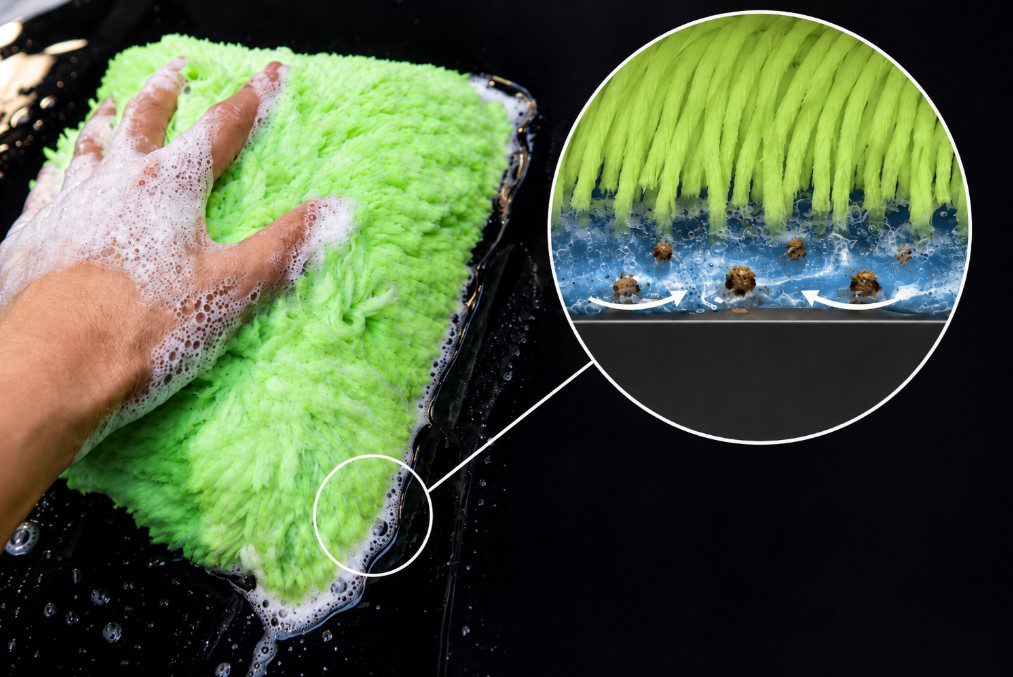
The situation changes when particles remain until the contact wash. A particle that moved freely in flowing water can create friction when it becomes trapped beneath a wash mitt.
Water and car shampoo then form a lubricating film between the mitt and the paint. This film gives particles more opportunity to move with the liquid instead of being pressed into one point and dragged across the clear coat.
If the liquid film becomes too thin, contamination accumulates in the mitt, or hand pressure rises, the same particles can increase scratch risk.
For loose particles, water is the driving force during non-contact removal, the friction regulator during contact washing and the carrier during the final rinse.
This is why loose particles can be among the easiest contaminants to remove and among the easiest to underestimate.
3. Hydrophobic Film Contamination: Wetting Must Come First
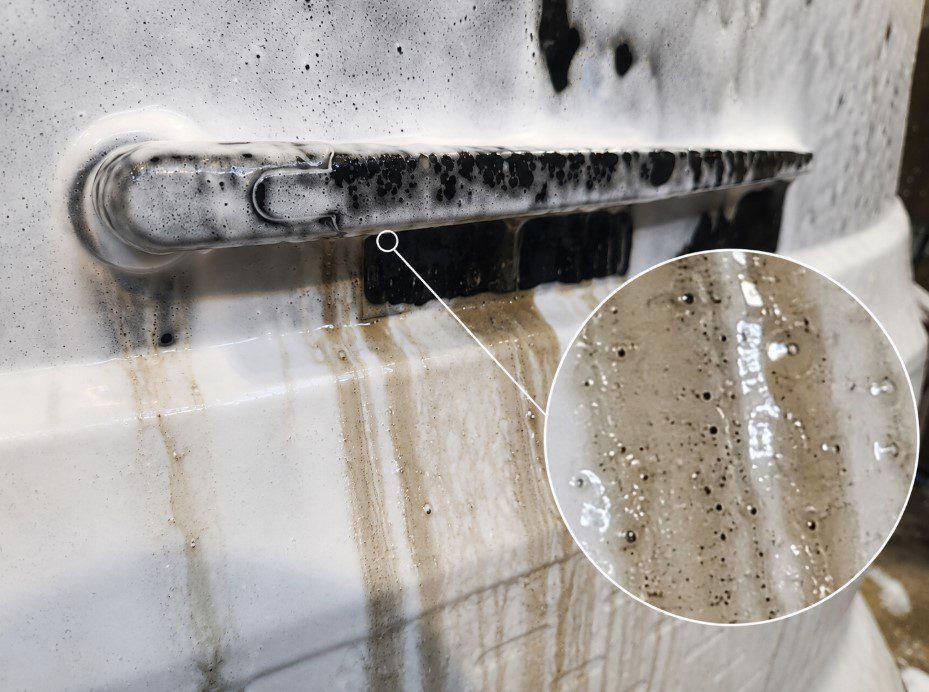
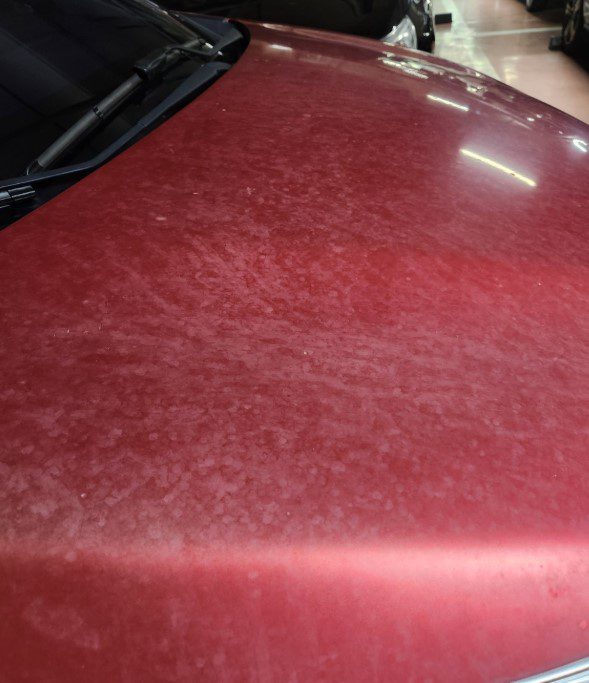
Road film and fresh oily residue are not simply one type of oil. They are usually composite layers containing oily material, exhaust-related residue, road dust and fine particles.
Their response to water-based cleaning changes with composition and the amount of buildup.
The defining problem is that water struggles to make sufficient contact with a hydrophobic film. On organic material with low affinity for water, droplets tend to gather instead of spreading evenly.
When the contact area is small, water and cleaning ingredients have difficulty reaching the interface between the film and the paint.
The first job of a surfactant is to create conditions in which water can contact the contamination more fully and oily material can be dispersed or emulsified.
As surface tension and interfacial tension decrease, the solution spreads across a larger area and can approach the interface beneath the organic film. Roll-up, dispersion, emulsification and solubilization can then move portions of the oily contamination into the water-based cleaning solution.
Once wetting has been established, water removes contamination as both a reaction medium and a carrier. Surfactants and cleaning ingredients move through the liquid phase, and the rinse removes dispersed oil and particles from the panel.
Water alone may not create enough contact with a hydrophobic film, so surfactants and suitable alkaline chemistry provide important support.
If a film remains after normal water-based cleaning, reassess its composition, thickness, cleaner concentration, dwell time and panel temperature. Then choose chemistry or limited mechanical contact that matches the remaining contamination.
4. Sticky Organic Contamination: Solvent Action and Physical Separation
Tree resin and road tar both have low affinity for water and can be too sticky for water alone to dissolve or weaken effectively. Their origins and compositions, however, are different.
Conifer resin commonly contains resin acids and terpene-related compounds. Road tar is a complex mixture of bitumen- or asphalt-related hydrocarbons. The compatible solvents and removal conditions are therefore not identical.
Dust, sand and other particles can become embedded in these sticky organic materials as they harden. Removal then requires two connected actions.
- Solvent action to soften, swell or partially dissolve the sticky organic material
- Separation and recovery to remove the embedded particles and loosened residue without dragging them across the paint
If pressure is applied before the sticky structure has loosened, embedded particles can behave like abrasive material and create scratches.
Do not scrape hardened resin or tar from the paint. Use a compatible automotive remover and allow the contamination to soften according to the product instructions. Recover it with light, controlled contact.
This is why the sticky material should be weakened before the particles and residue are collected.
Water’s role during solvent treatment depends on the formulation. In a water-based emulsified remover, water helps disperse and deliver the solvent ingredients and acts as a medium.
In a solvent-dominant product, the solvent phase directly penetrates the sticky organic material and may dissolve, swell or soften it. Water becomes more important during the wash and rinse that follow.
With either formulation, water returns to a central role after solvent treatment. Car shampoo or another suitable cleaner disperses the remaining organic material and solvent residue into a water-based solution, and sufficient flow carries it off the vehicle.
Water therefore has limited direct weakening action on sticky organic contamination. Depending on the product formulation, it may first act as a medium and then complete the process as a carrier.
This is where the principle “water is central, but it is not the whole process” becomes clearest.
For contaminant-specific procedures, see How to Remove Tree Sap and Pine Resin From a Car and How to Remove Tar From a Car | Safe Road Tar Removal Guide.
5. Bonded Mineral Contamination: Water Enables the Chemical Reaction
Water spots and mineral contamination begin when dissolved inorganic material remains on the surface after water evaporates.
A visible circular mark may be a mineral deposit on the surface, bonded residue that remains after treatment, or clear-coat etching beneath the original deposit. These conditions must be distinguished before the removal method is escalated.
For acid-reactive mineral deposits, acidic ingredients are the agents that dissolve or chemically change the deposited material. Chelating agents can bind metal ions, help keep them in solution and reduce redeposition.
Water delivers these ingredients to the contamination and creates the liquid environment in which ions and reaction products can move. In this stage, water is the reaction medium.
The effective range of an acidic product depends on mineral composition and the condition of the deposit. Poorly acid-reactive material or repeated layers of buildup may require controlled repeat treatment or limited physical removal.
If the deposit is gone but an outline or difference in gloss remains, inspect for possible clear-coat etching.
A remaining mark is not automatically removable contamination. First confirm that mineral deposits and bonded residue are gone. If the surface is clean and smooth but an outline, gloss difference or depression remains, the clear coat may be etched. Repeating stronger acidic treatment will not correct a changed paint surface.
Once the clear coat itself has changed, the process moves from contaminant removal to surface correction. Depending on the condition, a paint cleaner or polishing process may be required.
Evaporation conditions are also important. Follow the product’s recommended working time and prevent the solution from drying on the surface. Rapid water loss can concentrate cleaning ingredients and reaction products and leave new residue.
After the reaction, water removes contamination by carrying dissolved material and chemical residue off the vehicle. It connects delivery of reactive ingredients → maintenance of a liquid reaction environment → recovery of reaction products and residue.
For the difference between acidic dissolution, controlled physical removal and polishing, see How to Remove Water Spots | Removers, Etching & Polishing.
How Water’s Role Changes by Contaminant
Key point: Water is central to the process, but it is not the whole process. Its role changes from direct agent to reaction medium, friction regulator and carrier.
| Contamination type | Change in water’s role | Representative action |
|---|---|---|
| Dried organic contamination | Direct agent → reaction medium → carrier | Rehydration and swelling → cleaning action → separation and recovery |
| Loose particle contamination | Driving force → friction regulator → carrier | Flow-driven movement → lubricating film → recovery |
| Hydrophobic film contamination | Reaction medium → carrier | Environment for wetting, dispersion and emulsification → recovery |
| Sticky organic contamination | Limited direct action → formulation-dependent medium → carrier | Solvent action → washing and recovery |
| Bonded mineral contamination | Reaction medium → carrier | Acid and chelation environment → residue recovery |
Across these five groups, water removes contamination through a changing set of roles. It may begin as the direct agent and then become the medium for cleaning chemistry. During contact washing, it forms a liquid film that controls friction. Finally, it carries loosened material away.
This role change is a result of composite contamination. Car washing begins and ends with water, but water has a limit to what it can weaken directly. Chemicals extend that range, and tools physically separate contamination that remains.
Cleaning is completed when you can distinguish the part water can perform, the point where suitable chemistry must take over and the stage where controlled physical separation is required.
Even when water’s direct action is limited, it returns during the final stage to carry separated contamination and cleaning residue away.
Frequently Asked Questions
Which contaminants can water remove by itself?
Water flow can move much of the loose dust and some water-soluble residue on a surface. Supplying enough water can also soften dried bugs and bird droppings so that larger pieces release. Their composition and degree of bonding may leave residue that requires a cleaner, solvent or limited contact.
How long should dried bugs and bird droppings soak?
Judge the process by whether moisture has reached and softened the deposit rather than by one fixed time. Keep the surface wet and follow the cleaner manufacturer’s recommended dwell time. If a hard section remains, do not scrub it. Rewet the area and allow more time.
Can pressure water alone remove road film?
Road film is a composite layer of hydrophobic oily material and fine particles, so a thin film often remains after pressure rinsing alone. Surfactants and suitable alkaline chemistry create wetting and dispersion conditions. Water then carries the weakened film and cleaner residue away.
Does higher pressure make particle removal safer?
Higher pressure can increase local separation force, but safety and coverage also depend on flow rate, nozzle size, spray angle and distance. A narrow jet used too close to the surface can stress paint and vehicle components. Consider both the force that detaches particles and the water volume that carries them away.
What does water do during tree-resin and tar removal?
Water helps disperse and deliver the solvent in water-based emulsified products. Solvent-dominant products rely on the solvent itself to weaken the contamination. Whichever formulation is used, follow up with car shampoo and a thorough rinse to wash away the loosened residue and any remaining remover.
Should I use a stronger product when a water-spot mark remains?
First confirm whether mineral deposits or bonded residue remain. If the product has been used according to its instructions and the surface is clean and smooth but an outline or gloss difference remains, inspect for possible clear-coat etching. Repeating stronger acidic treatment will not correct etched paint; the surface may require controlled polishing after inspection.
Does a sufficient water film prevent all wash-mitt scratches?
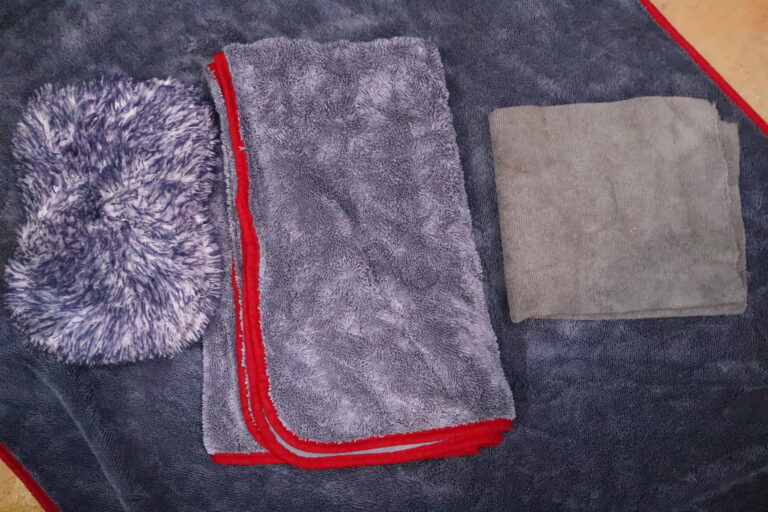
A water-and-shampoo film reduces direct contact and lowers the chance of particles being trapped and dragged across the paint. Scratch risk still rises when contamination accumulates in the mitt, solution becomes insufficient or hand pressure increases. Use plenty of shampoo solution, light pressure and frequent mitt cleaning together.
Next: How Pressure and Flow Work During Car Washing
Part 3 examines the physical conditions that detach weakened contamination and carry it off the vehicle. It will explain how pressure, flow rate, nozzle size, spray angle and distance change separation force and recovery coverage—and why one pressure-washer setup cannot suit every contaminant.