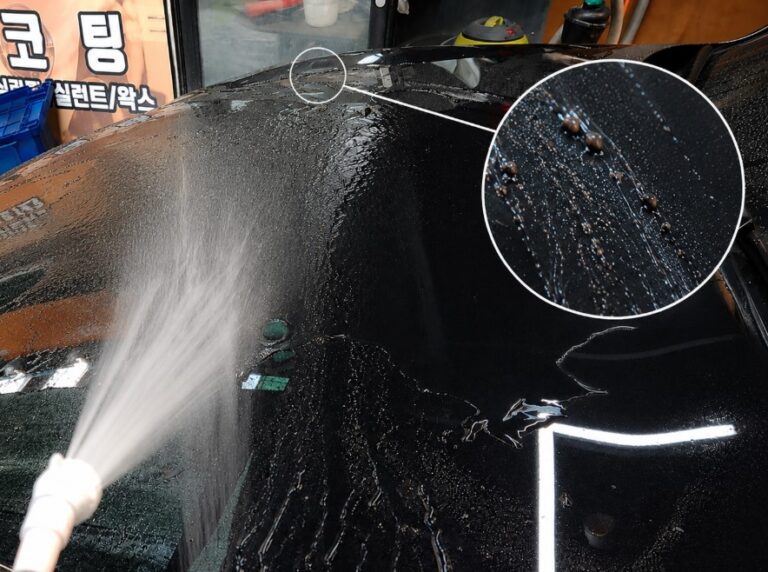
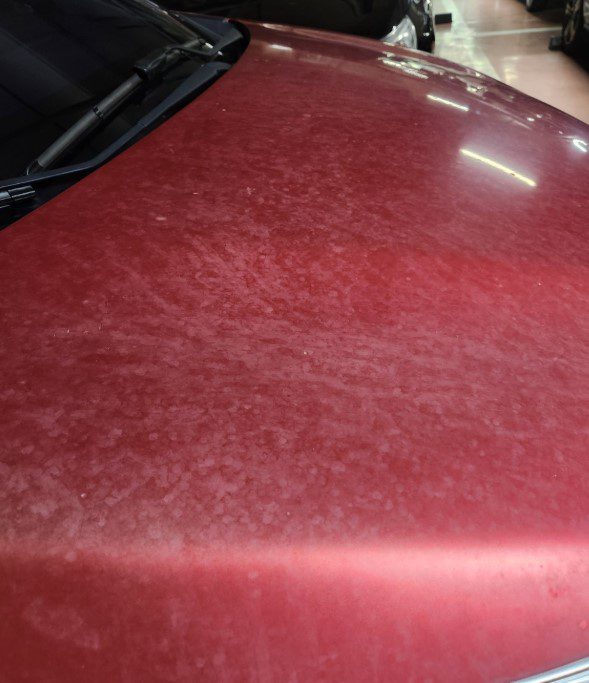
After driving on freshly paved or repaired roads, you may notice small black spots around the lower doors, side skirts, fenders, and bumpers.
These spots are commonly called road tar.
Road tar is easy to see on white or light-colored cars because of its dark color. On black paint, however, it can blend into the surface and remain unnoticed even after washing.
Because tar looks black, sticky, and oily, it is also easy to treat it like ordinary grease or oily road film. On hot summer days, it may even soften enough to smear when wiped with a towel.
But road tar is different from ordinary oily contamination. It is more closely associated with bitumen and asphalt-based materials from the road surface.
That is why normal car-wash cleaners often struggle to remove it.
So why doesn’t regular washing remove road tar effectively?
To understand that, it helps to first look at what road tar actually is and how it behaves on automotive paint.
Table of Contents
- What Is Road Tar?
- Characteristics of Road Tar Contamination
- Tar Is More Than Ordinary Oily Contamination
- Why Regular Car-Wash Cleaners Struggle With Tar
- How Temperature and Time Change Tar
- Particle Contamination Trapped in Tar
- Why Should Road Tar Be Removed?
- How to Remove Tar From a Car
- How to Find Tar on a Black Car
- What Product Should You Use?
- Step-by-Step Tar Removal Process
- How to Remove Large or Thick Tar Spots
- Tar Removal Precautions
- Frequently Asked Questions
1. What Is Road Tar?
The black spots commonly called road tar in automotive detailing are associated with bitumen and asphalt-based materials from road surfaces.
Because they are thrown up from the road while driving, they tend to collect around areas such as the lower doors, side skirts, fenders, wheel arches, and lower bumpers rather than covering the entire vehicle evenly.
Tar itself is usually black or dark brown.
This makes it easy to spot on light-colored paint but much harder to see on a black vehicle.
So what exactly is this dark, sticky material we call road tar?
2. Characteristics of Road Tar Contamination
Tar Is More Than Ordinary Oily Contamination
Crude oil refining produces a wide range of petroleum products, including relatively lighter fractions such as gasoline and diesel.
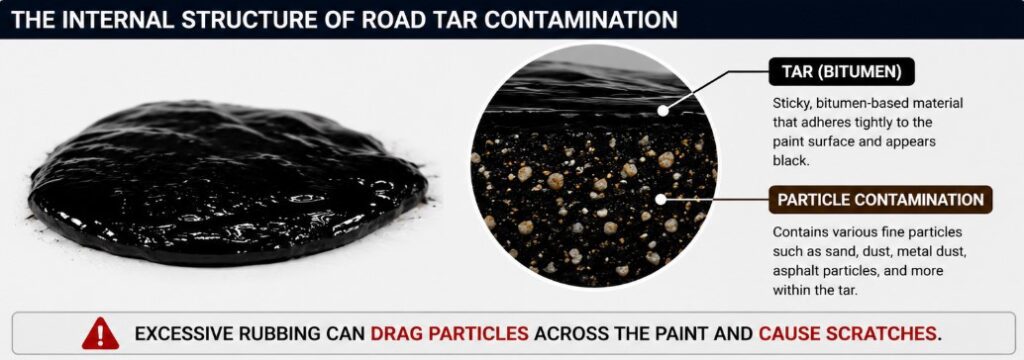
Bitumen is a heavy, sticky petroleum-based material derived from heavier refinery fractions.
Asphalt pavement mixtures use bitumen as a binder to hold aggregates such as stone and sand together.
As a vehicle travels, bitumen- and asphalt-related material can be thrown from the road surface and stick to the lower body panels. In automotive care, this dark and sticky road contamination is commonly referred to as road tar.
Bitumen is not simply one type of oil. It is a complex mixture of heavier petroleum-derived components.
Understanding this difference makes it easier to see why road tar often survives a normal car wash.
Why Regular Car-Wash Cleaners Struggle With Tar
Bitumen-based contamination has low affinity for water.
A typical alkaline pre-wash relies on water, cleaning agents, and surfactants to loosen road film and other common contamination so it can be rinsed away.
Tar, however, is a water-resistant bitumen-based contaminant. Once it has adhered to the paint, ordinary water-based cleaning may not soften and separate it efficiently.
If tar remains after a normal wash, repeatedly using stronger alkaline cleaners is usually less efficient than using a solvent that is compatible with the tar and can soften or dissolve it.
This is why dedicated tar removers are commonly solvent-based.
For a closer look at how alkaline cleaners work on road film, bugs, wheels, and other automotive contamination, see How to Use Alkaline Cleaners on a Car.
Tar Becomes Softer as Temperature Rises
Bitumen-based materials change significantly with temperature.
As temperature rises, they generally become softer and flow more easily. As temperature falls, they become firmer.
This is why road tar can become soft enough to smear when wiped on a hot summer day.
But soft tar should not simply be scrubbed away.
There may be other contaminants trapped inside it.
Old Tar Can Behave Differently
Time also changes the condition of road tar.
Bitumen-based material can undergo aging through processes such as oxidation and the loss of some lighter components.
As this happens, old tar may become harder and more difficult to remove than when it first adhered to the vehicle.
This is another reason why removing tar when you find it generally makes maintenance easier.
Tar Can Contain Particle Contamination
Road tar on a vehicle should not be thought of as perfectly clean bitumen.
As it is thrown from the road, sand, dust, asphalt particles, and other fine debris may become trapped in the sticky material.
More particles can also adhere to its surface while driving.
This creates an important risk.
If softened tar is aggressively rubbed with a towel, the trapped particles can be dragged across the paint and cause scratches.
The key principle is simple: soften and dissolve tar first, then remove it with as little physical contact as possible.
3. Why Should Road Tar Be Removed?
Road tar is different from contaminants such as bird droppings or some insect residue that may require more urgent attention because of their potential interaction with the paint.
That does not mean tar should simply be left in place.
It Affects Appearance and Surface Smoothness
On white and light-colored vehicles, black tar spots are immediately visible.
On black vehicles, they may be difficult to see, but raised contamination can still interfere with the smooth, uniform feel of the paint surface.
Sometimes you first notice it because a wash mitt or buffing towel catches slightly around the lower body panels.
Old Tar Can Become More Difficult to Remove
As tar ages and collects additional contamination, removal may require more work.
Trying to scrape or aggressively rub stubborn tar also increases unnecessary physical contact with the paint.
If particles are trapped in the tar, that contact can increase the risk of scratching.
For routine maintenance, it is easier to remove tar when you find it during a normal wash.
4. How to Remove Tar From a Car
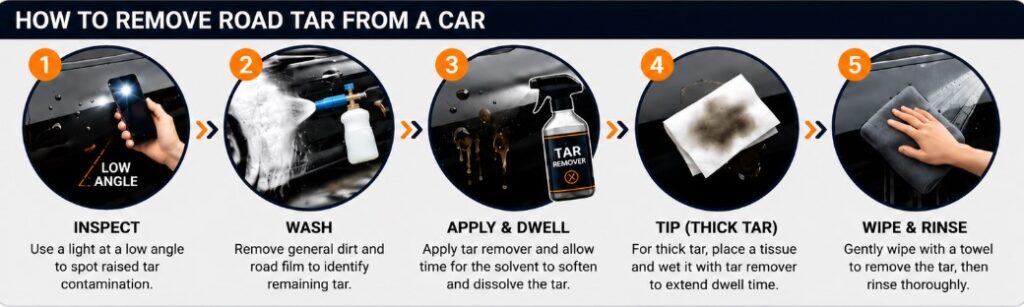
Because road tar can contain fine particles, physical contact should be kept to a minimum.
The basic approach is to let chemistry do most of the work.
Use a suitable solvent to soften and dissolve the tar first, then gently remove the loosened contamination.
Tar removal principle:
Soften and dissolve first. Touch as little as possible.
How to Find Tar on a Black Car
Tar can be difficult to see on black paint because the contamination and paint are similar in color.
During routine washing or wax buffing, pay attention to the lower body panels. If a mitt or towel catches on isolated raised spots, suspect bonded contamination such as tar or iron particles.
First, complete a normal wash to remove loose dirt and road film.
Then shine your phone light across the paint at a low angle.
The low-angle light can make raised contamination easier to see through changes in reflection and surface height.
Tar often appears as relatively distinct raised spots.
Tar or Iron Contamination?
The following are general tendencies. Appearance and texture can overlap depending on the size and condition of the contamination.
| Road Tar | Iron Contamination | |
|---|---|---|
| Feel | Often catches at individual raised spots | Often feels gritty or rough across multiple points |
| Appearance | Relatively larger dark spots or bumps | Usually finer particles |
| Common areas | Fenders, side skirts, lower doors, lower bumpers | Across the body, especially around wheels and lower panels |
| Inspection | Use low-angle phone light to identify raised spots | Check overall surface texture and contamination |
| Removal approach | Soften/dissolve with solvent | Use an iron remover to react with iron contamination |
| Product | Tar remover | Iron remover |
On a black vehicle, a practical sequence is:
Notice unusual texture during washing or buffing → wash the surface → inspect with a phone light.
What Product Should You Use?
If tar remains after washing, use a product containing solvents capable of softening or dissolving bitumen-based contamination.
The simplest option is a dedicated automotive tar remover.
Its solvent system softens and dissolves the tar, making it easier to separate from the paint without aggressive rubbing.
Some products are marketed for both tar and adhesive/sticker residue removal. The reason is similar: both tar and many adhesive residues are water-resistant organic contaminants that can respond well to solvent-based softening and dissolution.
A solvent-based degreaser may also work, depending on its formulation.
However, degreasers vary considerably. Check that the product is intended for tar removal and is safe for automotive paint.
The important question is not simply how strong the cleaner is.
Check whether it can soften or dissolve tar and whether it is designed for use on the surface you are treating.
For most routine detailing, a dedicated automotive tar remover is the simplest choice.
Step-by-Step Tar Removal Process
Tar remover is generally most efficient as a targeted cleaner, applied where tar remains rather than sprayed unnecessarily over the entire vehicle.
1. Wash First
Remove normal contamination such as road film, dust, sand, and loose dirt with your usual pre-wash and contact wash.
Once the surface is clean, identify the remaining tar spots.
2. Apply Tar Remover and Let It Work
Apply the tar remover directly to the affected area.
Do not start rubbing immediately.
Give the solvent enough time to soften and loosen the tar.
3. Gently Remove the Loosened Tar
Once the tar has softened, use a soft towel to gently lift and collect the loosened contamination.
If it does not come off in one attempt, do not increase pressure.
Apply the remover again and repeat the process.
Finish by cleaning away any remaining product and loosened contamination, then rinse thoroughly.
Wash → Inspect → Apply & dwell → Gently remove → Repeat if needed → Clean & rinse
How to Remove Large or Thick Tar Spots
Large or thick tar deposits can be more difficult because the solvent may run off or evaporate before the tar has softened sufficiently.
💡 For a thick tar spot, place a piece of tissue over the contamination and wet it with tar remover. This helps keep the solvent in contact with the tar for longer.
The tissue is not there to scrub the tar.
Its purpose is to hold the remover against the contamination and provide enough working time.
Once the tar has softened, remove the tissue and gently collect the loosened material with a soft towel.
If necessary, apply the remover again rather than increasing pressure.
Do not allow the product to dry on the surface, and follow the manufacturer’s recommended application and dwell time.
5. Tar Removal Precautions
Do Not Scrub Tar Immediately
Tar may become soft in warm weather, but it can contain sand, dust, and other fine particles.
Aggressive wiping can drag those particles across the paint and cause scratches.
Let the remover soften the tar first, then use minimal physical contact.
Avoid Working on Hot Paint
Solvents can evaporate quickly on a hot surface.
This reduces the time available for the product to soften the tar.
Work in the shade and allow hot paint to cool before applying the remover.
Also, do not let the product dry on the surface.
Because solvent systems and recommended dwell times vary, follow the product manufacturer’s instructions.
Avoid Paint Thinner, Gasoline, and Acetone
These solvents may dissolve tar, but they are not automotive tar-removal products.
Strong solvents that were not designed for automotive paint may affect the paint or existing protection depending on the solvent, surface, and contact time.
A dedicated automotive tar remover is the safer and more practical choice.
Test Plastic, Rubber, and PPF First
Tar removers vary in solvent type and concentration.
A product that is suitable for painted surfaces may behave differently on plastic, rubber, or paint protection film (PPF).
If compatibility is uncertain, test a small, inconspicuous area first.
For PPF, check for discoloration, gloss changes, tackiness, or softening before wider use.
Check the Protection After Removal
Solvent-based products may also affect existing wax or sealant layers.
If water behavior or surface feel changes after tar removal, reapply protection where necessary.
6. Frequently Asked Questions
Can Road Tar Be Removed With a Normal Car Wash?
Small or fresh tar spots may occasionally come off during washing.
However, bitumen-based contamination has low affinity for water, so normal water-based washing may not remove bonded tar efficiently.
If tar remains after washing, using a dedicated automotive tar remover is generally more effective than repeatedly increasing the strength of an alkaline cleaner.
Do Black Cars Get Road Tar Too?
Yes.
Road tar is related to driving conditions, not paint color.
It is simply harder to see on black paint.
If you notice isolated raised spots around the lower panels while washing or buffing, wash the area first and inspect it with a phone light held at a low angle.
How Can I Tell Tar From Iron Contamination?
Tar often appears as relatively larger dark spots or raised bumps.
Iron contamination is often finer and may produce a more generally gritty or rough texture.
These are only general tendencies. The appearance and feel can overlap depending on the contamination.
Can I Scrape Tar Off With My Fingernail or a Towel?
It is not recommended.
Road tar can contain fine particles from the road.
Soften and dissolve the tar first, then remove it with minimal physical contact.
Can I Spray Tar Remover Over the Entire Vehicle?
This depends on the product, but for normal road-tar removal, targeted cleaning is usually more efficient.
Wash the vehicle first, identify the remaining tar spots, and apply the remover only where needed.
How Do I Remove a Large Tar Spot?
If a thick tar deposit does not stay wet long enough, place a piece of tissue over it and wet the tissue with tar remover.
This helps maintain contact between the solvent and the tar.
Once the tar has softened, gently remove it. If necessary, repeat the application rather than increasing pressure.
Can I Use Paint Thinner or Acetone to Remove Road Tar?
The fact that a solvent can dissolve tar does not mean it is suitable for automotive paint.
Paint thinner, acetone, and gasoline are not dedicated automotive tar-removal products and may affect the paint or existing protection.
Use a tar remover designed for automotive surfaces.
What If the Paint Still Feels Rough After Tar Removal?
Tar is only one possible source of roughness.
If the surface still feels gritty after tar removal, iron particles, industrial fallout, overspray, or other bonded particle contamination may remain.
Instead of repeatedly applying tar remover, identify the remaining contamination and choose the appropriate removal method.
Final Thoughts
The contamination commonly called road tar is associated with bitumen and asphalt-based material from road surfaces.
Bitumen is not simply ordinary oily dirt. It is a complex mixture of heavier petroleum-derived components with low affinity for water.
That is why repeatedly using stronger alkaline cleaners is often less effective than softening and dissolving the tar with a compatible solvent.
The removal process is straightforward:
Wash → Inspect → Apply & dwell → Gently remove → Repeat if needed → Clean & rinse
The most important principle is equally simple:
Soften and dissolve tar first, then remove it with as little physical contact as possible.
On black vehicles, where tar is difficult to see, pay attention to unusual texture around the lower panels during washing or buffing. If something feels raised, wash the surface and inspect it with a phone light at a low angle.
If roughness remains after the tar is gone, check for iron contamination or other bonded particles and use a removal method suited to that contamination.