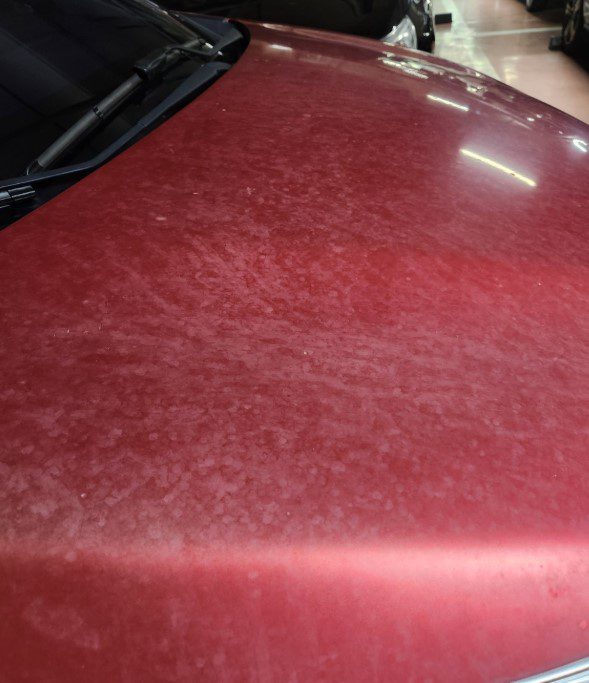
The role of water in car washing is much broader than most people realize. From the moment the first cleaning solution touches the paint to the final rinse and drying stage, water plays an active role throughout the entire process.
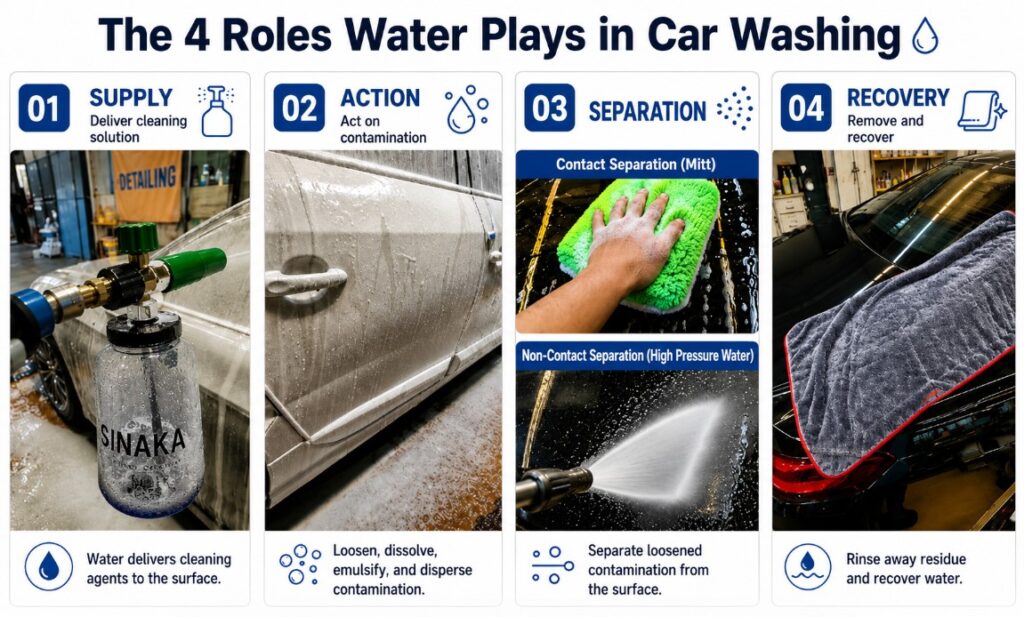
During pre-washing, water carries cleaning agents to contamination. In the contact-wash stage, it forms a water film between the wash mitt and the paint. When rinsing begins, water carries loosened contamination and cleaner residue away from the vehicle.
Even the final drying result depends partly on how much water remains on the surface and the quality of that water. After the wash, the way water beads and drains can also provide useful information about the current condition of the surface.
We tend to focus first on products and tools such as pre-wash cleaners, car shampoos, and wash mitts. But water connects their functions from the beginning of the wash to the end.
Understanding the role of water in car washing also makes it easier to understand why different cleaners and tools work alongside it.
The goal is not simply to use more water. What matters is understanding what water needs to accomplish and using cleaners and tools to help it perform those functions more effectively.
Spray water onto a dirty vehicle and loose dust or soil may move easily. Dried bug remains, oily road film, and mineral deposits, however, often remain even when exposed to the same water.
That is because water interacts differently with different types of contamination.
Loosely deposited particles can move with water flow alone. Dried contamination needs to absorb water again before it becomes softer. With oily contamination, the interface must change so that water can make sufficient contact with the surface. Chemically bonded contamination requires an environment in which cleaning agents can react within the water.
Weakening contamination is not the end of the wash.
Once contamination becomes weaker, it must separate from the surface and then move away from the vehicle with the water flow.
Key Point
Contamination leaving the paint and contamination leaving the vehicle are two different stages.
Water sits at the center of this entire process. In real-world washing, cleaners, car shampoo, wash mitts, pressure washers, and other tools help water work faster and more effectively.
The wash is complete only when water carries the loosened contamination away from the vehicle.
Table of Contents
- Water Weakens Contamination
- Water Separates Weakened Contamination and Carries It Away
- Water Determines How Much Time Cleaning Reactions Have
- After Cleaning, Water Reveals the Result
- Frequently Asked Questions
A. The Role of Water in Car Washing: Weakening Contamination
Before we can remove contamination, we first need to change the condition in which it clings to the surface.
How water weakens contamination depends on the type of contamination. Water-soluble components move into solution, while dried contamination that does not simply dissolve can absorb water again and undergo structural changes.
With oily contamination that does not mix readily with water, changing the interface helps water make sufficient contact.
Understanding these differences makes it easier to distinguish between dissolution, rehydration, and wetting.
1. Dissolution and Reaction Medium — How Water Works with Mineral and Iron Contamination
Mainly during the pre-wash and chemical reaction stage
After rainwater dries on a vehicle, some salts and other water-soluble residues left on the paint can gradually dissolve again when enough water reaches them.
This is the most direct example of dissolution by water.
Because water is a polar solvent, it can move water-compatible substances such as salts and sugars into solution. Dust and soil do not simply dissolve as a whole, but removing their water-soluble components can change the structure of the contamination and the way it adheres to the paint.
When Water Alone Is Not Enough
Real-world car washing often requires another step.
Not every contaminant dissolves readily in water. Chemically altered contamination such as mineral deposits and oxidized iron will not necessarily disappear quickly simply because we supply more water.
Water still plays an important role here. It provides the medium in which cleaning agents can work.
Water carries dissolved or dispersed acids, alkalis, chelating agents, and iron-removal ingredients across the paint. These cleaning agents travel through the aqueous solution, reach the contamination, and react with it.
With contamination such as mineral deposits or oxidized iron that water cannot remove effectively on its own, cleaning agents change the condition of the contamination so that removal becomes easier.
If bonded contamination such as iron particles, tar, or fine particulate contamination remains after washing, the appropriate removal method depends on what holds that contamination to the surface. The different types of bonded particulate contamination and their removal methods are covered in Car Paint Feels Rough After Washing: Why Iron Remover Alone Is Not Enough.
The cleaning agent drives the chemical reaction, but water carries that agent to the contamination and provides the environment in which the reaction can occur.
This reaction-medium function forms an important part of the role of water in car washing.
A product’s dilution ratio determines the concentration of its active cleaning ingredients, while water delivers that solution across the paint and serves as the reaction medium.
So far, we have looked at materials that either dissolve in water or can change chemically within an aqueous environment.
Dried bugs and bird droppings behave differently. They do not simply dissolve and disappear. Instead, their dried structures absorb water again and become softer.
This brings us to rehydration and swelling.
2. Rehydration and Swelling — Why Dried Bugs and Bird Droppings Should Be Soaked Before Removal

Mainly during the pre-wash and soaking stage
Fresh bug remains on a summer bumper are often relatively easy to remove while they still contain moisture.
After several days of sunlight and heat, however, the contamination can dry and harden to the point where briefly spraying it with water is no longer enough.
The first step is to supply moisture again.
Contamination such as dried bugs and bird droppings originally contains water. As it dries, that moisture escapes.
As water leaves the contamination, the remaining material becomes more concentrated, contracts, and hardens. It may also dry while conforming closely to the microscopic texture of the paint surface.
What Happens When Dried Contamination Absorbs Water
Once water begins to enter the dried contamination again, its condition starts to change.
We call the process of dried contamination absorbing lost moisture rehydration.
As water penetrates the material, swelling follows. The structure expands and becomes more flexible, while the hardened contamination gradually loses some of its internal cohesion and adhesion to the paint.
For this reason, thoroughly wet dried contamination before rubbing or wiping it.
Research involving dried protein soils also describes water uptake and swelling as early stages in changing hardened deposits into a condition that allows easier removal.
Rehydration Takes Time
Spraying water onto contamination does not mean moisture instantly reaches its interior.
The outside may look wet while a hard, dehydrated structure remains inside. The older and thicker the dried organic contamination is, the longer water alone may take to soften it sufficiently.
Dried bug remains and bird droppings therefore need enough moisture and time to soften before removal.
How Alkaline Pre-Wash Supports Rehydration
An alkaline pre-wash can make this rehydration process more effective.
Alkaline cleaning ingredients can act on protein and lipid components in organic contamination such as bug remains, loosening the hardened structure and helping water penetrate more easily.
This is why soaking and chemical cleaning often work together rather than relying on water alone for the same amount of time.
Water re-enters the contamination and softens it, while the alkaline cleaner helps rehydration and softening occur faster and more effectively.
The dwell time of a pre-wash is therefore not simply time spent waiting for the chemical cleaner to react. Water also uses this time to move into dried contamination.
3. Wetting and Interfacial Penetration — Why Cleaners Are Needed for Road Film and Oily Contamination
Mainly during the pre-wash and chemical reaction stage
Spray water onto a panel covered with oily road film and you may see the water gather into droplets instead of spreading evenly.
For water to help remove contamination, it first needs sufficient contact with that contamination.
Water can dissolve many substances, but it does not spread across every surface in the same way. When hydrophobic materials such as oils cover a surface, water tends to form droplets rather than spreading into a broad, thin layer.
Even when we use the same amount of water, large droplets can reduce the actual contact area between the water and the contamination.
This is where wetting becomes important.
The more widely water spreads and the more effectively it enters narrow interfaces around contamination, the larger the area over which cleaning agents can act.
Water, however, has relatively high surface tension and struggles to spread across strongly hydrophobic contamination.
How Surfactants Help Water Spread
Cleaning products use surfactants to overcome this limitation.
Surfactants lower the surface tension of water and the interfacial tension between water and contamination. This allows the cleaning solution to spread more widely and thinly.
The solution can then reach narrow interfaces between the contamination and paint more effectively, increasing the area over which the cleaning agents can make contact.
With some oily contamination, surfactants go a step further. They can emulsify or disperse oils into the aqueous phase and change the contact between the oil and the paint, making the contamination easier to separate.
Research on aqueous surfactant cleaning shows that organic film removal can involve mechanisms such as roll-up, emulsification, and solubilization. Water flow and mechanical forces then help remove the weakened contamination.
Ultimately, the role of surfactants cannot be separated from the role of water in car washing.
Water must contact contamination in order to act on it, and surfactants help that water make broader and more effective contact.
B. The Role of Water in Separation and Removal
Up to this point, water and cleaning solutions have dissolved certain materials, restored moisture to dried contamination, and penetrated interfaces to make contamination easier to remove.
Now the contamination must actually leave the surface.
Once that happens, water still needs to carry it away from the vehicle.
In an actual wash, the sequence may be pre-wash → first rinse → contact wash → final rinse. Here, we will separate two functions of water: the water film created during contact washing and the physical force and flow used for separation and removal.
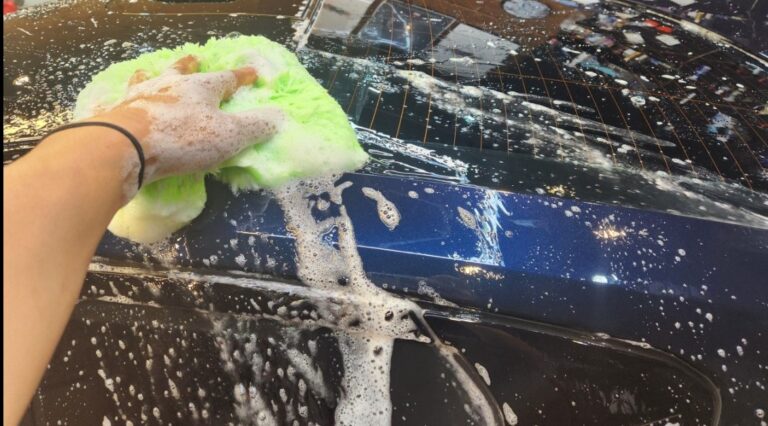
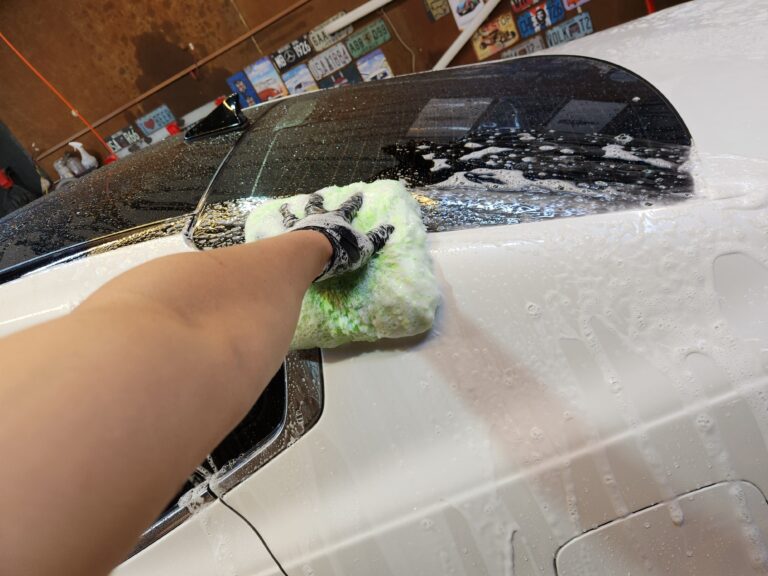
4. Water Film and Friction Control — Why Car Shampoo Helps Reduce Wash-Mitt Friction
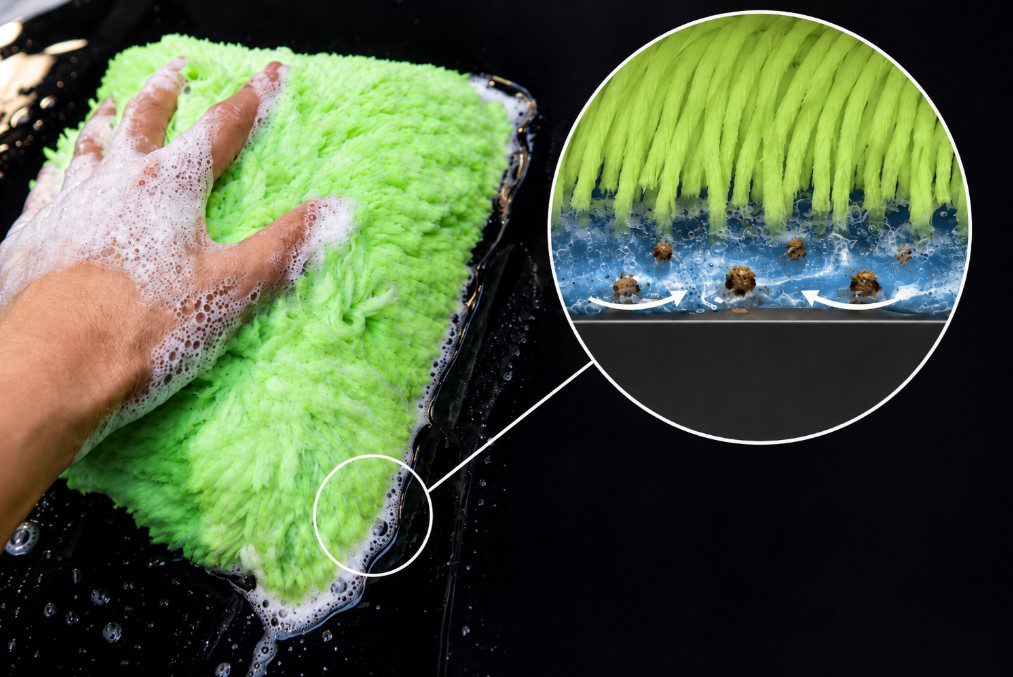
During the contact-wash stage
There is a simple reason we do not move a dry wash mitt directly across dry paint.
Enough water and cleaning solution must remain between the mitt and the paint to remove contamination safely.
Liquid between the two surfaces allows the mitt to move more smoothly than it would under dry direct-contact conditions. The liquid also gives loosened contamination space to move away from the contact area.
This is the basic function of the water film during contact washing.
When a sufficient water film remains between the two surfaces, particles are less likely to stay pressed firmly against one point while the mitt moves across the paint.
Why Car Shampoo Helps Maintain the Water Film
Water has low viscosity.
Pressure from the mitt can easily push water out of the contact area.
A film made from water alone can therefore become thin quickly depending on the contact conditions. As contamination accumulates in the mitt, particle-induced friction can also increase again.
This is why pH-neutral car shampoo works together with water during contact washing.
The surfactants and lubricating components in car shampoo help water function more consistently between the wash mitt and the paint.
With enough wash solution, the mitt moves more smoothly and provides more liquid for detached particles to move within.
This friction-control function is another important part of the role of water in car washing.
Safe contact washing depends on maintaining the water film, controlling the amount of contamination accumulated in the mitt, and supplying enough wash solution.
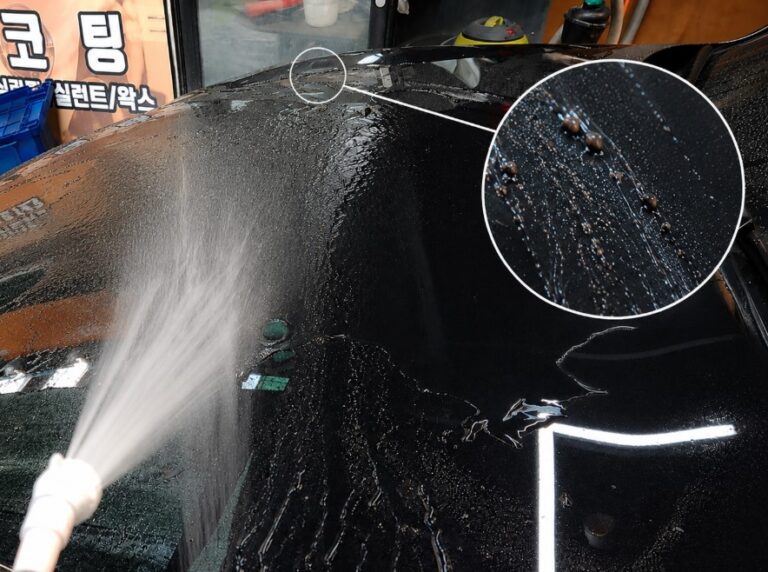
5. High-Pressure Water — Separation, Transport, and Removal
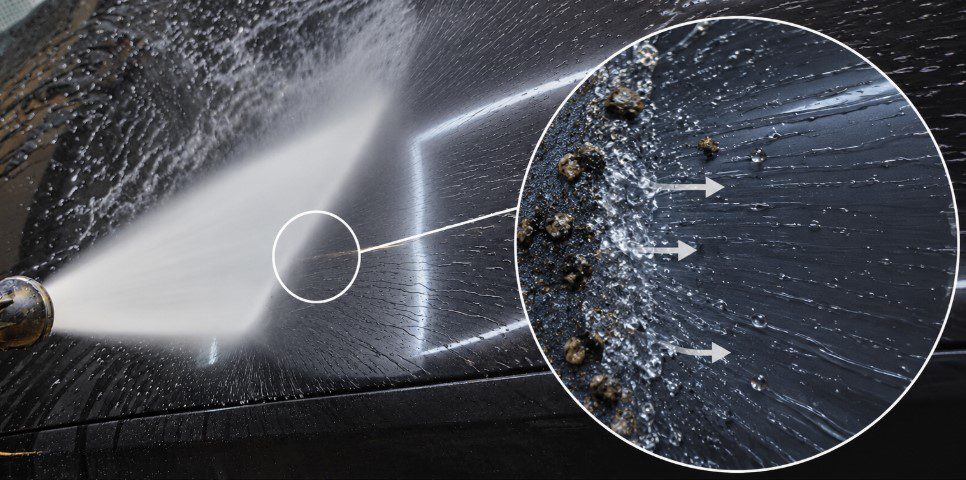
During the first rinse after pre-washing and the final rinse after contact washing
When you use a pressure washer after the pre-wash stage, visible contamination can suddenly begin flowing off the vehicle.
At this point, the water transfers its force to contamination that the previous cleaning stage has already weakened.
How High-Pressure Water Detaches Contamination
When a high-pressure jet strikes the paint, it transfers force directly to the impact area. The water then spreads rapidly across the surface and generates shear forces.
These forces can break the weakened contact between the contamination and the paint.
Pressure plays an important role in jet velocity and in generating localized impact and shear.
But pressure alone does not determine pressure-washer cleaning performance. The result depends on the combination of pressure, flow rate, nozzle orifice size, spray angle, spray distance, and movement speed.
Spraying from too far away reduces impact and shear. An excessively narrow spray angle or very short distance concentrates force over a small area.
Detached Contamination Still Has to Leave the Vehicle
The wash is not complete when contamination leaves the paint.
Detached soil and particles, along with spent cleaning solution, may still remain somewhere on the vehicle.
They can travel in water flowing across panels, collect in gaps, or remain in cleaning solution around lower areas.
Continuously supplied water now dilutes these materials and uses gravity and flow to move them away from the vehicle.
This is transport and removal.
Flow rate determines how much water reaches the surface over time and therefore plays a major role in transporting detached contamination and cleaning residue across larger areas.
Providing sufficient water flow during rinsing helps carry detached contamination and cleaner residue away from the vehicle more reliably.
Insufficient rinsing can leave detached particles and dissolved materials in panel gaps or lower areas, where they may appear again as residue during drying.
Pressure vs. Flow Rate
Pressure strongly influences jet velocity and the formation of impact and shear forces.
Flow rate strongly influences the transport and removal of detached contamination and cleaner residue from the vehicle.
Both work together during actual cleaning and rinsing.
This separation-and-removal stage demonstrates another major role of water in car washing:
Contamination weakened → contamination detached from the paint → contamination removed from the vehicle
C. Water Determines How Much Time Cleaning Reactions Have
Dissolution, rehydration, wetting, and chemical cleaning reactions all require time.
What ultimately matters is whether water and cleaning solution can remain on the surface long enough for those processes to occur.
Panel temperature, wind, and humidity affect the evaporation rate of water, and evaporation determines how much actual cleaning time is available.
Temperature and evaporation are therefore not separate cleaning stages. They determine whether the processes described above have enough time to work.
6. Heat Transfer and Evaporation — Why Cleaners Dry Faster on Hot Panels
Throughout the washing process
Spray water onto a hot hood that has been sitting in summer sunlight and it will disappear much faster than it would on a cool panel.
The water evaporates more quickly.
During washing, water does more than transport contamination and cleaning agents. It also absorbs heat from the panel and helps determine how long the cleaning solution remains wet.
Water has a high specific heat capacity and can absorb substantial heat. Cooling a hot panel with water lowers its surface temperature and can slow the evaporation of the cleaning solution applied afterward.
Why Evaporation Shortens Cleaning Time
As moisture in the cleaning solution evaporates, cleaning ingredients and reaction products become more concentrated on the surface. The solution may dry before the contamination has enough time to weaken.
Rapid evaporation and concentration can also contribute to white marks or uneven residue after a pre-wash solution dries.
Ultimately, we manage panel temperature for the same reason: to keep water in contact with the contamination for the time it needs to work.
Effective use of water therefore also requires controlling evaporation.
On a hot panel, cool the surface first when necessary, work in the shade, or reduce the size of the area you treat at one time.
When necessary, add more water or cleaning solution to keep the surface wet.
If the cleaner supports foam application, foam can help the cleaning solution remain on a broad area for longer.
The important point is to provide enough time for dissolution, rehydration, wetting, and chemical cleaning to occur before the water and cleaning solution dry.
Even with the same product, actual dwell time can vary depending on panel temperature, wind, and humidity.
Managing this wet contact time is another important part of the role of water in car washing.
After Cleaning, Water Reveals the Result
1. Water Behavior Can Help Assess the Current Surface Condition
Once cleaning is complete, water becomes an observational tool for evaluating the current condition of the surface.
On a highly water-repellent surface, water tends to form rounded beads. When the surface holds those droplets less strongly, they move across the panel more easily.
Sheeting behavior and the amount of water remaining after drainage also provide useful information about the current surface condition.
Beading Alone Does Not Tell the Whole Story
Beading alone is not enough to determine the condition of a coating.
Water may form round beads yet remain on the surface for a long time. Oily contamination can temporarily create strong beading. Conversely, road film or mineral residue can mask the behavior of an existing coating and make beading or drainage appear weaker.
| Water Behavior | What It May Indicate |
|---|---|
| Water beads evenly and drains quickly | Current water repellency and droplet release are relatively uniform |
| Water forms round beads but remains on the surface | Droplet release is relatively weak despite visible beading |
| Beading and drainage vary across the panel | Local contamination or uneven coating condition may be present |
2. Comparing Water Behavior Before and After Washing Provides More Information
Before washing, water behavior reflects the combined condition of the coating and the contamination covering it.
Observing the same surface again under similar conditions after a proper wash can show how much contamination had masked the water repellency and drainage performance.
If beading and drainage become uniform again after washing, surface contamination may have been masking the coating’s performance.
If certain areas still fail to recover, further inspection may reveal remaining bonded contamination, coating degradation, or areas where the coating may not be present.
Water behavior tells us about the water repellency and drainage performance currently visible at the surface. It cannot, by itself, measure coating thickness or determine the exact amount of coating remaining.
Using water to observe these changes adds one more function to the role of water in car washing: it helps reveal the result after cleaning.
Frequently Asked Questions
Can Water Alone Remove Contamination from a Car?
Loose dust and soil that cling only weakly to the paint can often move substantially with water flow alone.
Dried bugs and bird droppings, oily road film, mineral deposits, and bonded iron contamination are much more difficult to remove quickly with water alone.
Using cleaners and tools alongside water helps it contact contamination more effectively, change its condition, and carry detached contamination away from the vehicle.
Why Should Dried Bug Splatter Be Soaked Before Removal?
Bug contamination loses moisture as it dries, becoming more concentrated, contracted, and hardened.
When water returns to the contamination, rehydration begins as the dried material absorbs moisture. Swelling then follows as the structure expands and becomes more flexible.
For this reason, soften dried bug splatter with sufficient moisture before rubbing or wiping it.
Why Use an Alkaline Pre-Wash for Bug Removal?
Old, dried bug contamination may take a long time to rehydrate with water alone.
An alkaline pre-wash acts on protein and lipid components in bug remains and helps loosen the hardened structure. This allows water to penetrate more easily and helps rehydration and softening occur more quickly.
Why Does Car Shampoo Reduce Wash-Mitt Friction?
Water itself forms a film between the wash mitt and paint, improving contact conditions compared with dry surfaces.
Because water has low viscosity, pressure from the mitt can easily push it away from the contact area.
Surfactants and lubricating components in car shampoo help maintain a more stable water film and allow the mitt to move more smoothly, helping control friction during contact washing.
Does Higher Pressure Always Mean Better Pressure-Washer Cleaning?
Pressure-washer cleaning performance depends on flow rate, nozzle orifice size, spray angle, spray distance, and movement speed as well as pressure.
Higher pressure can increase localized impact and shear, but sufficient flow also helps carry detached contamination and cleaner residue away from the vehicle.
How Long Should a Pre-Wash Cleaner Dwell?
There is no single dwell time that applies in every situation.
Follow the manufacturer’s recommended dwell time while also considering actual working conditions.
Panel temperature, sunlight, wind, and humidity all affect how quickly the cleaning solution dries.
Why Is It a Problem if Cleaner Dries on the Paint?
As water evaporates from the cleaning solution, cleaning ingredients and reaction products can become concentrated on the surface.
If the cleaner dries before the contamination has weakened sufficiently, cleaning performance may decrease and residue may remain.
Does Strong Beading Mean a Ceramic Coating Is in Good Condition?
Rounded beads provide one piece of information about the current water repellency of the surface.
When evaluating coating behavior, also look at droplet mobility, drainage speed, the amount of water remaining after drainage, and uniformity across the panel.
Oily contamination can temporarily create strong beading, while road film or mineral buildup can reduce beading even when the coating is still present.
What Can Comparing Beading and Drainage Before and After Washing Tell Us?
Before washing, water behavior reflects both the coating and the contamination currently covering it.
If beading and drainage improve after a proper wash, surface contamination may have been masking the coating’s performance.
If specific areas still do not recover, bonded contamination, coating degradation, or missing coating may need further investigation.
What Is the Overall Role of Water in Car Washing?
The role of water in car washing extends from the beginning of the wash to the end.
Water changes the condition of contamination → separates it from the paint → carries it away from the vehicle → and finally reveals the condition of the surface.
Cleaners, car shampoos, wash mitts, pressure washers, and other tools help water perform each of these functions more effectively.
In One Sentence
The role of water in car washing is to change the condition of contamination → separate it from the paint → carry it away → and help reveal the result.
Water Changes, Separates, Removes, and Reveals
The role of water in car washing follows one continuous process.
Water restores moisture to dried contamination and softens it, while water-soluble components dissolve into the aqueous phase. With the help of surfactants, water can spread more effectively across hydrophobic contamination and reach the interface beneath it.
During contact washing, a water film forms between the wash mitt and the paint, while car shampoo improves lubrication and friction control within that film.
When high-pressure rinsing begins, the impact and flow of water separate weakened contamination from the paint. Sufficient flow then carries detached contamination and cleaner residue away from the vehicle.
Throughout these processes, managing panel temperature and evaporation gives water enough time to perform its functions.
After the wash, beading, droplet mobility, and drainage behavior help reveal the current condition of the surface.
This also makes the relationship between water, cleaners, and tools clear.
Alkaline pre-wash loosens hardened organic contamination and helps water rehydrate it more quickly. Surfactants help water spread across contamination and reach interfaces more effectively. Car shampoo improves lubrication and friction control within the water film. Pressure washers and nozzles then transfer water’s momentum effectively for separation and removal.
Water remains at the center of the process, while cleaners and tools help it perform each role more effectively.
The role of water in car washing can therefore be summarized as:
Water changes the condition of contamination → separates it → carries it away → and reveals the result.
This principle provides a basic framework for understanding the delivery → action → separation → removal stages of car washing.
In Part 2, we will look at how water behaves differently depending on the type of contamination. We will examine dried organic contamination, loose particulate contamination, hydrophobic film contamination, sticky organic contamination, and bonded inorganic contamination to identify what water can do directly—and where cleaning chemistry or tools need to assist.