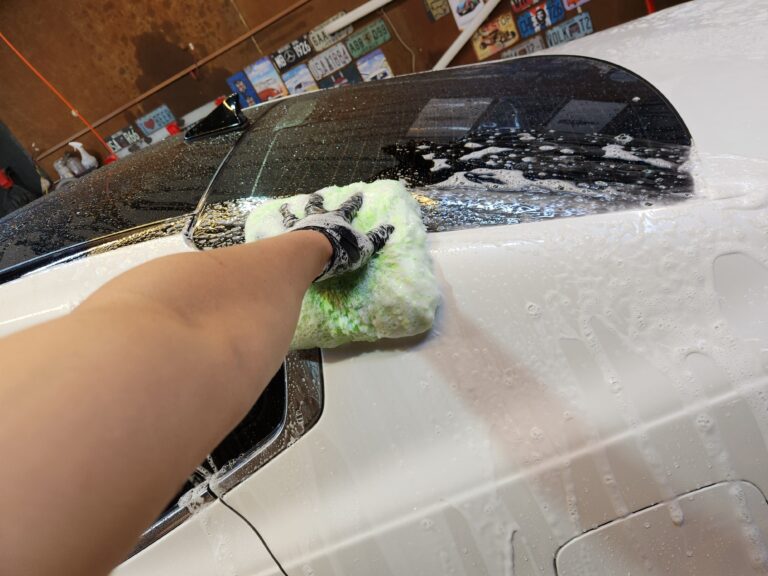
Using an acidic pre-wash correctly involves more than choosing a dilution ratio and waiting for the cleaner to react.
Acidic cleaners do not react equally with every mineral. They can help reduce acid-reactive inorganic deposits, including carbonate-based deposits that may contain calcium and magnesium. However, increasing the concentration does not make an established deposit detach from the paint all at once.
A stronger acidic mixture can also increase the burden on surrounding vehicle materials before it delivers the result you expect.
The previous guide explained why acidic pre-wash and dedicated water-spot removers serve different purposes. This article moves from that cleaning mechanism to the practical wash process.
To reach thin mineral buildup, you must first reduce the oily road film covering or surrounding it. Then apply the acidic cleaner evenly, using a lower concentration within the manufacturer’s recommended range and a wet, fluid foam that maintains stable contact with the surface.
Chemical reaction alone may not remove bonded contamination completely. A safe physical wash must follow so that the reacted deposits and remaining residue can separate from the paint.
Acidic pre-wash performance does not depend on concentration alone. Wash order, reaction time, foam moisture, physical washing, and final rinsing all work together.
This guide explains the correct wash sequence for mineral contamination and the practical standards for acidic pre-wash concentration, foam, reaction time, and rinsing.
Table of Contents
- The Correct Wash Order for Mineral Contamination
- How to Use Acidic Pre-Wash: Concentration, Foam, and Reaction Time
- Frequently Asked Questions
- Final Thoughts
The Correct Wash Order for Mineral Contamination
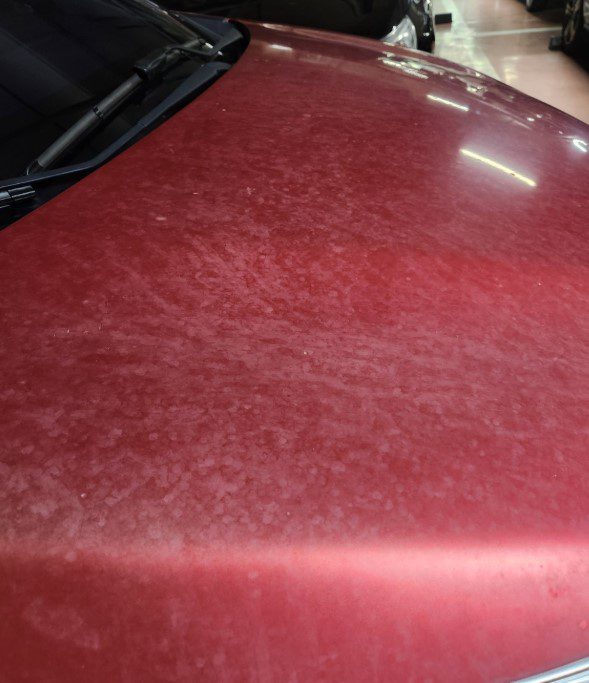
Mineral contamination is not simply loose dirt sitting on top of the paint.
After water evaporates, inorganic material can remain as solid residue or bonded deposits. Fresh oily contamination, dust, soot, and fine particles may then accumulate over and around those deposits, creating another layer of road film.
For this reason, applying an acidic cleaner at the beginning of the wash may not provide the most effective access to the mineral contamination.
The upper contamination should be reduced first.
Remove Road Film Before Trying to Reach Mineral Deposits
Vehicle contamination rarely consists of only one material.
Oil, soot, traffic residue, dust, and fine particles combine to form road film. Beneath that film, or within its irregular structure, the paint may also hold bonded contamination such as mineral deposits, iron particles, or uneven protection residue.
When you apply an acidic cleaner directly over heavy road film, part of the product may be consumed by the contamination above the deposit. It may also fail to reach the actual mineral reaction surfaces evenly.
This is why the process begins with an alkaline pre-wash.
However, you should not treat “alkaline first, acidic second” as a memorized pH sequence. The alkaline cleaner does not come first to neutralize the acidic product or satisfy a formal three-step wash system.
The alkaline stage comes first because reducing oily road film exposes the mineral and other bonded contamination underneath, allowing the next cleaner to reach its actual target.
Once you understand the position and properties of the contamination, the wash order becomes much easier to follow.
Washing Must Address Bonded Contamination Too
Many people think of washing as the process of removing visible dust and oily grime.
That is only part of the job.
Even after pre-washing and a routine contact wash, the paint may still hold mineral deposits, iron contamination, or old protection residue. These materials all remain attached to the surface, but they do not share the same composition or bonding mechanism.
Using one stronger cleaner for every problem rarely produces a consistent result.
A complete wash does more than remove loose surface dirt. It identifies the bonded contamination that remains and treats it according to its properties.
Contamination Type Determines the Wash Sequence
A practical mineral-management process can follow this sequence:
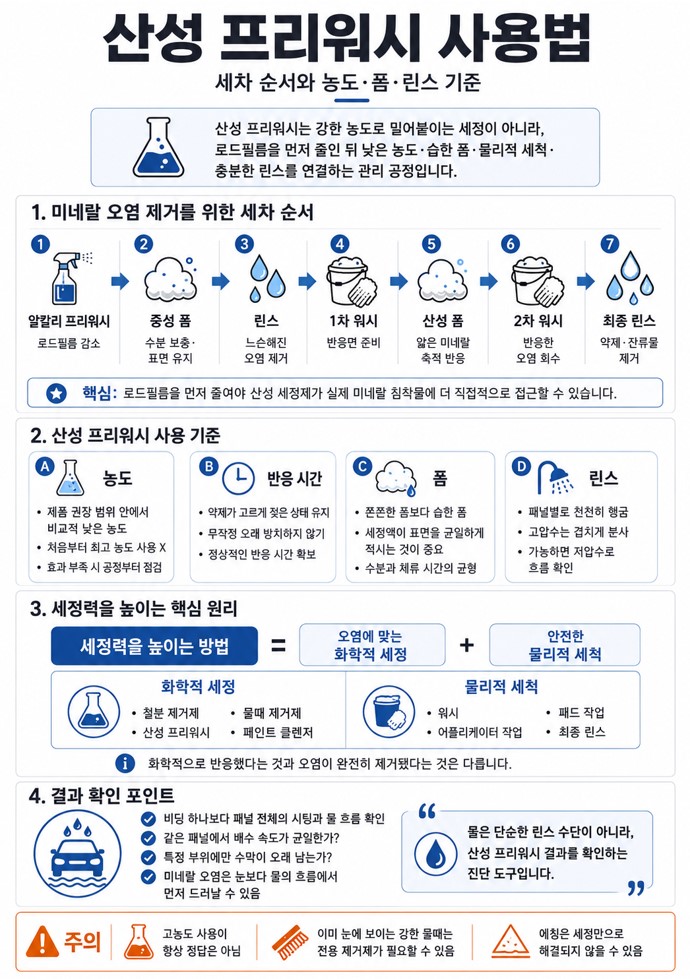
Alkaline pre-wash → neutral foam → rinse → first wash → acidic foam → second wash → final rinse
Each stage performs a different job. The process does not simply repeat the same wash twice.
Alkaline Pre-Wash
The alkaline pre-wash weakens the continuity and surface adhesion of oily road film.
Its primary purpose is not to remove mineral deposits directly. Instead, it reduces the contamination covering them so that the following stages can reach the bonded material more effectively.
Neutral Foam
Neutral foam adds water across the surface and helps maintain more even reaction conditions for the alkaline cleaner.
This is not a neutralization stage.
The goal is not to create the thickest possible layer of foam. The foam should support moisture and even coverage across the panels.
Rinse
A thorough rinse removes the alkaline cleaner and the road film it has loosened.
When rinsing is incomplete, dissolved or displaced oily residue can remain on the paint and interfere with the later acidic stage.
First Wash
The first wash removes the oily film and fine particles that remain after pre-washing and rinsing.
As explained above, this stage prepares the surface so that the acidic cleaner can reach the mineral deposits more directly.
Acidic Foam
Apply the acidic foam after reducing the road film and remaining surface contamination.
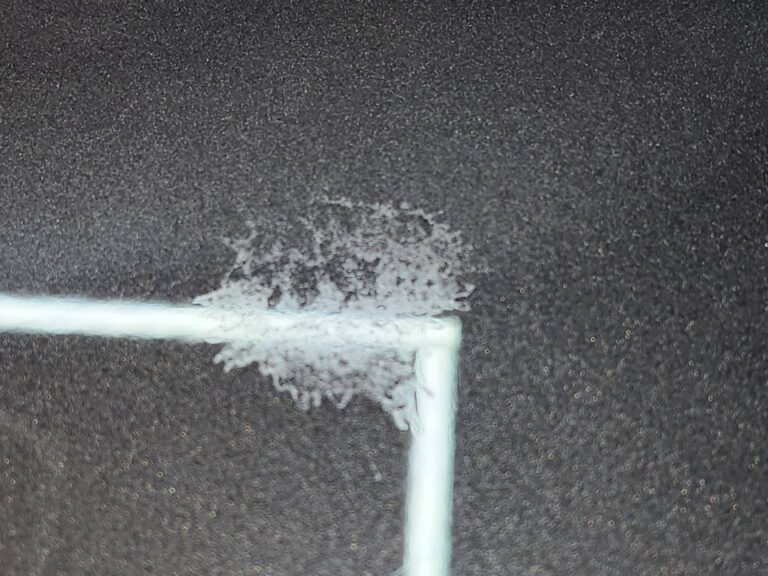
Choose a lower concentration within the manufacturer’s recommended dilution range. Spread it widely and evenly so that the cleaner can contact thin, acid-reactive inorganic deposits.
Second Wash
A chemical reaction does not guarantee that every deposit will release from the paint by itself.
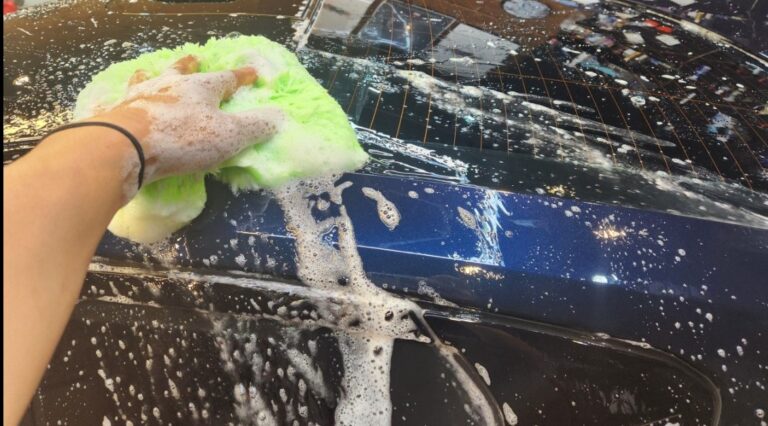
The second wash separates and collects mineral residue that the acidic stage has weakened or made easier to remove. It also recovers remaining reaction residue from the surface.
Final Rinse
The final rinse removes the acidic cleaner, reacted residue, and contamination separated during the second wash.
Do not rush across the entire vehicle. Divide the surface into panels and rinse each area slowly and thoroughly.
The First and Second Wash Stages Serve Different Purposes
The two wash stages are not identical contact washes.
The first wash exposes bonded contamination. The second wash separates and recovers contamination after the chemical reaction.
The first stage prepares the mineral reaction surfaces. The second stage completes the removal process after the acidic cleaner has acted.
That difference makes the two washes separate parts of one connected process rather than simple repetition.
How to Use Acidic Pre-Wash: Concentration, Foam, and Reaction Time
An acidic pre-wash is not designed to remove thick, established water spots in one aggressive application.
Its main purpose is to manage thin mineral residue that has begun accumulating across a larger area.
For that reason, effective use depends less on maximizing concentration and more on creating even, stable reaction conditions.
Stay Within the Manufacturer’s Recommended Concentration Range
A higher acidic concentration may increase the reaction rate with acid-reactive deposits.
However, the entire deposit does not separate at once simply because the solution is stronger. The response may differ according to the deposit’s composition, amount, bonding condition, and exposed reaction surfaces.
At the same time, increasing the concentration may place greater stress on other vehicle materials.
Always use the product within the dilution and concentration range provided by the manufacturer. Within that range, begin with a lower concentration rather than immediately choosing the strongest option.
A lower concentration does not mean arbitrarily diluting the product beyond its recommended range.
It means choosing a lower concentration within the approved range and allowing the cleaner to react evenly while the surface remains properly wet.
When the result appears weak, do not increase the concentration immediately.
First check whether:
- the road film was sufficiently reduced;
- the product reached the surface evenly;
- the foam stayed wet during the reaction period;
- the first and second wash stages were completed properly;
- the final rinse removed all loosened residue.
A stable reaction period also does not mean leaving the cleaner unattended for as long as possible.
Use the product within the manufacturer’s recommended working time and keep the surface evenly wet throughout that period.
Wet Foam Works Better Than Thick, Dry Foam
Many users judge foam quality by thickness.
However, an acidic pre-wash does not need to resemble dense shaving cream.
During acidic cleaning, the thickness of the foam matters less than how evenly the liquid wets and remains on the surface.
The actual cleaning solution must reach the paint and contact the mineral reaction surfaces.
A very thick but dry foam may remain visually impressive on the panel while offering limited moisture, mobility, and contact with the underlying deposit.
A wet, fluid foam is usually more suitable for this process.
It can:
- distribute a lower-concentration solution across a wide area;
- keep the paint and deposits evenly wet;
- reduce excessive product concentration in isolated spots;
- support a stable chemical reaction;
- maintain more consistent conditions across a large panel.
Slow downward movement is not necessarily a disadvantage.
Some mobility allows fresh solution to continue wetting the surface and contacting newly exposed reaction areas. However, foam that runs off immediately may not provide enough working time.
The goal is a balance between moisture and surface retention.
Bonded Contamination Requires the Correct Removal Method
Bonded contamination is not simply loose dirt resting on the paint.
Water evaporation, heat, repeated contamination, and old product residue can all strengthen its attachment to the surface. Because different contaminants have different compositions and bonding mechanisms, one acidic cleaner cannot solve every problem.
| Contamination | Suitable Removal Method |
|---|---|
| Iron particles | Iron remover |
| Thin, widespread mineral buildup | Acidic pre-wash |
| Visible, firmly bonded water spots | Dedicated water-spot remover |
| Old protection residue or uneven film | Wet paint cleanser |
| Oily road film | Alkaline cleaner |
The goal is not to choose the strongest available chemical.
Identify whether the remaining contamination is iron, mineral buildup, old protection residue, or oily road film, then choose a process that can act on that specific material.
An acidic pre-wash does not aim to remove every form of bonded contamination. It manages thin, widespread mineral buildup that remains after the upper road film has been reduced.
Cleaning Power Comes From Chemical and Physical Cleaning Together
Selecting the correct chemical does not automatically complete the removal process.
A chemical reaction and complete separation from the paint are not the same thing.
After the product reacts, the surface may still hold:
- weakened mineral deposits;
- partially reacted residue;
- fine particles trapped within the deposit;
- mixed contamination containing old protection residue;
- remaining reaction by-products.
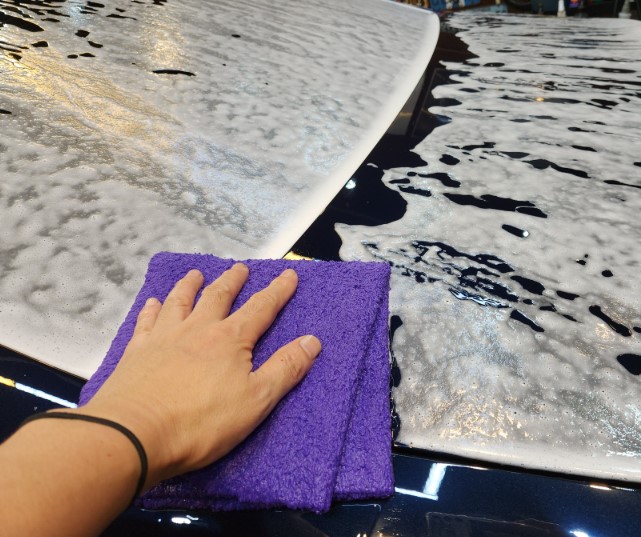
Physical washing helps separate and recover this material from the paint.
Greater cleaning performance = contamination-specific chemical cleaning + safe physical washing
The chemical stage weakens or changes the bonded contamination so that it becomes easier to remove. The physical wash then lifts and recovers the reacted material from the surface.
The connection varies according to the contamination:
- iron remover followed by thorough rinsing and contact cleaning when needed;
- acidic pre-wash followed by a safe wash and final rinse;
- water-spot remover used locally with a suitable applicator;
- wet paint cleanser used with an appropriate pad.
When bonded contamination remains, simply increasing chemical concentration is not always the correct answer.
Create the correct chemical reaction first, then connect it to a safe physical removal process.
Final Rinsing Becomes More Important After the Acidic Stage
When the acidic stage appears near the end of the wash process, the final rinse becomes especially important.
You are not rinsing away foam alone.
The water must remove:
- remaining acidic cleaner;
- residue produced during the mineral reaction;
- fine contamination separated during the wash;
- diluted solution collected around panel edges and curved areas.
Do not sweep the pressure washer quickly over the entire vehicle.
Work panel by panel. Move the spray slowly and overlap each pass so that enough water reaches every part of the surface.
Pressure matters, but complete water coverage matters just as much.
When free-flowing or low-pressure water is available, use it after the pressure rinse to observe how water drains across the panel.
This step can help reveal remaining product, uneven surface conditions, and differences in drainage.
Check the Result Through Water Behavior, Not Gloss Alone
Do not judge an acidic pre-wash only by how glossy the dry paint appears.
Thin mineral residue may be difficult to see after drying. Water, however, can respond to subtle differences in the surface before they become visually obvious.
Many users judge the result by looking only at beading. In practice, sheeting and overall water flow across the panel can provide more useful information about surface uniformity.
During the final rinse, check whether:
- water drains at a similar speed across the same panel;
- a thin water film remains longer in one area;
- the transition between sheeting and beading changes suddenly;
- irregular boundaries remain after the water drains;
- faint circular marks appear while a thin water film is present.
Wax and coating conditions can change the size and shape of the beads. For this reason, one bead does not prove that the mineral contamination has been removed.
Look at whether the water behavior has become more even across the entire panel.
Thin mineral contamination may reveal itself through final-rinse water behavior before it becomes obvious on dry paint.
Water is not only a rinsing tool. It can also serve as a diagnostic tool.
Frequently Asked Questions
Can I Apply Acidic Foam Immediately After Alkaline Pre-Wash?
You can rinse thoroughly after the alkaline stage and then apply an acidic cleaner.
However, heavy road film and fine particles may still prevent the acidic solution from reaching the actual mineral deposits evenly.
For more controlled mineral management, complete the first wash before applying the acidic foam.
Why Is the First Wash Necessary Before Mineral Removal?
The first wash removes oily film and fine particles that remain after the pre-wash and rinse.
This stage prepares the reaction surfaces for the acidic cleaner. It is not simply another routine contact wash.
Should I Use a Lower Concentration and a Longer Reaction Time?
Choose a lower concentration within the manufacturer’s recommended range and allow the product to work evenly for the approved reaction period.
A longer reaction is not automatically better. Maintaining an evenly wet surface within the recommended working time is different from leaving the product on the vehicle indefinitely.
Why Is Wet Foam Better Than Thick Foam for Acidic Pre-Wash?
The purpose of acidic foam is not to create the thickest possible layer.
The liquid must reach the mineral deposits and wet the surface evenly. A wetter, more fluid foam can distribute the cleaner across the panel and support more consistent contact with the contamination.
Can Chemical Cleaning Alone Remove Bonded Contamination?
Some contamination may rinse away after the chemical stage.
However, weakened deposits and mixed residue can remain attached to the paint. Safe physical washing helps separate and recover that material from the surface.
How Can I Check Mineral Removal During the Final Rinse?
Observe the entire panel rather than one or two water beads.
Compare drainage speed, sheeting patterns, remaining water films, and sudden changes in water behavior. Low-pressure water can make these differences easier to observe.
What Should I Do if Water Spots Remain After Acidic Pre-Wash?
Acidic pre-wash is designed for thin, early mineral buildup.
Visible or firmly bonded water spots may require a dedicated water-spot remover. When a circular mark remains after the mineral material has been removed, the paint may have etching or another form of surface damage.
Do not continue increasing the acidic concentration. Reassess whether the surface needs contamination removal or paint correction.
Final Thoughts: Acidic Pre-Wash Depends on Process, Not Maximum Strength
An acidic pre-wash does not become effective simply because you add another chemical stage to the wash.
First reduce the road film so that the mineral deposits become accessible. Apply the acidic product evenly at a lower concentration within the manufacturer’s recommended range. Then connect the chemical reaction to a safe physical wash and a thorough final rinse.
Greater cleaning performance = contamination-specific chemical cleaning + safe physical washing
Finally, do not judge the result by one water bead or dry gloss alone. Look for more even sheeting, drainage, and water behavior across the entire panel.
The purpose of acidic pre-wash is not to remove water spots through maximum chemical strength. It is to connect the correct wash order, controlled acidic reaction, safe physical washing, and complete rinsing into one mineral-management process.
The next guide will explain the main risks of acidic cleaning, including hot panels, product drying, sensitive metals and trim, trapped solution, and possible effects on waxes, sealants, and coatings.