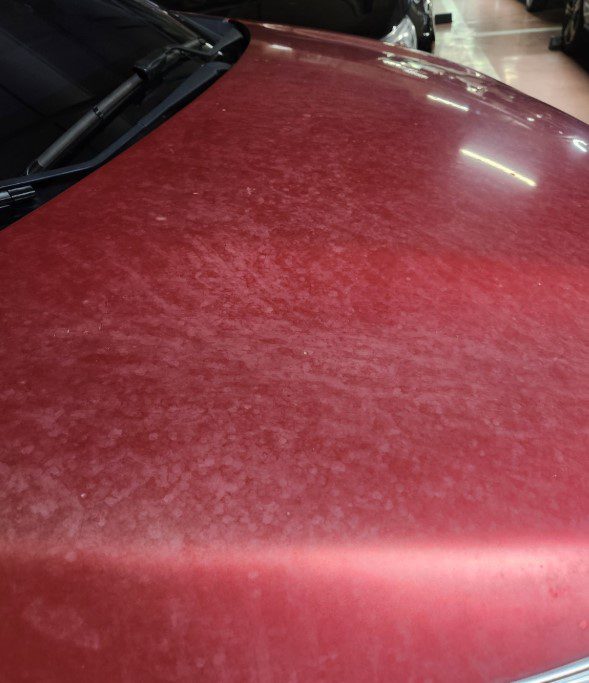
When an acidic pre-wash fails to remove visible water spots, increasing the product concentration may seem like the obvious next step.
That approach often works more directly with an alkaline pre-wash. When oily road film is heavy, using a stronger dilution within the manufacturer’s recommended range can improve cleaning performance.
Acidic cleaning, however, does not work in the same way.
A higher concentration may increase the reaction with mineral deposits. Even so, established deposits do not separate from the surface all at once like loosened oily road film.
More importantly, stronger acidic chemistry can increase the risk to metal components, trim, emblems, panel gaps, and paint protection.
This does not mean acidic cleaners are ineffective. Alkaline and acidic cleaners remove contamination through different mechanisms.
A simple thin-link and thick-link analogy helps explain how those mechanisms differ. This article also explains why an acidic pre-wash and a dedicated water-spot remover should be treated as separate processes.
Table of Contents
- Why Is Mineral Contamination More Difficult to Remove With Acidic Cleaning?
- Why Can’t Higher Acidic Pre-Wash Concentration Solve the Problem?
- Why Are Acidic Pre-Wash and Water-Spot Removers Different?
- Frequently Asked Questions
Why Is Mineral Contamination More Difficult to Remove With Acidic Cleaning?
Alkaline and acidic cleaners are not simply products positioned at opposite ends of the pH scale.
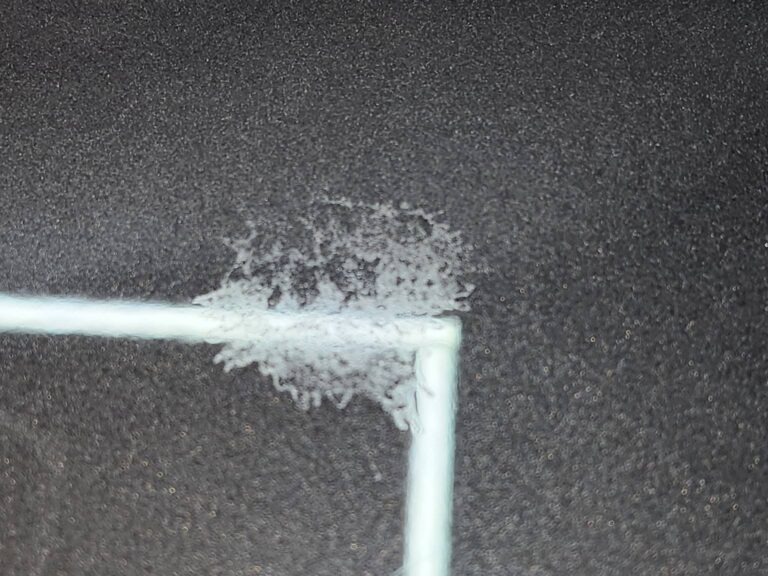
Alkaline cleaning mainly weakens the continuity and surface adhesion of road film made from oils and fine particles. Surfactants then help disperse the loosened contamination, while pressure rinsing carries it away.
Acidic cleaning works differently. It must reach and react with accessible surfaces on the solid mineral deposits left behind after water dries.
Therefore, the two cleaners differ not only in the contamination they target but also in how that contamination leaves the surface.
Alkaline Cleaning Weakens the Continuity and Adhesion of Road Film
For a closer look at the role of pH and surfactants, see [how alkaline cleaning weakens oily road film].
Automotive road film does not consist of a single contaminant.
Oils, dust, soot, tar-like residue, and inorganic particles combine to form a thin, complex film over the paint.
An alkaline pre-wash reduces the stickiness of this film and loosens its structure. Surfactants help water penetrate the contamination while keeping separated oils and particles dispersed instead of allowing them to settle back onto the surface.
The cleaner does not need to break down every component of the road film at a molecular level.
Once alkaline chemistry and surfactants sufficiently weaken the film’s continuity and adhesion, the contamination becomes easier to disperse into smaller sections or separate from the paint.
Pressure rinsing can then carry away much of the loosened contamination.
In other words, the purpose of an alkaline pre-wash is not to chemically destroy every part of the oily contamination. It changes the condition of the film so the following wash stage can remove it with less mechanical contact.
Acidic Cleaning Must React With Mineral Deposits
Mineral contamination exists in a different physical state from oily road film.
After water evaporates, some dissolved minerals remain on the surface as thin residue or more established mineral deposits. An acidic cleaner must reach an accessible reaction surface and interact with the deposit itself.
Some reactive mineral material may dissolve or change into a form that rinses away more easily.
However, a deposit does not peel away as one perfectly uniform layer.
The acidic reaction occurs wherever the cleaner can contact a reactive surface. Reaction speed may vary according to the composition and condition of the deposit. Some areas may respond quickly, while others react slowly or hardly at all.
As mineral material is reduced, new reaction surfaces become exposed and allow the process to continue.
For this reason, the more mineral material that has accumulated, the more material the acidic cleaner must actually react with.
A Thin-Link and Thick-Link Analogy
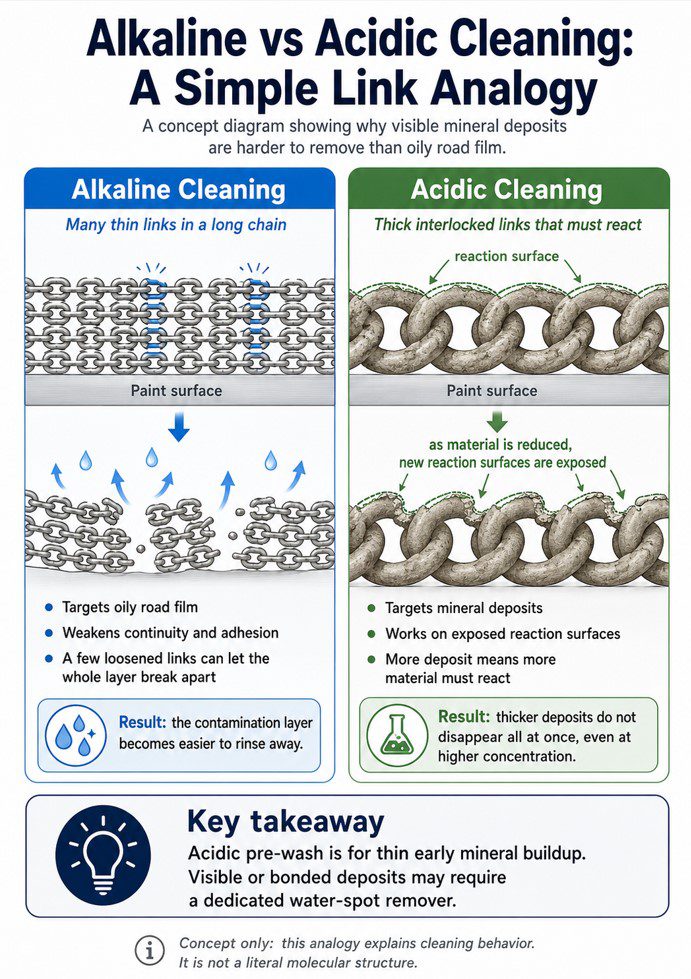
A simple chain analogy helps explain the difference.
Imagine oily road film as a long structure made from many thin links.
You do not need to break every single link. Once several connections become loose, the larger structure loses continuity and becomes easier to separate from the paint during rinsing.
Now imagine mineral deposits as a series of thick, tightly interlocked links.
Reacting with one exposed section does not make the rest of the deposit fall away automatically. The cleaner must continue reacting with accessible mineral surfaces. As one area is reduced, another reaction surface becomes exposed.
Alkaline cleaning can make an entire contamination film easier to remove by weakening some of its many connections. Acidic cleaning must continue reacting with the remaining mineral deposit before its actual mass decreases.
This analogy does not represent the literal molecular structures of road film or mineral deposits. It is a simplified way to explain the difference in cleaning behavior.
More Mineral Buildup Means More Material Must React
Early mineral residue is thin, and the total amount of material requiring a reaction is relatively small.
Repeated natural drying and recontamination, however, can allow mineral deposits to accumulate. Fresh road film may also form over existing deposits, making it more difficult for acidic chemistry to reach the mineral reaction surfaces.
As a result, visible water spots may not consist of one isolated type of contamination.
The affected surface may contain:
- Mineral deposits
- Oily road film over the deposits
- Dust and fine particles
- Composite residue formed through repeated drying
In these cases, alkaline cleaning may need to reduce the upper oily contamination before acidic chemistry can reach the mineral deposits more effectively.
This is why alkaline cleaning may come before acidic cleaning. The purpose is not simply to neutralize one pH with another.
The more important goal is to reduce different types of contamination in sequence so the acidic cleaner can reach the mineral deposits it is intended to treat.
Why Can’t Higher Acidic Pre-Wash Concentration Solve the Problem?
When water spots remain, using a more concentrated acidic solution may appear to be the simplest answer.
A higher concentration can increase reaction speed or allow more mineral material to react during a given period. However, acidic cleaning does not weaken the continuity of an entire contamination film in the same way as an alkaline pre-wash.
Therefore, a stronger solution does not necessarily make a thick deposit disappear in one treatment.
Higher Concentration Does Not Release the Entire Deposit at Once
Acidic chemistry works at the mineral reaction surfaces it can reach.
When a deposit is thick or has a complex structure, some material must first be reduced before new reaction surfaces become accessible. Established water spots may therefore require repeated localized treatment or controlled mechanical assistance rather than one aggressive application.
The composition of water spots can also vary.
Some deposits respond relatively well to acids. Others may contain different inorganic materials or oily contamination, causing the reaction to proceed slowly or remove only part of the deposit.
Acidic cleaning cannot be calculated this simply:
Twice the concentration
→ Exactly twice the cleaning power
→ Complete removal in one application
Concentration matters, but the final result also depends on:
- The composition and amount of the deposit
- The product formulation
- Contact time
- Surface temperature
- Whether the cleaner begins to dry
In practice, material safety usually becomes the limiting factor before cleaning power does.
Acidic Chemistry Does Not React Only With Mineral Deposits
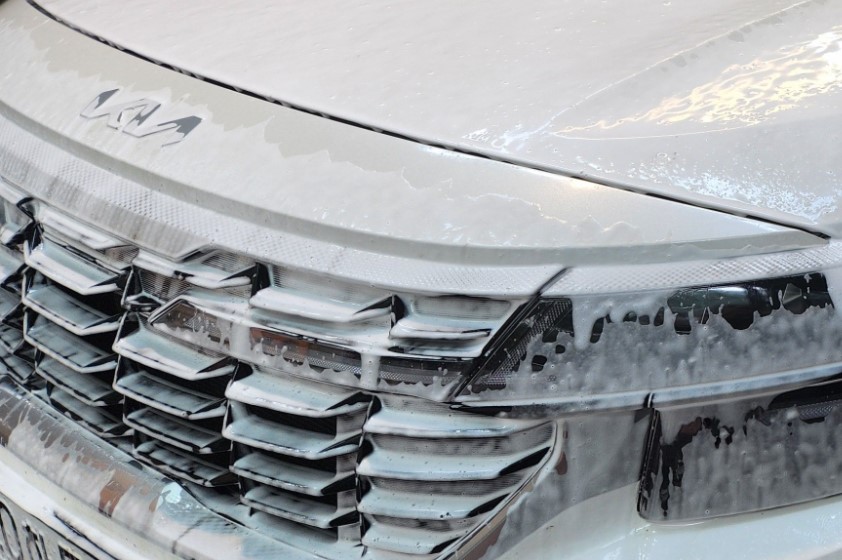
Increasing concentration does not strengthen only the desired reaction with mineral deposits.
Vehicles also contain materials that may be more sensitive to acidic chemistry, including:
- Exposed aluminum and other metal components
- Chrome and plated trim
- Areas around emblems and moldings
- Panel gaps and joints
- Certain plastics and sensitive finishes
- Wax and sealant protection
When an acidic cleaner is applied over a wide area, the solution can run into mirrors, moldings, emblem recesses, and panel gaps.
The visible paint may appear to have been rinsed thoroughly. However, diluted cleaner trapped inside gaps can later run out or dry in a concentrated area.
Material Safety Can Become the Limit Before Cleaning Power Does
A higher concentration can increase the reaction with minerals.
However, the risk of staining, discoloration, corrosion, or reduced protection may become unacceptable before the mineral deposit has been fully removed.
For this reason, acidic cleaning cannot be pushed indefinitely through the following cycle:
The water spot remains
→ Increase the concentration
→ It still remains
→ Extend the dwell time
Increasing concentration and dwell time together does not raise cleaning performance alone. It also places greater stress on surrounding materials.
This is why acidic cleaning cannot be pushed indefinitely by increasing concentration and dwell time.
If the cleaner begins to dry, the concentration and reaction conditions can become even less uniform.
Drying Makes Concentration and Reaction Conditions Uneven
Allowing an acidic cleaner to dry does more than extend its contact time.
As water evaporates, the liquid can no longer move evenly across the surface. Acidic components and reaction residue may become concentrated in particular areas.
This problem may occur more easily around emblems, mirrors, moldings, and panel gaps than across a broad, open panel.
Therefore, concentration and dwell time should never be considered separately from drying conditions.
Even with the same dilution, a hot panel or direct sunlight can cause the actual surface conditions to change much faster than expected.
The goal is not to find the strongest possible concentration.
The goal is to maintain a stable reaction within the product’s recommended range while preventing the cleaner from drying on the surface.
Why Are Acidic Pre-Wash and Water-Spot Removers Different?
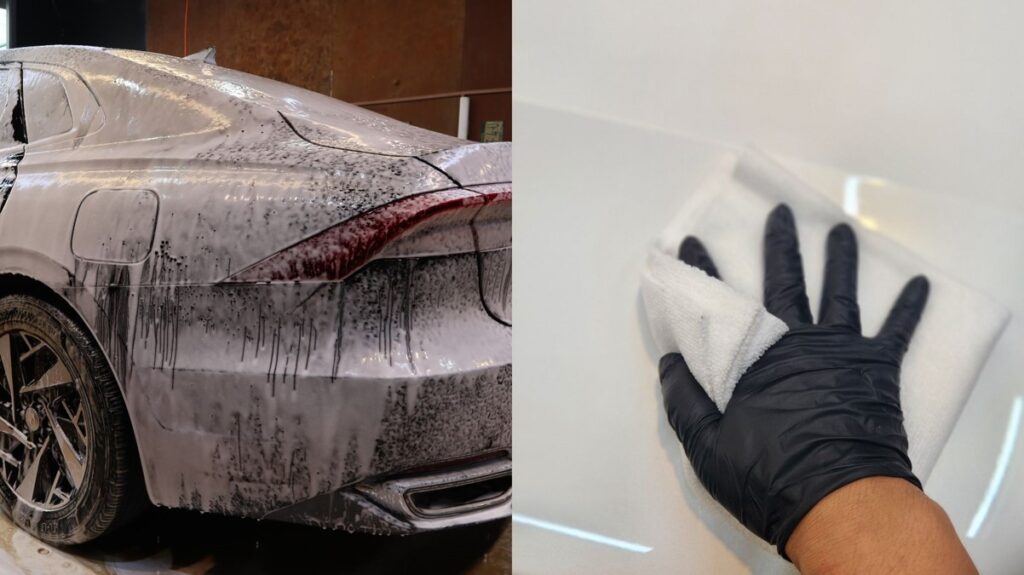
An acidic pre-wash and a water-spot remover may both use acidic chemistry.
However, they are not the same process.
The difference is not simply that one is weak and the other is strong. They target different stages of mineral contamination and serve different purposes.
Acidic Pre-Wash Manages Thin, Early Mineral Buildup
This maintenance approach begins with understanding [why acidic pre-wash is needed before mineral buildup becomes visible].
An acidic pre-wash targets early mineral residue that is still difficult to see or spread thinly across a broad area.
At this stage, only a small amount of mineral material needs to react. A relatively low concentration can therefore help manage a larger section of the vehicle.
The goal is not to aggressively remove visible water spots in a single treatment.
Instead, the process reduces the small amounts of mineral residue left through repeated wetting and drying. This helps slow the development of thicker, more firmly bonded deposits.
An acidic pre-wash is not a weaker version of an aggressive water-spot removal process. It is a separate maintenance step designed to manage mineral buildup while the deposits remain thin and the amount of material requiring reaction is still small.
Water-Spot Removers Target Established Deposits
A dedicated water-spot remover targets mineral contamination that has already become visible, such as faint circular outlines, pale residue, or firmly bonded deposits.
At this stage, the deposits may be thicker or more strongly attached than the early residue targeted by an acidic pre-wash.
The affected area may require a separate process, including:
- Localized product application
- Controlled contact time based on product instructions
- Repeated treatment
- Light mechanical assistance where permitted
- Inspection after each treatment
A water-spot remover may also use acidic chemistry. However, its purpose and application method differ from the periodic, broad-surface maintenance performed with an acidic pre-wash.
| Category | Acidic Pre-Wash | Water-Spot Remover |
|---|---|---|
| Target | Thin, widespread early mineral residue | Visible or firmly bonded mineral deposits |
| Purpose | Manage repeated accumulation | Remove deposits that have already formed |
| Application area | Broad vehicle surfaces | Localized problem areas |
| Reaction strength | Relatively low concentration and controlled reaction | Potentially stronger localized treatment, depending on the product |
| Limitation | May not remove thick water spots | Requires greater care around materials and paint protection |
Increasing Acidic Pre-Wash Concentration Does Not Turn It Into a Water-Spot Remover
Continuing to increase the concentration of an acidic pre-wash does not automatically turn the process into dedicated water-spot removal.
The products may differ in formulation, intended use, and recommended application area.
Using an excessively concentrated pre-wash over a broad surface may place sensitive vehicle materials under stress before it adequately removes established deposits.
Likewise, applying a strong dedicated water-spot remover across an entire vehicle may be inappropriate.
Do not distinguish these products by pH or dilution ratio alone. Consider:
- What stage of mineral contamination the product targets
- Whether it is intended for broad maintenance or localized correction
- Whether rinsing alone completes the process
- Whether repeated treatment or mechanical assistance is expected
- Which materials and working conditions the manufacturer restricts
Etching Is Surface Damage, Not Remaining Mineral Contamination
A visible mark may remain even after the mineral deposit has been removed.
In that case, the remaining mark may be etching rather than contamination.
Etching is not material sitting on top of the paint. Increasing the acidic concentration will not correct it.
Etching is microscopic damage to the paint surface itself. Correcting it may require restoring a more uniform surface rather than continuing to remove contamination.
Depending on the condition, a paint cleaner or polishing process may be necessary. Deep damage may not be fully correctable.
This distinction matters because repeatedly applying acidic cleaner to an etched mark can increase stress on the paint and surrounding materials even though no removable mineral deposit remains.
Frequently Asked Questions
Will a Stronger Acidic Pre-Wash Remove Visible Water Spots?
A stronger concentration may improve the removal of thin, reactive deposits.
However, visible or firmly bonded water spots may not disappear in a single treatment simply because the pre-wash is mixed more strongly.
Applying a high concentration over the entire vehicle can also increase the risk to metals, trim, emblems, panel gaps, waxes, and sealants. A dedicated remover applied to the affected area may be more appropriate for established deposits.
Why Can Alkaline Pre-Wash Respond Better to Higher Concentration Than Acidic Cleaning?
An alkaline pre-wash weakens the continuity and surface adhesion of oily road film, making the contamination easier to separate from the paint.
It does not need to react individually with every component. Once the film becomes sufficiently loose, rinsing can remove a substantial amount of it.
Acidic chemistry, by contrast, must interact with accessible reaction surfaces on the remaining solid mineral deposits. As the amount of mineral material increases, the amount that must react also increases. For this reason, concentration alone may not solve the problem.
Does a Longer Dwell Time Remove More Water Spots?
Acidic chemistry may require some reaction time.
However, longer is not always better. Once the product begins to dry, reaction conditions become uneven and certain areas may experience greater concentration.
Follow the product instructions and consider surface temperature, sunlight, and drying speed when setting dwell time.
Can Repeated Acidic Pre-Washing Replace a Water-Spot Remover?
Periodic acidic pre-washing can help reduce the accumulation of thin, early mineral residue.
However, visible or firmly bonded deposits may require a dedicated water-spot remover and localized treatment.
Repeated pre-washing cannot replace every corrective water-spot removal process.
Why Use Acidic Cleaning After Alkaline Cleaning?
Alkaline cleaning reduces the oily road film and organic contamination that may overlay mineral deposits.
This can make it easier for acidic chemistry to reach the mineral reaction surfaces beneath.
Therefore, using alkaline cleaning before acidic cleaning is not merely about neutralization. It allows different types of contamination to be reduced in sequence.
Why Does a Circular Mark Remain After the Mineral Deposit Is Removed?
If a mark remains after the mineral deposit has been removed, the paint may have developed etching.
Etching is damage within the paint surface rather than contamination sitting on top of it. A stronger acidic cleaner will not remove it.
Depending on the severity, correction may require a paint cleaner or polishing to restore a more uniform surface.
Conclusion
Alkaline and acidic cleaners are not simply opposite-pH versions of the same cleaning process.
An alkaline pre-wash weakens the continuity and adhesion of oily road film. It does not need to remove every component individually. Once the contamination becomes sufficiently loose, rinsing can carry it away.
Acidic cleaning must react with accessible surfaces on the solid mineral deposits left after water dries. As mineral buildup increases, more material must react, and a higher concentration does not make the entire deposit separate at once.
More importantly, increasing acidic concentration can also increase the stress placed on metal parts, trim, emblems, panel gaps, and paint protection.
Therefore, acidic cleaning cannot rely on repeatedly increasing the concentration whenever water spots remain.
An acidic pre-wash is not an underpowered water-spot remover. It is a maintenance process used to reduce mineral buildup while the deposits remain thin and the amount of material requiring reaction is still small.
That is the main reason an acidic pre-wash and a dedicated water-spot remover should be treated as separate processes.