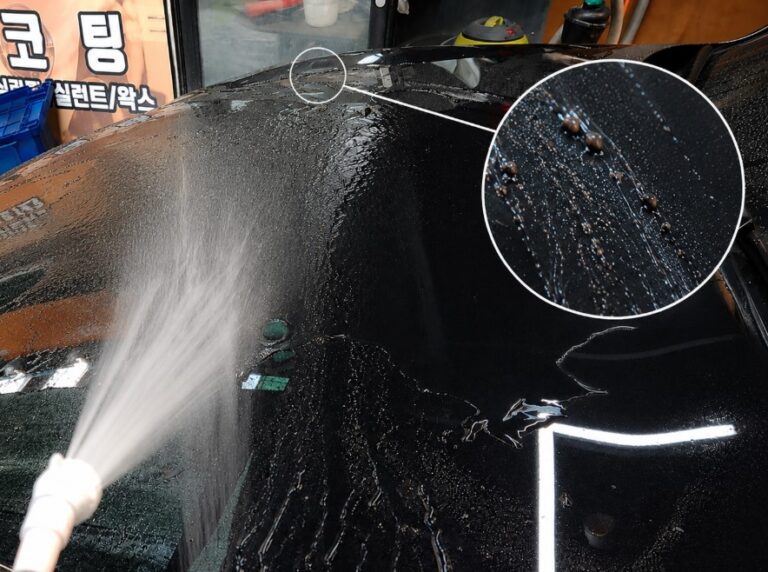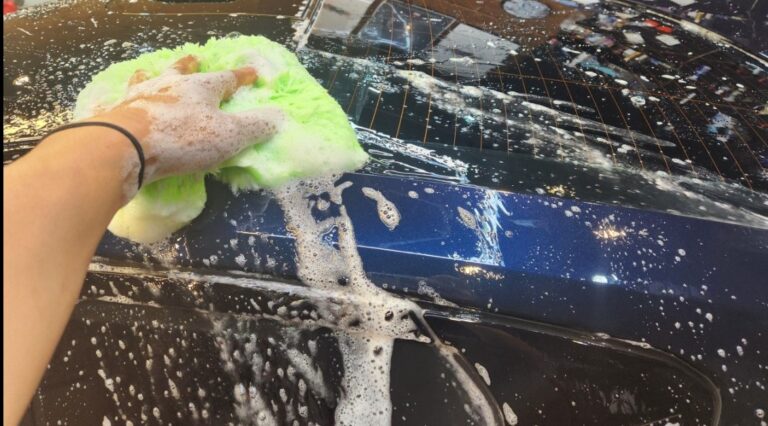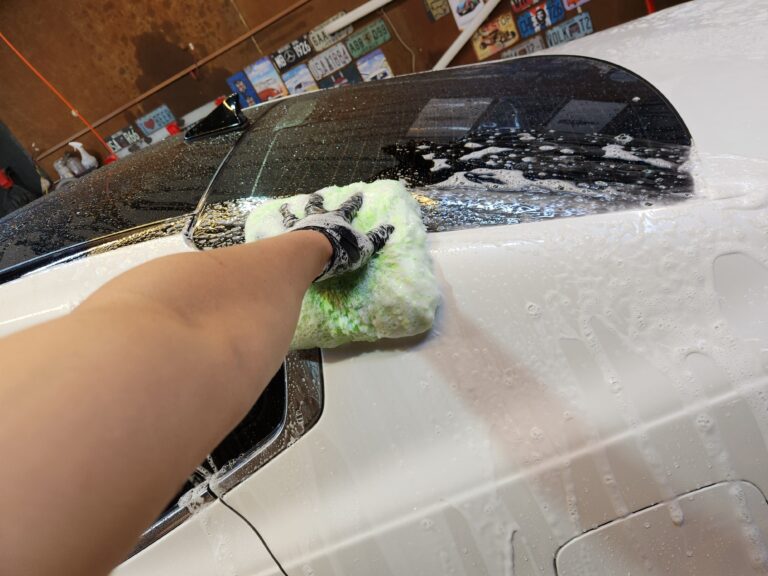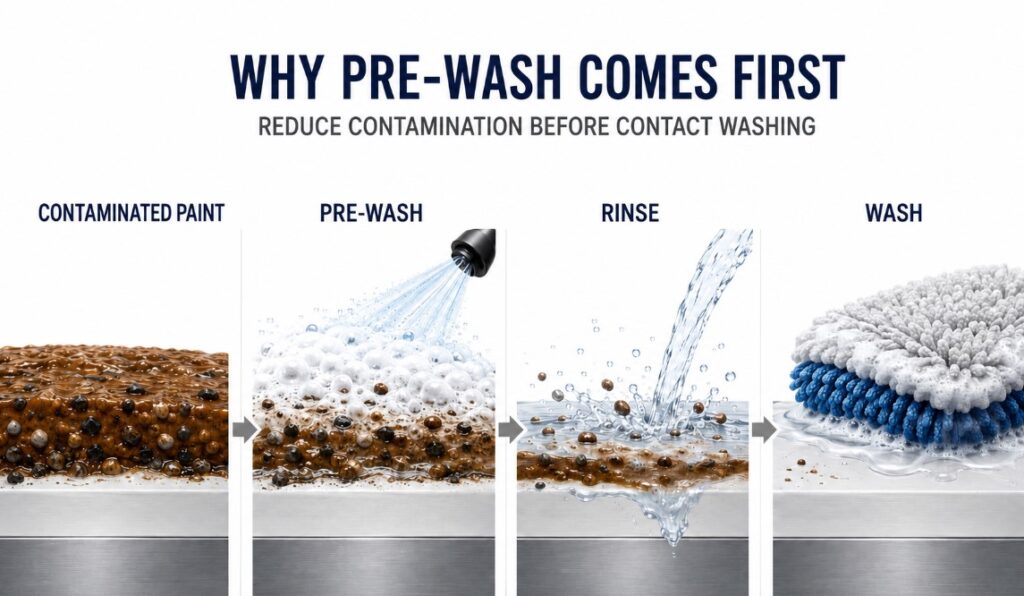
Pre-wash is the first step used to reduce loose particles and weaken bonded contamination before a contact wash begins.
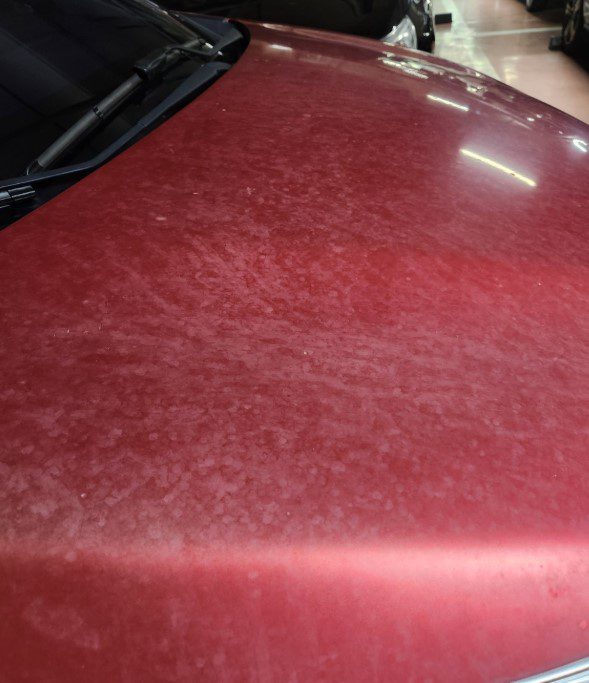
Before washing a vehicle, the paint is usually covered with contamination in several different states.
Some dust rests loosely on the surface. Other contamination has mixed with soil and road grime during rain or snow and then dried onto the paint. Repeated wetting and drying can form a hardened layer along the lower sides and rear of the vehicle. The front may also be covered with dried bug residue that has bonded firmly to the surface.
A high-pressure rinse can remove much of the loose dust and particulate contamination. However, it cannot remove everything that has dried onto the paint or bonded with other substances.
The problem begins when a contact wash is performed while this contamination is still present.
As the wash mitt moves, particles trapped between the mitt and the paint can move with it. Light pressure may leave firmly bonded contamination behind. Increasing pressure or repeatedly washing the same area may remove it, but the additional pressure and particle movement can increase the risk of scratches.
Going directly to a contact wash therefore creates two possible problems:
- If you wash lightly, hardened contamination may remain.
- If you apply more force, the contamination may come off, but the risk of scratching increases.
The first decision before a contact wash should not be how much pressure to apply with the mitt. The priority is to reduce particulate contamination and lower the adhesion and removal resistance of hardened dirt.
In other words, the contamination should first be changed into a state in which it can be removed with less force.
Table of Contents
- What risk does pre-washing reduce before a contact wash?
- Why contamination that does not rinse away must be weakened first
- How chemical cleaning makes contamination easier to remove
- What changes during the contact wash after chemical cleaning?
- Key questions and answers
- Conclusion: Reduce the force required before increasing removal force
1. What Risk Does Pre-Wash Reduce Before Contact Washing?
A contact wash cannot eliminate pressure, friction, or movement
A contact wash separates contamination by placing a wash mitt or towel on the paint and moving it across the surface.
No matter how soft the mitt is, contact creates pressure and friction. If contamination is not removed in one pass, the mitt must travel over the same area again, increasing the amount of movement.
The main problem is not always the mitt itself. It is the particulate contamination trapped between the mitt and the paint.
When hard particles remain on the surface, they can be dragged across the paint as the mitt moves. A soft mitt does not make the particles trapped beneath it soft.
BB Detailing Guide describes this relationship as follows:
Scratch risk = Particulate contamination × Pressure × Friction × Movement
This is not a quantitative formula for calculating the number or depth of scratches. It is a framework for identifying the conditions that increase scratch risk during washing.
Pressure, friction, and movement cannot be completely eliminated from a contact wash. Without moving the mitt, the remaining contamination cannot be separated from the paint.
The first variable that can be reduced before contact begins is therefore particulate contamination.
Pre-washing does not replace the contact wash
The purpose of pre-washing is not to complete the entire wash without contact.
It removes loose particles before the mitt touches the paint and changes contamination that does not rinse away with water into a state that is easier to remove. This reduces both the amount of contamination and its resistance to removal before the contact wash begins.
Pre-washing is therefore not a step designed to eliminate contact. It creates the conditions needed to perform the contact wash with less risk.
2. Why Pre-Wash Must Weaken Contamination That Water Cannot Remove
Not every particle on a vehicle exists in the same condition.
Loosely settled dust can move easily with flowing water. Particles that have been wetted and dried, or mixed with other contamination, can clump together and adhere more firmly to the paint.
This is why contamination must be assessed not only by how much is present, but also by how firmly it is attached.
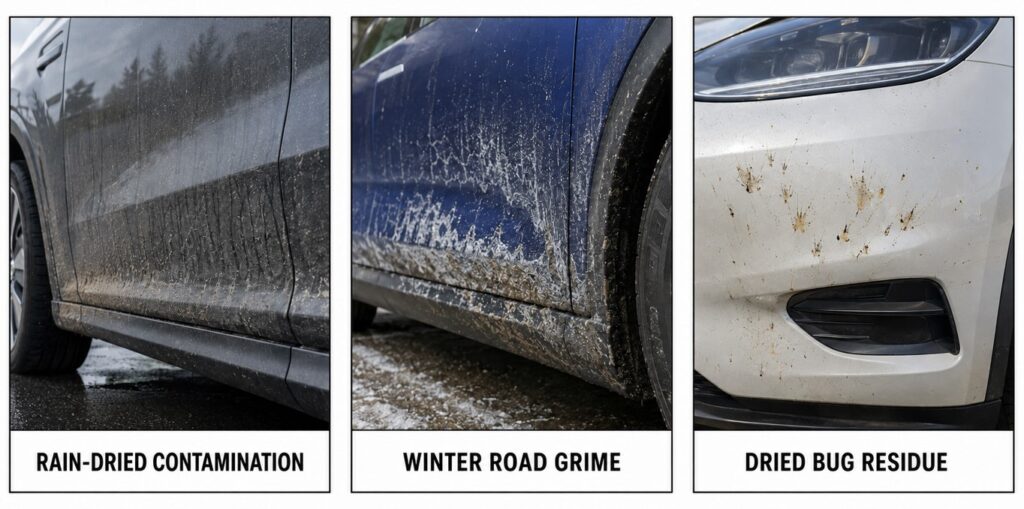
Dried contamination on the sides and rear after rain
After rain, soil and road grime often remain across the lower sides and rear of the vehicle.
This is different from dry dust simply resting on the surface. While driving, particles are splashed onto the vehicle with rainwater and mixed with existing contamination. As the water evaporates, the mixture remains as a thin layer bonded to the paint.
This mixed contamination layer, formed from rainwater, soil, and road grime with different properties, may not be completely removed by water alone.
A high-pressure rinse can remove loosely settled particles. However, contamination that has gone through repeated wetting and drying may remain attached to the surface.
If this remaining contamination is immediately removed with a contact wash, particles can travel across the paint while under pressure. The risk is not caused only by the amount of contamination. It also increases because the contamination has changed into a more firmly attached state that water alone cannot easily remove.
Hardened mixed contamination after driving on snowy roads
Vehicles driven on snowy roads collect a mixture of soil, road particles, de-icing salts, and other contamination along their lower sections.
Some components dissolve in water and rinse away easily. Others remain after the moisture evaporates. As the vehicle dries under airflow and heat, a mixed contamination layer can form along the lower sides and rear.
A high-pressure rinse may remove loose residue without removing the entire bonded film.
Trying to remove what remains in a single contact-wash pass increases the pressure applied through the mitt and the number of repeated movements. Snow-road contamination is therefore a clear example of why loose residue and bonded contamination must be treated differently.
Dried bug residue
Dried bug residue covers a relatively small area, but it clearly demonstrates the risks involved in contact washing.
It may be easy to remove shortly after driving. Once dried by sunlight and heat from the paint, however, it can adhere firmly to the surface. If marks remain after a normal wash, it is tempting to apply concentrated pressure with a finger or towel and repeatedly rub the same spot.
This concentrates pressure within a small area and repeats friction and movement in the same direction. The contaminated area may be small, but the physical force applied to the paint can become disproportionately high.
The situation changes when the residue is thoroughly wetted and chemically weakened first. As the hardened material softens and its adhesion decreases, it can be separated without heavy pressure.
The first condition to change is adhesion
Rain contamination, snowy-road grime, and dried bug residue differ in composition and formation.
However, all three share the same characteristics:
- They do not rinse away completely with water alone.
- Drying or mixing with other contamination increases cohesion within the layer, adhesion to the paint, or both.
- Wiping them immediately increases pressure and repeated movement.
The answer is not to begin with more aggressive contact.
Before increasing physical force, the force holding the contamination in place must first be reduced.
3. How Pre-Wash Chemical Cleaning Makes Dirt Easier to Remove
Chemical weakening does not make contamination disappear instantly
Spraying a cleaner does not cause contamination to immediately disappear from the vehicle.
The cleaning solution first wets the contamination and penetrates openings within the layer. Depending on the product formulation and the type of contamination, it may soften hardened material, dissolve, emulsify, or disperse some components, and reduce both the cohesion within the contamination layer and its adhesion to the paint.
Even when there is little visible change, the condition of the contamination may already be different.
Contamination that initially required heavy pressure may begin to separate under a high-pressure rinse. Dirt that would otherwise require repeated scrubbing may come away during a light contact wash.
The purpose of chemical cleaning is therefore not necessarily to remove all contamination in one step.
Its key role is to reduce the physical force required during the cleaning stages that follow.
The chemical action of pH, solvents, and surfactants is explained in more detail in 3PH Car Wash Cleaning Power | How pH, Solvents, and Surfactants Work.
Concentration and dwell time are required for real chemical action
A cleaner’s potential performance is not the same as the cleaning performance achieved on the vehicle.
Real-world cleaning performance = Product design × Process execution
Even a well-formulated product may not work effectively if it is diluted too heavily or rinsed off immediately after application.
Concentration is not simply a control for making a cleaner stronger. It determines whether enough active cleaning ingredients are supplied to weaken the target contamination.
Dwell time is not simply waiting time. It is the period during which the solution remains wet and can continue interacting with the contamination.
Practical methods for controlling concentration, effective dwell time, and mechanical cleaning are covered in 3PH Car Wash Cleaning Power Part 2 | How to Use Concentration, Dwell Time, and Mechanical Cleaning.
Chemical weakening alone does not complete the process. The high-pressure rinse physically separates and carries away much of the loosened contamination before the contact wash begins.
4. What Changes During the Contact Wash After Chemical Cleaning?
The mitt encounters fewer particles
During pre-washing and rinsing, loose particles and some chemically weakened contamination are removed before the contact wash begins.
This reduces the number of particles that can become trapped between the mitt and the paint.
Even when the same wash mitt is used, the contact conditions are no longer the same.
Less force is required for the remaining contamination
Some contamination may still need to be removed during the contact wash.
However, pre-washing does more than reduce the amount left behind. It also lowers the adhesion and removal resistance of the remaining contamination.
Because less pressure and fewer repeated passes are needed to separate it from the paint, the risk of scratching is also reduced.
Key Questions and Answers
Why is chemical cleaning needed before a contact wash?
If hardened contamination that remains after rinsing is wiped immediately, light contact may leave it behind. Increasing pressure or making repeated passes can raise the risk of scratching.
Chemical cleaning first reduces the contamination’s adhesion and resistance to removal.
Can a high-pressure rinse remove all contamination?
It can remove much of the loose dust and particulate contamination.
However, a dried layer formed from rain, soil, and road grime—or dried bug residue—may not rinse away completely with water alone.
How does chemical cleaning weaken contamination?
The solution wets and penetrates the contamination. Depending on the formulation and contamination type, it may soften the layer and dissolve, emulsify, or disperse some components.
This reduces cohesion within the contamination layer, adhesion to the paint, or both, making the contamination easier to separate.
What changes after pre-washing and rinsing?
Some chemically weakened contamination separates from the surface and is rinsed away.
The mitt then encounters fewer particles, while the remaining contamination can be removed with less pressure and fewer repeated passes.
What determines pre-wash cleaning performance?
Cleaning performance depends on both product formulation and process execution, including concentration and effective dwell time.
Real-world cleaning performance = Product design × Process execution
The product must be used at an effective concentration and given enough time to interact with the contamination while the surface remains wet.
Conclusion: Reduce the Force Required Before Increasing Removal Force
A contact wash can remove contamination effectively, but it cannot avoid pressure, friction, and movement.
When a large amount of particulate contamination remains on the surface—or when the contamination is firmly attached—removal requires more force and more repeated movement.
This is why chemical cleaning should come before the contact wash.
The cleaner reduces cohesion within the contamination layer, adhesion to the paint, and the resulting resistance to removal. The high-pressure rinse then physically separates and carries away much of the weakened contamination.
As a result, the contact wash encounters less dirt and can remove what remains with less force.
The goal is not to increase force until the contamination comes off. It is to first reduce the amount of force required to remove the same contamination.
When oil-based contamination and particles are combined within the same mixed layer, which type of chemical cleaning should be applied first?
The next article will examine why alkaline cleaning is commonly placed first in the 3PH wash sequence by looking at the structure of road film and mixed vehicle contamination.