In the previous article, we examined why chemical cleaning should come before the contact wash.
When contamination remains after rinsing, light contact may fail to remove it. Increasing pressure or making repeated passes may remove the dirt, but it also raises scratch risk. The first priority is therefore to reduce particulate contamination and weaken firmly bonded dirt before the mitt touches the paint.
This leads to another question: why use an alkaline pre-wash before other types of chemical cleaning?
It is not because alkaline cleaners are always stronger than acidic or neutral cleaners. Nor is alkaline → neutral → acidic a fixed sequence for every vehicle.
The deciding factor is what type of contamination is trapping the particles that must be reduced before contact.
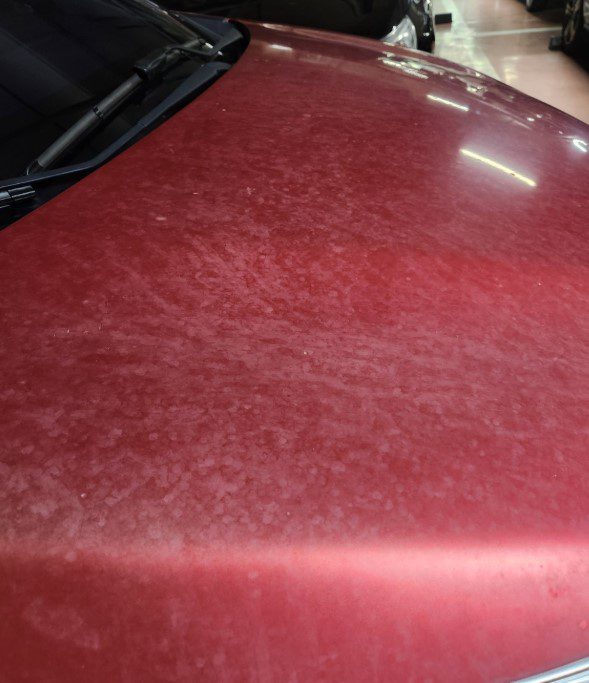
On a road-driven vehicle, soil and road particles rarely remain separate. They mix with oily road film, organic residue, dust, and other grime, forming a mixed contamination layer. When particles are embedded in this layer, the structure holding them must be weakened before they are moved mechanically.
👉 For the principle behind chemical cleaning before contact, see Why Pre-Wash Before a Contact Wash?.
Table of Contents
- Cleaning order is determined by contamination structure, not pH
- Why some particles remain after rinsing
- How alkaline pre-wash reduces mixed contamination
- Why alkaline pre-wash cannot remove everything
- Key questions and answers
- Conclusion: Weaken the layer before moving the particles
1. Cleaning Order Is Determined by Contamination Structure, Not pH
Alkaline first is not a fixed pH sequence
pH indicates whether a cleaner is acidic or alkaline, but it does not define the product’s complete cleaning performance or its ability to remove every type of contamination.
Acidic and alkaline cleaners mainly target different soils. The chemistry that should be used first can therefore change according to what remains on the vehicle.
However, most road-driven vehicles commonly develop:
- Oily road film
- Soil, dust, and fine road particles
- Organic residue such as bug remains
- Mixed contamination hardened by repeated wetting and drying
Before contact washing, the main concern is the hard particulate matter that may move between the mitt and the paint. Many particles that remain after rinsing are embedded in oily or organic contamination.
Cleaning order should therefore be based on the structure holding those particles, not on pH values alone.
Using alkaline first means selecting the chemistry that targets the contamination structure that must be reduced before contact. It does not mean following a predetermined pH sequence.
Particulate contamination is the first variable to reduce
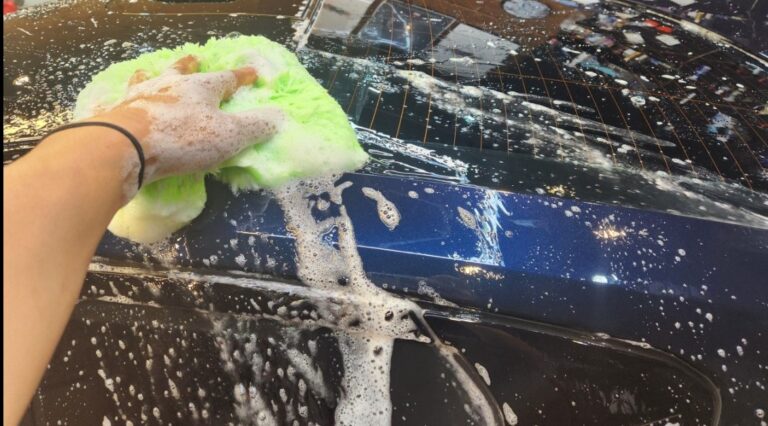
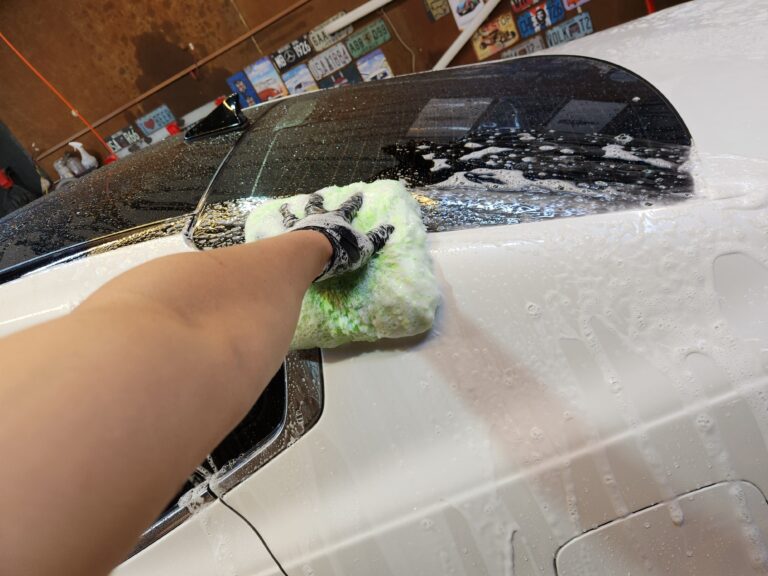
A contact wash requires the mitt to touch and move across the paint.
Pressure, friction, and movement cannot be completely eliminated. If contamination is not removed in one pass, the mitt must travel over the same area again.
The main risk comes from hard particles remaining between the mitt and the paint.
Scratch risk = Particulate contamination × Pressure × Friction × Movement
This is not a formula for calculating scratches. It is a framework for identifying the conditions that increase scratch risk during washing.
Because pressure, friction, and movement are unavoidable during contact, particulate contamination is the variable that should be reduced first.
Water alone, however, cannot move every particle in the same way. Loosely settled particles and particles embedded in a contamination film require different removal conditions.
2. Why Some Particles Remain After Rinsing
Loose particles and embedded particles exist in different states
Light dust and loosely settled particles can be moved relatively easily by the impact and flow of water.
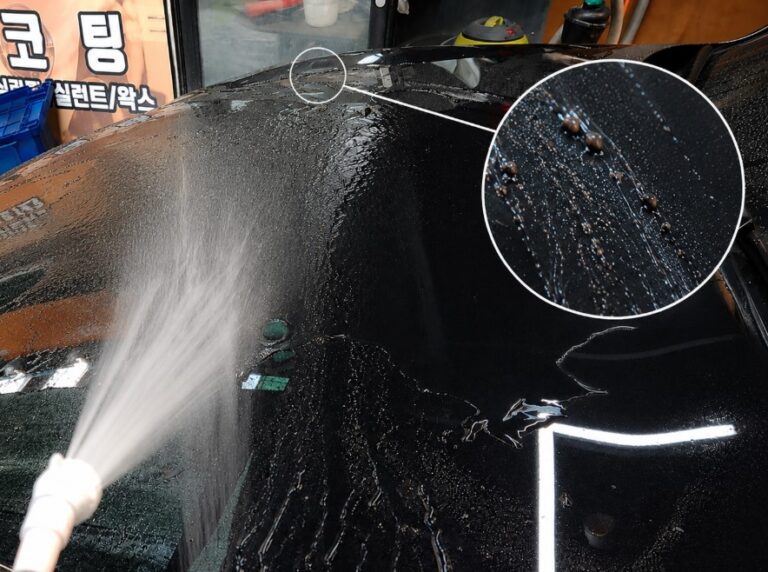
Particles mixed with oily contamination or exposed to repeated wetting and drying behave differently. They may clump together or become embedded in a film that remains attached to the paint. Rinsing can remove loose material from the surface while leaving part of this layer behind.
The particles themselves have not necessarily changed. Their state on the surface has changed.
- Loosely settled particles move easily with flowing water.
- Embedded particles are easier to remove after the surrounding film has been weakened.
- Repeatedly dried contamination may require more chemical action or physical force.
Contamination should therefore be assessed not only by quantity, but also by how it is attached and what surrounds it.
Road contamination forms a mixed layer
The contamination found on the sides and rear of a vehicle is rarely made from a single substance.
Oily road film, organic residue, dust, and fine particles mix and dry together. Repeated exposure to water, airflow, and heat gradually forms a layer in which the film and particles remain attached as one structure.
Bug residue can develop in a similar way. It may be relatively easy to remove when fresh, but after drying under sunlight and panel heat, it bonds more firmly. Dust and road particles can then accumulate over it.
Trying to remove this contamination in one contact-wash pass may require more pressure and repeated movement. Even if the goal is to reduce particles, the film holding them must first be addressed.
Stubborn contamination is a condition, not a separate substance
“Stubborn dirt” is not a single chemical substance.
It is better understood as a condition created when oils, organic matter, dust, and road particles repeatedly mix, become wet, and dry. As this continues, the contamination becomes more difficult to remove.
The same soil may respond differently when fresh and after several drying cycles. What once rinsed away easily may later require suitable chemistry or a longer wet dwell time.
Stubborn contamination describes an accumulated and dried state with greater resistance to removal, not a separate category of substance.
The particle-bearing layer must be weakened first
When particles are embedded in mixed contamination, forcing them away mechanically requires more pressure and movement.
The first step should therefore be to weaken the oily and organic material surrounding them. Once this layer loosens, rinse water can separate more of the film and carry away the particles within it.
Weaken the mixed contamination layer
→ Reduce the force holding embedded particles
→ Improve separation during rinsing
→ Leave less contamination for the contact wash
Alkaline pre-wash intervenes at this stage.
3. How Alkaline Pre-Wash Reduces Mixed Contamination
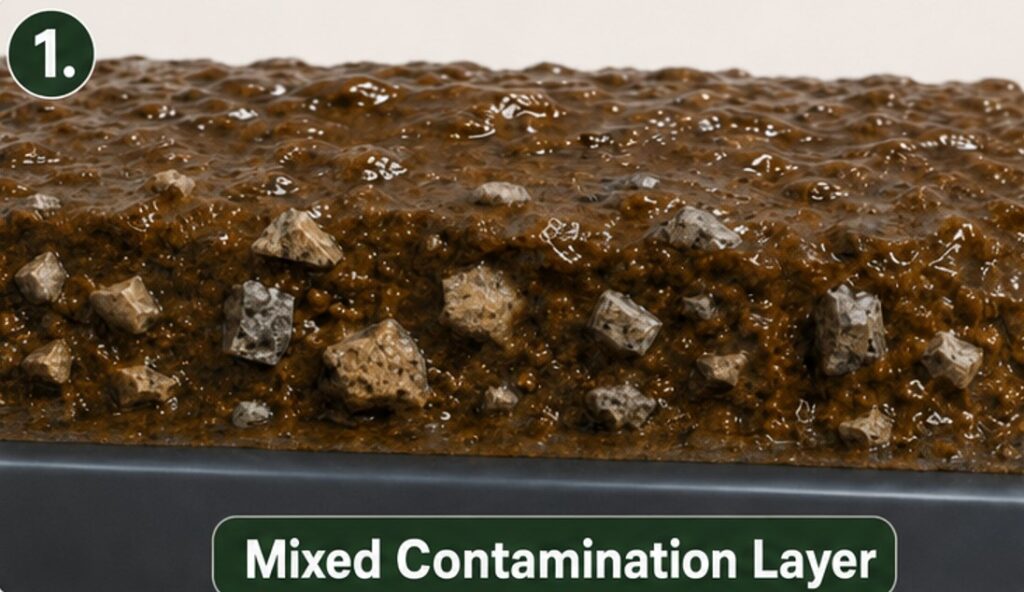
The cleaning performance of an alkaline pre-wash does not come from pH alone.
Formulations vary, but alkaline components and surfactants generally work together. Some products also contain solvents and other cleaning aids. These ingredients overlap in action as they wet, weaken, separate, and disperse the contamination.
Alkaline components weaken oily and organic contamination

Alkaline components can help break down certain fatty soils and swell some organic residues, allowing water and the cleaning solution to act more effectively.
This does not mean they directly dissolve soil or inorganic road particles.
Their main role is to loosen the oily and organic material surrounding those particles. Once the film weakens, the particles within it become easier to remove during the rinse stage.
Solvents and cleaning aids act on hardened oily soils
Depending on the formulation, solvents and other cleaning aids can help soften or dissolve oily contamination that water does not readily wet.
As hardened grime begins to loosen, other components of the cleaner can penetrate and act more effectively.
Not every alkaline pre-wash contains the same solvents or uses them in the same proportions. Actual cleaning behaviour depends on the complete formulation rather than pH alone.
Surfactants support wetting, separation, and dispersion
Surfactants help the cleaning solution spread across the paint and wet the contamination evenly.
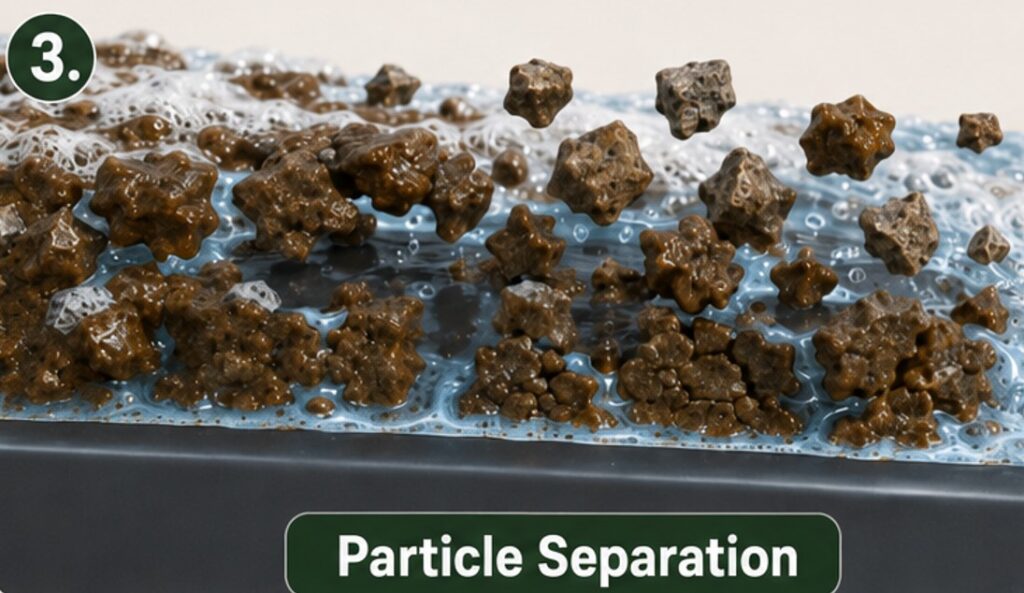
They also support the separation of weakened grime and help keep removed material dispersed in the solution. This reduces clumping and redeposition while preparing the contamination to leave the surface with the rinse water.
For explanation, these functions can be divided into separate roles. In practice, however, they overlap:
- Wetting the contamination
- Weakening oily and organic material
- Loosening the connection between the film and embedded particles
- Separating and dispersing the released contamination
👉 For a detailed explanation of cleaner ingredients, see What Creates the Cleaning Power of an Automotive Cleaner?.
The same product must be operated differently for different conditions
Product formulation alone does not determine the result achieved on the vehicle.
Real-world cleaning performance = Product design × Process execution
A thin layer of everyday road film and a thick layer hardened through repeated drying may not respond equally to the same concentration and dwell time.
Concentration supplies the active ingredients needed to affect the target contamination. It is not simply a control for making the cleaner “stronger.”
Dwell time is not just the number of minutes after application. It is the period during which the solution remains wet and able to interact with the contamination.
Application method also changes these conditions:
- A liquid spray can wet hardened contamination quickly and thoroughly.
- Foam slows runoff and drying, helping maintain wet dwell time.
Neither method is universally better. The appropriate choice depends on contamination thickness, surface temperature, drying conditions, and product characteristics.
Increasing concentration or dwell time without limit is not the answer. The cleaner should be used within its recommended range and must not be allowed to dry on the surface.
Rinsing separates and removes the weakened contamination
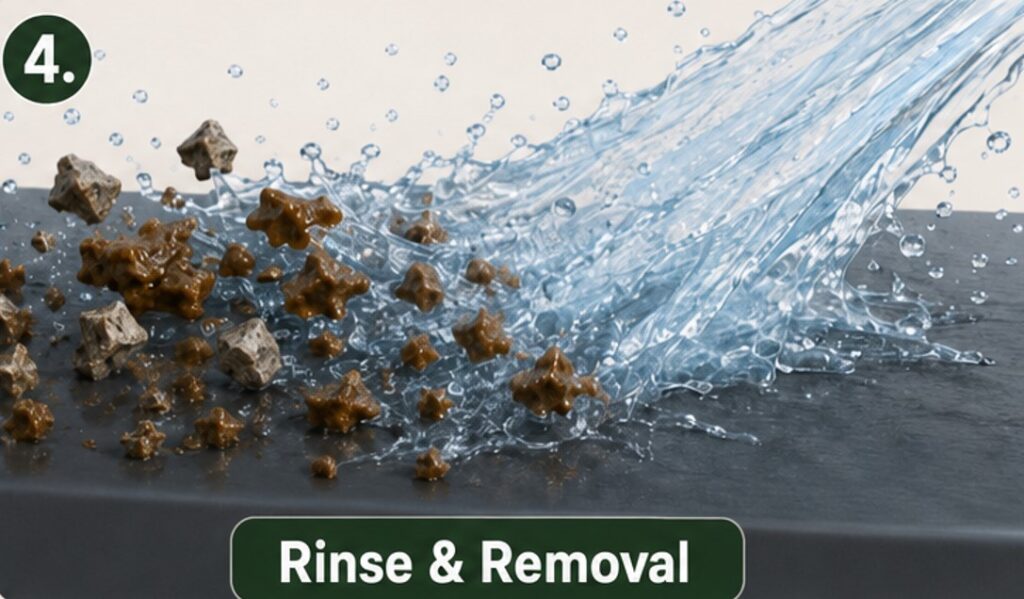
Chemical weakening alone does not remove contamination from the vehicle.
The cleaner lowers the force holding the film in place. The impact and flow of rinse water then separate the loosened material and carry it away.
Alkaline pre-wash
→ Chemical weakening of the mixed layer
→ Physical separation during rinsing
→ Removal of the film and embedded particles
→ Contact washing with less contamination and less required force
Thorough rinsing is essential. If the vehicle is not rinsed properly, weakened dirt and cleaner residue may remain on the paint or inside crevices.
Alkaline pre-wash becomes a complete process only when application and wet dwell time are followed by sufficient rinsing.
The result is not necessarily a perfectly clean surface. It is a surface on which the mitt encounters fewer particles and the remaining contamination requires less pressure and fewer repeated passes.
4. Why Alkaline Pre-Wash Cannot Remove Everything
Different contamination requires different chemistry
The primary purpose of alkaline pre-wash is to weaken common oily and organic road contamination and reduce the particles embedded within it.
Not everything left on a vehicle has the same properties.
- Tar may require a stronger solvent-based approach than ordinary road film.
- Ferrous contamination may require a dedicated iron remover.
- Mineral deposits may require chemistry different from alkaline cleaning.
- Aged tree sap and bird droppings may require separate spot treatment.
An alkaline pre-wash should not be judged by whether it removes every type of contamination in one application.
Its first job is to reduce widespread mixed contamination before contact and create safer conditions for the wash stage.
Accumulated bonded contamination requires separate assessment
Ferrous and mineral contamination may remain even after the surrounding road film has been removed.
These deposits can be difficult to see while thin. Repeated accumulation and drying can make them more firmly bonded and harder to remove with ordinary pre-wash chemistry.
The answer is not simply to keep increasing alkaline concentration or dwell time. The remaining contamination must be identified and treated according to its own properties and attachment state.
This raises a new question:
Is it most efficient to remove all accumulated, firmly bonded contamination through chemical cleaning alone during the pre-wash stage?
The next article examines where chemical weakening and physical separation should be combined.
Key Questions and Answers
Why use alkaline pre-wash before other chemical cleaning?
Because road-driven vehicles commonly carry particles embedded in oily and organic grime. Alkaline pre-wash weakens this layer so more of it can be removed before contact.
Must alkaline → neutral → acidic always be followed in that order?
No. Cleaning order depends on the contamination present, not on a fixed pH sequence.
Does alkaline cleaner dissolve soil and road particles?
Not primarily. It weakens the oily and organic material surrounding the particles, helping the rinse stage remove them more effectively.
Can rinsing alone remove particulate contamination?
It can remove loose particles. Particles embedded in a dried contamination film may remain until that film is weakened.
Is stubborn contamination a different substance?
No. It describes contamination that has become harder to remove through repeated mixing, wetting, drying, and accumulation.
Is a higher concentration always better?
No. The goal is to provide an effective concentration and enough wet dwell time without allowing the cleaner to dry or placing unnecessary stress on exterior materials.
Which is more effective, liquid spray or foam?
Liquid spray wets hardened dirt quickly. Foam slows runoff and drying. The appropriate method depends on the contamination and working conditions.
Should alkaline pre-wash remove every type of contamination?
No. Its priority is widespread mixed road contamination. Tar, ferrous deposits, minerals, and other bonded soils may require separate treatment.
Conclusion: Weaken the Layer Before Moving the Particles
Particulate contamination is the first risk to reduce before contact.
Many particles that remain after rinsing are not resting freely on the paint. They are embedded in oily and organic contamination or in a layer hardened by repeated wetting and drying.
Moving them directly with a mitt may require greater pressure and repeated passes. Weakening the surrounding layer first allows rinsing to remove more of the contamination before contact begins.
Alkaline pre-wash performs this role through the combined action of alkaline components, surfactants, and—depending on the product—solvents and other cleaning aids.
Alkaline pre-wash comes first not because alkaline chemistry is always the strongest, but because it targets the mixed contamination layer that commonly holds road particles on the surface.
After that general layer has been reduced, tar, ferrous deposits, minerals, and other bonded contamination may still require separate assessment.
Should all of these remaining deposits also be removed chemically during the pre-wash stage?
👉 In the next article, we will examine Why Chemical Weakening and Physical Separation Should Be Combined for Accumulated, Bonded Contamination.