3PH car wash cleaning power does not come from pH or any single ingredient alone. Even when the same cleaner is used, the result can change depending on concentration, dwell time, mechanical contact, and rinsing.
In Part 1: What Determines 3PH Car Wash Cleaning Power?, we looked at how cleaning power is built into a product.
pH changes the chemical condition of contamination. Solvents penetrate oily contamination and reduce its viscosity and cohesion. Surfactants help separate weakened contamination and keep it dispersed in water.
However, choosing the right cleaner does not guarantee the same result every time. Actual performance depends on how much cleaning chemistry reaches the surface, how long it remains active, and how the weakened contamination is separated and removed.
Cleaning power = product design × technique
Product design determines the range of cleaning performance a product can deliver. Technique determines how much of that performance is actually achieved.
This second part explains how concentration and dwell time control chemical cleaning, how mechanical cleaning separates weakened contamination, and how rinsing completes the process.
Contents
- 3PH Car Wash Cleaning Power: Supply, Action, Separation, and Recovery
- Chemical Cleaning Power: Concentration and Dwell Time
- Mechanical Cleaning Separates Chemically Weakened Contamination
- Rinsing Recovers Separated Contamination
- 3PH Car Wash Cleaning Power FAQ
- Conclusion: Cleaning Power Comes From Connecting All Four Stages
3PH Car Wash Cleaning Power: Supply, Action, Separation, and Recovery
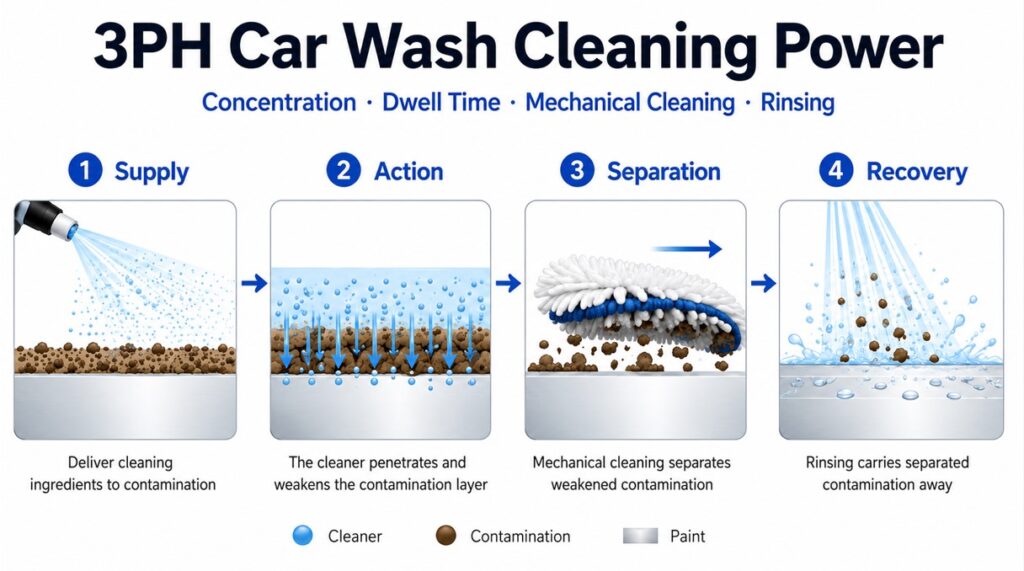
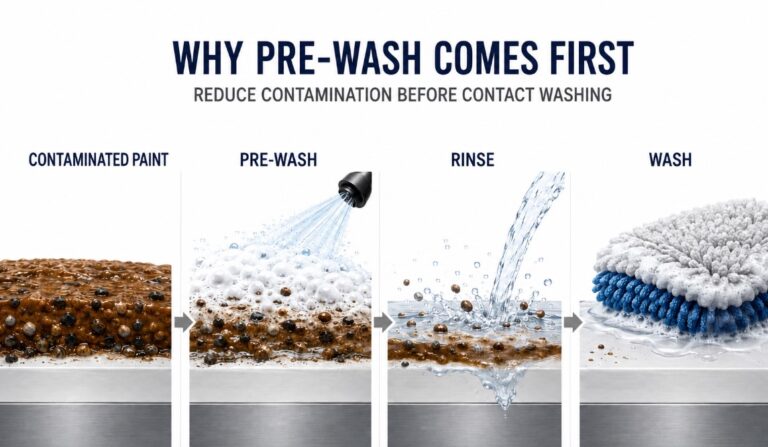
The cleaning process can be simplified into four stages.
Supply → Action → Separation → Recovery
Concentration controls how much active cleaning material reaches the contamination. Dwell time gives those ingredients enough time to work.
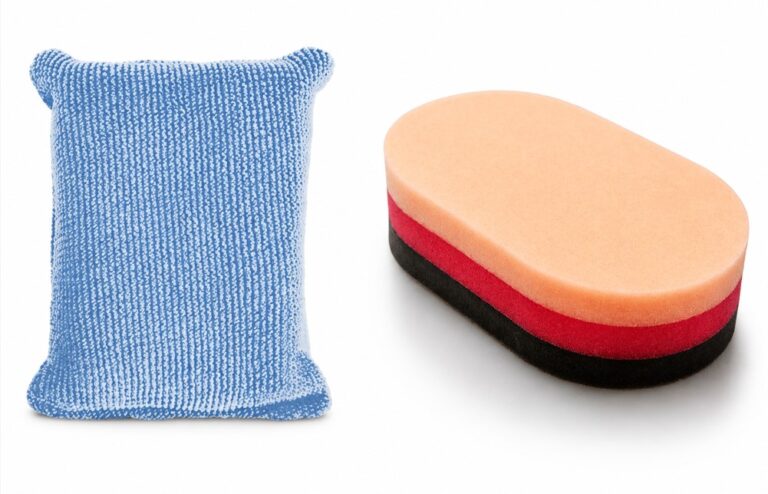
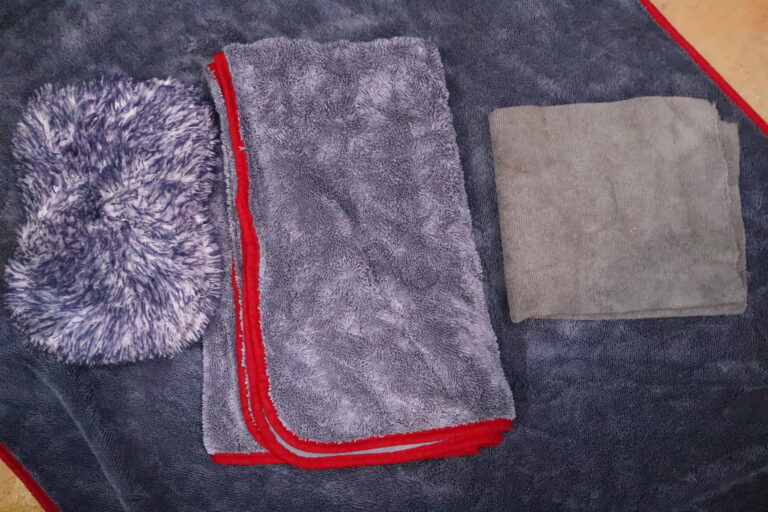
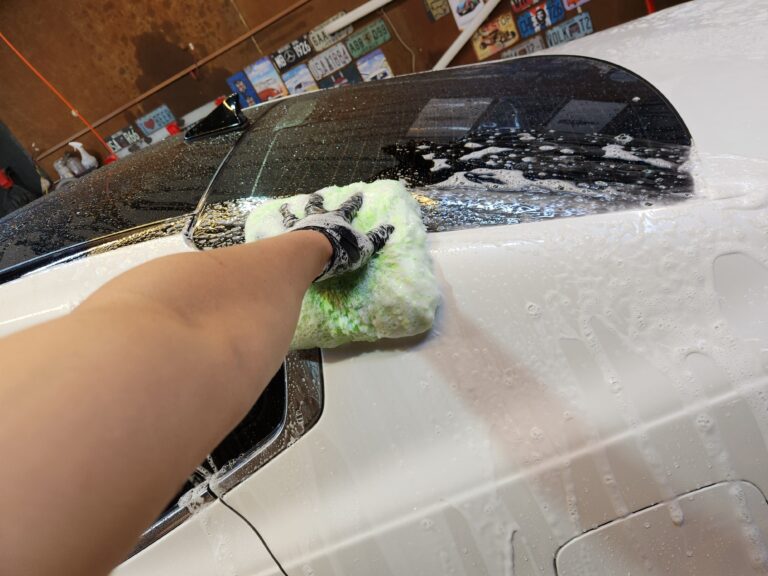
Once chemical action has weakened the contamination, a wash mitt, towel, applicator pad, or brush separates it from the surface. Rinsing or wiping then carries the separated contamination and remaining cleaner away.
In this framework, Recovery means carrying separated contamination and residual cleaner away from the surface through rinsing or wiping.
These four stages do not work independently.
If too little cleaning material reaches the surface, the contamination may not weaken enough. If the active time is too short, the cleaner may be rinsed away before it has had enough time to work.
Contamination can also remain on the surface even after it has weakened if no mechanical separation takes place. If the separated material is not properly recovered, it can remain behind or settle back onto the surface.
Cleaning power therefore does not come from maximizing one stage. It comes from keeping the entire process connected from supply to recovery.
Chemical Cleaning Power: Concentration and Dwell Time
The pH, solvents, surfactants, and supporting ingredients inside a product cannot be changed during use.
What can be adjusted is how much of that chemistry reaches the contamination and how long it remains active.
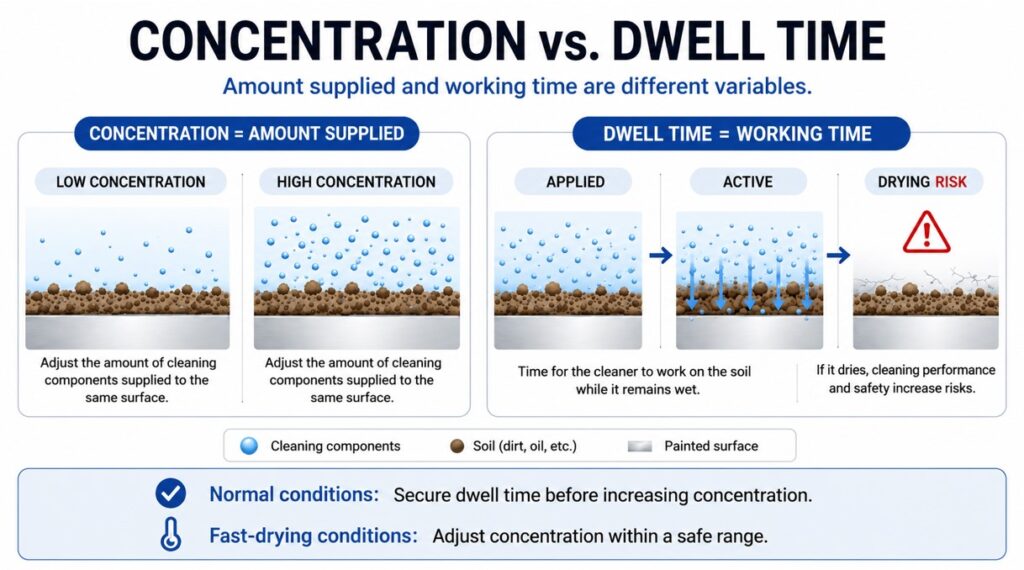
For practical chemical cleaning, the two main variables are concentration and dwell time.
Concentration Controls the Supply of Cleaning Ingredients
Increasing concentration delivers more active cleaning material to the same surface area.
More acidic or alkaline ingredients, solvents, and surfactants can contact the contamination, making it easier to establish the chemical action required for removal.
A standard dilution may not supply enough active material when contamination is unusually heavy or has built up into a thick layer.
However, cleaning performance does not continue increasing at the same rate as concentration.
Beyond a certain point, the additional cleaning benefit may become smaller while stress on materials and protection layers increases. More product also means more residue must be rinsed away.
Higher concentration = potential increase in cleaning power + greater material stress + greater rinsing demand
A stronger concentration should therefore be treated as a tool for heavily contaminated areas, not as the default setting for the entire vehicle.
Contamination is rarely distributed evenly.
Lower panels and wheel areas often collect heavier road grime and oily contamination, while upper panels may remain relatively clean. Bug residue concentrates on bumpers and mirrors, while bird droppings or isolated bonded contamination may affect only one panel.
Raising the concentration across the entire vehicle because one area is heavily contaminated exposes cleaner sections to unnecessarily strong chemical action. It also increases product use and rinsing demand.
A more efficient approach is to use a normal concentration across the vehicle and apply a stronger mixture only where contamination is concentrated.
The correct concentration is not one fixed dilution ratio. It is a concentration distributed according to contamination level and location.
Manufacturer dilution guidance remains the correct starting point. However, the same product and dilution may behave differently depending on temperature, season, and region.
In colder conditions, concentration may be adjusted slightly within the manufacturer’s permitted range. In hotter conditions, lowering concentration and reducing the working area can help control drying and material stress.
The goal is not to change ratios mechanically according to temperature. Start from the recommended dilution, then adjust according to contamination, working conditions, and actual results.
Dwell Time Secures the Active Working Time
A cleaner begins working as soon as it reaches the surface, but not all contamination weakens immediately.
Thick, dry, and hardened contamination needs time to become wet again, soften, and allow the cleaner to reach deeper layers. Bonded mineral contamination also requires sufficient contact time for the cleaner to react and weaken its attachment to the surface.
Dwell time is not simply waiting. It is the active period needed to wet, penetrate, soften, and react with contamination.
When contamination remains after cleaning, the cause is not always insufficient concentration. The product may have been suitable, but it may have been rinsed before it had enough time to act.
That does not mean longer dwell time is always better.
Effective dwell time lasts only while the cleaner remains wet. Once drying begins, water evaporates while cleaning ingredients and loosened contamination remain on the surface.
This can cause the remaining material to concentrate, leave residue, or allow partially separated contamination to settle back onto the surface.
Effective dwell time = wetting, penetration, softening, and reaction
Drying stage = concentration, residue, and redeposition risk
For this reason, suitable dwell time cannot always be reduced to a fixed number of minutes.
The correct dwell time is the period in which the cleaner remains wet and has enough time to act on the contamination.
Application method also affects active time.
Under the same product and working conditions, a liquid spray can directly wet hardened contamination and penetrate it efficiently. However, it may run off quickly or dry faster in heat or wind.
Foam usually remains on the surface longer, slows evaporation, and helps preserve reaction time. A very thick foam layer, however, may remain on the surface without wetting deep contamination as quickly as a liquid application.
Liquid application supports wetting and penetration. Foam supports moisture retention and reaction time.
For thick, hardened contamination, a liquid application can be used first to wet the surface, followed by foam to keep it wet.
Concentration and Dwell Time Support Each Other
When contamination is severe, the first response is often to increase concentration.
In normal washing conditions, however, it is usually more efficient to secure enough dwell time before immediately making the mixture stronger.
Even at the same dilution, proper wetting and sufficient reaction time can allow the product chemistry to work more effectively. This also avoids unnecessary material stress and rinsing demand.
Under normal conditions, secure dwell time before increasing concentration.
Hot surfaces, strong wind, and dry conditions make it difficult to maintain active dwell time. Waiting longer under these conditions may increase drying and residue risk rather than weaken more contamination.
The first response should be to work in shade, reduce panel temperature, and divide the vehicle into smaller sections.
When short active time still limits performance, concentration may be adjusted within the product’s safe range on small areas that can be rinsed immediately.
The goal is not to maximize either concentration or dwell time.
Adjust the supply of cleaning ingredients and their active time so that both variables support each other.
Mechanical Cleaning Separates Chemically Weakened Contamination
With suitable concentration and dwell time, hardened contamination becomes softer and its attachment to the surface weakens.
However, chemical action does not always cause all contamination to detach by itself.
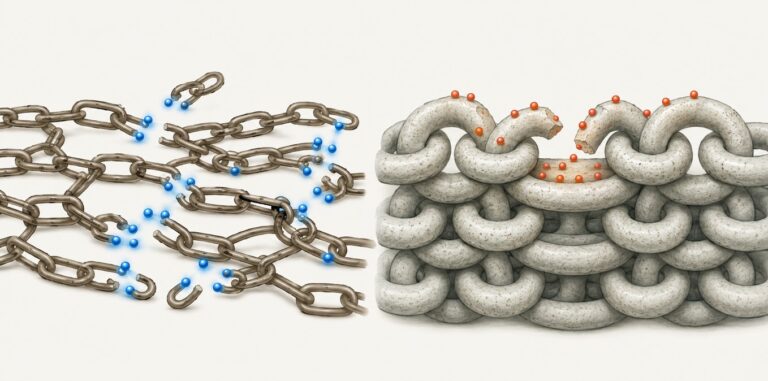
Chemical cleaning creates a condition in which contamination is easier to remove. Mechanical cleaning performs the actual separation from the surface.
Mechanical Cleaning Separates Weakened Contamination
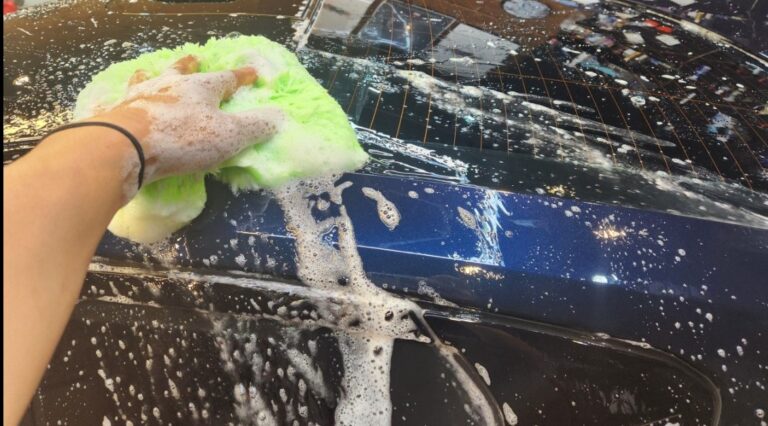
Contact from a wash mitt, towel, applicator pad, or brush separates contamination that has already been loosened.
The tool is not simply scraping dirt away by force. It removes the chemically weakened outer layer, moves it into the cleaning solution, and exposes a fresh contamination surface to the cleaner.
Mechanical cleaning separates and moves contamination that has already been weakened chemically.
The most important factor is not how much force is applied, but the condition of the contamination when contact begins.
When contamination has weakened sufficiently, it can be separated with lower pressure and fewer movements.
When hardened contamination is attacked mechanically before chemical weakening, more pressure, friction, and repeated movement are required.
The relationship between contamination, contact force, pressure, friction, and scratch risk is explained further in Car Detailing Physics: How F=ma Helps Reduce Swirl Marks.
A more practical explanation of how scratch risk changes throughout washing, drying, and buffing is available in How to Prevent Car Scratches: The Ultimate Detailing Guide.
Chemical and Mechanical Cleaning Repeat in Layers
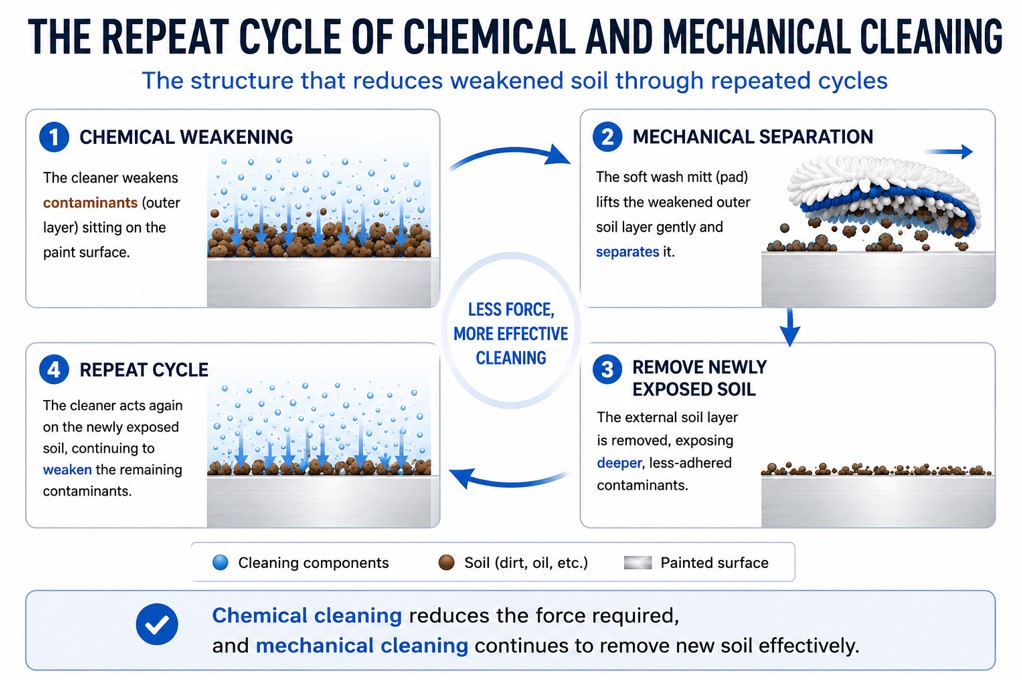
Chemical cleaning and mechanical cleaning may appear to be separate steps, but during contact cleaning they continue to interact.
This becomes especially clear when removing thick or hardened contamination that cannot be removed in one pass.
- The cleaner weakens the outer layer of contamination.
- A mitt or applicator separates part of the weakened layer.
- Removing the outer layer exposes a fresh contamination surface.
- The cleaner reaches and acts on the newly exposed surface.
- The next movement separates another weakened layer.
The two methods do more than add their individual strength together. Each action creates better conditions for the other.
Chemical cleaning reduces the force required for contact, while mechanical cleaning exposes new contamination surfaces to continued chemical action.
Trying to remove hardened contamination mechanically before it has weakened increases pressure, friction, and repeated movement.
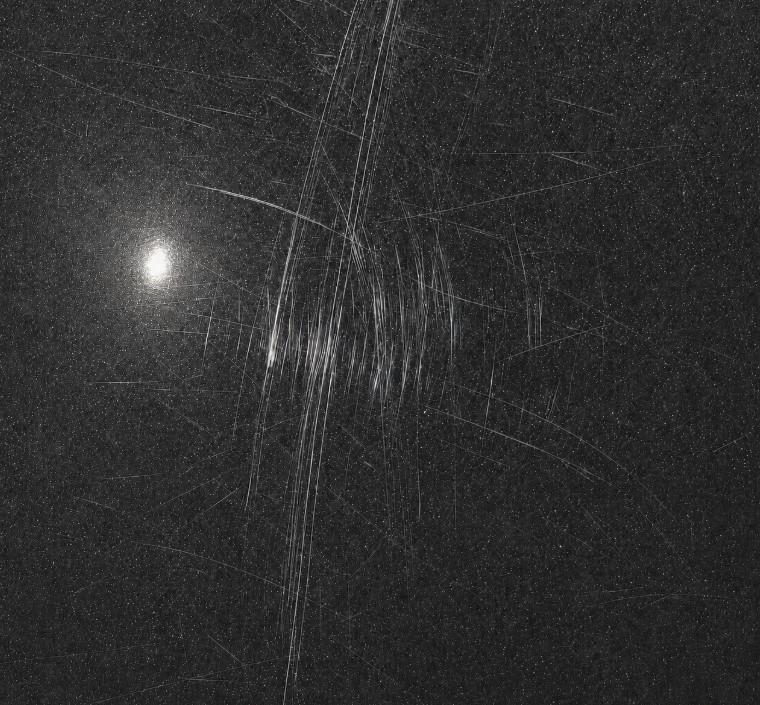
If hard particles remain on the paint, this can also increase the risk of scratching and marring.
When chemical weakening comes first, the same contamination can be separated with less force.
Paint Cleaners Show How Chemical and Mechanical Cleaning Work Together
Paint cleaners may contain solvents, surfactants, and other cleaning ingredients. Some products also contain fine abrasives.
They are rarely applied and simply left on the paint.
As a foam or microfiber applicator pad moves across the surface, the chemical ingredients soften oily residue and hardened film while the pad separates the weakened upper layer.
Once part of the contamination has been removed, a thinner layer remains underneath. The cleaner then acts on this newly exposed surface, and the process repeats.
This is why thick or hardened contamination may not disappear in a single pass.
Chemical weakening and mechanical separation repeat until the contamination layer becomes progressively thinner.
The same principle applies when using a concentrated contamination remover with a brush, towel, or applicator pad.
A stronger product alone does not complete the process. Reaction time and controlled mechanical contact allow the contamination to be separated with less force.
Rinsing Recovers Separated Contamination
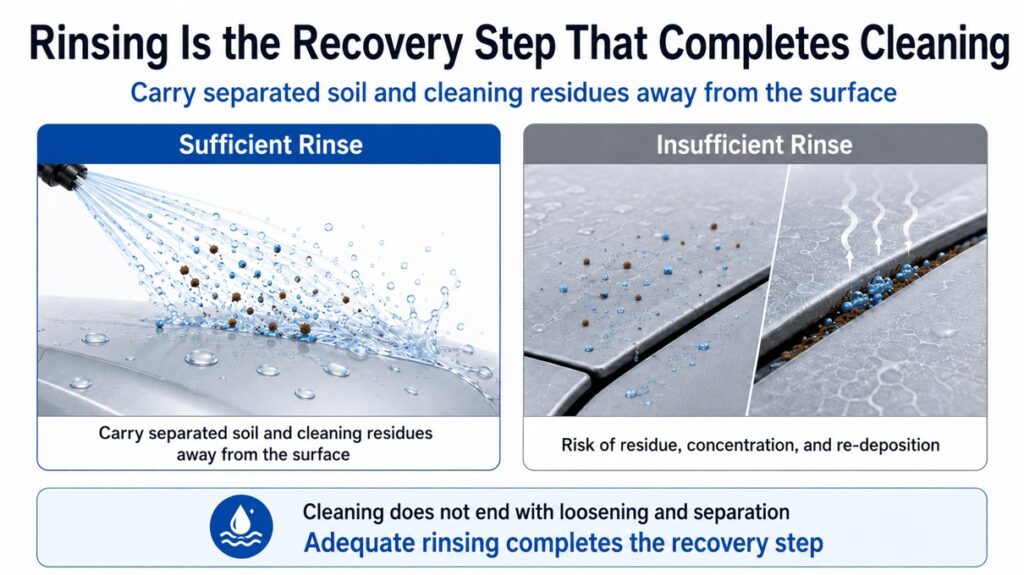
Weakening and separating contamination does not complete the cleaning process.
The separated contamination and remaining cleaner must be removed from the surface.
In a water-based wash, rinsing performs this recovery. With wipe-off products such as paint cleaners, a clean towel removes both the remaining product and the separated contamination.
Insufficient rinsing can leave cleaning ingredients and loosened contamination on the surface or inside panel gaps.
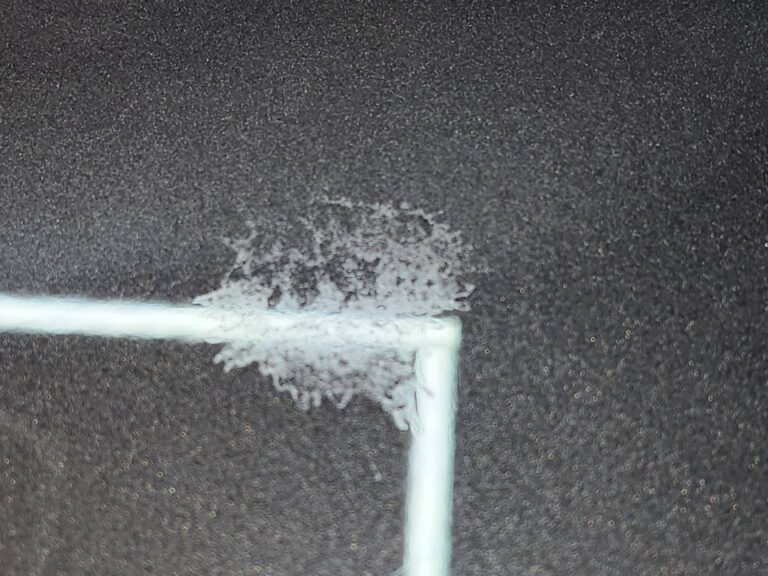
As water evaporates, the remaining material can become concentrated and lead to residue, staining, or redeposition.
Cleaning is complete only when weakened and separated contamination is fully recovered from the surface.
Rinsing is therefore not merely the step that removes visible foam.
It is the final cleaning process that carries away contamination weakened by chemistry and separated through contact.
The process by which alkaline cleaner residue and loosened contamination can dry and settle back onto paint is explained in Alkaline Pre-Wash Risks: Re-Deposition and Paint Clarity Loss.
For acidic cleaners, trapped solution inside trim, emblems, mirrors, and panel gaps can create a different risk. See Acidic Pre-Wash Risks: Rinsing, Trapped Residue, and Corrosion.
3PH Car Wash Cleaning Power FAQ
Should I Increase Concentration First When Contamination Is Severe?
Under normal conditions, first secure enough dwell time while keeping the cleaner wet.
When contamination still remains, adjust concentration within the safe range specified for the product. Applying a stronger mixture only to heavily contaminated areas is usually more efficient than increasing concentration across the entire vehicle.
How Long Should Dwell Time Be?
There is no single fixed time.
The correct duration depends on the product, contamination level, surface temperature, wind, and humidity.
The important point is not reaching a set number of minutes. It is keeping the cleaner wet long enough to act without allowing it to dry.
Does Thicker Foam Always Increase Cleaning Power?
Thick foam can improve surface retention and delay drying, but foam thickness alone does not determine penetration or cleaning power.
For thick and hardened contamination, a liquid application may wet the contamination first, while foam can then help maintain moisture.
Is Contact Cleaning Unnecessary When Chemical Cleaning Is Strong Enough?
Light contamination may be removed substantially through chemical cleaning and rinsing alone.
However, contamination that remains attached to the surface may still require mechanical contact. The goal is not to scrub harder, but to weaken the contamination first so that less pressure and fewer repeated movements are needed.
Why Can a Paint Cleaner Produce Strong Cleaning Results?
Its chemical ingredients weaken oily films and residue while movement from the applicator pad separates the softened contamination.
Some products may also include fine abrasive action, so their individual formulation and instructions should always be checked.
Conclusion: 3PH Car Wash Cleaning Power Comes From Connecting All Four Stages
When cleaning performance feels insufficient, it is easy to increase concentration, wait longer, or scrub harder.
But 3PH car wash cleaning power does not come from one variable.
The correct amount of cleaning chemistry must reach the contamination and remain active without drying. Chemically weakened contamination must then be separated through controlled mechanical contact and recovered through rinsing or wiping.
Supply → Action → Separation → Recovery
Each stage creates the conditions required for the next, and cleaning is completed only when the process reaches final recovery.
The core of 3PH washing is not simply using acidic, neutral, and alkaline products in sequence. It is selecting the chemical action that matches the contamination and operating it so that its full cleaning potential can be used.
Cleaning power is not created by pushing one variable to an extreme. It is created by keeping supply, action, separation, and recovery connected.