Pre-wash and car shampoo are often compared by pH. Alkaline products are described as strong, while neutral products are treated as mild or weak.
However, pH alone does not determine the cleaning power of a car wash chemical.
Chemical cleaning power is created by the combined reactivity of pH adjusters, solvents, surfactants, chelating agents, and other supporting ingredients. As chemical reactivity increases, the ability to weaken, loosen, and dissolve contamination also increases.
At the same time, stronger chemical reactions can have a greater effect on paint, plastic, metal, trim, and protective coatings. This places a practical limit on how far chemical cleaning power can be increased.
This article, Part 1 of the series, explains what creates the cleaning power of pre-wash and car shampoo, why bonded contamination requires greater chemical reactivity, and why chemical cleaning eventually reaches a limit.
For the complete operating mechanism of cleaning power, read 3PH Car Wash Cleaning Power: Concentration, Dwell Time, and Mechanical Cleaning.
Contents
- Chemical Reactivity Creates Cleaning Power
- Bonded Contamination Requires Greater Reactivity
- Chemical Cleaning Power Has a Limit
- Frequently Asked Questions
- Part 1 Conclusion
1. Chemical Reactivity Creates Cleaning Power
What Is Chemical Cleaning?
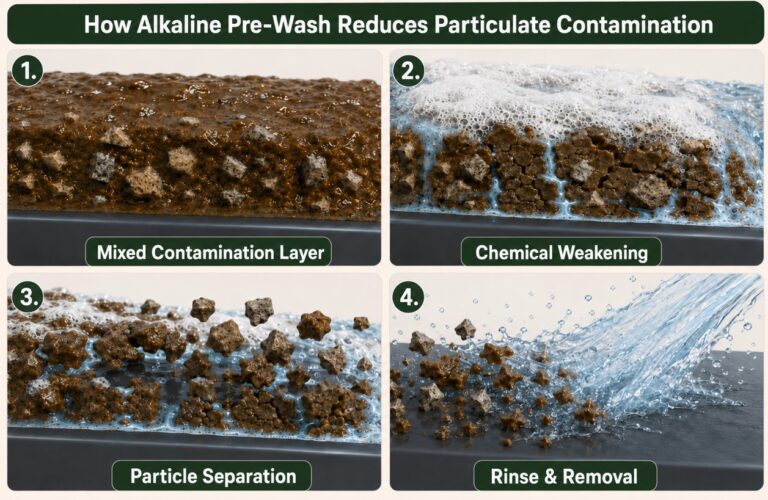
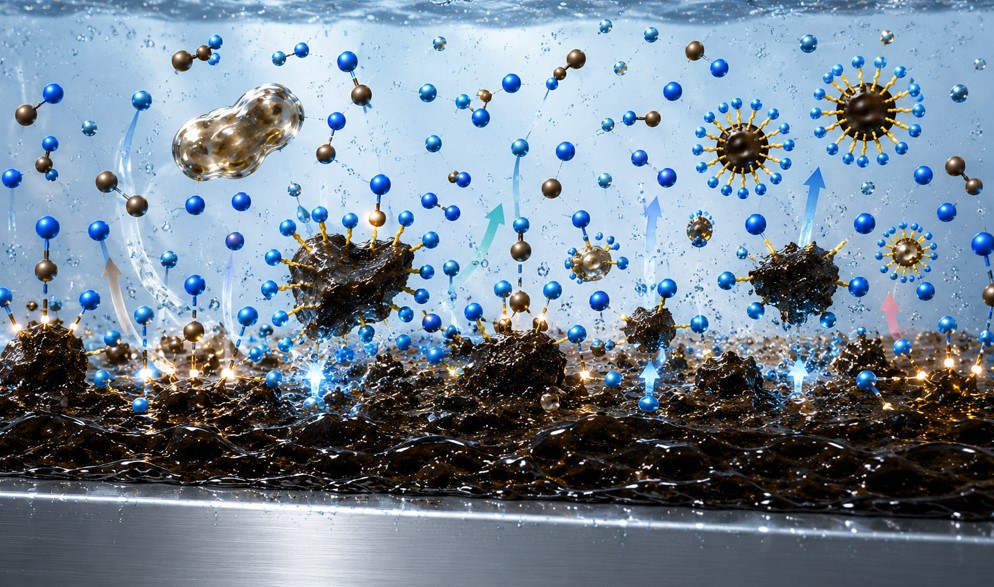
Chemical cleaning changes the condition of contamination through a chemical reaction.
Depending on the product and the type of contamination, this reaction may:
- Wet the contamination
- Penetrate the contamination layer
- Weaken its internal cohesion
- Reduce its adhesion to the surface
- Emulsify or disperse oily residues
- Dissolve or loosen mineral deposits
In other words, chemical cleaning makes contamination easier to remove by weakening, loosening, or dissolving it.
The stronger this reaction becomes, the greater the chemical cleaning power becomes.
Greater chemical reactivity creates greater chemical cleaning power.
This is the basic relationship behind the cleaning performance of pre-wash chemicals, car shampoos, mineral removers, iron removers, and other detailing chemicals.
pH Is Only One Part of Chemical Reactivity
pH indicates whether a product is acidic, neutral, or alkaline. It also helps determine which types of contamination the product can react with effectively.
Alkaline cleaners are generally suited to oily road film, grease, organic contamination, and some protein-based residues. Acidic cleaners are used mainly for mineral contamination, alkaline deposits, and certain metal oxides.
However, pH does not explain the entire cleaning system.
A neutral product can still produce significant cleaning action through surfactants, solvents, and chelating agents. An alkaline product used at a very low working concentration may produce less actual cleaning action than its label suggests.
This is why two products with a similar pH can produce different results.
The complete formulation—and how it is used—determines the actual chemical reaction.
The roles of pH, solvents, surfactants, chelating agents, and functional additives are explained in What Determines 3PH Car Wash Cleaning Power?.
What Else Creates Chemical Reactivity?
Several chemical systems work together inside a cleaner.
Surfactants help water spread across the surface, penetrate contamination, and separate oily residues from water-resistant dirt. They also help keep loosened contamination dispersed in the wash solution.
Solvents soften or dissolve oily contamination that water alone cannot remove effectively. Their performance depends on the type of solvent, its concentration, and the contamination it is designed to target.
Chelating agents bind to metal ions such as calcium, magnesium, and iron. They help control mineral residues and reduce the chance of dissolved minerals attaching to the surface again.
Supporting ingredients control wetting, foam, dwell time, viscosity, stability, and rinsing behavior. These properties influence how efficiently the active chemistry reaches and reacts with contamination.
The cleaning power of a product is therefore not created by one ingredient.
It is the result of the entire formulation working as a system.
Product Design and Use Conditions Work Together
The same product can produce different cleaning results depending on how it is used.
Actual chemical reactivity is affected by:
- Working concentration
- Amount of solution supplied
- Dwell time
- Surface temperature
- Contamination type
- Contamination thickness
- Whether the product dries
- How thoroughly the surface is rinsed
A well-formulated product cannot deliver its intended cleaning power if too little solution is applied or if it is rinsed away before sufficient reaction time has been achieved.
The opposite is also true. Increasing concentration or dwell time can strengthen the reaction, but only within a safe operating range.
Chemical cleaning power is therefore created by two factors:
Chemical cleaning power = product design × operating conditions
The label tells us how the product was designed. The way it is diluted, applied, allowed to dwell, and rinsed determines how much of that design is actually used on the vehicle.
2. Bonded Contamination Requires Greater Reactivity
Not All Contamination Is Attached in the Same Way
Fresh dust and loose particles require relatively little chemical action. Water flow or a mild neutral cleaner may be enough to move them.
Road film, oily residues, insect remains, old traffic film, and mineral contamination behave differently. They may form mixed layers, dry repeatedly, oxidize, or become firmly bonded to the surface.
As contamination becomes thicker, harder, or more strongly bonded, it becomes more difficult for the cleaning solution to penetrate and weaken the entire layer.
This creates a simple relationship:
The more firmly contamination is bonded, the greater the chemical reactivity required to weaken it.
Light contamination may respond to a mild neutral cleaner. Oily road film may require stronger alkaline or solvent action. Mineral contamination may require acidic or chelating chemistry.
The required chemical reaction changes because the contamination itself has changed.
Why Pre-Wash and Car Shampoo Have Different Priorities
Pre-wash and car shampoo are both cleaning chemicals, but they are not designed around exactly the same task.
A pre-wash is used before direct contact with the paint. Its main role is to weaken contamination and reduce the amount of dirt that remains for the contact wash.
For this reason, pre-wash products usually place greater emphasis on chemical cleaning action, penetration, wetting, and dwell time.
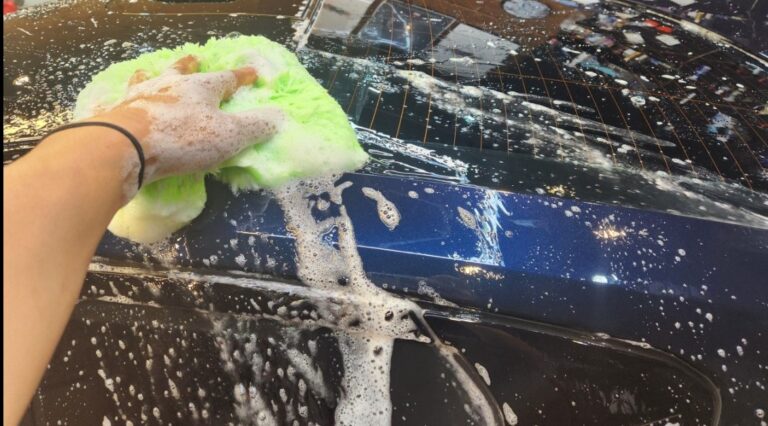
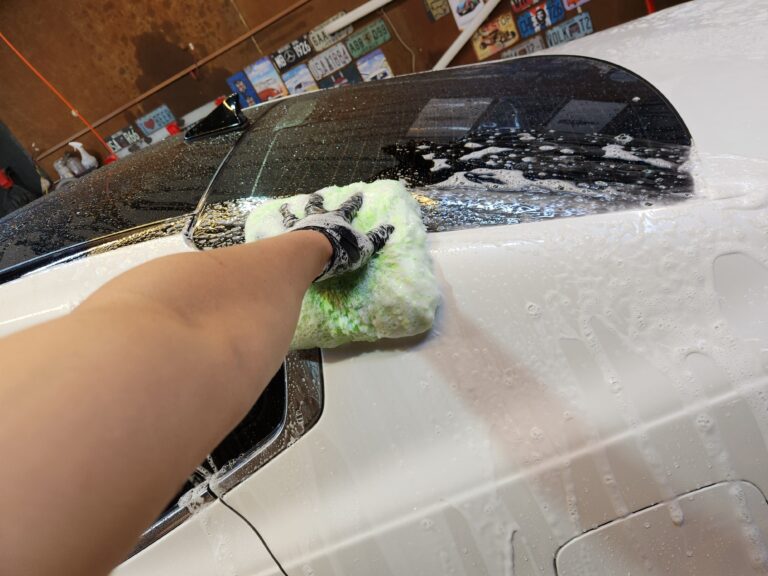
Car shampoo is used while a wash mitt moves across the paint. It must clean, but it must also provide enough water retention and lubrication to control friction and help carry loosened contamination away from the contact area.
Its formulation therefore has to balance cleaning power with lubrication, glide, rinsing, and contamination suspension.
A car shampoo is not simply a weaker version of a pre-wash. The two products distribute their performance differently because they are used at different stages.
These differences are examined further in Snow Foam vs Car Shampoo: Differences, Uses, and How to Choose.
Higher Reactivity Can Remove More Contamination
When chemical reactivity increases, more contamination can be weakened, loosened, or dissolved.
This can be achieved by changing the chemical system, increasing the working concentration, extending the effective dwell time, or using a product designed for the specific contamination.
However, “longer dwell time” does not mean allowing the cleaner to dry.
Effective dwell time is the period during which the cleaning solution remains wet and continues reacting with the contamination. Once it dries, the remaining chemicals become more concentrated and may leave residue or affect the surface.
Increasing chemical reactivity can improve cleaning power, but it also increases the need for careful control.
That is where the limit of chemical cleaning begins.
3. Chemical Cleaning Power Has a Limit
The Cleaner Reacts With More Than Contamination
A cleaner is applied not only to contamination but also to the material underneath it.
A vehicle contains many different surfaces:
- Clear coat and painted panels
- Unpainted plastic
- Rubber seals
- Chrome and plated trim
- Glass
- Bare or coated metal
- Wheels and brake components
- Wax, sealant, and ceramic coatings
A stronger chemical reaction may remove more contamination, but it can also have a greater effect on these materials and protective layers.
The same principle applies to concentration and dwell time. Increasing either one can improve the reaction with contamination, but it can also increase staining, drying, residue, corrosion, discoloration, or coating degradation.
Chemical cleaning power cannot be increased without limit because the vehicle surface must remain stable.
Material Safety Sets the Practical Range
Automotive cleaners are not designed to deliver the strongest chemical reaction theoretically possible.
They are designed to provide useful cleaning power within a range that can be used safely on automotive materials.
This means a product may not completely dissolve thick or heavily bonded contamination in one application. That does not necessarily mean the product has failed.
Its reaction may have reached the limit permitted by the material underneath the contamination.
When cleaning power is insufficient, repeatedly increasing concentration or dwell time is not always the correct answer. At some point, the removal method must change.
Residual Contamination Does Not Always Require Stronger Chemistry
If contamination remains after chemical cleaning, there are two possibilities.
The chemical reaction may not yet have been used effectively. The concentration, dwell time, supply, temperature, or choice of chemistry may need to be corrected.
Or the contamination may already have been weakened as far as the material-safe chemical range allows.
In the second case, trying to dissolve everything chemically can increase surface risk without producing a proportional improvement in cleaning.
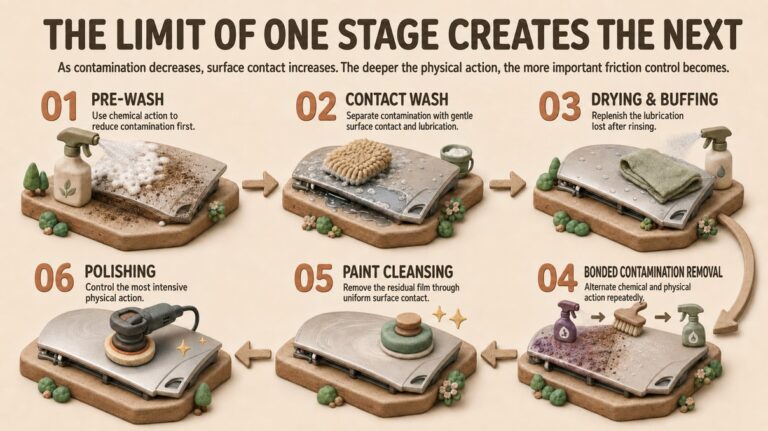
The remaining contamination must then be separated through controlled mechanical cleaning.
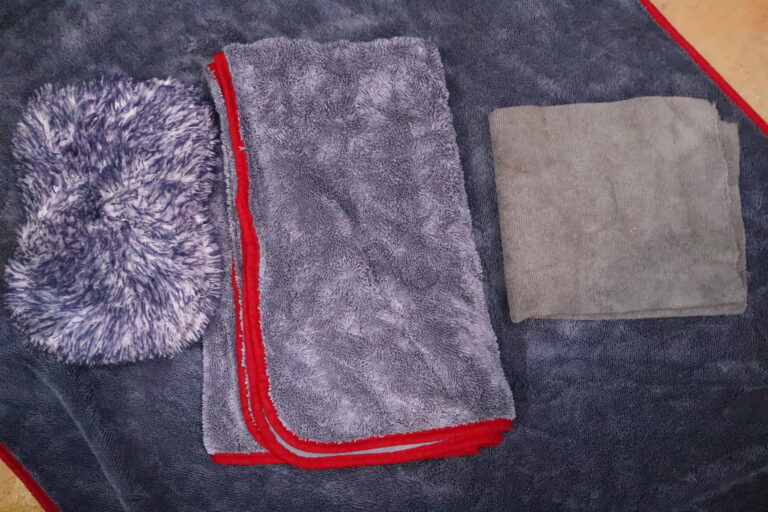
A pressure rinse, wash mitt, towel, brush, pad, paint cleanser, or polishing process can provide this physical separation. The correct method depends on how much contamination remains, how firmly it is bonded, and how clean the surface already is.
Chemical cleaning weakens the contamination. Mechanical cleaning separates what remains.
This is not a conflict between two methods. It is the point where one method reaches its limit and the next method becomes necessary.
Part 2 explains the physical side of this relationship: Car Wash Cleaning Power: High-Pressure Water, Contact and Polishing.
Frequently Asked Questions
Is an alkaline pre-wash always stronger than a neutral car shampoo?
No. Alkaline and neutral describe pH range, not the complete level of cleaning power.
Actual cleaning performance depends on the full formulation, including surfactants, solvents, chelating agents, working concentration, and dwell time. An alkaline product is not automatically stronger in every condition, and a neutral product is not automatically weak.
Does a pH farther from neutral always provide greater cleaning power?
A greater difference from neutral can increase reactivity toward certain types of contamination, but pH alone does not determine total cleaning power.
The type and concentration of active ingredients, the contamination being targeted, and the operating conditions must all be considered.
Does increasing the concentration always improve cleaning?
A higher concentration can supply more active ingredients and increase chemical reactivity.
However, it can also reduce rinsability, increase residue, accelerate drying, and raise the risk to paint, plastic, metal, and protective coatings. Concentration should be increased only within the product’s safe working range.
Can strong chemical cleaning replace the contact wash?
It can reduce the amount of contamination that remains before contact, but it cannot always remove every bonded residue.
Chemical cleaning prepares contamination for safer removal. Any contamination that remains after the material-safe chemical reaction may still require controlled mechanical separation.
Why does the same product produce different cleaning results?
The result can change with dilution, solution volume, dwell time, surface temperature, weather, contamination type, and contamination thickness.
A product’s cleaning power is not determined by formulation alone. It is completed by how the product is used on the vehicle.
Part 1 Conclusion: Chemical Reactivity Creates Cleaning Power
The cleaning power of pre-wash and car shampoo is created by chemical reactivity.
pH determines part of the reaction, but surfactants, solvents, chelating agents, supporting ingredients, concentration, and dwell time work together to determine the actual result.
As chemical reactivity increases, the ability to weaken, loosen, and dissolve contamination also increases.
However, the effect on paint, plastic, metal, trim, and protective coatings increases at the same time. Material safety therefore places a limit on how far chemical cleaning power can be raised.
This is why strongly bonded contamination cannot always be removed by stronger chemistry alone.
Once chemical cleaning reaches its safe limit, the remaining contamination must be separated through controlled mechanical cleaning.
Part 2 examines how water impact, surface contact, pressure, friction, movement, and recovery create physical cleaning power—and why the required level of physical intervention changes from washing to bonded-contamination removal and polishing.
SEO Metadata
SEO Title: Pre-Wash and Car Shampoo Cleaning Power: Why Chemical Reactivity Matters
Focus Keyphrase: pre-wash and car shampoo cleaning power
Meta Description: Learn what determines the cleaning power of pre-wash and car shampoo, how chemical reactivity weakens contamination, and why material safety limits chemical cleaning.
Excerpt: The cleaning power of pre-wash and car shampoo is not determined by pH alone. It comes from the combined chemical reactivity of the formulation and the way the product is used.