3PH car wash cleaning power does not come simply from using an acidic, neutral, and alkaline cleaner in sequence. Actual cleaning performance also depends on how pH, solvents, surfactants, and functional additives interact with contamination.
Two cleaners with similar pH values can produce very different results. One may work well on bug residue and fatty organic contamination, while another may remove oily traffic film more effectively. Even neutral cleaners can differ significantly in cleaning power, rinsing behavior, and residue.
These differences come from four main components:
- pH
- Solvents
- Surfactants
- Functional additives
Each component performs a different role. Some chemically change contamination, some penetrate and mix with oily films, and others separate loosened soil and keep it suspended in the wash solution.
Cleaning is not complete until the loosened contamination and cleaner residue are rinsed completely away.
Table of Contents
- Cleaning Power in a 3PH Car Wash Is Not Determined by pH Alone
- Four Components That Shape Cleaning Performance
- pH
- Solvents
- Surfactants
- Functional Additives
- How the Four Components Work Together
- Cleaning Is Not Complete Until the Contamination Is Removed
- Cleaning Power Comes From the Balance of Four Actions
- Frequently Asked Questions
- Conclusion
Cleaning Power in a 3PH Car Wash Is Not Determined by pH Alone
pH is an important way to classify a cleaner.
Acidic cleaners are often effective against mineral deposits and certain forms of inorganic contamination. Alkaline cleaners can help weaken fatty residues, protein-based contamination, bug remains, and other forms of organic grime.
However, pH describes the reaction environment. It does not measure the complete cleaning power of a finished product.
Two cleaners with similar pH values may perform differently because their solvent content, surfactant system, builders, chelating agents, viscosity, and other additives are different.
A cleaner containing suitable solvents may penetrate oily contamination more effectively. Another formulation may rely more heavily on surfactants to detach contamination and keep it dispersed in water. Water hardness control and pH stability can also affect how consistently the product works.
Mineral oil, silicone oil, tar, and other water-insoluble contamination may not respond sufficiently to alkaline chemistry alone. These soils often require the combined action of solvents and surfactants.
pH changes the chemical condition of contamination. Solvents mix with oily contamination. Surfactants detach contamination and keep it suspended in water. Functional additives help these processes remain stable.
Four Components That Shape Cleaning Performance
Applying a cleaner does not make contamination disappear instantly.
The contamination must first become chemically weaker or easier to move. It must then detach from the surface, transfer into the wash solution, and finally leave the vehicle during rinsing.
The complete process can be summarized as:
Chemical weakening or change → Detachment → Transfer into water → Rinsing and removal
The four main components perform different jobs within this process.
| Component | Primary role | How it works | Main precautions |
|---|---|---|---|
| pH | Creates the reaction environment | Acidic or alkaline conditions change the chemical state, charge, solubility, or aggregation of contamination, making it easier to remove during the next stage | High concentration, excessive dwell time, and drying may affect paint and surrounding materials |
| Solvents | Penetrate and mix with oily contamination | Enter oily films and mix with them, reducing viscosity, adhesion, and cohesion while forming a solvent–oil mixture | May affect waxes, coatings, rubber, and plastic depending on formulation and exposure |
| Surfactants | Detach and disperse contamination | Reduce the boundary between water and oil, help detach contamination, and stabilize it in the wash solution | High concentrations and trapped residue may cause streaking, tackiness, loss of clarity, or redeposition |
| Functional additives | Stabilize cleaning conditions and formulation performance | Control water hardness, bind metal ions, stabilize pH, protect metals, and adjust viscosity and storage stability | Usually support cleaning performance rather than acting as the primary cleaning mechanism |
The four components do not remove contamination in the same way.
pH changes its chemical condition. Solvents mix with oily contamination. Surfactants separate contamination and keep it mobile in water. Functional additives help these processes continue under stable conditions.
pH
Characteristics
pH indicates whether an aqueous solution is acidic or alkaline.
In vehicle cleaning, acidic or alkaline conditions can change the chemical state of specific types of contamination.
Depending on the soil, this may affect:
- charge
- solubility
- swelling
- aggregation
- adhesion to the surface
The important question is not simply whether the pH number is high or low.
The more useful question is:
What type of contamination can this chemical environment change?
Acidic cleaners are generally useful against mineral deposits and some metal oxides. Alkaline cleaners can reduce the adhesion of fatty organic residues and make some protein-based contamination swell and become easier to remove.
However, mineral oils, silicone oils, and tar may not respond sufficiently to pH alone.
For a deeper explanation of why thin mineral residue may remain after alkaline cleaning, read Why Acidic Pre-Wash Is Needed for Mineral Residue.
The difference between early mineral accumulation and visible bonded water spots is explained in Mineral Contamination vs. Water Spots.
How pH Helps Remove Contamination
Acidic or alkaline conditions change the chemical state of contamination.
The result depends on the type of soil. Its solubility, electrical charge, aggregation, adhesion, or accessibility to water and surfactants may change.
Acidic conditions may dissolve carbonate-based mineral deposits or change the state of certain metal oxides. Alkaline conditions may alter fatty residues or swell some protein-based contamination.
Because these reactions differ by contamination type, pH cleaning cannot be represented accurately by one universal reaction equation.
pH creates a reaction environment that changes contamination into a state that is easier to remove during the next cleaning stage.
Risks and Side Effects
A chemical environment capable of changing contamination may also affect nearby materials.
High concentration, excessive dwell time, hot panels, direct sunlight, and drying can increase the burden on:
- paint
- metal trim
- plastic
- rubber
- coatings
- narrow panel gaps
When water evaporates, the remaining chemical ingredients become more concentrated. This is especially important around emblems, trim, plated parts, mirrors, handles, and panel joints.
The risk of acidic cleaner remaining in gaps and concentrating during drying is explained in Acidic Pre-Wash Risks: Rinsing, Trapped Residue, and Corrosion.
Diagram
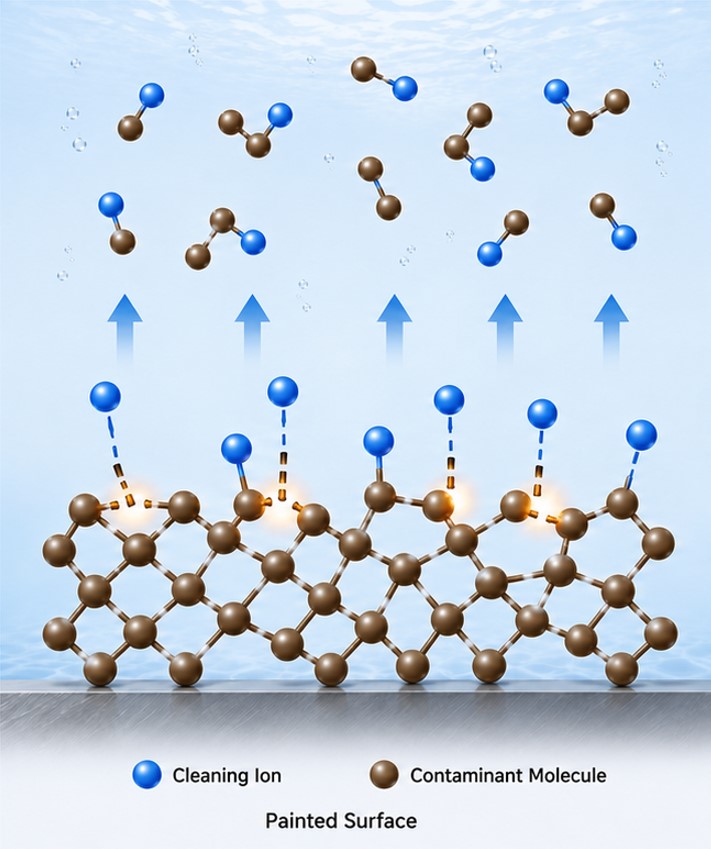
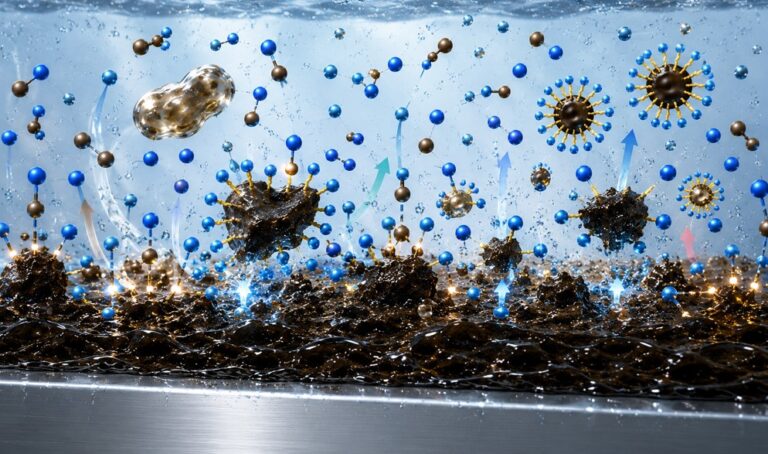
pH action in 3PH car wash cleaning power changing contamination structure
In the diagram, the brown structure represents the original contamination and the blue particles represent cleaning ions.
The lower connected structure changes during the reaction, while the altered structures move upward into the solution.
This is a simplified visual model. It does not represent one universal molecular reaction for every acidic or alkaline cleaner.
The key point is that the chemical structure or aggregation state of contamination can differ before and after exposure to the cleaner.
Key Point
pH is not simply a number showing cleaner strength. It creates the chemical environment in which contamination changes.
Solvents
Characteristics
Oily contamination does not mix easily with water.
A solvent can penetrate this contamination and mix directly with it. This is often explained through the principle that substances with similar polarity and intermolecular interactions tend to mix more readily.
A solvent does not necessarily cut oil molecules into smaller pieces.
Instead, it enters the oily film and changes its viscosity, adhesion, and cohesion by forming a mixture.
How Solvents Remove Oily Contamination
When a solvent reaches a concentrated oily layer, mixing begins at the exposed upper portion of the contamination.
The lower layer may still contain concentrated oil, while the upper region becomes a mixed solvent–oil phase.
As mixing continues, the contamination becomes less viscous and less cohesive. It can then detach more easily or become easier for surfactants and rinsing water to transport away.
The primary action of a solvent is not fragmentation. It is mixing and dissolution.
Risks and Side Effects
A solvent may affect more than the target contamination.
Depending on the product, it may weaken or alter:
- wax
- sealant
- certain coating layers
- plastic oils
- rubber components
- adhesive residue
- exterior dressing
Strong solvents, excessive exposure, or repeated use may contribute to dryness, discoloration, or reduced surface clarity.
Before use, check:
- the intended contamination
- paint and coating compatibility
- plastic and rubber compatibility
- whether the product is intended for spot treatment or full-panel use
- whether rinsing or neutralization is required
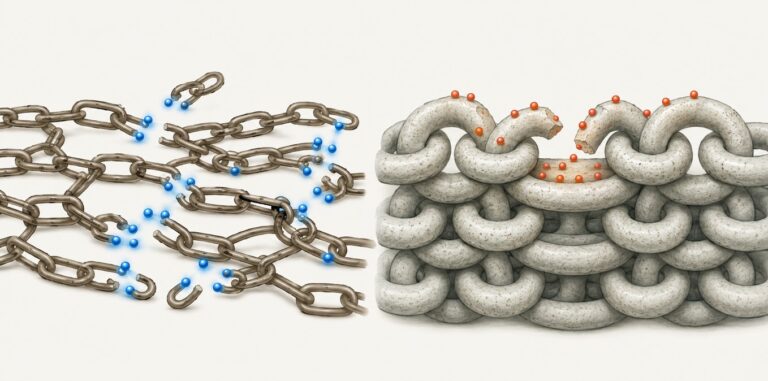
Diagram
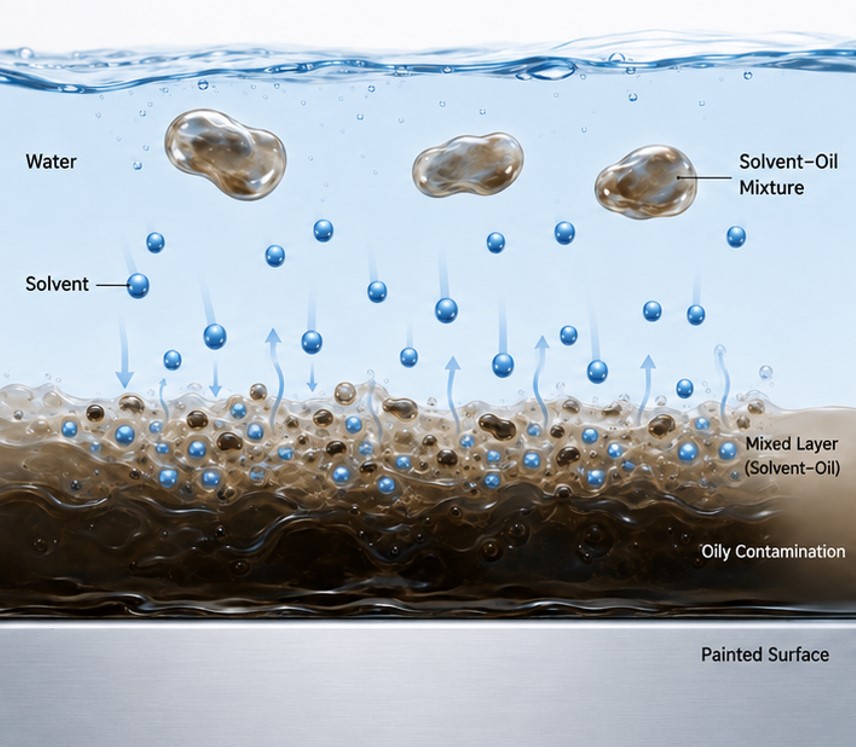
Solvent action in 3PH car wash cleaning power mixing with oily contamination
The concentrated oily contamination remains near the surface at the bottom.
As solvent penetrates from above, a mixed layer forms. The material floating higher in the liquid is not pure oil.
It is a solvent–oil mixture.
This is different from a surfactant-stabilized dispersion, where the contamination remains as a distinct oily center surrounded by surfactant molecules.
Key Point
A solvent penetrates oily contamination and mixes with it, forming a less viscous and less cohesive solvent–oil mixture.
Surfactants
Characteristics
Water and oil do not mix easily.
A surfactant has two different regions:
- a hydrophobic region that associates with oily contamination
- a hydrophilic region that associates with water
This structure allows the surfactant to position itself between water and oil.
By lowering interfacial tension and improving wetting, surfactants help water reach contamination and support its detachment from the surface.
How Surfactants Remove Contamination
The hydrophobic part of the surfactant associates with oily contamination, while the hydrophilic part remains oriented toward the surrounding water.
As surfactants gather around the contamination, the edge of the oily film becomes easier to lift and separate into smaller droplets or particles.
Once detached, the contamination can remain in water as a surfactant-stabilized dispersion.
At smaller molecular scales, micelle-like structures may also form. However, not every visible oil droplet should be understood as a perfect spherical micelle.
The important point is that surfactants perform two connected jobs:
- They help detach contamination.
- They help prevent the detached contamination from immediately recombining or redepositing.
Why High Concentrations Can Be Harder to Rinse
Increasing surfactant concentration may increase the amount of active material contacting the contamination.
However, it also increases the amount of cleaner that must be removed from the paint and trapped areas.
When people shower or wash their hair, they can touch the surface and feel whether detergent remains. A slippery or tacky feeling indicates that further rinsing is needed.
During a vehicle wash, people often judge the rinse only by whether visible foam has disappeared.
But removing visible foam and removing all surfactant residue are not the same thing.
Higher concentrations may leave more cleaner around:
- emblems
- mirrors
- window trim
- door handles
- grilles
- panel gaps
- lower trim
More product therefore requires sufficient water volume and rinse time.
Problems Caused by Residue
When surfactants and loosened contamination remain on the surface and the water evaporates, the non-volatile material becomes concentrated.
This may contribute to:
- streaking
- tackiness
- reduced paint clarity
- increased dust attraction
- cleaner dripping out of gaps after washing
- contamination redeposition
The process through which drying alkaline pre-wash can concentrate loosened road film and cleaner residue is explained in Alkaline Pre-Wash Risks: Re-Deposition and Paint Clarity Loss.
Diagram
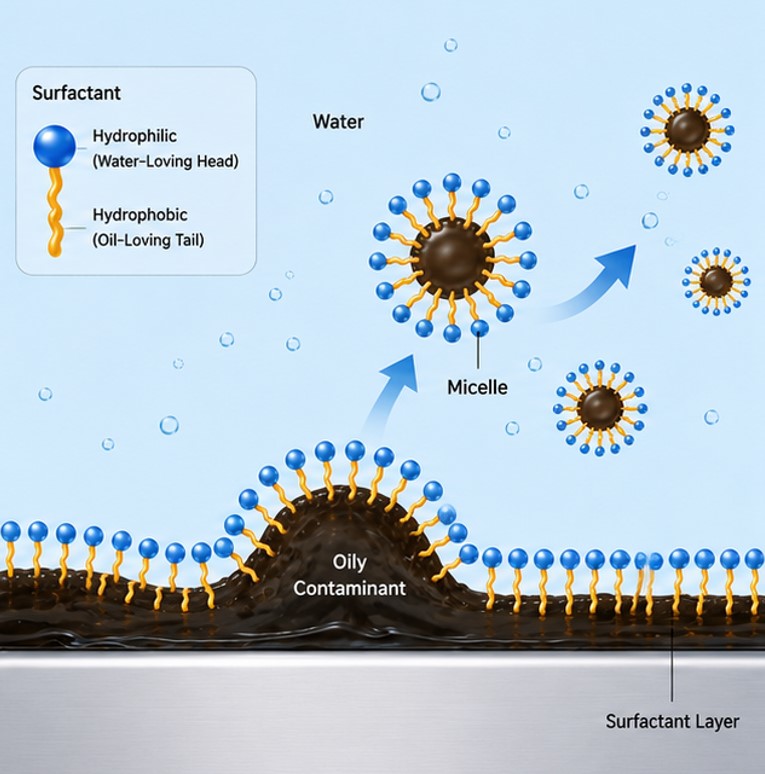
Surfactant action in 3PH car wash cleaning power dispersing oily contamination in water
The oily contamination remains at the center of the structure.
Surfactant molecules are arranged around the outside, with their oil-compatible regions facing inward and their water-compatible regions facing outward.
Unlike the solvent diagram, the result is not one uniformly mixed solvent–oil phase.
It is a distinct contamination droplet or particle stabilized in water by surfactants.
Key Point
Surfactants help detach contamination and keep it dispersed in water so that rinsing can carry it away.
Functional Additives
Automotive cleaners also contain ingredients that support the main cleaning mechanisms.
These additives may not perform the primary removal action, but they help pH, solvents, and surfactants work under more stable conditions.
Builders and Water Softeners
Builders can support alkalinity, improve the cleaning environment, and reduce performance loss caused by hard water.
Chelating Agents
Chelating agents bind calcium, magnesium, iron, and other metal ions.
This can reduce precipitation, mineral interaction, and contamination redeposition.
Buffers
Buffers help prevent rapid pH changes while the product is in use.
Corrosion Inhibitors
Corrosion inhibitors can reduce the chemical burden on metal surfaces.
Their presence does not eliminate the need for thorough rinsing.
Thickeners
Thickeners adjust viscosity and dwell behavior.
Greater viscosity may improve surface contact, but excessive thickness can increase trapped residue and make rinsing more difficult.
Preservatives
Preservatives reduce microbial growth and product degradation during storage.
Enzymes and Oxidizing Ingredients
Some interior and textile cleaners use enzymes or oxidizing ingredients to act on protein-based contamination, odor-producing compounds, or staining.
These ingredients are less common in general exterior wash products.
Fragrance and Color
Fragrance and color improve user experience and product identification.
They should not be confused with the primary cleaning power of the product.
Key Point
Functional additives stabilize the cleaning environment, formulation behavior, and storage performance rather than replacing the main cleaning mechanisms.
How the Four Components Work Together
In a real cleaner, pH, solvents, surfactants, and functional additives do not act independently.
Their effects overlap while the cleaning solution remains in contact with the contamination. pH changes the chemical state of certain soils. Solvents penetrate and mix with oily contamination, while surfactants improve wetting, help detach the contamination, and keep it dispersed in water. Functional additives help these processes continue under stable conditions.
Their individual roles can be summarized as follows:
- pH: changes the chemical state of contamination
- Solvents: penetrate and mix with oily contamination
- Surfactants: improve wetting, detachment, and dispersion
- Functional additives: stabilize the reaction conditions and formulation
This is why cleaners with similar pH values can differ in cleaning performance, rinsing behavior, dwell characteristics, and material compatibility.
The practical use of alkaline cleaners on paint, bugs, wheels, tires, and engine-bay contamination is explained in How to Use Alkaline Cleaners on a Car.
The amount of cleaning power required should also match the condition of the vehicle. A maintenance wash and a heavily contaminated vehicle do not necessarily require the same dilution or product strength. This is covered in How to Choose an Alkaline Pre-Wash for Your Car.
Cleaning Is Not Complete Until the Contamination Is Removed
Chemical action is only the beginning of contamination removal.
Even if contamination has become weaker or detached from the surface, the wash is not complete while that material remains on the vehicle.
The entire process must continue through all four stages:
Chemical weakening or change → Detachment → Transfer into water → Rinsing and removal
pH changes contamination. Solvents reduce the viscosity and cohesion of oily films. Surfactants keep loosened contamination mobile in the wash solution.
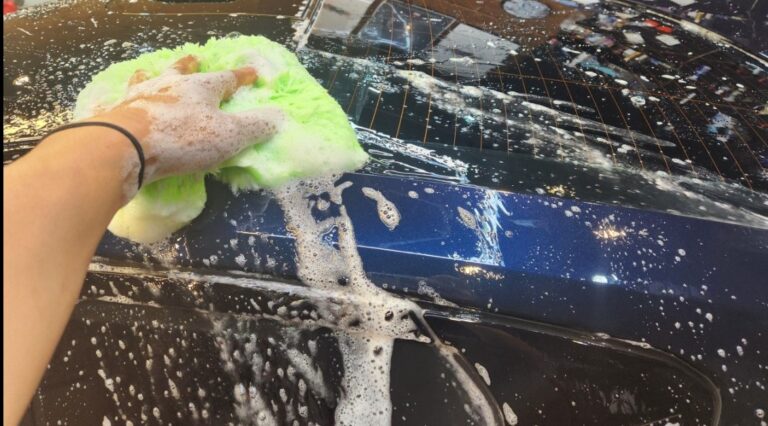
If necessary, contact washing separates contamination that remains attached after pre-washing.
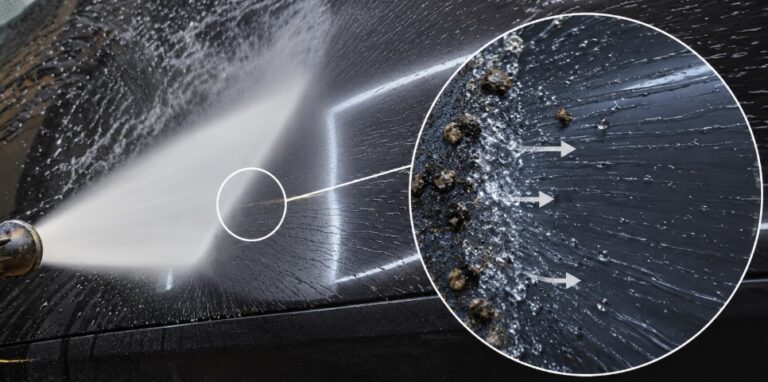
Afterward, pressure rinsing or flowing water must remove both the contamination and the cleaning solution from the vehicle.
Rinsing must remove more than visible foam:
- detached contamination
- solvent–oil mixtures
- surfactant-stabilized dispersions
- remaining cleaner ingredients
- diluted solution trapped in gaps
Mirrors, emblems, trim, handles, grilles, and panel joints can hold diluted cleaner even after visible foam has disappeared from the main panels.
Rinsing is not simply the removal of foam. It is the stage that carries altered contamination and remaining cleaner completely off the vehicle.
This distinction is particularly important with alkaline pre-washes. As explained in Alkaline Pre-Wash Risks: Re-Deposition and Paint Clarity Loss, loosening contamination and removing it are separate stages. When the solution dries first, loosened contamination and cleaning ingredients may concentrate and settle back onto the paint.
Cleaning Power Comes From the Balance of Four Actions
The cleaning performance of a 3PH car wash does not come from high pH alone.
Consider a thick, hardened layer of oily contamination. Solvents penetrate the oily film and mix with it. This reduces its viscosity and cohesion, making a firmly bonded layer more mobile and easier to remove.
The alkaline environment changes and weakens certain fatty and organic soils. Surfactants act at the boundary between the contamination and the wash solution. They improve wetting, help detach the weakened contamination from the paint, and keep the separated oil and soil particles dispersed in water so that they are less likely to recombine or settle back onto the surface.
Functional additives help these actions remain stable. They may reduce hard-water interference, support pH and viscosity control, and help the formulation remain in a suitable condition while it works on the surface.
For clarity, the roles of solvents, pH, and surfactants are described separately. In an actual alkaline cleaner, however, these actions do not occur as a strict sequence.
While the cleaner remains in contact with the contamination, solvent penetration and mixing, alkaline changes to the soil, and surfactant wetting, detachment, and dispersion overlap and occur almost simultaneously.
The relationship can be summarized as follows:
Solvent penetration and mixing + pH-driven changes to contamination + surfactant wetting, detachment, and dispersion → rinsing and removal
The strongest individual action does not necessarily produce the best cleaning result.
A solvent may reduce the viscosity of an oily film, but the contamination can remain or redeposit if surfactants do not keep it stable in water. An alkaline environment may weaken organic soil, but cleaning is not complete unless that soil detaches from the surface.
Even when surfactants successfully detach and disperse contamination, insufficient rinsing can leave both the contamination and the cleaning ingredients on the vehicle.
The best cleaning performance therefore does not come from one ingredient acting first or from one chemical mechanism being more aggressive than all the others.
It comes from each component performing its own role, those actions supporting one another, and the loosened contamination and remaining cleaner being safely removed at the end of the process.
Cleaning power is not the result of one aggressive chemical action. It is the result of solvents, pH, surfactants, functional additives, and rinsing working together in balance.
Frequently Asked Questions
Does a Higher or Lower pH Always Mean More Cleaning Power?
No.
pH describes the acidic or alkaline reaction environment. Actual cleaning performance also depends on solvents, surfactants, functional additives, concentration, dwell time, temperature, and rinsing.
Why Can Two Cleaners With the Same pH Perform Differently?
Their formulations may contain different solvents, surfactant systems, builders, chelating agents, thickeners, and corrosion inhibitors.
Therefore, two products with similar pH values may differ in penetration, wetting, dispersion, rinsing behavior, and material compatibility.
Do Neutral Cleaners Have Less Cleaning Power?
Not necessarily.
A neutral cleaner can still provide strong cleaning performance through its surfactant system, suitable solvents, chelating agents, and other formulation choices.
Neutral means that the product is not strongly acidic or alkaline. It does not mean that the product has no chemical cleaning ability.
What Is the Difference Between a Solvent and a Surfactant?
A solvent penetrates oily contamination and mixes directly with it, forming a solvent–oil mixture.
A surfactant helps detach the contamination and surrounds or stabilizes the separated oily material in water.
The solvent creates a mixed phase. The surfactant creates a stabilized dispersion.
Is Rinsing Finished When the Foam Disappears?
No.
Surfactants, loosened contamination, solvent–oil mixtures, and diluted cleaner may remain even after visible foam has disappeared.
Rinsing is complete only when the contamination and cleaning ingredients have been carried completely off the vehicle.
Does Using a Higher Concentration Always Increase Cleaning Power?
A higher concentration can help when the original mixture does not provide enough active material.
However, beyond the required level, residue, drying risk, rinse difficulty, and material stress may increase faster than useful cleaning performance.
The goal is not the highest possible concentration. It is the lowest effective concentration that provides enough cleaning action for the contamination.
Conclusion
3PH car wash cleaning power does not come from pH alone.
pH changes the chemical condition of contamination. Solvents penetrate and mix with oily films. Surfactants detach contamination and keep it mobile in water. Functional additives stabilize the chemical and physical conditions required for these mechanisms to work.
However, chemical action alone does not complete the wash.
The loosened contamination, solvent mixtures, surfactant dispersions, and remaining cleaner must all leave the vehicle during rinsing.
3PH car wash cleaning power does not come from one aggressive ingredient. It comes from the complete process: changing contamination chemically, detaching it from the surface, keeping it mobile in water, and removing it fully during rinsing.