Introduction
The purpose of an acid pre-wash is to remove mineral deposits bonded to the paint surface.
However, even when the same acid cleaner is used, its effectiveness varies depending on how the minerals are present and how firmly they have bonded. Minerals do not exist separately on a vehicle’s surface. They are found within composite contamination made up of oily road film, organic matter, and road particles. Repeated deposition and solidification also increase their cohesion, giving them greater removal resistance than ordinary contamination.
To use an acid cleaner effectively, we must first understand the characteristics of mineral deposits and bonded contamination. Understanding how minerals exist within composite contamination—and why heavily bonded deposits require greater cleaning power—allows concentration, dwell time, and mechanical cleaning to be combined more effectively.
This article explains why composite contamination should be removed first, how much real-world cleaning power bonded mineral deposits require, how to increase cleaning power safely during a whole-vehicle pre-wash, and how mineral management should change according to the level of buildup.
Contents
- Bonded minerals become the target contamination only after composite contamination is removed
- Why does strongly bonded contamination require greater cleaning power?
- How can cleaning power be increased safely during a whole-vehicle pre-wash?
- Mineral management methods should change according to the maintenance cycle
- Key questions and answers
- Conclusion: Mineral removal begins with judging the condition, not choosing the strongest product
Part 1. Bonded Minerals Become the Target Contamination Only After Composite Contamination Is Removed
Bonded minerals exist within composite contamination
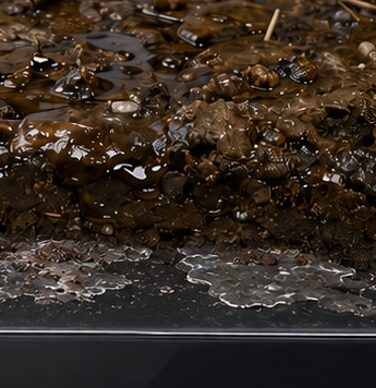
The mineral contamination targeted by an acid cleaner consists of inorganic substances from water that have repeatedly settled, concentrated, and solidified on the vehicle’s surface.
In reality, however, bonded minerals do not exist by themselves. Oily road film, organic contamination, soil, dust, and road particles become mixed and layered together, forming composite contamination.
The position and condition of the minerals are not uniform. Some are mixed into the composite contamination, while others remain bonded directly to the surface. Even on the same panel, thick contaminated areas can exist beside areas where minerals are relatively exposed.
Vehicle contamination should therefore not be understood as separate layers of oil and minerals. The actual task is to remove bonded minerals from a surface where several types of contamination are mixed together.
Removing bonded minerals requires consideration not only of the minerals themselves, but also of the contamination covering and surrounding them.
A dedicated cleaner reacts first with the most accessible targets
When an acid cleaner is applied to composite contamination, its active ingredients do not immediately act only on the bonded minerals.
The cleaning solution first encounters the reaction targets it can reach most easily. Composite contamination can also contain minerals and inorganic residues that react with acids, so some of the active ingredients may be consumed by these accessible materials first.
As a result, fewer active ingredients may reach the minerals bonded to the underlying surface.
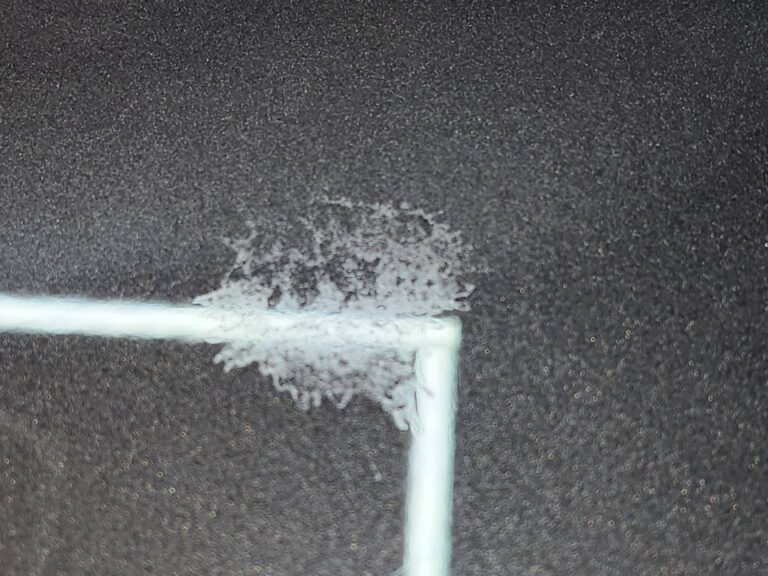
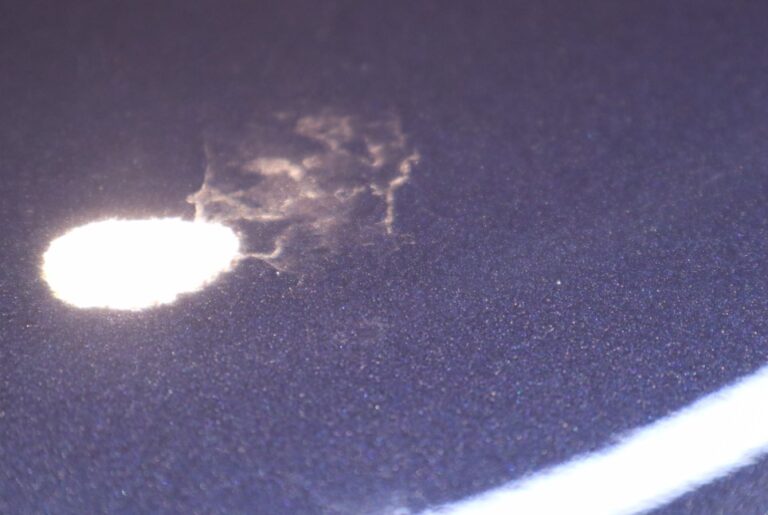
The reaction of an iron remover offers a useful comparison. When an iron remover is applied before ordinary contamination has been removed, the purple reaction first appears around exposed iron particles on the surface or within the contamination layer. A widespread colour reaction, however, does not necessarily mean that the more firmly bonded iron particles have been removed sufficiently.
This is why ordinary contamination is generally removed before an iron remover is used.
Mineral reactions cannot be observed through the same colour change, but the operating principle is similar.
When an acid cleaner is used on a surface covered with composite contamination, minerals within that contamination may react first and reduce the cleaning efficiency available for the bonded mineral deposits underneath.
Oily composite contamination slows the penetration of the cleaning solution
Composite contamination does more than consume active ingredients before they reach the intended target. It can also obstruct the path of the cleaning solution to the bonded minerals.
Composite contamination built around road film contains oily substances. This oily film slows the ability of a water-based cleaning solution to wet the surface evenly and penetrate the contamination layer.
Even when sufficient acid remains in the solution, it may reach the target minerals too late, reducing the time available for an effective reaction. Because vehicle cleaning takes place within a limited dwell time, penetration speed is an important factor.
This issue should be distinguished from the preceding reaction described above.
- Preceding reaction: Active ingredients are consumed first by other accessible reaction targets within the composite contamination.
- Delayed penetration: The oily contamination film slows the movement of the cleaning solution toward the bonded minerals.
Both reduce cleaning efficiency, but they do so for different reasons.
Removing composite contamination turns bonded minerals into the target contamination
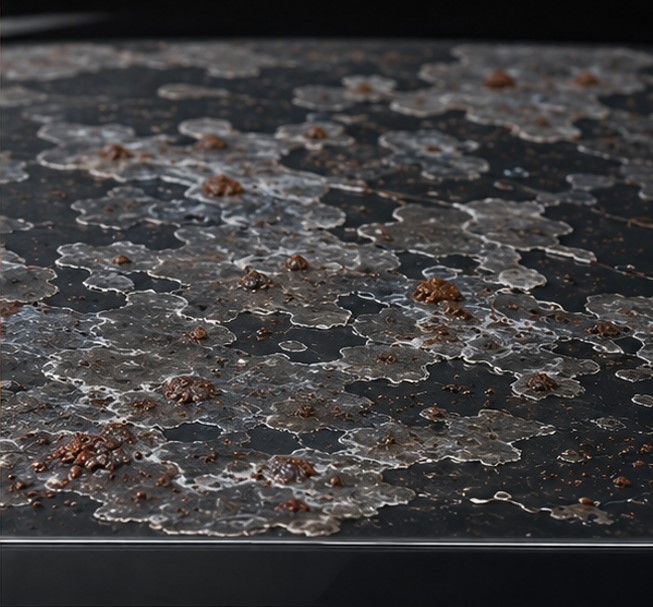
To make an acid cleaner act efficiently on bonded minerals, removing composite contamination should come before increasing the cleaner’s concentration.
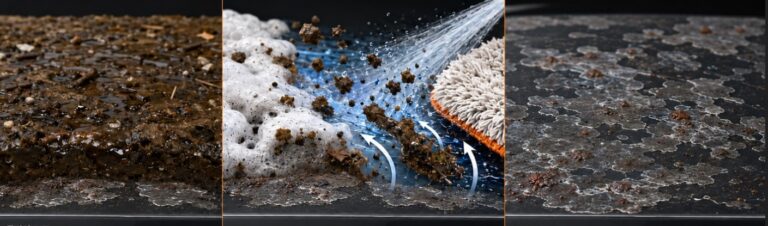
An alkaline pre-wash chemically weakens the oily contamination layer, and a pressure rinse removes loosened contamination and particles. A first contact wash can then remove the remaining ordinary contamination, exposing the bonded minerals as the actual target contamination.
This process produces two important changes:
- Preceding reactions within the composite contamination are reduced, limiting the unnecessary consumption of active ingredients.
- Removing the oily film allows the cleaning solution to reach the bonded minerals more quickly and evenly.
The purpose of removing composite contamination is not simply to make the surface look clean. It is to create the conditions required for the acid cleaner to act directly and effectively on the bonded minerals.
Removing composite contamination is the preparation stage for bonded mineral cleaning. Preceding reactions and delayed penetration must be reduced before the acid cleaner can act effectively on the target contamination.
Once the minerals have been exposed as the target contamination, chemical weakening and physical separation must be adjusted to the amount and condition of the buildup.
👉 The basic principle behind removing ordinary composite contamination first is explained in Why Alkaline Pre-Wash Comes First for Composite Contamination.
Part 2. Why Does Strongly Bonded Contamination Require Greater Cleaning Power?
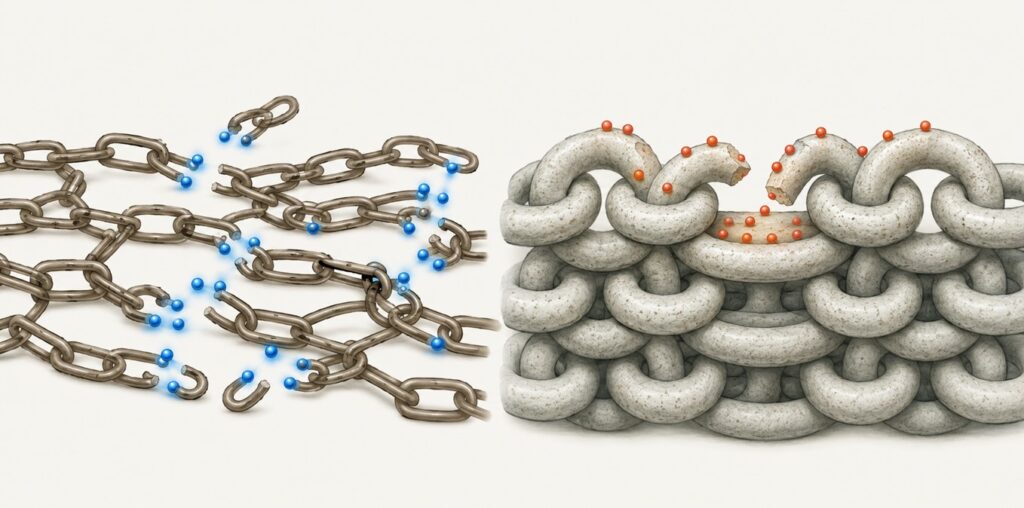
Composite oily contamination and minerals have different bonding structures
The removal structures of composite oily contamination and mineral deposits can be visualised as connected chain links.
The number of links represents the connections forming the contamination, while the thickness of each link represents how strongly that connection is maintained. Composite oily contamination can be viewed as many thin links tangled together, while mineral deposits may contain fewer connections, with each link being thicker and stronger.
This is a conceptual analogy for understanding how the two types of contamination are removed. It is not a literal representation of their molecular formulas or crystal structures.
Here, bonding strength does not refer only to the energy of an individual chemical bond. It refers to the overall force that allows the contamination to remain as a coherent layer and resist removal, including both internal cohesion and adhesion to the vehicle’s surface.
Composite oily contamination can loosen when only some connections are weakened
Composite oily and organic contamination forms a film as different substances and particles become entangled.
Not every connection must be completely broken one by one. When some of the connections supporting the contamination film are weakened, the entire structure can relax, allowing trapped particles to move more easily.
When alkaline ingredients, solvents, and surfactants wet and weaken the composite contamination, the impact of a pressure rinse and the movement of a contact wash can separate relatively large sections of the film.
This is why an alkaline pre-wash is efficient against ordinary composite contamination.
Composite contamination does not need to be broken down completely. Weakening the connections that maintain the contamination film can reduce the removal resistance of the entire structure.
Strong mineral bonds must be weakened sufficiently before separation
Repeatedly deposited minerals develop greater removal resistance as their crystals grow and bond together.
A reaction at part of the exposed surface does not cause all the minerals underneath to release at once. The exposed mineral units must first be weakened sufficiently for that section to separate. Only after the weakened material has been removed is a new mineral reaction surface exposed.
The greater the amount of mineral buildup, the more often chemical reaction and physical separation may need to continue in sequence.
Because weakening only part of the mineral structure does not release the entire deposit, minerals may require greater real-world cleaning power than ordinary composite contamination.
Three application variables can increase cleaning power
When the same cleaner is used, its real-world cleaning power can be increased through three main application variables.
- Increase the concentration to supply more active ingredients to the target contamination.
- Secure sufficient wet dwell time so that the chemical reaction can continue.
- Add mechanical cleaning to separate contamination that has already been weakened.
Mechanical cleaning is not intended to scrape minerals away with force.
Its role is to separate weakened material in larger sections, expose a fresh mineral reaction surface, and distribute the cleaning demand that would otherwise be placed entirely on concentration and dwell time.
Real-World Cleaning Power = Product Design × Real-World Application
Even a well-designed product will deliver limited cleaning power on the vehicle if it cannot reach the target contamination directly, or if sufficient wet dwell time, separation, and final removal are not connected as one process.
Part 3. How Can Cleaning Power Be Increased Safely During a Whole-Vehicle Pre-Wash?
Strongly bonded contamination such as mineral buildup requires greater cleaning power.
During a whole-vehicle cleaning process, however, concentration, dwell time, and mechanical cleaning cannot be increased without limit.
Concentration is limited by material safety
During spot treatment, a dedicated product can be applied only where contamination remains, allowing the application area and reaction time to be controlled closely.
A pre-wash, by contrast, reaches not only the paint but also glass, rubber, plastic, metal, protective layers, panel gaps, and other confined areas.
A higher concentration can supply more active ingredients to the target contamination. At the same time, however, it can increase the stress placed on different exterior materials and protective layers.
A whole-vehicle pre-wash should therefore be used within the manufacturer’s recommended concentration range, where material compatibility has been considered.
This is why a high-concentration spot remover and a pre-wash applied across the entire vehicle should not be compared according to the same standard.
Dwell time is limited by drying
Dwell time is not simply the total time a cleaner remains visible on the surface.
Effective dwell time is the period during which the cleaning solution remains wet and can actively react with the target contamination.
It is not a fixed amount of time. The effective wet dwell time available changes according to panel temperature, air temperature, wind, humidity, and other working conditions.
Once the solution begins to dry, the conditions needed for an effective reaction decline. As water evaporates, residual cleaning ingredients on the surface and inside panel gaps may also become more concentrated.
Dwell time should therefore be extended only within the period in which the cleaning solution remains wet.
The amount of time that visible foam remains on the surface is not always the same as effective dwell time.
Mechanical cleaning is limited by scratch risk
Increasing contact pressure and repeated movement can increase the force separating contamination from the surface.
However, when particles remain between the wash mitt and the paint, greater pressure and friction also increase the risk of scratching.
Excessive pressure can compress the mitt’s pile, reduce the space available for lubrication and displaced contamination, and force particles to act closer to the paint surface.
Scratch Risk = Contamination × Pressure × Friction × Movement
Here, friction refers to resistance at the contact area created by the mitt, contamination, and lubrication conditions. Movement refers to the distance and number of repeated passes over which that resistance acts on the paint.
Using greater force to remove contamination left behind by insufficient chemical cleaning is not a safe solution.
Cleaning power increases safely when the three variables work together
The safest way to increase cleaning power across an entire vehicle is not to push one variable to an extreme.
- Use the product within its recommended concentration range, considering the materials and working conditions.
- Secure sufficient wet dwell time before the cleaning solution begins to dry.
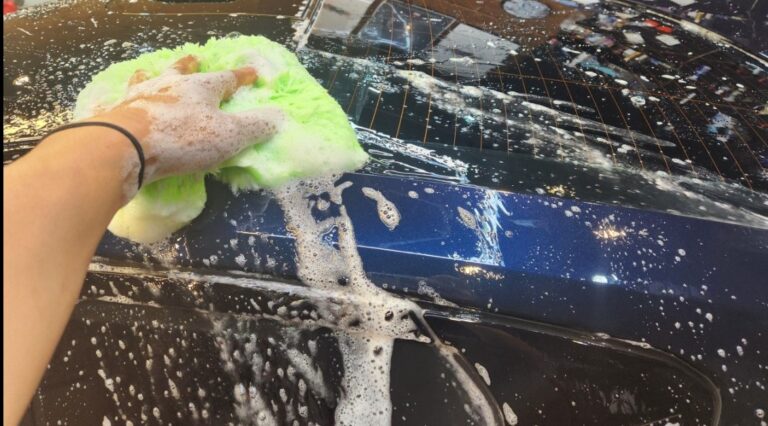
- Use a soft wash mitt and sufficient lubrication to clean with low contact pressure.
- Rinse thoroughly to remove separated minerals and residual cleaning ingredients.
Real-world cleaning power can be increased safely by securing the necessary chemical action within the recommended concentration range, maintaining effective wet dwell time before drying, and then separating the weakened contamination with a soft wash mitt and minimal force.
Mechanical cleaning is not a temporary substitute for an underperforming acid cleaner.
It distributes the cleaning demand that would otherwise be concentrated on chemical strength and dwell time, helping provide the total cleaning power required within the safety limits of whole-vehicle application.
👉 The relationship between concentration, dwell time, mechanical cleaning, and real-world cleaning power is explained in 3PH Car Wash Cleaning Power, Part 2 | How to Manage Concentration, Dwell Time, and Mechanical Cleaning.
Part 4. Mineral Management Methods Should Change According to the Maintenance Cycle
The principles above can be applied through two main mineral management approaches.
The first uses an acid cleaner intended for routine washing to reduce mineral buildup at short intervals. The second allows more accumulated mineral deposits to be treated at longer intervals with a dedicated water spot remover and, when necessary, polishing.
| Category | Cleaner-Based Maintenance|Short Cycle | Dedicated Remover and Polishing|Long Cycle |
|---|---|---|
| When to intervene | While mineral buildup is still thin | After gloss, sheeting, or drainage has declined, or visible water marks have appeared |
| Main methods | Acid pre-wash, acidic shampoo, or a combination of pre-wash and contact wash | Water spot remover and polishing when necessary |
| Main purpose | Reduce accumulation before removal resistance rises significantly | Concentrate cleaning power on accumulated deposits and correct remaining etching |
| Working area | Repeated whole-vehicle maintenance during routine washing | Targeted treatment after inspecting the remaining contamination |
| Maintenance type | Preventive maintenance | Corrective maintenance |
Short-cycle and long-cycle maintenance are not competing methods from which only one must be selected.
Short-cycle maintenance slows repeated mineral accumulation. Long-cycle maintenance concentrates on deposits that remain or continue to build despite routine care.
1. Cleaner-Based Maintenance|Short Cycle
Short-cycle maintenance uses an acid cleaner designed for routine washing to reduce mineral buildup before it becomes thick.
The purpose is not to remove everything aggressively in one treatment. It is to intervene repeatedly before removal resistance rises significantly.
Three approaches to short-cycle maintenance
| Application method | Advantages | Limitations | Most suitable condition |
|---|---|---|---|
| Acid pre-wash followed by rinsing | No contact cleaning, so mechanical load is minimal | Minerals that do not separate during rinsing may remain | Frequent management of thin, early-stage mineral buildup |
| Contact wash with an acidic shampoo | Combines chemical reaction and physical separation during a regular wash | Limited pre-reaction time may be insufficient for heavier deposits | Simple routine maintenance when mineral buildup is still light |
| Acid pre-wash + wet dwell time + contact wash | Allows minerals to be thoroughly wetted and weakened before low-force separation | Requires a longer process, contact washing, and careful mitt management | When minerals repeatedly remain after pre-washing and rinsing alone |
These approaches are not competing procedures. They are progressive options for increasing cleaning power only when needed.
If an acid pre-wash and rinse are sufficient, there is no reason to add contact. If mineral deposits repeatedly remain, an acidic shampoo wash or a combination of acid pre-wash and contact washing can provide the required mechanical separation.
The principle of short-cycle maintenance is not to use the strongest method every time. It is to combine only as much chemical reaction and mechanical separation as the current level of buildup requires.
Acid pre-wash followed by rinsing
An acid cleaner is applied to chemically weaken exposed mineral deposits, after which a pressure rinse separates and removes them.
Because there is no contact wash, this method creates the lowest mechanical load. It is therefore suitable for frequent management of thin, widespread, early-stage mineral buildup.
However, minerals that remain tightly attached after being chemically weakened may not separate completely through pressure rinsing alone.
Contact wash with an acidic shampoo
An acidic shampoo allows chemical action against mineral deposits and physical separation by the wash mitt to occur during the same process.
Its advantage is that mineral buildup can be managed during a regular wash without adding a separate pre-wash stage. Gentle contact cleaning can also reduce thin deposits that remain after rinsing alone.
However, because there is little separate dwell time before contact begins, the process may not weaken accumulated minerals sufficiently.
Acid pre-wash + wet dwell time + contact wash
An acid pre-wash thoroughly wets the mineral deposits. Effective wet dwell time is then maintained before the surface is gently contact-washed with a soft mitt.
This process first lowers removal resistance chemically and then separates the weakened minerals with minimal force. It can therefore increase real-world cleaning power without using an unnecessarily high concentration.
Acid Pre-Wash → Effective Wet Dwell Time → Gentle Contact Wash → Final Rinse
This is not the only method for removing accumulated mineral deposits. It is one practical way to combine chemical weakening and physical separation within the safety limits of whole-vehicle cleaning.
2. Dedicated Remover and Polishing|Long Cycle
If clearly defined water marks or localised bonded deposits remain after short-cycle cleaner maintenance, continually increasing the concentration and dwell time of a whole-vehicle acid pre-wash may not be appropriate.
Ordinary contamination should first be removed through a regular wash. The remaining areas can then be inspected and treated with a more concentrated method.
Water spot remover
A water spot remover concentrates more cleaning power than a routine acid pre-wash on the specific areas where it is needed.
Rather than being repeatedly applied across the entire vehicle, it is used locally after identifying the remaining water spots and mineral deposits.
Controlling the application area and reaction time more closely allows cleaning power to be focused on bonded mineral deposits while reducing unnecessary exposure to surrounding materials and confined gaps.
Always check the product instructions and compatible materials, and test the reaction on a small area first. The product must also be removed and rinsed thoroughly before it dries.
Polishing
If marks or surface distortion remain on a clean surface after the mineral deposits have been removed, the remaining defect may be etching in the paint rather than residual mineral contamination.
At this stage, repeating a stronger acid treatment is less appropriate than inspecting the paint damage and considering polishing.
Polishing is not a method of chemically cleaning mineral contamination. It is the process of physically levelling surface distortion and optical irregularity that remain after the minerals themselves have been removed.
Use acid pre-wash, acidic shampoo, or a combination of pre-wash and contact washing to manage buildup at short intervals. At longer intervals, use a dedicated water spot remover on remaining bonded deposits and consider polishing only when necessary.
Key Questions and Answers
Why should ordinary washing come before mineral removal?
Vehicle contamination does not exist in neatly separated categories. When oily composite contamination covers the minerals, the area where the acid cleaner can act directly on its target is reduced.
Removing ordinary contamination first reduces preceding reactions and delayed penetration, exposing bonded minerals as the target contamination.
Can mineral deposits be removed with an acid pre-wash alone?
Thin, early-stage minerals that have been sufficiently weakened may be removed through an acid pre-wash followed by rinsing.
However, repeatedly accumulated minerals that remain closely attached to the surface may not separate through pressure rinsing alone. In this case, an acidic shampoo wash or an acid pre-wash combined with low-pressure contact cleaning can be used.
Can a higher acid concentration remove accumulated minerals in one treatment?
Concentration alone does not determine the result. The exposure of the target minerals, effective concentration, wet dwell time, mechanical separation, and final removal must work as one connected process.
A whole-vehicle pre-wash also reaches many exterior materials and confined gaps, so the product’s recommended concentration and material compatibility must be considered.
Is a longer dwell time always better?
Dwell time is the period during which the cleaning solution remains wet and can actively react with the contamination.
Once the solution begins to dry, the conditions for an effective reaction decline and residual ingredients may become concentrated. Effective wet dwell time should therefore be secured only until the point before drying begins, with the working environment taken into account.
What is the difference between an acid pre-wash and a water spot remover?
An acid pre-wash is used at short intervals to manage thin mineral buildup across the entire vehicle. A water spot remover delivers more concentrated cleaning power to localised bonded deposits that remain after the regular wash.
Because the application area and degree of control differ, the two products should not be compared according to the same concentration or cleaning-power standard.
What should I do if marks remain after using a water spot remover?
First determine whether the remaining marks are mineral deposits that have not yet been removed or paint etching that remains after the deposits are gone.
If marks or surface distortion remain on a clean surface, inspect the condition of the paint and consider polishing rather than repeating a stronger acid treatment.
Conclusion: Mineral Removal Begins With Judging the Condition, Not Choosing the Strongest Product
Mineral contamination is bonded contamination attached to the paint surface.
However, minerals do not exist separately on a vehicle. Oily and organic composite contamination and road particles must first be removed so that the minerals become the target contamination.
The next step is to secure the real-world cleaning power required for the level of buildup.
Thin, early-stage mineral deposits can be managed with an acid pre-wash and rinse. When physical separation is needed, an acidic shampoo wash or a combination of acid pre-wash, effective wet dwell time, and gentle contact cleaning can be used.
For accumulated bonded deposits, cleaning power should be concentrated on the necessary areas with a water spot remover instead of continually strengthening the whole-vehicle pre-wash. If marks remain on the paint after the minerals have been removed, the surface should be assessed for etching and polishing considered when necessary.
Within this process, combining an acid pre-wash with contact washing is not the only correct answer. It is one practical application of chemical weakening and mechanical separation within the safety limits of whole-vehicle cleaning.
Mineral removal is not determined by product strength alone. The key is to remove composite contamination first, expose the minerals as the target contamination, and then provide the real-world cleaning power required for the level of buildup without exceeding the safe operating range.