Even after you thoroughly clean a vehicle with an alkaline pre-wash and contact wash, the paint may still lack clarity or feel rough to the touch.
This can look like ordinary dirt left behind by an incomplete wash. In reality, bonded contamination often causes this issue, and an alkaline pre-wash and regular contact wash cannot remove it.
Bonded contamination does not release easily from paint through chemical weakening, rinsing, or light wiping alone. Iron particles can remain embedded in or oxidized against the surface, while minerals concentrate as water evaporates and eventually form firmly bonded deposits. A persistent contamination film can also reduce gloss and leave the surface feeling rough even after washing.
Because these contaminants differ in both composition and how they bond to paint, alkaline cleaning alone cannot remove all of them.
Iron contamination requires an iron fallout remover. Bonded mineral deposits often require an acidic cleaner or water spot remover. A contamination film that remains after washing may require a paint cleaner designed to remove residual contamination from automotive paint. Each type of contamination needs the correct product and, when necessary, a physical separation process.
If alkaline pre-wash cannot remove this bonded contamination, why should you still use it before a dedicated decontamination product?
Because bonded contamination does not sit alone on an exposed paint surface. A mixed layer of oily road film, organic matter, dust, and loosely attached particles covers it.
If you apply a dedicated decontamination product at this stage, it will react first with contamination in the outer layer. The oily mixed contamination layer can also create uneven wetting and contact conditions, which affects how evenly the active ingredients reach the actual bonded sites.
Bonded contamination removal does not begin by immediately applying a stronger or more specialized product.
It begins by removing the outer mixed contamination layer with an alkaline pre-wash so the bonded contamination underneath becomes clearly exposed.
This article explains why alkaline pre-wash should come first—even though it cannot directly remove all the bonded contamination that you will treat afterward.
Table of Contents
- Why a mixed contamination layer interferes with targeted decontamination
- How alkaline pre-wash creates the right conditions for decontamination
- How to identify bonded contamination after washing
- Frequently asked questions
- Conclusion
1. Why a Mixed Contamination Layer Interferes With Targeted Decontamination
The same contaminant can exist in different conditions
When you classify bonded contamination only by type—such as iron, minerals, or tar—you can overlook the actual structure of the contaminated surface.
Oily road film, organic matter, dust, and particulate contamination combine to form a mixed contamination layer on the vehicle. Iron particles and minerals may also exist within this outer layer.
Other iron particles and mineral deposits, however, bond directly to the paint underneath it.
For this reason, not all iron contamination exists in the same condition.
- Loose iron particles mixed into the outer contamination layer
- Iron particles that you can remove during the regular washing process
- Iron particles bonded directly to the paint that require dedicated removal
The same applies to mineral contamination. Some drying marks mix with ordinary surface contamination, while other mineral deposits remain firmly attached to the paint even after washing.
Even when contaminants share the same chemical composition, their location and bonding strength require different removal methods.
Dedicated cleaners react with the contamination they contact first
When you apply an iron fallout remover before removing the mixed contamination layer, the product does not selectively search for iron particles bonded directly to the paint. It reacts first with iron that sits closest to the surface and is easiest to contact.
This explains why an iron remover can produce an intense color reaction across a large area when you apply it before washing. However, a strong reaction does not necessarily mean that you removed an equal amount of bonded iron from the paint.
Some of that reaction comes from loose iron particles mixed into the outer contamination layer.
The color change only confirms that the product has reacted with iron. It does not reveal where that iron was located or how firmly it was bonded.
You should view acidic cleaners in the same way. They may react with easily accessible mineral residue on the surface, but this does not mean they have sufficiently weakened mineral deposits beneath the mixed contamination layer.
The total visible reaction is not what matters most.
What matters is whether the active ingredients reach the actual bonded contamination.
Oily mixed contamination can create unfavorable wetting and delivery conditions
A mixed contamination layer contains oily substances that do not readily mix with water.
This oily film can prevent water from spreading evenly across the paint. It can also create unfavorable wetting and contact conditions for water-based iron removers and acidic cleaners.
Even if you apply enough product to make the surface look completely wet, that does not mean every bonded area receives the same exposure. Some of the product may react with the outer contamination first, while wetting and contact remain inconsistent in other areas.
A remaining mixed contamination layer creates two problems.
- Loose contamination within the outer layer reacts before the bonded contamination.
- Wetting and delivery of the active ingredients to the actual bonded sites become uneven.
Increasing the strength of the dedicated cleaner alone does not solve this problem. You must first prepare the surface so the active ingredients can act more directly on the intended target.
2. How Alkaline Pre-Wash Creates the Right Conditions for Decontamination
The first target is the outer mixed contamination layer
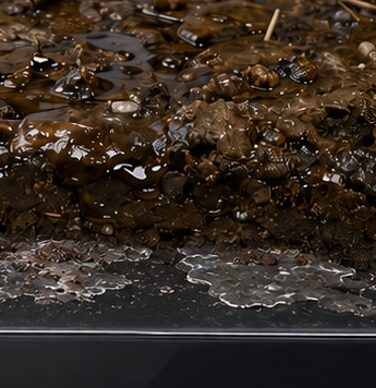
At this stage, the purpose of alkaline pre-wash is not to directly remove bonded iron or mineral deposits.
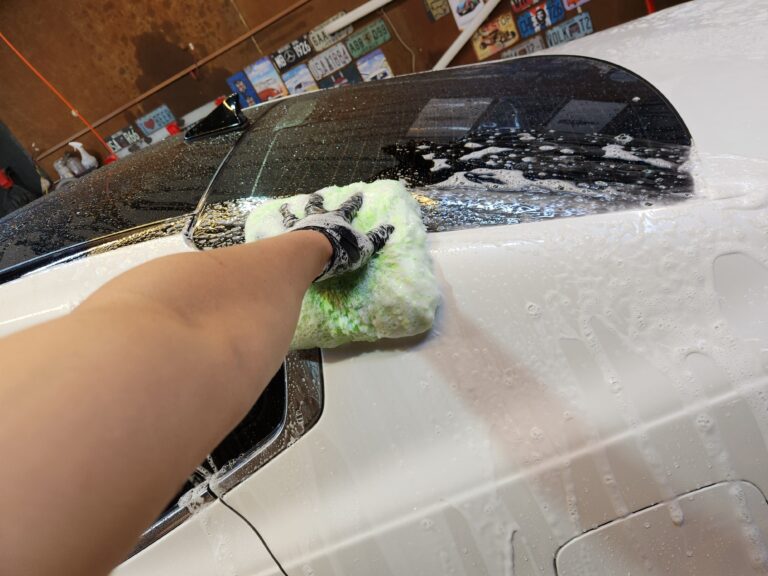
Alkaline cleaning weakens oily and organic contamination. Surfactants help disperse that contamination so water can carry it away. Rinsing and contact washing then physically separate the weakened mixed contamination layer from the paint.
This process also reduces loose iron particles, mineral residue, dust, and other particles mixed into the outer layer.
Alkaline pre-wash does not replace a dedicated decontamination product. It reduces unnecessary contamination that would otherwise react first and prepares the surface so the dedicated product can act on the bonded contamination that remains.
Removing the mixed contamination layer makes the real target clearer
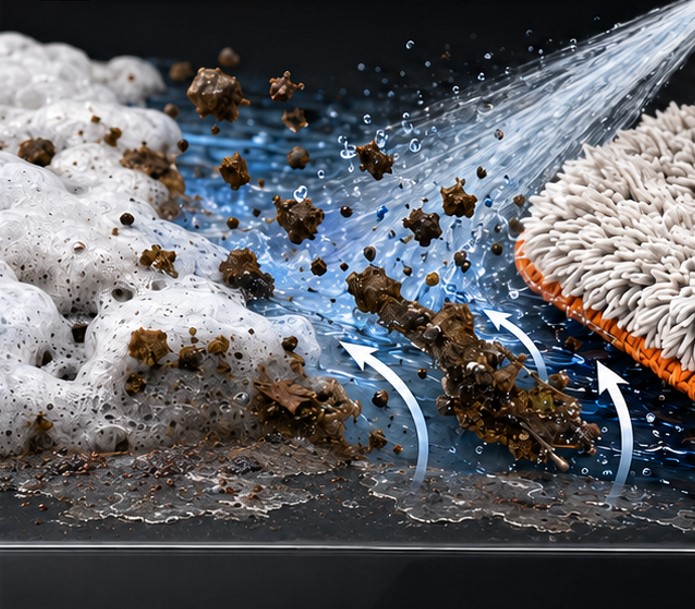
As you reduce the mixed contamination layer, the contact conditions between the paint, water, and dedicated cleaner improve.
A larger area of bonded contamination becomes directly accessible to an iron fallout remover or acidic cleaner. At the same time, fewer variables interfere with the action of the cleaning ingredients.
This does not mean alkaline pre-wash increases the strength of the dedicated product. It allows the dedicated cleaner to focus more directly on the contamination that actually needs removal.
The contamination that remains after washing is the real target
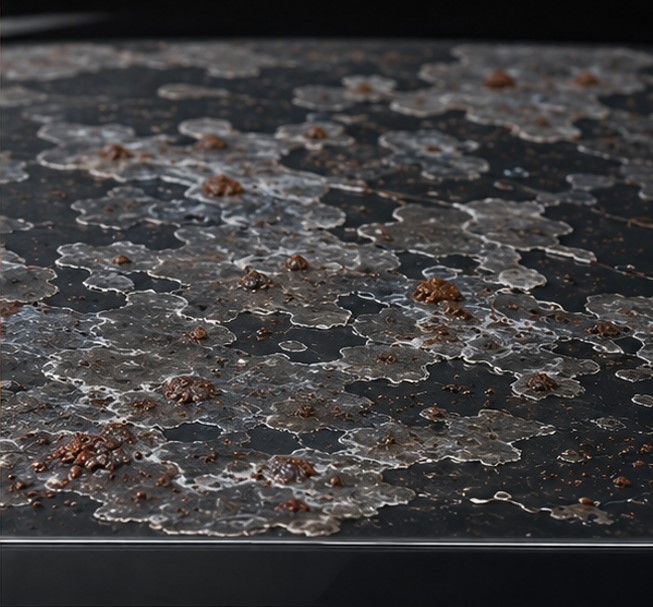
Before you remove the outer contamination layer, it can be difficult to determine whether a visible mark is ordinary dirt or truly bonded contamination.
An alkaline pre-wash, thorough rinse, and necessary contact wash reduce contamination that normal washing can remove. Iron particles, mineral deposits, surface roughness, and contamination films that remain afterward become the actual targets of the next decontamination stage.
The condition of the paint should guide your next step.
- If the paint feels rough or shows small yellow or orange spots, test it with an iron fallout remover.
- If white water marks remain, apply an acidic cleaner or water spot remover.
- If an unidentified contamination film remains, test a small area with a paint cleaner designed to remove residual contamination from automotive paint.
Paint cleaners differ considerably. Some rely mainly on chemical cleaning, while others contain fine abrasives or filling agents. You must interpret the result according to the product’s composition and method of action.
The contamination that remains after washing is the actual target of the dedicated decontamination process.
3. How to Identify Bonded Contamination After Washing
Paint condition after washing: The surface still feels rough
If the paint still feels rough after an alkaline pre-wash and contact wash, particulate contamination that resisted the regular wash may be bonded to the surface.
However, roughness alone does not confirm that the particles are iron. Start by applying an iron fallout remover and observe the reaction.
If the product turns purple, iron contributes to the rough texture. Remove the reacted iron, rinse thoroughly, and check the surface again.
If little or no iron reaction appears—or if the surface still feels rough after you remove the iron—the remaining particles may be non-ferrous contamination. These particles may be trapped within a hardened oily film or covered by coating residue.
Sometimes, people apply wet-applied protection products before properly decontaminating the paint. If particles and oily contamination remain during application, the protective layer can form over them and leave both the contamination and coating residue bonded to the surface. You may not easily remove this condition with a later alkaline pre-wash and regular contact wash.
If you see no meaningful iron reaction, applying more iron remover repeatedly will not solve the problem. Instead, test a small area with a paint cleaner designed to remove residual paint contamination. This helps determine whether it can weaken the remaining oily film and coating residue while physically separating the trapped particles.
Do not assume that every rough surface comes from iron. Check for an iron reaction first, then choose the next process based on what remains.
Paint condition after washing: White water marks remain
Not every water mark you see before washing is a bonded water spot.
As rainwater or wash water dries, it can leave behind minerals, oil, dust, and ordinary contamination. A drying mark formed on top of a mixed contamination layer can look similar to a mineral deposit bonded directly to the paint.
If the mark disappears after an alkaline pre-wash and contact wash, it was an ordinary drying mark that did not require a dedicated remover.
If a white mark remains after washing, minerals may be bonded directly to the paint.
Test a small area with an acidic cleaner or water spot remover. If the mineral deposit is removed, clarity should return. If the shape of the mark remains unchanged, the paint beneath the deposit may already be etched.
In that case, repeatedly applying an acidic product will not solve the problem. You must evaluate the surface to determine whether polishing is required.
Do not classify a water mark before washing. The marks that remain after removing ordinary contamination are the true targets of mineral decontamination.
Paint condition after washing: Gloss does not return and a hazy film remains
Even after an alkaline pre-wash and contact wash, the paint may still look cloudy instead of clear.
This can occur when oily contamination, old coating residue, and fine particles accumulate and bond together.
If you use a paint cleaner before washing, you may move ordinary contamination and loose particles across the surface with the applicator—even though normal washing could have removed them. This creates unnecessary friction and wastes the product’s action on contamination that did not require a dedicated process.
A paint cleaner does not replace the regular wash or remove the entire outer contamination layer. It serves as the next step for evaluating and removing the contamination film that remains after normal cleaning.
Apply the paint cleaner to a small test area and compare its gloss and texture with an untreated section.
If clarity returns and the surface becomes smoother, a bonded contamination film likely caused the issue. However, if the paint cleaner contains fine abrasives or filling agents, the visual improvement may not come solely from contamination removal. Always consider the product’s composition and method of action.
If gloss does not return even after removing contamination, the problem may involve paint damage—such as fine scratches, oxidation, or mineral etching. In this case, using a paint cleaner repeatedly is less effective than determining whether polishing is needed.
Do not assume that every loss of gloss comes from contamination. Consider how the product works and distinguish contamination from paint damage when gloss does not return after cleaning.
Frequently Asked Questions
1. Is it wrong to use an iron fallout remover before washing?
It is not universally wrong. However, if your goal is to target bonded iron, removing ordinary contamination first makes both the reaction and the removal result easier to interpret.
2. Can alkaline pre-wash remove iron and mineral contamination?
It can remove some loose iron particles and mineral residue mixed into the outer contamination layer. Contamination bonded directly to the paint requires a separate, dedicated removal process.
3. Does a strong color reaction mean that the iron is being removed effectively?
The color reaction only shows that the product has reacted with iron. It does not reveal where the iron was located, how firmly it was bonded, or how much you actually removed.
Evaluate the result after rinsing by checking whether visible iron contamination and surface roughness have decreased.
4. Does the preparation process end with alkaline pre-wash?
No. Alkaline pre-wash begins the process by weakening contamination. You must follow it with a thorough rinse and, when necessary, contact washing to physically separate and remove the weakened contamination.
5. Why should a paint cleaner be used after washing?
Removing ordinary dirt and loose particles first reduces the chance of dragging them across the paint with an applicator. It also allows the paint cleaner to focus on the bonded contamination that remains after washing.
Because paint cleaners vary in chemical cleaning ability, abrasive content, and filling properties, always check the product’s characteristics before use.
Conclusion | Bonded Contamination Removal Begins by Exposing the Target
A vehicle’s surface contains both contamination mixed into the outer layer and contamination bonded directly to the paint.
When you apply a dedicated remover before removing this outer layer, you may see a strong visible reaction. However, it becomes difficult to determine how much of that reaction involved the bonded contamination that actually needed removal. An oily mixed contamination layer can also create uneven wetting and contact conditions for the active ingredients.
Bonded contamination removal should begin with surface preparation rather than a dedicated decontamination product.
Once you remove the outer mixed contamination layer through alkaline pre-wash and contact washing, the bonded contamination that requires further treatment becomes exposed. You can then select iron fallout removers, acidic cleaners, water spot removers, and paint cleaners based on the actual condition of the paint.
If marks or loss of gloss remain even after the dedicated decontamination process, they may indicate paint damage rather than removable contamination. You must then evaluate the surface to determine whether polishing is required.
The objective is not to remove every form of contamination in a single step. It is to remove what you can safely remove first, then identify the nature of what remains.
Remove the outer mixed contamination layer first to reveal the bonded contamination underneath.
This is why alkaline pre-wash comes first. It reduces contamination that normal cleaning can remove and prepares the surface so each following decontamination process can focus on its intended target.
Even after thoroughly cleaning