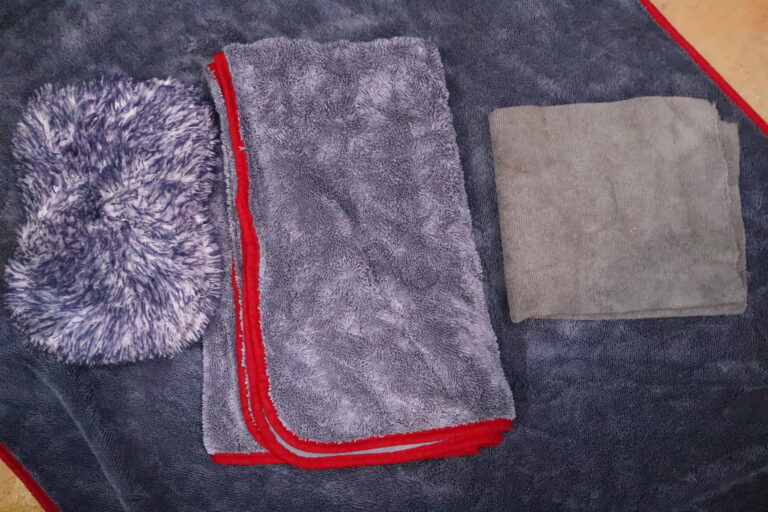
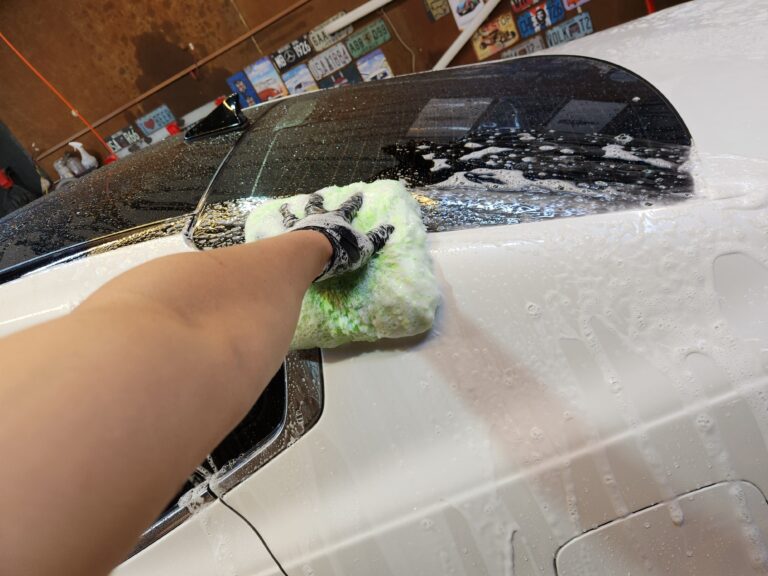
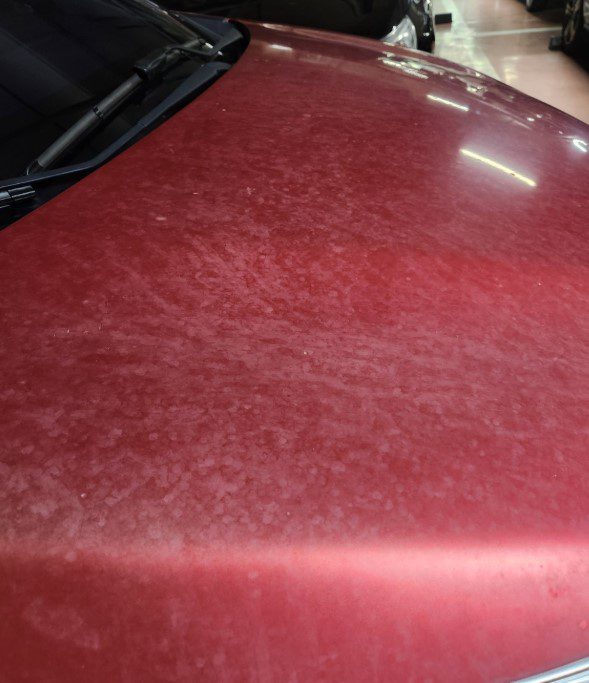
The difference between snow foam and car shampoo cannot be explained simply by calling one a pre-wash product and the other a contact-wash product. Both are generally built around surfactants, but their foaming, dwell time, lubrication, cleaning power, and rinsing behaviour vary according to the supporting ingredients and performance priorities of each formula.
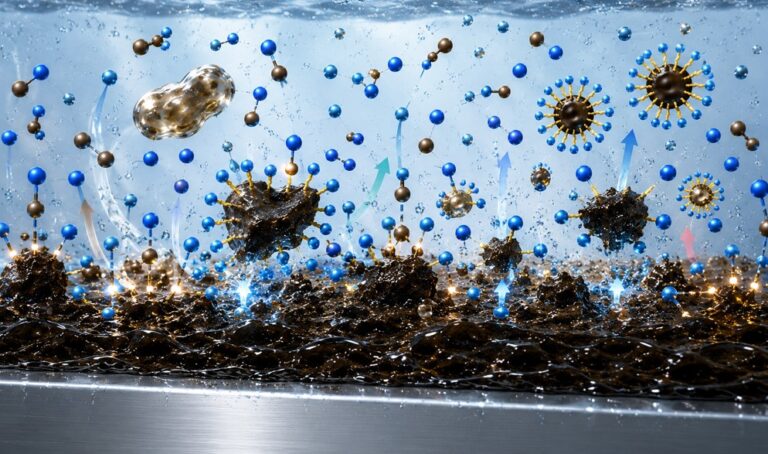
Surfactants help the cleaning solution wet contamination, allow oily soil to mix more readily with water, and keep loosened dirt dispersed instead of immediately redepositing on the surface. Foam stabilisers, viscosity modifiers, lubricating polymers, solvents, and chelating agents can then be added in different combinations to create snow foams, car shampoos, neutral cleaners, or dual-use products.
Instead of separating these products only by their labels, it is more useful to understand what the formula prioritises and how that changes its behaviour in use. This helps determine how a product can be used and whether another product would add a genuinely different capability or simply duplicate something already available.
Key takeaway
The difference between snow foam and car shampoo lies primarily in the balance of performance built into each formula. Snow foam usually focuses on wetting and dwell before contact, while car shampoo focuses on maintaining a continuous lubricating film and carrying loosened contamination away during contact washing. Dual-use products can provide both. The label alone does not define the full range of use.
Table of Contents
- What Does a pH-Neutral Snow Foam Do?
- How Is Car Shampoo Different from Snow Foam?
- How Formulation Changes Snow Foam and Car Shampoo Performance
- How Pre-Washing and Contact Washing Work Together
- When Neutral Snow Foam Is Not Enough
- Frequently Asked Questions
- Conclusion
1. What Does a pH-Neutral Snow Foam Do?
Why neutral snow foam is widely used for routine washing
A pH-neutral snow foam can clean vehicles with different paint-protection systems relatively conservatively. Rather than attempting to remove heavy oily contamination in one step, it wets recent dust and light road contamination before contact and reduces the amount of soil that must be handled during the contact wash.
Neutral snow foam is particularly useful for:
- Vehicles washed regularly before contamination becomes heavily established
- Vehicles mainly covered with recent dust and light road contamination
- Surfaces without a thick, widespread layer of oily road film
- Vehicles maintained with waxes, sealants, or ceramic coatings
- Vehicles protected with PPF or vinyl wraps
- Wash routines intended to reduce pressure and friction during contact washing
Ceramic coatings, PPF, vinyl wraps, waxes, and sealants are not permanent. Their service life can be affected by cleaning chemicals, sunlight, heat, outdoor parking, and repeated washing.
When strong chemical cleaning is unnecessary, using a suitable pH-neutral pre-wash can reduce avoidable stress on these protective surfaces.
To understand why contamination should be reduced before the wash mitt touches the paint, see Why Pre-Wash Before a Contact Wash?.
The cleaning solution works—not the foam alone
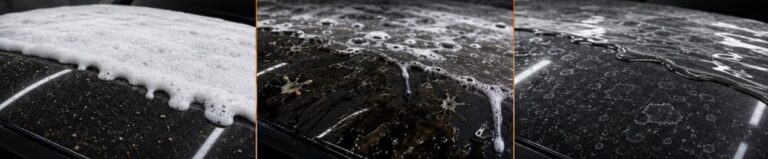
The purpose of snow foam is not simply to produce the thickest possible shaving-cream appearance. The liquid contained within the foam structure is what contacts and acts on contamination.
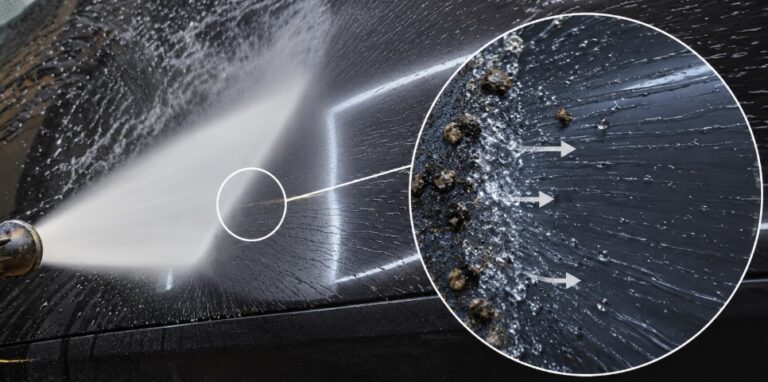
Surfactants help the solution spread over paintwork, wet contamination, and disperse oily soil. A pressure rinse then physically detaches loosened contamination and carries it away from the surface.
The process can be understood as:
Solution delivery → soil wetting → surfactant action → detachment and removal by rinsing
Foam is a delivery method that distributes the cleaning solution across a large area and helps it remain on the surface. Thick foam is not automatically more effective. A wet foam that covers the panel, moves slowly, and remains safe from drying may clean more effectively than foam that is extremely thick but does not wet the surface properly.
Not every pH-neutral cleaner behaves the same way
A neutral pH value does not reveal the product’s complete cleaning strength or compatibility with every protection system.
Some neutral pre-washes reinforce oily-soil cleaning with solvents, chelating agents, or penetration aids. These formulas may clean road film more effectively than a basic snow foam, but their effect on waxes, sealants, coatings, PPF, and wraps can also vary according to the ingredient type, concentration, exposure time, and surface temperature.
The advantage of a neutral pre-wash is not that it has no effect on protective layers.
A neutral cleaner designed for protected surfaces can provide a more conservative maintenance option when stronger chemical cleaning is unnecessary.
Different protection systems respond differently
The effect of a cleaner is not determined by pH alone. Surfactant strength, solvent type, concentration, dwell time, panel temperature, repeated exposure, and the type of protection all matter.
- Wax: Generally more sensitive to solvents that have an affinity for oily materials and to repeated exposure to strong cleaning solutions.
- Sealants and maintenance toppers: Water behaviour and slickness may decline first after repeated high-concentration cleaning.
- Ceramic coatings: The underlying coating may be chemically resistant, while a topper or silica-based maintenance product above it is removed first. Reduced water repellency or slickness can then make the coating itself appear degraded.
- PPF and vinyl wraps: Compatibility with the film’s topcoat, exposed edges, and any accessible adhesive should be considered.
A solvent-reinforced neutral foam may improve oily-soil removal, but it may also weaken waxes or oil-rich maintenance layers.
Chelating agents mainly bind mineral and metal ions. Their presence alone does not prove that a product will strip protection. The behaviour of the complete formula and the way it is used are more important.
A neutral pH describes acidity and alkalinity. It does not guarantee mild solvents or universal compatibility with every protected surface.
2. How Is Car Shampoo Different from Snow Foam?
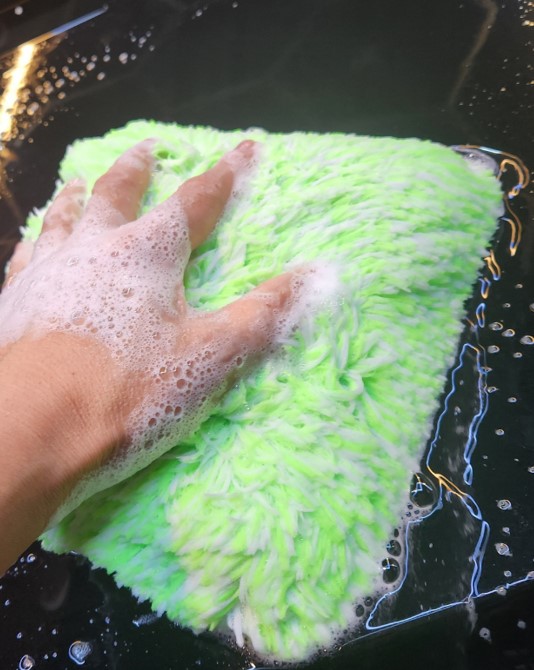
Car shampoo creates the conditions for contact washing
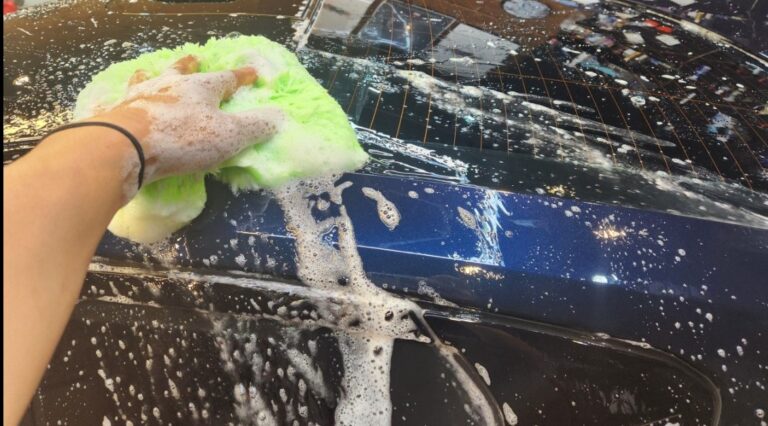
Some contamination remains after pre-washing and pressure rinsing. During the contact wash, a wash mitt physically detaches this remaining soil from the paint.
Car shampoo does more than chemically clean the surface. It supplies a large volume of wash solution, maintains a continuous lubricating film between the mitt and paint, and helps transport loosened contamination away from the direct contact zone.
The contact-wash process is:
Shampoo solution supply → lubricating film → soil detachment → transport → removal
When a wash mitt holds enough shampoo solution, liquid continues to flow towards the leading edge and contact area as the mitt moves. This supports lubrication and helps flush separated contamination away from the paint.
When the flow of shampoo solution decreases or contamination accumulates in the mitt, it is time to rinse and reload the mitt—not apply more pressure.
Lubrication is not created by one ingredient
Car-shampoo lubrication cannot be attributed universally to a single ingredient such as silicone or glycerine.
A basic lubricating film can be created by water and the surfactant system. Depending on the formula, polymers, humectants, viscosity modifiers, and different surfactant combinations can further improve slickness and film continuity.
Lubrication does not eliminate friction entirely. The solution forms a film between the mitt and paint that reduces direct contact and friction. It also reduces the likelihood of loosened solid particles dragging directly across the paint.
A car shampoo should therefore be assessed by several properties:
- Its ability to keep shampoo solution available as the mitt moves
- Lubrication between the wash media and paint
- Its ability to suspend and transport loosened contamination
- Resistance to soil redeposition
- Clean rinsing without excessive residue
A product should not be judged suitable for contact washing only because it feels slippery between the fingers or produces a large amount of foam. The lubricating film must remain during actual mitt movement while loosened soil is transported and removed safely.
Car shampoo can also be used as a pre-wash
A product labelled as car shampoo is not automatically limited to bucket washing.
If it provides suitable foaming, wetting, and dwell and supports foam-cannon or foam-lance application, it may also be used as a pre-wash. Conversely, a snow foam may produce excellent foam but still provide limited lubrication or film continuity for contact washing.
The product name is less important than the practical behaviour created by its formula and working concentration.
3. How Formulation Changes Snow Foam and Car Shampoo Performance
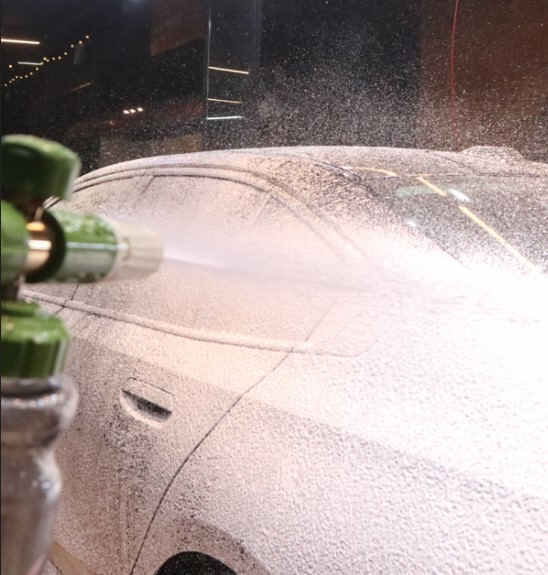
The same foundation can prioritise different results
The snow foam vs car shampoo distinction does not always begin with completely different primary ingredients. Both may share a surfactant foundation while being tuned around different priorities.
- Greater foam stability and dwell create stronger snow-foam performance.
- Greater lubrication and film continuity improve contact washing.
- Additional solvents and cleaning aids create a more intensive neutral cleaner.
- A balanced formula can support both pre-washing and contact washing.
Surfactants provide the fundamental cleaning action. Supporting ingredients and formula balance determine how the product performs in practice.
Neutral cleaners exist on a performance spectrum
| Formula priority | Potential benefit | What else to check |
|---|---|---|
| Foaming and foam stability | Wide application and dwell | Actual wetting and rinseability |
| Viscosity and cling | Longer dwell on vertical panels | Slow drainage and possible residue |
| Lubrication and film continuity | Lower contact-wash friction | Soil suspension, transport, and removal |
| Solvents and cleaning aids | Better oily-soil cleaning | Protection compatibility and foam stability |
| Balanced design | Pre-wash and contact-wash use | Whether each role performs well enough |
High foam production does not automatically mean poor lubrication, and the presence of a solvent does not always eliminate foam. Formulators can combine surfactants and supporting ingredients to maintain several properties.
However, it is difficult to maximise foaming, dwell, lubrication, cleaning power, rinseability, and protection compatibility simultaneously.
No neutral cleaner is automatically the best in every performance category.
Each formula is built around a different balance, so both its strengths and limitations should be considered.
Dedicated and dual-use products can both be valid
Some neutral pre-washes focus heavily on foaming and dwell. Some car shampoos place greater priority on lubrication and film continuity. Dual-use formulas are designed for both foam application and bucket washing.
The existence of dual-use products shows that the boundary between snow foam and car shampoo is not absolute.
The same concentrate can perform differently when its concentration and delivery method change. Foam application must account for additional dilution and dwell, while bucket washing uses a larger volume of solution to support lubrication, soil transport, and final removal.
This does not mean every neutral cleaner should be used interchangeably.
The important question is not whether products must or must not be dual-use. It is whether their real-world performance and working concentrations support both processes.
Buy by performance, not labels alone
Buying separate products labelled car shampoo, snow foam, and neutral pre-wash can result in overlapping capabilities.
If an existing cleaner provides adequate foam, dwell, lubrication, and rinsing, an additional product may add little. If one area is clearly insufficient in practical use, another formula may provide a useful difference.
Before buying, check:
- Whether foam-cannon and bucket use are both supported
- The recommended dilution for each application method
- Whether the solution wets and remains on the panel effectively
- Whether it maintains a continuous lubricating film during contact washing
- Whether solvents or additional cleaning aids are present
- Whether it rinses without residue or restricted water behaviour
- Whether repeated use is suitable for coatings, PPF, or vinyl wraps
- The concentrate used and actual cost per wash
Neither dedicated nor dual-use products are always superior. Labels suggest a general direction but do not describe the complete performance range.
Compare cost per wash, not price per litre
A lower bottle price does not always mean a lower washing cost.
Foam-cannon use can consume considerably more concentrate because of the stronger bottle mixture, equipment pickup rate, and overspray. A highly concentrated shampoo may cost more per litre but use much less product in a bucket.
Dual-use formulas can also reduce the number of separate products that need to be purchased and stored. However, one bottle is not automatically more economical if its foam-cannon consumption is high.
The simplest comparison is:
Cost per wash = price per millilitre × concentrate used per wash
Product price, dilution, equipment consumption, and the number of separate products required should be considered together.
4. How Pre-Washing and Contact Washing Work Together
The two processes divide the work
Snow foam and car shampoo are not necessarily competing alternatives. In a routine maintenance wash, they can work in sequence:
Apply neutral snow foam
↓
Wet and loosen light contamination
↓
Pressure rinse
↓
Reduce contamination before contact
↓
Contact wash with car shampoo and a wash mitt
↓
Detach, transport, and remove remaining soil
↓
Final rinse
Snow foam reduces the amount of contamination that reaches the contact stage. The pressure rinse physically detaches and carries away loosened soil. Car shampoo maintains a continuous lubricating film while the mitt removes what remains.
Rinsing is therefore not merely the final step of pre-washing.
Rinsing creates the first condition for safer contact washing by reducing the contamination left between the mitt and paint.
The same product may require different concentrations
A dual-use concentrate does not need to be used at the same concentration in a foam cannon and a wash bucket.
Foam application involves further mixing with pressure-washer water. Bucket washing uses a larger measured volume of water and must balance lubrication, soil suspension, drainage, and clean rinsing.
Increasing concentration may improve foam and dwell, but excessive concentration in a bucket can slow drainage and increase residue. An overly weak foam-cannon mixture may provide inadequate wetting and dwell.
The relationship between concentration, dwell time, mechanical cleaning, and rinsing is explained in 3PH Car Wash Cleaning Power: Concentration and Dwell Time.
A dual-use product does not perform every task through one universal dilution.
It allows the same concentrate to behave differently through changes in concentration and delivery.
Foam-cannon and bucket dilution ratios are not directly comparable
The dilution shown inside a foam-cannon bottle is not the final concentration reaching the paint. The premix is combined with additional pressure-washer water during application.
A bucket solution is mixed directly and therefore provides a more straightforward working concentration.
The following calculation is only a simplified example explaining additional foam-cannon dilution. Actual paint-surface concentration varies with the foam cannon’s pickup design, orifice, pressure-washer flow rate, adjustment setting, and product viscosity.
Estimated paint concentration = product concentration in the foam-cannon bottle ÷ additional equipment dilution
The following values are not recommended ratios for a specific product.
| Application | Initial mixture | Product concentration in mixture | Estimated concentration after additional dilution |
|---|---|---|---|
| Foam cannon | 1 part product : 10 parts water | About 9.1% | About 0.91% after 10× additional dilution |
| Foam cannon | 1 part product : 10 parts water | About 9.1% | About 0.45% after 20× additional dilution |
| Wash bucket | 1 part product : 500 parts water | About 0.20% | No additional dilution |
Under these hypothetical conditions, the foam application remains approximately twice as concentrated as the bucket solution even after 20× additional dilution.
Actual results can differ significantly. The ratio printed for the bottle should therefore not be treated as the final paint-surface concentration. Start within the recommended range and assess foam behaviour, dwell, wetting, and rinsing.
A foam-cannon ratio describes the mixture in the bottle. A bucket ratio is much closer to the actual working-solution concentration.
5. When Neutral Snow Foam Is Not Enough
Do not keep increasing neutral-foam concentration
Neutral snow foam is useful for recent dust and routine contamination, but it has limitations against established oily road film and hardened lower-panel contamination.
Continually increasing concentration may produce more foam and use more product without creating a proportional increase in cleaning power. Excess concentration can also make rinsing more difficult and temporarily reduce water behaviour on protected surfaces.
When cleaning is insufficient, first identify the type and distribution of the remaining contamination.
If neutral washing repeatedly leaves oily road film behind, see Alkaline Prewash vs Neutral Car Shampoo for the practical difference between the two stages.
Reinforce heavily contaminated areas with alkaline cleaning
Contamination may be concentrated on lower panels, the rear bumper, and the vehicle’s front rather than covering the entire car equally.
Instead of repeatedly applying strong alkaline cleaner over the whole vehicle, the process can be adjusted:
Apply alkaline cleaner locally to heavily contaminated areas
↓
Apply neutral snow foam over the vehicle
↓
Rinse thoroughly before drying
↓
Complete the contact wash with car shampoo
Alkaline cleaning is not a competing answer that makes neutral pre-washing incorrect. It reinforces the areas where neutral cleaning is insufficient.
Neutral cleaning is useful for conservative routine maintenance, while alkaline chemistry is more effective against established oily and organic contamination. Understanding both can prevent unnecessary cleaning strength from being applied across the entire vehicle.
For the reason oily and organic road film should be weakened before contact washing, see Alkaline Pre-Wash: Why It Comes First for Mixed Contamination.
Different contamination requires a different removal method
Increasing the concentration of a neutral or alkaline cleaner will not remove every contaminant.
- Iron contamination requires chemistry designed to react with iron.
- Tar requires a compatible solvent.
- Thin mineral residue may require acidic cleaning.
- Established water spots may require a dedicated remover, paint cleaner, or polishing.
- Bonded surface contamination may require clay and controlled physical separation.
When contamination remains, the answer is not always greater concentration or stronger pressure. If the contamination has changed, the chemical and physical removal method must change with it.
Frequently Asked Questions
Are snow foam and car shampoo the same product?
Not necessarily, although many products share a surfactant foundation. Their behaviour changes according to whether they prioritise foam and dwell, lubrication and film continuity, solvent cleaning, or a balance of several properties.
What is the main difference between snow foam and car shampoo?
Snow foam generally prioritises solution delivery, wetting, and dwell before contact. Car shampoo generally maintains a continuous lubricating film and supports soil suspension, transport, and removal during contact washing. The boundary is not absolute, and dual-use products can support both.
Can I wash a car using only one neutral snow foam?
Yes, if the product is designed to provide both pre-wash performance and the lubrication required for contact washing. Foam volume alone is not enough. It must maintain a lubricating film and carry loosened contamination away while the mitt moves. A dedicated pre-wash foam may still require a separate car shampoo for the contact stage.
Can I use car shampoo in a foam cannon?
It may be possible when the product supports foam application and provides sufficient foaming, wetting, and dwell. Do not apply the bucket dilution automatically. Additional equipment dilution and actual panel behaviour must be considered.
Can I use neutral snow foam for contact washing?
It may be suitable if it provides enough lubrication, film continuity, and soil suspension. Thick foam alone does not prove that a formula is appropriate for mitt washing.
Is pH-neutral pre-wash completely safe for coatings and PPF?
No cleaner is universally harmless. Solvents, cleaning aids, concentration, temperature, and dwell time can affect waxes, toppers, coatings, PPF, and wraps differently. Neutral pH supports conservative maintenance but does not guarantee compatibility with every protection system.
Does thicker foam provide stronger cleaning?
Not necessarily. Foam is a delivery and dwell mechanism. Cleaning power also depends on the surfactant system, supporting ingredients, working concentration, wetting, dwell time, and pressure rinsing.
Should I increase concentration when neutral pre-wash leaves contamination?
Concentration can be adjusted within the supported range, but continual increases may be inefficient. Oily contamination may require targeted alkaline cleaning, while iron, tar, and mineral contamination require chemistry appropriate to each contaminant.
Are dedicated products better than dual-use products?
Neither is always better. A dedicated formula can prioritise one area of performance, while a dual-use formula can support several processes. Its strengths, limitations, dilution, and cost per wash are more important than the category printed on the label.
Conclusion: Judge Performance, Not the Label
Snow foam and car shampoo may share the same surfactant foundation, but they are tuned around different priorities. Snow foam generally focuses on pre-contact wetting and dwell, while car shampoo focuses on maintaining a continuous lubricating film and carrying loosened contamination away during contact washing. Some products can perform both roles.
Choose products by how they behave in your wash process—not simply by whether the bottle says snow foam or car shampoo.
Consider dilution, application method, lubrication, rinseability, protection compatibility, and cost per wash together.
The same concentrate can produce different results when concentration and delivery change. Product design sets the direction of performance, while concentration, tools, dwell time, rinsing, and contact technique determine the result in practice.
Cleaning Power = Product Design × Real-World Use