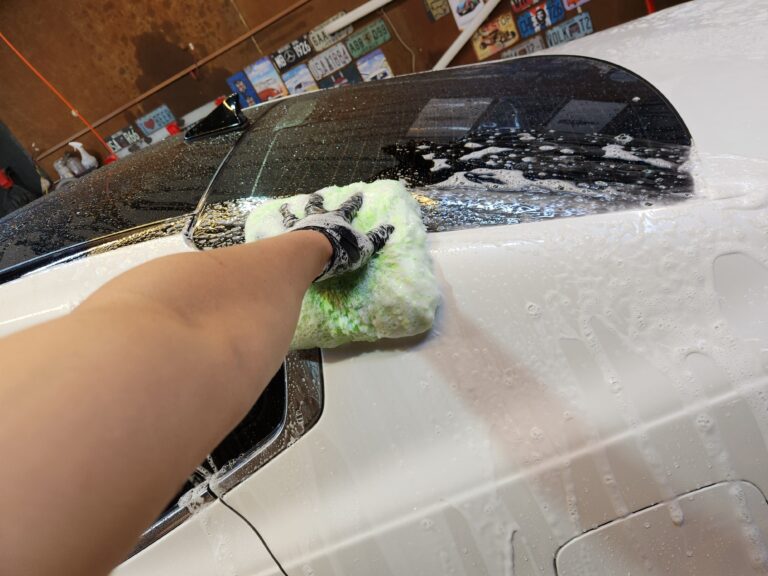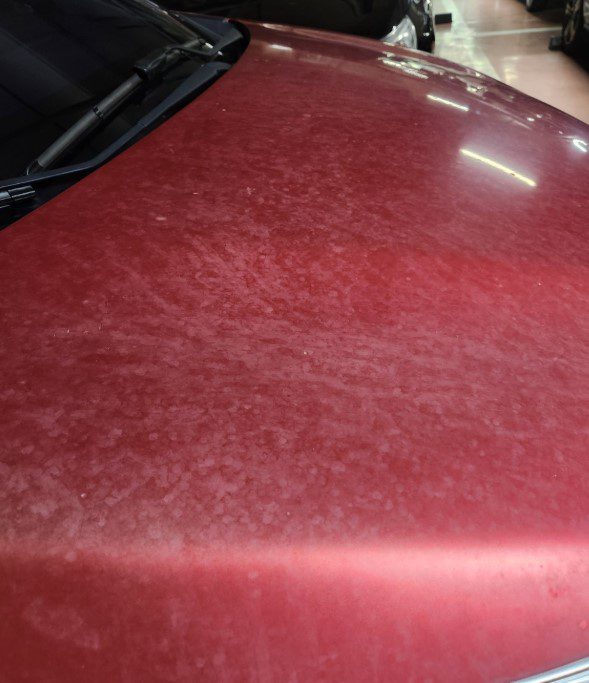
After pre-washing and rinsing, you place a wash mitt on the first panel.
But the mitt feels rougher than expected as it moves. Should you push harder, or should you stop contact?
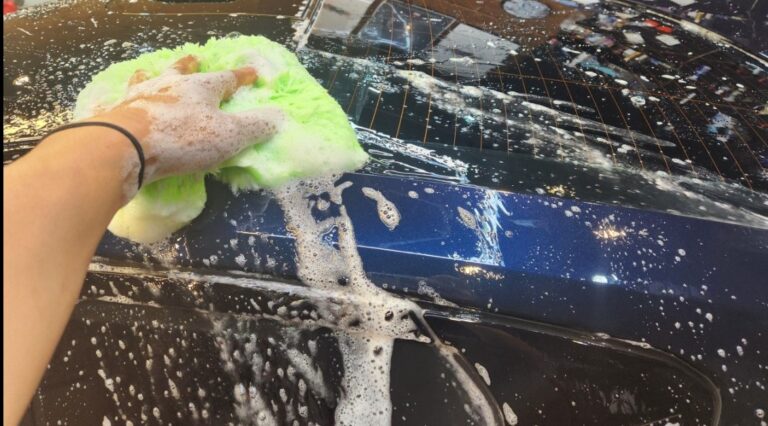
You rinse the mitt and load it with plenty of shampoo water. Water begins to flow again in the direction of travel, and the mitt moves more smoothly across the same panel.
The difference did not come from hand pressure.
It came from the amount of contamination reduced by the previous step, the structure of the mitt, and the lubrication and flushing created by the shampoo water.
So why do we avoid using a wash mitt during pre-wash and begin contact only at the wash stage? And why do tools become thinner and denser as the detailing process progresses?
These self-service car wash principles do not prescribe a fixed sequence. They explain how each stage prepares the conditions required by the next.
In Part 1 | Pre-Wash and Car Shampoo Cleaning Power: Why Chemical Reactivity Matters, we examined the limit of chemical cleaning power. We cannot increase reactivity indefinitely because every vehicle material must remain safe.
In Part 2 | Physical Cleaning Power: How Surface Contact Changes Cleaning and Scratch Risk, we examined the limit of physical cleaning power. We cannot increase surface contact indefinitely while particles remain on the paint.
Why Does Each Stage Use a Different Type of Contact?
No arbitrary convention dictates the sequence of a car wash. These two safety limits shape its structure.
We do not place a tool directly on the paint during pre-wash. A wash mitt, however, deliberately uses a thick, long pile. Even a polish designed to abrade the surface contains lubricants and dispersing agents.
These choices may look unrelated, but all of them come from the limits of chemical and physical cleaning.
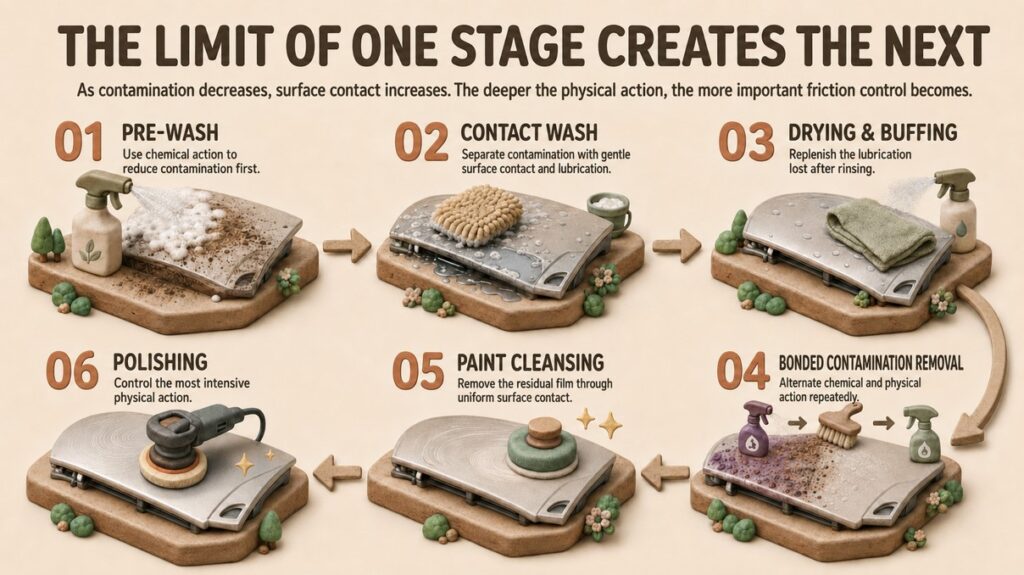
This article does not simply list what happens at each stage. It follows why each stage must take its particular form and how the problem left by one stage creates the need for the next.
Each stage passes what it cannot resolve to the stage that follows.
The sequence below is not a fixed procedure that every vehicle must follow. You may remove bonded contamination while the paint is still wet after washing, and the timing depends on the type of contamination and the chosen product.
A well-maintained vehicle, by contrast, may need only pre-washing, contact washing, and drying.
This sequence shows how permissible surface contact and product roles change as each stage reduces contamination.
Before we begin, one term needs to be clear.
How Does Surface Contact Change as the Wash Progresses?
In this article, surface contact does not mean hand pressure alone. It means how directly and evenly a tool follows the surface.
The long pile of a wash mitt, the thickness and density of a towel, and the structure of a pad all change the nature of that contact. As the process advances, it is not hand pressure that increases. Instead, each new task requires a tool that makes more direct contact.
The standard for judging that contact is:
Scratch risk = Contamination × Pressure × Friction × Movement
This is not a formula for calculating an exact number. It is a framework that shows the variables that create contact risk.
As washing progresses, contamination decreases. At the same time, contact area and surface conformity increase. Once rinsing removes the car shampoo, friction becomes a new variable.
Even so, less contamination does not give us permission to increase pressure and movement without control.
📌 Key Points from This Article (Click to Expand)
The Two Limits
- The Limits of Chemical and Physical Cleaning
We cannot keep increasing pre-wash chemistry because vehicle materials must remain safe. A wash mitt cannot use unlimited surface contact because of scratch risk. These two limits shape the structure of the wash process.
From Pre-Wash to Drying
-
Pre-Wash | Starting with Chemistry
Because we cannot yet place a tool directly on the paint, chemical reactions and high-pressure water reduce contamination first and prepare the surface for safer contact.
-
Contact Wash | Low Surface Contact and Lubrication
After pre-washing reduces the contamination load, the long pile of a wash mitt and the lubrication of shampoo water separate and flush away general contamination.
-
Drying and Buffing | Managing Friction
Contamination has decreased, but rinsing has also removed the shampoo. Moisture and lubricating ingredients must now control friction.
From Bonded Contamination to Polishing
-
Bonded Contamination Removal | Repeating Chemistry and Physical Separation
The correct chemical reaction weakens mineral deposits, iron particles, tar, or other bonded contamination. Physical contact then removes the weakened layer and exposes a new reaction surface.
-
Paint Cleansing | Uniform Surface Contact
A pad and cleaning ingredients refine a mixed contamination film across the paint, while lubrication stabilizes the greater surface contact.
-
Polishing | The Deepest Physical Action with Chemical Support
Polishing corrects the paint rather than removing contamination. Abrasive dispersion and pad lubrication control this stronger physical action.
💡 In One Sentence
Car washing is not a choice between chemistry and physics. It is a process of letting one take over where the other must stop.
Contents
- Pre-Wash | Chemistry Comes First Because Direct Surface Contact Is Not Yet Safe
- Contact Wash | Contact Is Now Possible, but Only at a Low Level
- Drying and Buffing | A Clean Surface Still Creates Friction
- Bonded Contamination Removal | Chemistry and Physical Separation Must Alternate
- Paint Cleansing | When There Is No Single Target, Contact Becomes Uniform
- Polishing | The Deepest Physical Action Needs Greater Chemical Support
- Frequently Asked Questions
- Conclusion
1. Pre-Wash | Chemistry Comes First Because Direct Surface Contact Is Not Yet Safe
Why Is Direct Tool Contact Unsafe at This Point?
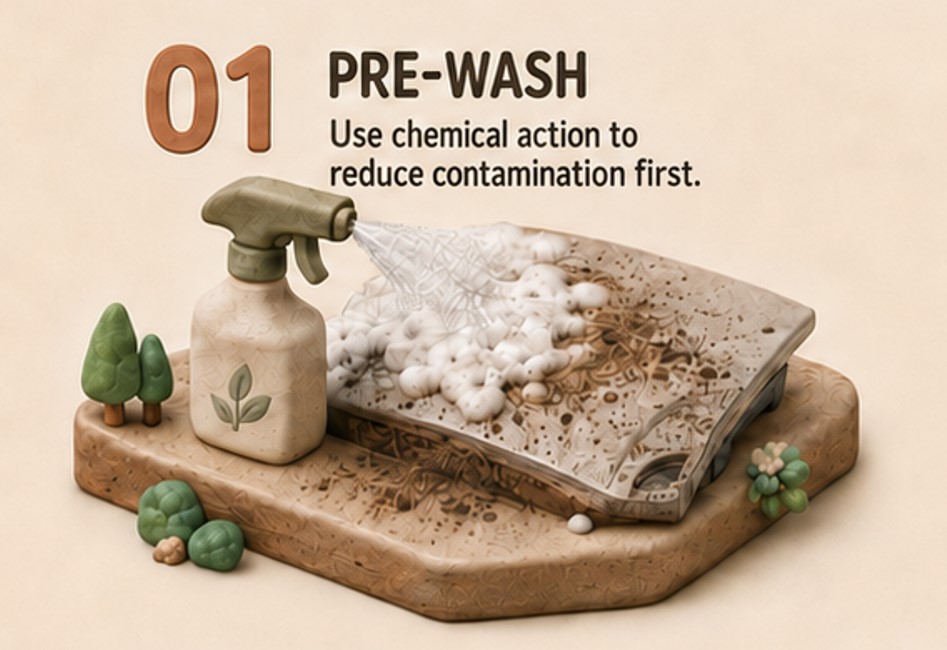
Tool contact creates physical cleaning power. At the beginning of a wash, however, oily and organic contamination films still hold particles such as soil and sand.
Direct tool contact traps those particles between the tool and the paint.
When the tool moves, the trapped particles move with it. That movement combines contamination, pressure, friction, and motion—the four variables that create scratch risk.
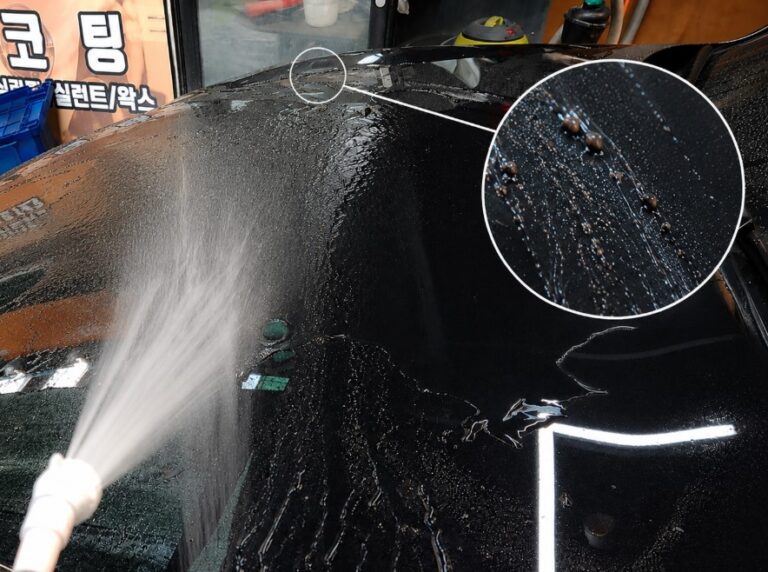
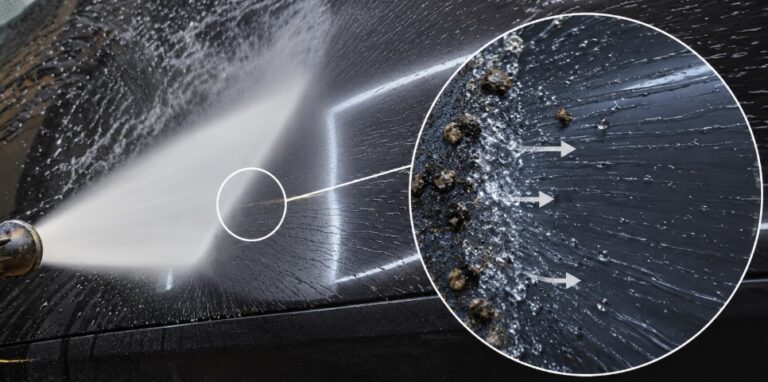
For this reason, pre-washing does not merely reduce surface contact. It avoids direct tool contact altogether. The physical force used at this stage comes from the impact and flow of high-pressure water rather than a mitt or towel.
Chemical cleaning power cannot finish the process alone, either. No matter how much a cleaner weakens the bonds within contamination, the weakened material does not leave the paint by itself.
The cleaner reduces the forces holding the contamination together, and high-pressure water pushes the weakened material away and carries it off the paint. Chemical action fills the role left by the absence of direct tool contact, while water performs the separation and recovery that chemistry cannot complete.
What Does Pre-Wash Leave Behind?
Increasing chemical reactivity or extending dwell time can weaken more contamination. But a pre-wash cleaner touches not only the paint. It also reaches rubber, plastic, metal, and trim.
We cannot increase reactivity indefinitely just to match the contamination. The vehicle’s most vulnerable material sets the upper limit.
Pre-washing is therefore not a stage that removes every contaminant and finishes the job. Its purpose is to remove as much as high-pressure water can carry away and create a condition in which direct contact is reasonably safe.
A thin film of general contamination, fine particles, and bonded contamination that high-pressure water cannot remove may remain. The next stage introduces a wash mitt to remove the thin general contamination film.
What pre-wash leaves behind is the reason the contact wash exists.
Related Reading
- Car Pre-Wash Guide | Neutral, Alkaline, and Acidic Pre-Wash Explained
- Why Pre-Wash Before a Contact Wash?
- 3PH Car Wash Cleaning Power Part 2 | Concentration, Dwell Time, and Physical Cleaning
2. Contact Wash | Contact Is Now Possible, but Only at a Low Level
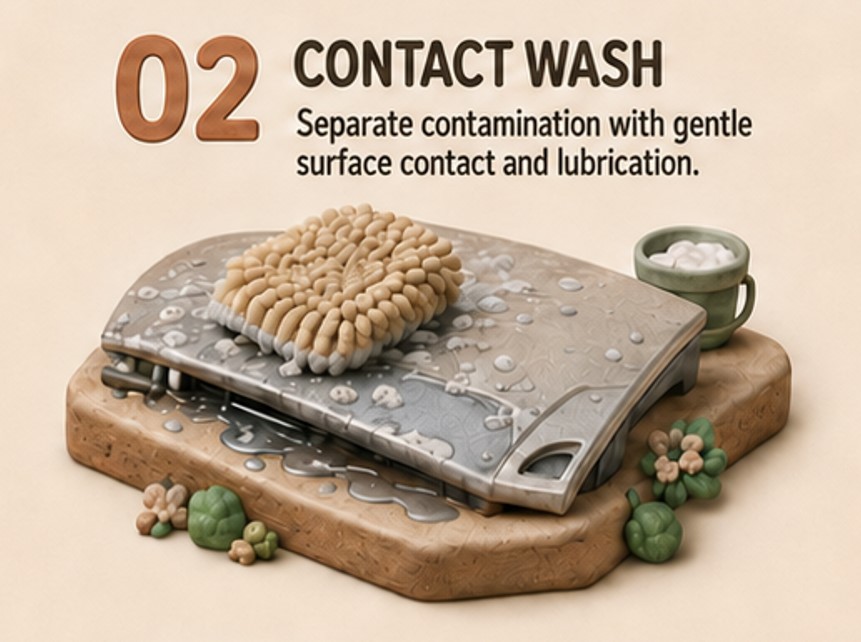
What Makes Contact Possible?
A wash mitt can touch the paint at this stage not because it is an inherently safe tool, but because pre-washing has already reduced the number of particles and contamination films that can move freely across the surface.
The amount and condition of the remaining contamination always determine how much surface contact is permissible.
Fine particles may still remain after pre-washing, so high surface contact is not yet safe. The thick, long pile of a wash mitt is not safe merely because the material feels soft.
Its structure reduces how directly the mitt touches the paint and provides space between the fibers to receive separated particles and isolate them from the contact area.
Contact Requires Both Car Shampoo and Flowing Shampoo Water
Car shampoo must also be present when contact begins. We need to distinguish its two functions.
The cleaning ingredients in car shampoo loosen the contamination film left after pre-washing. Its lubricating ingredients and the shampoo water, by contrast, reduce friction between the paint and the mitt.
Chemical cleaning power acts on contamination, while lubrication stabilizes contact. Although these functions differ, the wash requires both.
When a wash mitt holds plenty of shampoo water, that solution flows out in the direction of travel. The flow continuously supplies lubrication between the mitt and the paint while pushing separated contamination away from the point of contact.
The cleaning power of a wash mitt therefore does not come only from rubbing the surface with its pile.
Cleaning ingredients that loosen contamination + long pile that reduces direct contact + lubrication and flushing created by abundant shampoo water
These three conditions must work together to separate general contamination with relatively low risk.
If the flow of shampoo water decreases or the mitt begins to drag, it is not time to add pressure. Rinse the mitt to release the contamination held inside, reload it with clean shampoo water, and then resume contact.
What Does the Contact Wash Leave Behind?
The design of a wash mitt separates general contamination, receives it within the pile, and helps flush it away. That same design cannot tear bonded minerals, iron particles, or tar from the paint through pressure.
If you try to remove these contaminants with mitt pressure, remaining fine particles and newly separated fragments can move together across the paint.
When rinsing carries away the contamination and car shampoo, the lubrication that protected the space between the mitt and the paint disappears as well.
The contact wash ends by leaving two things behind: bonded contamination that a wash mitt cannot safely address, and a surface that has lost most general contamination as well as shampoo lubrication.
From this point, the center of scratch risk shifts. The main concern is no longer carrying a heavy contamination load across the paint, but precisely controlling the friction created by towels and pads.
Related Reading
- Snow Foam vs Car Shampoo | Differences, Uses, and Selection Criteria
- Physical Cleaning Power | How Wash Mitt and Towel Contact Changes Cleaning and Scratch Risk
3. Drying and Buffing | A Clean Surface Still Creates Friction
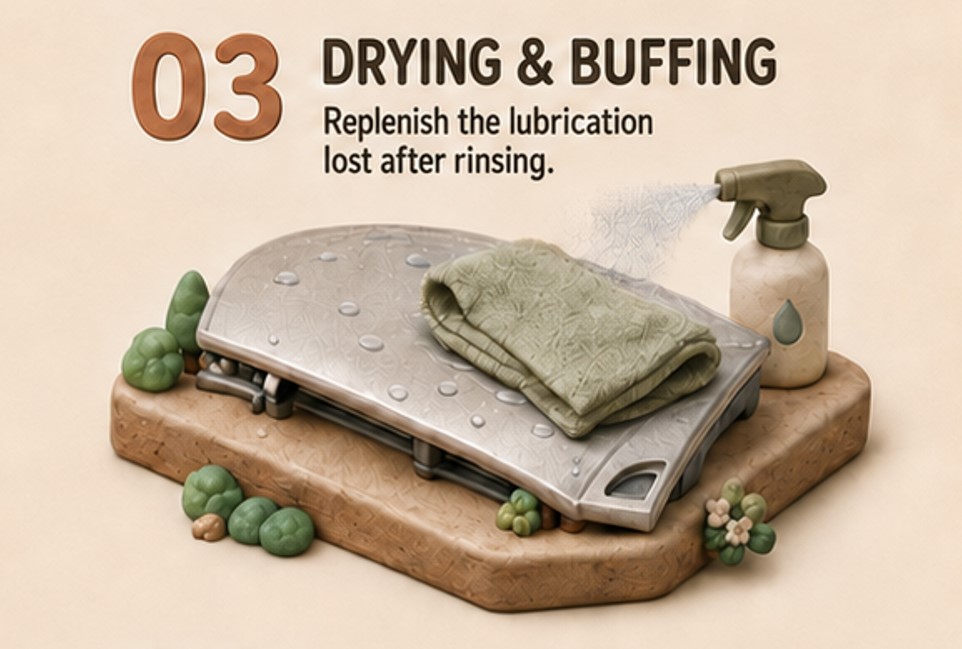
Why Does Contact Risk Remain on a Clean Surface?
Washing and rinsing greatly reduce the number of particles that can move freely across the paint. For the first time, conditions allow more precise surface contact.
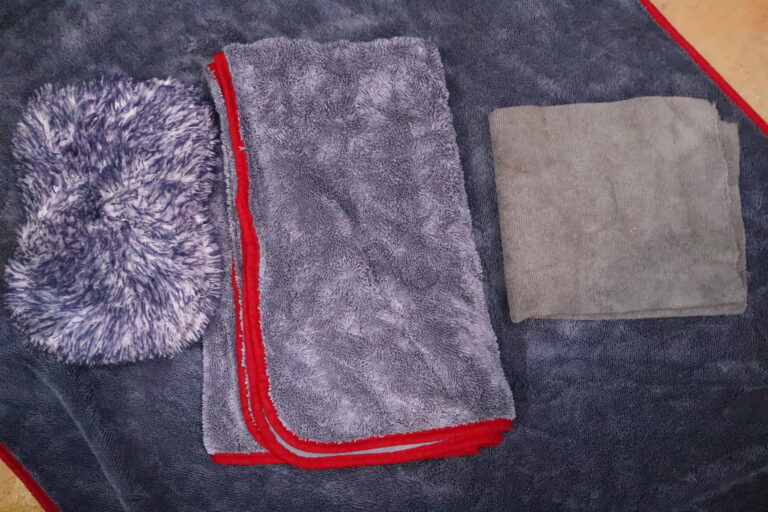
The structure of the tool changes as well. A wash mitt needs a thick, long pile to receive remaining particles, whereas a drying towel mainly handles water.
A buffing towel handles thin residues from waxes or sealants, so its denser structure generally follows the surface more evenly.
As the process moves from washing to drying and buffing, the tool changes from a structure that isolates particles to one that precisely recovers water and thin residue. Earlier stages have reduced the contamination load enough to allow more direct surface contact.
But the same rinse that removed contamination also washed away water and car shampoo. Rinsing has now removed the lubrication between the paint and the tool.
Risk does not disappear in this section of the process; its character changes. Earlier, the concern was particles moving with the tool. Now the concern is friction on a surface with limited lubrication.
The Role of Products Changes Here
This is why the moisture and lubricating ingredients in drying aids and protection products still matter even when technicians need to remove little general contamination.
Chemical cleaning power plays a much smaller role at this stage. Instead, moisture and lubrication reduce the towel’s resistance to movement and help prevent contact from catching at one point.
This is not chemical cleaning power that weakens contamination. It is friction management that allows physical contact to remain even and controlled.
Do not repeatedly rub a dry surface with a drying towel or try to remove hardened, grabby residue by adding buffing pressure.
Check the remaining moisture and the condition of the product. Add lubrication or reduce the working area when necessary.
What Do Drying and Buffing Leave Behind?
A drying towel absorbs water, and a buffing towel removes thin product residue. Neither tool should remove remaining general contamination through high surface contact.
If black contamination appears on a clean towel, that is not a sign to keep wiping. It means that a previous stage has left contamination on the paint. Stop contact and return to the necessary cleaning stage.
In other cases, no general contamination appears on the towel, but isolated marks, roughness, or dull gloss remain.
This may indicate a different type of contamination that the tools used so far cannot address effectively.
The remaining problems revealed during drying and buffing lead to bonded contamination removal.
Related Reading
- Practical Car Drying Guide | Drying Towel Use and Air-Drying Sequence
- Car Buffing Principles | Towel Saturation and Swirl Management
- Car Swirl Marks | Causes and How to Reduce Them
4. Bonded Contamination Removal | Chemistry and Physical Separation Must Alternate
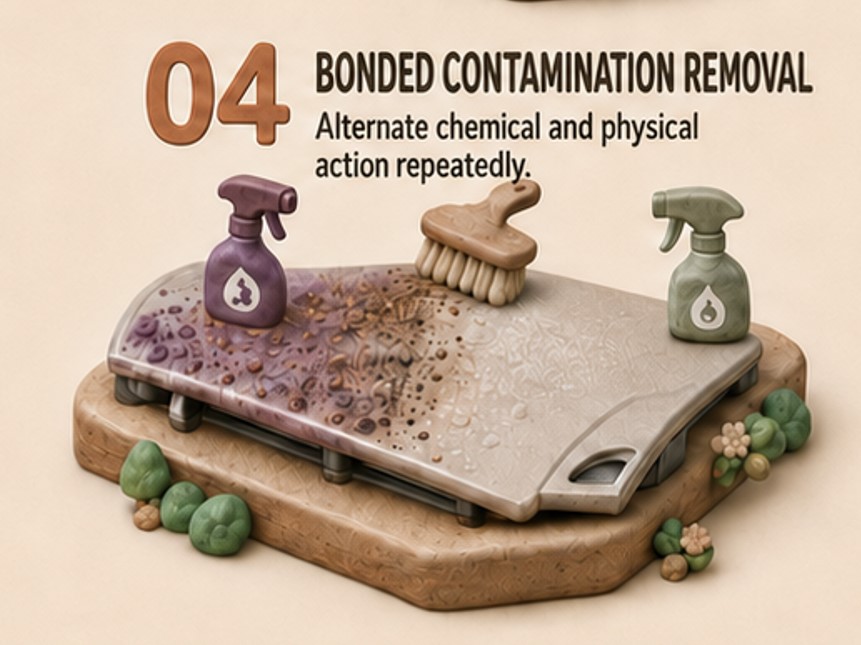
Why Can Neither Side Finish the Job Alone?
Earlier stages have already reduced general contamination and freely moving particles, so specific areas can now accept more precise physical contact. Bonded contamination moves less than loose particles, allowing a suitable tool to follow the surface more directly while you check the condition.
The proportion of physical separation can therefore increase compared with the previous wash stage. A second wash that combines an acidic cleaner or acidic shampoo with a wash mitt or brush uses this condition.
The selected chemical reaction weakens the contamination while the tool physically separates the weakened surface layer.
This does not mean that you should tear unreacted bonded contamination away with pressure alone. Physical contact now becomes possible, but pressure still cannot replace chemical weakening.
You also cannot keep increasing the reactivity of a general-purpose cleaner. As pre-washing showed, reactivity must remain within the range that vehicle materials can tolerate.
Instead of increasing only the strength of the reaction, this stage changes the type of reaction. Choose acidic cleaners for mineral deposits, iron removers for iron contamination, and suitable solvents for tar.
First remove general contamination; then identify what remains and choose the correct target.
Layered Contamination Requires a New Reaction Surface
Even the correct product may not remove accumulated bonded contamination in one attempt. Repeated deposits form layers, and the cleaner first reacts with the exposed outer surface.
The cleaner weakens the outer layer, the tool separates the weakened portion, and rinsing or a towel carries it away. When the tool removes the outer layer, it exposes a new contamination surface that the deposit previously covered.
The cleaner can then act on this newly exposed surface before the tool separates the weakened layer again.
Chemical weakening → Physical separation → New contamination surface exposed → Chemical action again
One reaction and recovery cycle may remove thin, early-stage contamination. Layered contamination, however, becomes thinner only when you separate the reacted surface in time and repeatedly expose a new reaction surface.
Fragments released during this process become loose particles again. Do not continue rubbing while those particles remain on the paint. Remove them immediately with rinsing or a towel.
What Does Bonded Contamination Removal Leave Behind?
The correct reaction and controlled physical separation can remove contamination with an identifiable target. Even then, the whole paint surface may still appear dull or retain a thin residue.
What remains may be a mixed film of light oil, aged protection products, cleaning residue, and other contamination that is difficult to define by a single property.
Because there is no single reaction target, repeating the same specialized chemical more aggressively does not refine the entire surface evenly.
The problem has now shifted from a local target to the full paint surface. This is where a paint cleaner enters the process.
Related Reading
- Why Alkaline Pre-Wash Comes First | Preparing Bonded Contamination for Targeted Cleaning
- Mineral Contamination vs Water Spots | What Is the Difference?
- How to Use Acidic Pre-Wash | Sequence, Concentration, Foam, and Rinsing
5. Paint Cleansing | When There Is No Single Target, Contact Becomes Uniform

Why Does the Approach Change Here?
Acidic cleaners, iron removers, and tar removers have relatively clear reaction targets. A paint cleaner, by contrast, does not select and remove only one type of bonded contamination.
It evenly refines the oil, aged protection products, cleaning residue, and mixed contamination film left across the paint.
Instead of identifying one contaminant and reacting with it, the process distributes the cleaning ingredients evenly across the paint and uses a pad or applicator to work uniformly over the surface.
This is possible because the earlier stages have already reduced loose particles, general contamination, and identified bonded contamination. The tool can therefore change from a wash mitt that receives particles within its pile to a pad or applicator that follows the entire surface evenly.
Surface contact has increased, but that does not mean you should simply press harder.
Cleaning Ingredients, the Pad, and Lubrication Perform Different Jobs
The cleaning ingredients in a paint cleaner weaken contamination and residue left on the paint. The pad spreads the product across the working area and physically separates the weakened contamination with consistent contact.
A towel then recovers the product and the separated contamination together.
At the same time, greater surface contact transfers pad friction more directly to the paint.
Because no car shampoo remains on the surface at this point, the lubricating ingredients within the paint cleaner must stabilize contact.
Lubrication does not increase the chemical cleaning power of the paint cleaner.
It allows the greater surface contact to remain uniform across the panel by preventing the pad from grabbing or concentrating friction at one point.
Not all paint cleaners work in the same way. Non-abrasive products rely mainly on cleaning ingredients and pad contact to remove contamination films and residue.
Products containing fine abrasives can also perform very shallow surface refinement. Check the character of the product, the pad, and the working area before use.
What Does Paint Cleansing Leave Behind?
After a paint cleaner has done its job, few contamination films or residues should remain on top of the paint.
If marks or dull gloss remain, do not immediately add pressure. First determine whether the remaining issue is contamination on top of the surface. It may instead be a height difference in the clear coat itself, such as etching, oxidation, or scratches.
If the shape of the clear coat has changed rather than something simply sitting on top of it, cleaning cannot restore it.
The cleaning process ends here, and paint correction begins.
Related Reading
6. Polishing | The Deepest Physical Action Needs Greater Chemical Support
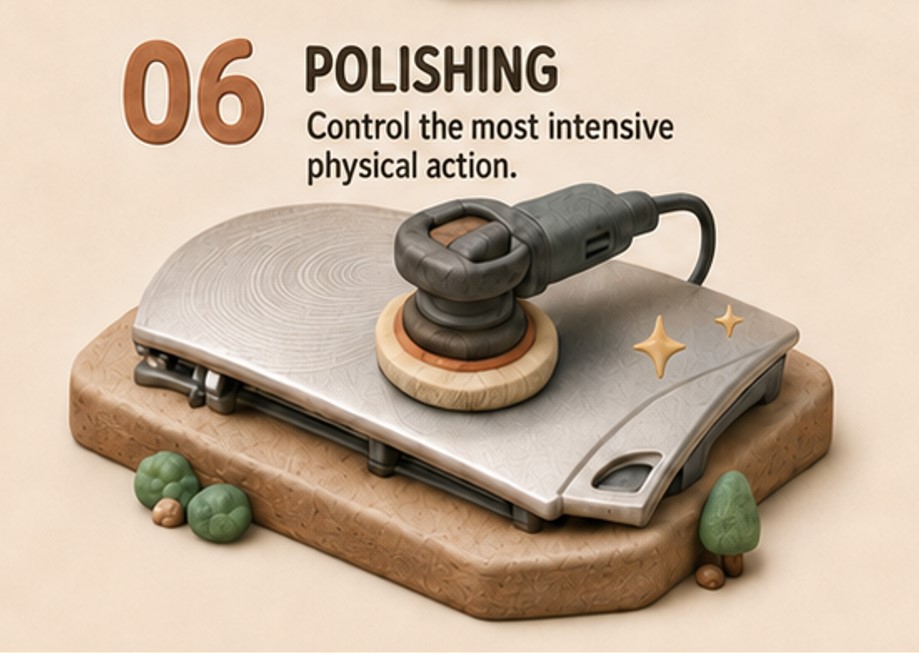
Correction Is Not Stronger Cleaning
This process does not scrub the remaining contamination more aggressively. It uses a pad and abrasives to remove microscopic high points in the clear coat and reduce the surface height differences that create defects such as swirl marks and etching.
Polishing is therefore not the automatic next step when cleaning power seems insufficient. Consider it only after distinguishing removable contamination from an actual paint defect.
Why Polishing Requires a Clean Working Surface
Polishing uses the deepest physical intervention in the detailing process. The pad makes broad, sustained contact with the paint, and machine rotation and movement repeatedly work the abrasives across the surface.
If particulate or bonded contamination remains, the pad can drag it across the panel and create unintended scratches. Contamination also interferes with the pad and abrasives and makes the true depth of paint defects harder to judge.
The cleaning stages that precede polishing—from pre-washing and contact washing to bonded contamination removal and paint cleansing—do more than make the paint look clean. They create a clean working surface that supports the highest level of contact and repeated movement.
Why Compounds Need Lubrication and Dispersing Agents
Polishing continuously draws abrasives into the working area. As the pad rotates and moves while remaining in contact with the paint, the abrasives keep moving across the surface. Removed clear coat and broken-down abrasive material accumulate at the same time.
Unlike the previous stages, polishing does not deal only with existing contamination. The work itself continuously changes the surface condition.
This is why compounds contain more than abrasives. Lubricating ingredients keep the pad moving evenly without grabbing or concentrating friction and heat in one area. Dispersing agents keep abrasive particles separated and distributed across the working surface. These conditions allow the same movement to produce a consistent result across the panel.
In earlier stages, chemistry always preceded physical action: it weakened contamination before tools removed it. During polishing, however, the working conditions continue to change while physical action takes place. Physical action therefore needs chemical support during and after the work, not only before it.
Adding pressure because the result is insufficient increases only the physical side. If force increases while the conditions that support it remain unchanged, correction does not become uniformly stronger. Heat and friction become concentrated in specific areas.
Create the required correction by adjusting the pad and abrasive combination, machine movement, working area, and number of passes together.
Polishing is the stage with the deepest physical intervention. Yet even this level of physical action cannot continue without the conditions that allow it to work consistently.
Related Reading
- Car Wash Cleaning Power | High-Pressure Water, Contact, and Abrasion
- Car Swirl Marks | Causes and How to Reduce Them
Related Articles
- Part 1 | Pre-Wash and Car Shampoo Cleaning Power: Why Chemical Reactivity Matters
- Part 2 | Physical Cleaning Power: How Surface Contact Changes Cleaning and Scratch Risk
- What Creates Car Wash Cleaning Power?
Frequently Asked Questions
1. Can a Stronger Pre-Wash Replace the Contact Wash?
On a well-maintained vehicle with light contamination, pre-washing alone may remove most visible dirt. However, pre-wash reactivity must remain within the range that the vehicle’s most vulnerable materials can tolerate, and a thin contamination film that high-pressure water cannot separate may remain.
Simply making the pre-wash stronger therefore cannot always replace the level of cleaning provided by a contact wash.
2. Does Greater Surface Contact Mean Pressing Harder?
No. Surface contact means how directly and evenly a tool follows the paint. Its character changes as the tool changes from a wash mitt to drying and buffing towels, then to pads designed for later stages.
Treat pressure as a separate control variable. Do not increase it automatically to create greater surface contact.
3. Is Contact Safe Once the Surface Is Clean?
Not automatically. As contamination decreases, water and shampoo lubrication also disappear, which makes friction an important variable later in the process.
This is why drying aids, paint cleaners, and compounds need lubricating ingredients. Lubrication is not chemical cleaning power, but it is an essential condition for stabilizing physical contact.
4. Why Can Bonded Contamination Require Several Attempts?
One reaction and recovery cycle may remove thin, early-stage contamination. Accumulated contamination, however, forms layers, so the cleaner first reacts with the exposed outer surface.
You must physically separate the weakened outer layer to expose a new surface underneath. Layered contamination may therefore require repeated cycles of chemical weakening and physical separation.
5. Does Every Vehicle Need Every Stage from Pre-Wash to Polishing?
No. The sequence in this article is not a fixed procedure. It is a framework showing how the conditions for chemical and physical cleaning change with the state of the contamination and the paint.
A well-maintained vehicle may need only pre-washing, contact washing, and drying. Choose bonded contamination removal, paint cleansing, or polishing only when the relevant problem remains after the preceding stages.
Conclusion | Neither Side Can Finish the Process Alone
We can now connect the entire sequence.
How Each Stage Hands Off to the Next
Pre-washing begins with chemical reactions and high-pressure water because direct tool contact is not yet safe. But chemical reactivity must stop within the limits of material safety, leaving a thin general contamination film and bonded contamination behind.
Once pre-washing has reduced the particle load, the low surface contact of a wash mitt becomes possible. Car shampoo loosens the remaining general contamination, while the long pile and abundant shampoo water provide lubrication and flushing that separate and carry it away.
Bonded contamination that a wash mitt cannot safely address remains. Rinsing then removes both the shampoo and its lubrication, shifting the main risk from contamination to friction.
Drying and buffing use more precise surface contact because the contamination load is lower, but moisture and lubricating ingredients must replace the lost lubrication.
Earlier removal of general contamination allows more precise physical contact during bonded contamination removal.
Rather than tearing the contamination away with pressure alone, the correct chemical reaction weakens its bonds. Physical contact separates the weakened layer and exposes a new reaction surface.
A paint cleaner evenly refines a thin mixed contamination film that has no single chemical target. Lubrication is once again necessary to stabilize the greater surface contact.
Polishing uses the deepest physical action. For that very reason, it requires more precise support through abrasive dispersion, pad lubrication, working-time control, and residue recovery. At this stage, the purpose of physical action changes from contamination removal to paint correction.
How the Role of Chemistry Changes
The role of chemistry does not remain the same throughout this process. In the early stages, chemical cleaning power weakens the bonds within contamination.
Later, the proportion of chemical cleaning decreases, while chemical functions that control physical action—lubrication, dispersion, and working-time management—become more important.
These functions are not the same as chemical cleaning power, but all of them help physical action remain within the range in which it can work safely and consistently.
Chemical cleaning lets tools separate contamination with less physical action. Physical cleaning then removes the contamination that chemistry has weakened.
And as physical intervention becomes deeper, chemical cleaning power does not simply become stronger. Instead, the lubrication and dispersion used to control physical force become more precise.
Car washing is not a choice between chemistry and physics.
It is the process of understanding where each one must stop and letting the other take over from there.