To buff car wax by hand safely, apply a thin and even layer, remove the residue with a clean folded microfiber towel, and use only enough pressure to keep the towel flat against the paint.
Rotate to a clean towel face as soon as the towel begins to drag or leave streaks. A saturated towel cannot remove more wax by pressing harder. It only spreads the collected residue back across the paint and increases unnecessary friction.
This guide explains how to buff car wax by hand without creating avoidable streaks or increasing swirl-mark risk.
In this article, buffing means removing and leveling wax or sealant residue with a microfiber towel. It does not refer to machine polishing or abrasive paint correction.
How to Buff Car Wax by Hand: Quick Answer
The safest hand-buffing process is:
- Inspect the paint for hard or bonded contamination.
- Work on a cool panel away from direct sunlight.
- Apply a thin, even layer of wax.
- Follow the product’s recommended removal time.
- Fold a clean microfiber towel into several working faces.
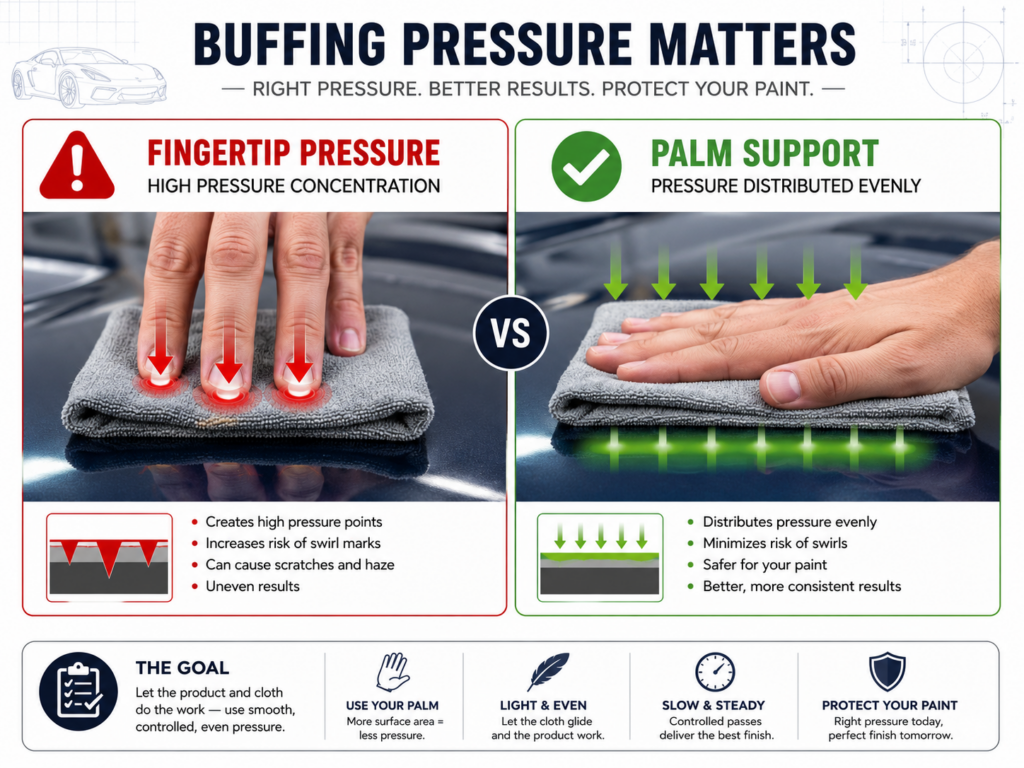
- Support the towel broadly with the palm.
- Use short, controlled passes with minimal pressure.
- Rotate the towel as soon as it begins to drag or smear.
- Finish with a clean, dry towel face.
- Stop wiping once the residue is gone.
The goal is not to rub the paint until it becomes glossy.
The goal is to remove excess product while leaving the protection thin, even, and clear.
How to Buff Car Wax by Hand in 8 Steps
A safe buffing process begins before the microfiber towel touches the paint.
The condition of the panel, the amount of wax, the removal timing, and the cleanliness of the towel all affect the final result.
1. Inspect the Paint Before Applying Wax
Wax should be applied to paint that is clean enough to accept the product evenly.
After washing and drying, inspect the surface under direct sunlight or a bright inspection light. Look for:
- Water marks
- Shampoo residue
- Oily film
- Road film
- Tar
- Iron particles
- Hardened mineral deposits
- Paint overspray
- Residue draining from mirrors or panel gaps
Light oily streaks and soft product residue can usually be removed during buffing.
However, hard or bonded contamination should not be forced across the paint with a towel. Tar, iron particles, mineral deposits, and overspray require an appropriate decontamination process first.
Buffing is the final finishing stage. It is not a substitute for proper cleaning.
2. Work on a Cool Panel
Do not apply or remove wax from a hot panel unless the product specifically allows it.
Heat can make the carrier ingredients evaporate too quickly. The wax may dry unevenly, become difficult to remove, or leave streaks before it has been spread correctly.
Work in the shade when possible.
Panel temperature, humidity, product type, and application thickness all affect removal time. There is no single waiting time that applies to every wax.
Follow the product manufacturer’s removal instructions rather than waiting for the thickest possible haze.
3. Apply a Thin and Even Layer
More wax does not automatically create more protection.
A thick application creates more residue for the towel to collect. It also increases:
- Hazing
- Towel saturation
- Towel drag
- Repeated wiping
- Uneven gloss
- Oily streaks
Apply only enough product to cover the panel evenly.
The wax layer should be controlled, not piled onto the surface. A thin application usually produces a cleaner result with fewer towel passes.
4. Fold the Microfiber Towel
Do not use the towel fully opened or crushed into a ball.
Fold it twice to create a stable pad slightly larger than the palm. This provides:
- Several clean working faces
- Better cushioning
- More even pressure distribution
- Improved towel control
- A clear system for rotating used sections
In practical detailing work, the working unit is not the entire towel.
The working unit is one clean towel face.
When one section becomes loaded with residue, turn to another section. When all available faces have been used, replace the towel.
5. Support the Towel With the Palm
Place the palm broadly over the folded towel and spread the fingers across it.
The hand should keep the towel flat and stable. It should not press the towel aggressively into the paint.
Avoid pushing through only the fingertips. Fingertip pressure concentrates force into a much smaller area.
A broad palm position spreads the same hand force across more of the towel, reducing local pressure points.
6. Use Short, Controlled Passes
Move the towel only as far as necessary to collect the residue.
Long passes carry any remaining particle or accumulated product across a greater distance. Repeated wiping also increases contact after the surface is already clean.
Use short, overlapping passes and inspect the result as you work.
Do not continue rubbing a clear section simply because the towel is already in your hand.
Once the residue has disappeared, additional wiping provides little benefit.
7. Rotate the Towel Before It Becomes Saturated
Do not wait until the towel is completely soaked with wax.
Rotate to a clean face when:
- Streaks begin to reappear
- Hazing spreads instead of disappearing
- The towel starts to drag
- The towel feels heavier or less responsive
- Residue transfers from one section to another
- More pressure seems necessary to move the towel
These signs usually mean the towel face is no longer collecting residue effectively.
Changing to a clean towel face is safer and more effective than increasing pressure.
8. Finish With a Clean, Dry Face
After the first pass has collected most of the residue, inspect the panel from several angles.
Use a separate clean, dry face for the final pass. This removes the thin film that may remain after the first towel face has become lightly loaded.
The first pass collects and levels the product.
The second pass confirms that the panel is clear.
For a more detailed spray-wax process, see the practical guide to towel priming and two-pass finishing.
What Does Buffing Car Wax Mean?
The word “buffing” can describe several different processes.
In some contexts, car buffing refers to using a rotary or dual-action polisher with an abrasive compound. That process removes a small amount of clear coat to reduce visible paint defects.
That is not the process discussed here.
In this guide, buffing means using a microfiber towel to:
- Remove excess wax or sealant
- Level the remaining product
- Collect light oily residue
- Remove minor streaks
- Inspect the paint after protection
- Leave the final surface clear and uniform
Buffing does not create gloss through aggressive rubbing.
The appearance comes mainly from:
- The condition of the paint
- The cleanliness of the surface
- The characteristics of the wax or sealant
- The evenness of the final product layer
The towel’s job is to collect what should be removed and level what should remain.
When wax becomes difficult to remove, pressing harder usually adds friction rather than gloss.
Why Surface Inspection Matters Before Buffing
A vehicle may look clean immediately after washing and drying, but small amounts of contamination can remain or return to the surface.
Water may drain from mirrors, trim, emblems, door handles, and panel gaps. Fine dust may settle between drying and wax application. A towel may also transfer contamination if it was not completely clean.
The paint may still contain bonded contamination such as:
- Iron particles
- Tar
- Hardened mineral deposits
- Tree sap
- Paint overspray
- Old product residue
Separate Light Residue From Hard Contamination
Light residue and bonded contamination should not be treated the same way.
Buffing can manage:
- Thin wax residue
- Light sealant residue
- Minor oily streaks
- Soft water trails
- Mild cleaner residue
Buffing should not be used to remove:
- Tar spots
- Embedded iron particles
- Hardened water spots
- Rough overspray
- Solid debris
- Grit trapped in panel gaps
If the towel catches on one small area, stop and inspect it.
Do not assume that more pressure is required. A hard particle may be trapped between the towel and the clear coat.
Appropriate removal may require an iron remover, tar remover, water-spot remover, paint cleanser, clay treatment, or polishing.
Do not turn a finishing towel into a decontamination tool.
How Much Pressure Should You Use When Buffing Car Wax?
The paint is cleaner during buffing than it was during washing.
However, it is also much drier.
During contact washing, water and shampoo provide lubrication between the wash mitt and the paint. By the time the vehicle reaches the buffing stage, most of that lubrication has disappeared.
Wax residue may also become tacky as it dries. The towel can begin to resist movement, leading the user to press harder without noticing.
How Contact Area Changes Buffing Pressure
The relationship between force and contact area can be summarized with a simple formula:
Pressure = Force ÷ Contact Area
The same amount of force creates higher pressure when it is concentrated over a smaller area.
When a towel is pressed with only the fingertips, the force is concentrated into several small points. When the towel is supported broadly with the palm, the force is distributed across a much larger area.
This is why hand position matters even when the user believes they are applying only light force.
Why Fingertip Pressure Is Risky
A microfiber towel provides some cushioning, but it does not eliminate pressure.
If a small particle remains under the towel, the hand presses that particle toward the paint. When the towel moves, the particle can travel across the clear coat while under load.
The risk is affected by:
- Particle hardness
- Downward pressure
- Contact area
- Distance traveled
- Number of repeated passes
The goal is not to eliminate all contact. Buffing requires enough contact to collect residue.
The goal is to avoid unnecessary force, concentrated pressure, and repeated movement.
Use these practical rules:
- Keep the towel flat.
- Support it with the palm.
- Avoid fingertip-only pressure.
- Use the minimum force needed.
- Work in short sections.
- Stop when the towel begins to drag.
- Change the towel condition before increasing force.
For a broader explanation of how contact risk changes during washing, drying, and finishing, see the guide to car detailing scratch risk.
Why Does Car Wax Leave Streaks After Buffing?
Car wax streaks are often blamed on insufficient wiping.
In reality, more wiping frequently makes them worse.
The most common causes are:
- Too much product
- Uneven application
- Removing the wax too early
- Allowing it to dry too long
- Working on a hot panel
- Using a saturated towel
- Using a contaminated towel
- Applying new wax over oily residue
- Using the same towel face for too long
The Microfiber Towel Saturation Trap
A clean microfiber towel initially collects wax residue between its fibers.
As buffing continues, the working face gradually fills with wax, oils, solvents, and other product ingredients.
Eventually, the towel can no longer collect residue efficiently.
Instead, it begins moving the existing residue from one area to another.
The sequence is:
Excess product → residue buildup → towel saturation → residue redeposition → streaking → towel drag → increased pressure
This is the microfiber towel saturation trap.
The user thinks the paint needs more buffing, but the real problem is that the towel face has stopped working properly.
Signs That the Towel Face Is Saturated
A saturated towel may:
- Leave a streak immediately after each pass
- Spread hazing over a larger area
- Feel less smooth than it did at the beginning
- Transfer residue to the next panel
- Require more effort to move
- Produce a result that disappears with a fresh towel
Pressing harder does not restore the towel’s ability to collect wax.
Supply a clean towel face before supplying more force.
How to Remove Wax Streaks
When car wax leaves streaks:
- Stop using the loaded towel face.
- Turn to a clean, dry section.
- Use light, short passes.
- Inspect the panel under angled light.
- Replace the towel if streaking continues.
- Check whether too much wax was applied.
- Confirm that the panel is cool.
- Follow the product’s recommended removal timing.
When a fresh towel immediately removes the streaks, the problem was probably towel saturation rather than the paint itself.
If streaking remains even with a clean towel, the surface may contain old protection, road film, oily residue, or an incompatible product layer.
Why More Wax Does Not Mean More Protection
A wax or sealant must remain on the paint in a thin and reasonably uniform layer.
This does not mean that every visible trace of product should remain after application. It also does not mean that a thicker application creates proportionally greater durability.
Excess product usually remains as material that must be removed.
A thick wax layer can create:
- Heavy residue
- Difficult removal
- Uneven curing
- Oily smears
- Rapid towel saturation
- More wiping passes
The safest way to buff car wax by hand begins with applying less product.
Product quantity affects buffing difficulty before the towel ever touches the panel.
Check the Existing Surface Before Adding Another Layer
Applying a maintenance product over existing protection is not automatically wrong.
However, adding wax after every wash without inspecting the paint can gradually create an uneven surface.
The vehicle may have accumulated:
- Road film
- Mineral residue
- Oily contamination
- Uneven old protection
- Previous wax residue
- Drying-aid residue
Adding more product over this condition may cause hazing and streaking that move around rather than disappear.
Before applying another layer, ask:
Is the paint clean enough to accept this product evenly?
When the panel repeatedly looks cloudy or oily, cleaning the surface may be more useful than adding more wax.
An alkaline wash or paint cleanser may help remove oily contamination and old residue, depending on the condition of the surface.
The objective is not always to strip every remaining protective ingredient.
The objective is to restore a clean and uniform base.
Should You Buff Car Wax in Circles or Straight Lines?
The direction of the hand movement is not the main cause of swirl marks.
A hard particle can mark the paint whether the towel moves in a circle, a straight line, or an arc.
The more important variables are:
- Contamination under the towel
- Applied pressure
- Distance traveled
- Repeated contact
- Towel cleanliness
- Product resistance
Short, straight or gently controlled passes are still practical because they make towel movement easier to monitor. They also limit the distance that a trapped particle may travel.
However, straight-line movement does not make a dirty towel safe, and circular movement alone does not create the circular appearance of swirl marks.
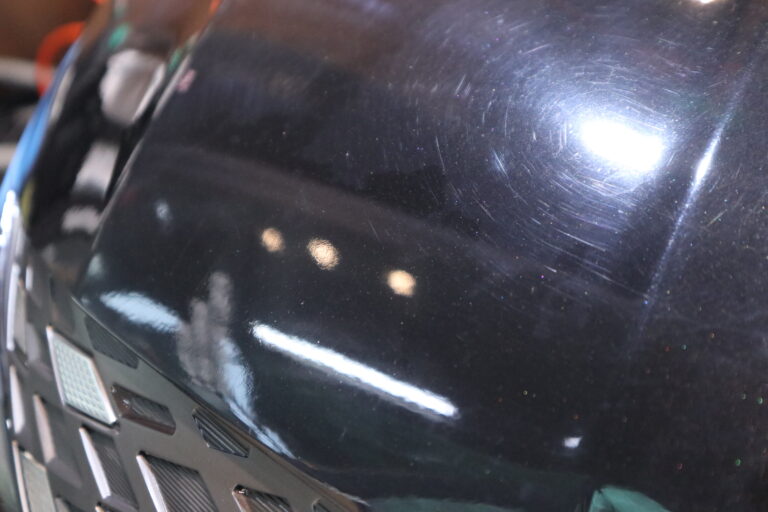
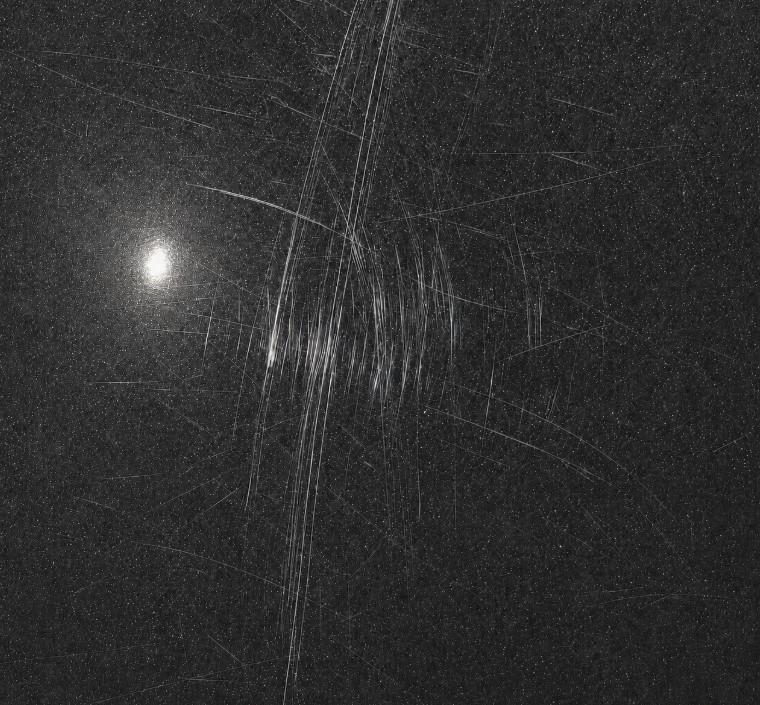
Swirl marks often appear circular under a point light because scratches located around the reflected light source become visible from different directions.
The safest technique is therefore not defined by direction alone.
Use a clean towel, minimal pressure, short travel, and as few passes as necessary.
Can Car Wax Hide Swirl Marks?
Some waxes and glazes can make shallow swirl marks appear less visible.
Fine defects scatter reflected light. Oils, fillers, and other ingredients may temporarily soften the visual contrast between the scratch and the surrounding paint.
The paint may look darker, glossier, or clearer after application.
However, the underlying defect has not been removed.
Wax can mask swirl marks. It cannot correct them.
As the product wears away through washing, weather, and time, the defects become visible again.
When Should You Move From Wax to Paint Correction?
Shallow swirl marks can often be managed through careful washing, protection, and temporary concealment.
This approach avoids polishing the clear coat every time a minor mark becomes visible.
However, swirl marks accumulate over time.
Eventually:
- Paint clarity decreases
- Reflections become less defined
- Strong light reveals more defects
- Wax no longer produces enough improvement
- Glaze no longer hides the overall damage
At that point, the maintenance method should change.
Paint correction uses an abrasive polishing process to remove a very small amount of material around the defects, reducing the difference between the scratches and the surrounding clear coat.
Clear coat thickness is limited. Therefore, polishing should not be treated as a routine response to every shallow swirl mark.
A balanced maintenance cycle is:
Reduce unnecessary contact → conceal manageable defects → correct only when concealment no longer restores acceptable clarity
The goal is not to maintain permanently flawless paint through repeated polishing.
The goal is to slow defect accumulation and select the least aggressive method that produces an acceptable result.
Can Buffing Towels Be Reused After Washing?
Buffing towels can and should be washed correctly.
However, washing does not guarantee that every towel will recover one hundred percent of its original performance.
Wax, sealant, drying aid, and maintenance coating ingredients are designed to remain durable on surfaces. Some of these ingredients may also remain between microfiber filaments after repeated use and laundering.
A towel may look clean while its performance has changed.
Remaining product can:
- Reduce absorbency
- Increase towel drag
- Cause oily streaks
- Reduce residue collection
- Make fibers feel clogged
- Transfer old product to new panels
This does not mean a buffing towel must be discarded after one use.
It means the towel should be evaluated by its current performance, not only by its original price or label.
The Microfiber Downgrade System
A practical towel-management method is to move towels to less paint-sensitive tasks as their performance declines.
A simple sequence is:
Paint Buffing → Interior Finishing → Door Jambs and Panel Gaps → Engine Bay and Lower Areas
A towel should remain in paint-buffing service only while it is:
- Clean
- Soft
- Free from hard contamination
- Able to collect residue
- Able to move smoothly
- Free from repeated oily smearing
- Free from hardened or heat-damaged sections
When washing no longer restores reliable paint performance, move the towel to interior finishing.
Later, it can be used for door jambs, panel gaps, engine bays, wheels, or lower contaminated areas.
Once a towel has been downgraded, do not return it to paint-buffing duty.
For washing temperatures, detergent use, drying, and material selection, see the complete guide to microfiber towel care.
Premium Towels Versus Affordable Towels
Dedicated buffing towels may offer:
- Softer fibers
- Better pile structure
- Safer edges
- Lower linting
- Easier handling
However, a premium towel does not maintain perfect performance forever.
Affordable multipurpose microfiber towels can also work well for hand buffing when they are:
- Soft
- Clean
- Sufficiently thick
- Free from rough edges
- Properly folded
- Replaced before heavy saturation
Not every inexpensive towel is safe for paint.
Avoid towels with rough fibers, hard stitching, embedded contamination, excessive lint, damaged edges, or heat-stiffened areas.
A towel’s present cleanliness and residue-removal ability matter more than its original price.
Common Car Wax Buffing Mistakes
Applying Too Much Wax
A thick layer does not guarantee stronger protection.
It creates more residue, saturates the towel faster, and requires additional passes.
Using One Towel Face for Too Long
A towel may still look usable after it has stopped collecting residue effectively.
Rotate early rather than waiting for severe streaking.
Pressing Harder When the Towel Drags
Towel drag is a warning.
Check the towel, product quantity, panel temperature, and surface condition before increasing pressure.
Buffing a Hot Panel
Heat may cause uneven drying and difficult removal.
Move the vehicle into the shade and allow the panel to cool.
Trying to Remove Hard Contamination With a Towel
Buffing towels are for light residue and product leveling.
Use the correct decontamination method for tar, iron particles, mineral deposits, and overspray.
Continuing to Wipe a Clear Panel
Once the residue is gone, more wiping adds contact without improving the result.
Inspect the panel and stop.
Returning Downgraded Towels to Paint
A towel used on door jambs, wheels, lower panels, or engine bays should not return to paint work.
Separate towels permanently according to their assigned task.
Frequently Asked Questions About Buffing Car Wax by Hand
How Long Should Wax Dry Before Buffing?
There is no universal drying time for every car wax.
Follow the product instructions and adjust for panel temperature, humidity, application thickness, and working conditions. Removing wax too early may cause smearing, while leaving it too long may make removal unnecessarily difficult.
What Type of Towel Should I Use to Buff Car Wax?
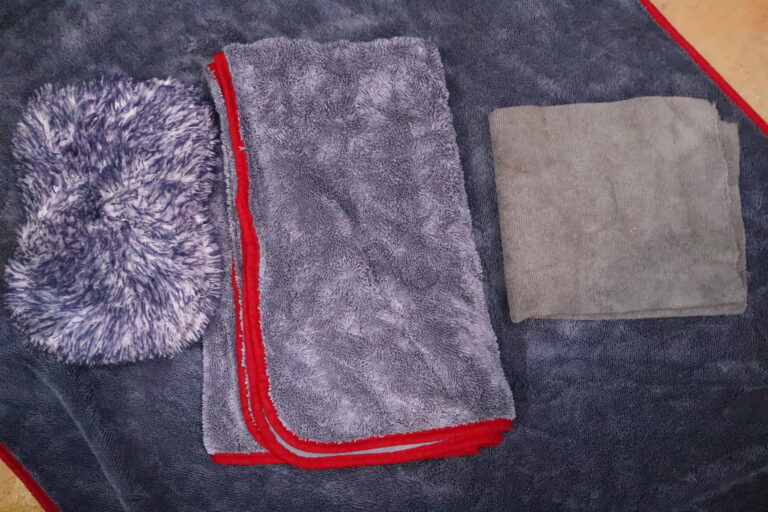
Use a clean, soft microfiber towel with enough thickness to provide cushioning after folding.
For paint, check the edges, stitching, labels, lint level, and previous use. A towel that feels soft in the center may still have a rough edge or contaminated section.
Can I Buff an Entire Car With One Microfiber Towel?
That depends on the product quantity, vehicle size, towel thickness, and amount of residue.
Do not judge the process by how few towels were used. Replace or rotate the towel whenever the working faces become loaded.
Why Is My Car Wax So Hard to Remove?
Common causes include:
- Applying too much product
- Allowing it to dry too long
- Working on a hot panel
- Using a saturated towel
- Applying wax over oily contamination
- Ignoring the manufacturer’s removal instructions
Try a clean towel face before increasing pressure.
Can Buffing Remove Swirl Marks?
Hand buffing with wax does not remove swirl marks.
Wax or glaze may temporarily conceal shallow defects. Abrasive polishing is required to physically reduce them.
Can Buffing Create Swirl Marks?
Buffing can contribute to swirl marks when contamination is trapped under the towel or when excessive pressure and repeated wiping are used.
The risk is reduced by inspecting the surface, using clean towel faces, applying thin product layers, and stopping once the residue is gone.
Should I Use More Pressure on Stubborn Wax?
No.
First change to a clean towel face and check the product timing, application thickness, panel temperature, and surface condition.
More pressure should not be the first solution.
Final Principle: Change the Contact Condition Before Adding Pressure
To buff car wax by hand safely, control the process before trying to control the towel with force.
Inspect the paint.
Apply less product.
Work on a cool panel.
Fold the towel.
Support it with the palm.
Rotate to clean working faces.
Stop when the residue is gone.
When the towel begins to drag, the solution is usually not more pressure. The solution is to change the condition causing the resistance.
That may mean:
- Using a clean towel face
- Reducing product quantity
- Correcting the removal timing
- Cooling the panel
- Cleaning old residue
- Removing bonded contamination separately
A fresh towel face often solves more than additional pressure ever will.
Car wax buffing is not simply the act of wiping off wax. It is the final stage where paint condition, product quantity, towel saturation, pressure, and contact time must be managed together.
The safest result comes from using the least contact necessary to leave the protection clean, thin, and even.