Most microfiber towel care guides give similar advice.
Avoid very hot water. Do not use fabric softener. Select low heat when using a dryer, or air-dry the towels away from strong sunlight.
However, many guides do not explain why microfiber towels are sensitive to heat. Simply saying that microfiber is synthetic does not explain where its absorbency comes from.
It also does not explain why blend ratios such as 70/30 and 80/20 matter.
To understand proper microfiber towel care, we first need to look at how the towel absorbs water. Once that structure becomes clear, both the care instructions and the blend ratio begin to make sense.
Quick Takeaway
- Microfiber absorbs water through fine split fibers, increased surface area, and microscopic gaps.
- High heat does not instantly melt the towel, but repeated exposure may affect its pile, edges, and fine structure.
- A 70/30 blend generally favors softness and moisture affinity.
- An 80/20 blend often balances durability, price, and general-purpose use.
- Blend ratio matters most when two all-purpose towels have similar size, weight, construction, and price.
Microfiber Towel Care Starts with Understanding Absorbency
A microfiber towel is made from extremely fine synthetic fibers.
Most detailing towels use a combination of polyester and polyamide. These materials are formed into a composite fiber and then split into much finer sections.
As a result, one larger fiber becomes many smaller strands. This greatly increases the total surface area.
Small gaps also form between the split fibers. These gaps create pathways that allow water to move into the towel.
The fine strands increase contact with the surface. Meanwhile, the microscopic spaces help draw water inward. The pile then provides room to hold the collected moisture.
In simple terms, a microfiber towel has three important features:
A large contact surface, pathways for water movement, and space to store moisture.
This is why a microfiber towel behaves differently from a smooth conventional synthetic cloth.
Split microfiber does not absorb water because of one material alone. Its performance comes from the relationship between the fiber blend, the splitting process, and the finished fabric structure.
What Do Polyester and Polyamide Do?
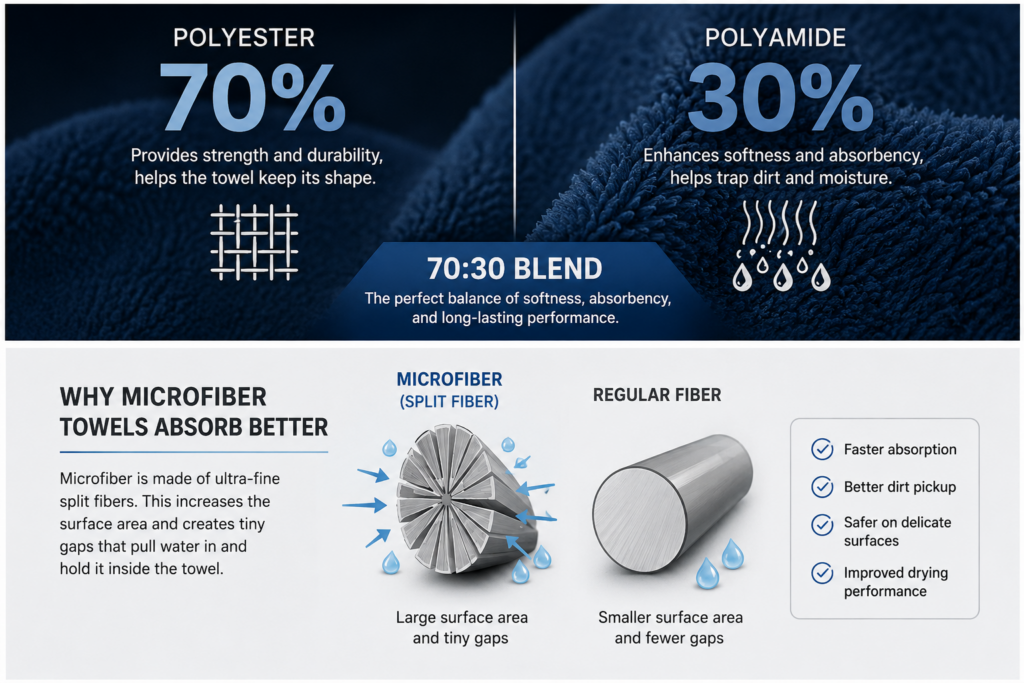
Most microfiber towel labels show one of the following blend ratios:
- 80% polyester and 20% polyamide
- 70% polyester and 30% polyamide
The two materials do not perform exactly the same role.
Polyester Supports the Towel Structure
Polyester contributes strength and shape stability.
It helps the fabric maintain its overall structure during repeated use and washing. It also supports the knitted base and helps the pile stay attached to the towel.
Because of this, polyester plays an important role in durability and general handling.
Polyamide Adds Softness and Moisture Affinity
Polyamide has a stronger affinity for moisture than polyester.
It also contributes to a softer feel. In addition, polyamide forms part of the split-fiber structure that creates more surface area and microscopic pathways.
However, polyamide content alone does not determine absorbency.
Final performance also depends on:
- how finely the fibers are split
- the thickness and length of the pile
- the knitting method
- fabric density
- edge construction
- dyeing and finishing quality
Therefore, the most accurate summary is:
Polyamide contributes softness and moisture affinity, while polyester supports strength and shape stability. The split structure and fabric construction determine how effectively the towel moves and stores water.
Why Are Microfiber Towels Sensitive to High Heat?
Polyester and polyamide are both synthetic materials. Their properties may change when they face repeated high-temperature exposure.
A microfiber towel does not normally melt during a warm wash cycle. The more realistic concern is a gradual change in performance.
In particular, strong dryer heat may place stress on the fine pile, edging, stitching, and finishing materials.
Over time, the pile may become flatter or more tangled. Fibers may also sit closer together.
As a result, the towel may lose some of the open structure that originally allowed water to move inward.
The change may follow this pattern:
Changes in pile and fiber arrangement
→ fibers become flatter or more tangled
→ microscopic gaps become smaller
→ water moves into the towel more slowly
→ softness and absorbency decline
The towel may still look normal from a distance. However, it may begin to push water instead of absorbing it.
It may also feel rougher or drag more across painted surfaces.
In practice, functional decline often appears before visible damage.
For this reason, it is more accurate to say that microfiber is not simply a material that “cannot handle heat.”
Instead, the fine structure responsible for its performance is sensitive to unnecessary high-temperature exposure.
Why Do Many Microfiber Towel Care Guides Recommend 40°C or Below?
A recommendation of 30°C to 40°C does not mean that the fibers melt at those temperatures.
Microfiber towels differ in several ways:
- raw material quality
- fiber thickness
- splitting method
- dyeing
- edge construction
- fabric finishing
Some commercial microfiber products tolerate higher washing temperatures. However, consumers rarely know every detail of the manufacturing process.
For that reason, 30°C to 40°C works as a conservative care range.
It provides enough warmth for routine cleaning while reducing unnecessary stress on the pile, dye, edges, and finishing materials.
One hot wash does not automatically destroy a towel. Still, there is usually no reason to expose a detailing towel to repeated high heat.
For general drying towels and soft buffing towels, use:
- cool or lukewarm water
- a mild liquid detergent
- a thorough rinse
- no fabric softener
This microfiber towel care method is not about reducing cleaning power at all costs. The goal is to remove contamination without adding unnecessary heat or leaving detergent residue behind.
What About Heavily Contaminated Buffing Towels?
Buffing towels may hold wax, sealant, polish residue, and oily carriers.
In that case, a mild wash may not always be enough.
However, increasing the water temperature should not be the first solution. Instead, adjust the detergent strength and washing process.
Use a suitable detergent, allow enough wash time, and add an extra rinse when needed.
This approach helps remove residue without depending entirely on hotter water.
Some heavily contaminated towels may never return to their original condition. Modern waxes and sealants can remain inside the pile even after washing.
When this happens, the towel may leave smears or residue during future buffing.
For that reason, many detailers gradually downgrade older buffing towels to less sensitive work.
Why Are Low-Heat Drying and Shade Drying Recommended?
Low-temperature drying follows the same basic principle.
A tumble dryer removes moisture quickly. However, high heat may continue even after the towel is almost dry.
At that point, the dry fibers, edging, and stitching remain exposed to hot air and the heated drum.
Therefore, select:
- a low-heat setting
- an air-only setting
- a gentle synthetic-fabric cycle
High heat is not necessary to dry a microfiber towel effectively.
Modern dryers may also offer low-temperature programs designed for synthetic or functional clothing. These settings can be useful for microfiber towels, provided the temperature remains low.
Why Avoid Strong Direct Sunlight?
Shade drying is not only about preventing color fading.
Under direct sunlight, the towel surface may become hotter than the surrounding air. The fabric is also exposed to ultraviolet light.
A few drying sessions in sunlight will not instantly ruin the towel. Nevertheless, repeated exposure does not help preserve the fabric over the long term.
The most practical method is simple:
Spread the towel fully in a well-ventilated shaded area and allow it to dry completely.
Shade drying does not mean leaving the towel damp for many hours.
Airflow should remove moisture quickly. The goal is to avoid unnecessary heat while still drying the towel thoroughly.
How Can You Tell When a Microfiber Towel Has Lost Performance?
A damaged or contaminated towel may show several warning signs.
First, the pile may lean in one direction or stick together. The towel may also feel stiffer when dry.
Next, place a few drops of water on the surface.
A healthy towel usually begins pulling the water into the fibers. A towel with poor performance may leave the drops sitting on the surface.
During drying, it may push water across the paint instead of absorbing it.
The towel may also feel unusually resistant as it moves.
However, heat damage is not the only possible cause.
Similar symptoms may come from:
- fabric softener
- wax residue
- sealant residue
- detergent buildup
- incomplete rinsing
- excessive product contamination
Therefore, wash and rinse the towel thoroughly before deciding that the structure has permanently changed.
If absorbency does not return, downgrade the towel to a less sensitive task.
For example, a former paint towel may become suitable for:
- door jambs
- wheels
- interior plastics
- engine bay cleaning
- general utility work
For more information on controlling friction and towel pressure, see the practical car drying guide.
Understanding Heat Also Explains the Blend Ratio
Once the microfiber structure is understood, the meaning of 70/30 and 80/20 becomes clearer.
The numbers refer to the material composition.
- 70/30 means 70% polyester and 30% polyamide
- 80/20 means 80% polyester and 20% polyamide
These numbers are not simply decorative marketing terms.
Assume that two towels use similar fiber thickness, splitting quality, knitting, and finishing.
Under those conditions, a 70/30 blend generally leans toward greater softness and moisture affinity.
By contrast, an 80/20 blend contains more polyester. It often offers a practical balance of durability, price, and general-purpose performance.
Still, the blend ratio is not a complete quality grade.
It is better understood as material information that shows the basic direction of the product.
Why Is 70/30 Common in Premium Detailing Towels?
Many higher-end drying and buffing towels use a 70/30 blend.
This is not surprising.
A manufacturer that wants to emphasize softness and moisture handling has a reason to use more polyamide.
For that reason, 70/30 appears frequently in towels designed for:
- drying paint
- removing polish residue
- leveling wax or sealant
- final buffing
- sensitive paintwork
However, 70/30 does not automatically make a towel excellent.
A poorly split or badly knitted 70/30 towel may perform worse than a well-made 80/20 towel.
The final result still depends on construction quality.
The blend ratio sets the basic material direction. Manufacturing quality determines how well that direction appears in the finished towel.
Good raw materials do not automatically create a good product.
At the same time, good manufacturing does not make the material ratio meaningless.
Why the 70/30 Blend Matters Most for All-Purpose Microfiber Towels
Dedicated drying and buffing towels usually have a clear purpose. Their pile structure, weight, and price often reflect that purpose.
In most cases, premium specifications also come with a premium price.
However, the situation changes when we look at all-purpose microfiber towels.
Consider the common bulk towels sold in large packs, including products similar to Kirkland microfiber towels.
Once the thinnest budget options are excluded, many of these towels look remarkably similar.
They often have comparable dimensions, thickness, pack sizes, and prices.
Yet one important difference is easy to miss:
the blend ratio printed on the care label.
Some towels use an 80/20 blend. Others use 70/30.
When two towels have a similar size, weight, construction, and price, this difference deserves attention.
The Hidden Value of a 70/30 Blend
A 70/30 towel contains 10 percentage points more polyamide than an 80/20 towel.
Polyamide contributes to softness and moisture affinity. Therefore, when fiber quality, splitting, pile structure, and manufacturing standards are similar, a 70/30 blend generally leans toward a softer feel and better moisture handling.
This does not mean every 70/30 towel will outperform every 80/20 towel.
A poorly split 70/30 towel with rough edges may still be worse than a well-made 80/20 towel.
However, when the products are otherwise comparable, the blend ratio becomes a meaningful material advantage.
That is especially important with all-purpose towels because their prices are often very close.
If one towel offers a 70/30 blend at nearly the same price, you are getting a higher polyamide content without paying a large premium.
Therefore, do not rely only on marketing terms such as “ultra-plush” or “super thick.”
Check the care label first. Then compare the GSM, pile structure, edge finish, and long-term wash performance.
For all-purpose microfiber towels, the blend ratio may reveal more than the front of the package.
How to Choose a Good All-Purpose Microfiber Towel
Do not choose a towel only because it feels fluffy in the package.
An all-purpose towel may be used for:
- interior cleaning
- glass
- paint
- spray wax
- light buffing
- door jambs
- small spills
- general detailing work
Therefore, it needs enough thickness and cushioning without becoming difficult to fold and control.
It should also release contamination reasonably well during washing.
1. Check the Blend Ratio
When price, size, and thickness are similar, check whether the towel is 70/30 or 80/20.
A 70/30 label does not guarantee quality. However, it is a useful signal that the manufacturer selected a blend that favors softness and moisture affinity.
For that reason, it is a practical first comparison point.
2. Check the Thickness and Pile
An all-purpose towel should not be excessively thin.
Some thickness creates cushioning when the towel is folded. It also provides more room for moisture, cleaner, and loose contamination.
However, more thickness is not always better.
A very heavy towel may be harder to control. It may also hold more product and take longer to rinse and dry.
Choose a thickness that matches the intended task.
3. Look for a GSM Rating
GSM means grams per square meter.
It describes the weight of the fabric over a fixed area.
GSM does not directly measure quality or absorbency. Two towels with the same GSM may feel very different because of pile length, weave, and density.
Still, GSM is useful when comparing towels of similar dimensions.
It provides a more objective reference than vague product descriptions such as “extra thick” or “premium weight.”
For general-purpose detailing, a mid-weight towel often offers a useful balance of cushioning, control, and washability.
4. Examine the Pile
The pile should look even and open.
Avoid towels with heavily flattened, clumped, or inconsistent sections.
Uneven pile may collect water and contamination less consistently.
A dual-pile towel may also be useful.
The longer side can collect moisture and loose residue. The shorter side can help level product and complete the final wipe.
5. Check the Edges and Label
Soft fabric does not help if the edge is hard or rough.
For paint and buffing tasks, look for:
- edgeless construction
- soft microfiber edging
- smooth stitching
- removable labels
A hard edge or rough label may become the most aggressive part of an otherwise soft towel.
6. Judge the Towel After Washing
Some towels feel soft only when new.
After the first few washes, inspect the pile again.
A good all-purpose towel should retain a reasonably open structure. It should not become flat, stiff, or heavily clumped after normal care.
Long-term performance reveals more than the first touch in the package.
When using an all-purpose towel for spray wax or residue removal, folding and pressure control also matter. The car buffing guide explains how to distribute pressure and rotate to clean towel sections.
Does a 70/30 Blend Always Mean a Better Towel?
No. A 70/30 blend is a good starting point, not a complete quality guarantee.
The finished towel also depends on:
- fiber fineness
- splitting quality
- GSM
- pile length
- knitting density
- edge construction
- dyeing and finishing
- wash durability
A well-made 80/20 towel may outperform a poorly made 70/30 towel.
However, this does not make the blend ratio unimportant.
When price, size, GSM, pile structure, and manufacturing quality are similar, 70/30 provides a higher polyamide content and a stronger bias toward softness and moisture affinity.
The most practical buying order is:
Check the blend ratio first. Then compare GSM, pile structure, edging, and wash durability.
Blend ratio is not the only standard. It is simply one of the easiest and most useful material specifications to verify.
Microfiber Towel Care Mistakes to Avoid
Proper washing is only part of microfiber towel care.
The following mistakes may reduce performance even when the washing temperature is low.
Using Fabric Softener
Fabric softener coats the fibers.
This coating may reduce water movement and make the towel repel moisture. It may also leave smears on glass and painted surfaces.
For detailing towels, fabric softener should be avoided.
Using Too Much Detergent
More detergent does not always mean cleaner towels.
Excess detergent may remain inside the pile. This residue can make the towel feel stiff and may reduce absorbency.
Use only the amount needed for the load and contamination level.
Washing Paint Towels with Dirty Utility Towels
A drying or buffing towel should not be washed together with towels used on wheels, lower panels, engine bays, or heavily contaminated interiors.
Mixing them may transfer abrasive contamination and chemical residue.
Separate towels by task and contamination level.
Drying at High Heat for Too Long
Even a low-heat cycle should stop when the towels are dry.
Leaving dry microfiber in a heated drum for longer than necessary adds no benefit.
Storing Towels While Damp
Low heat and shade drying do not mean slow, incomplete drying.
Towels should be fully dry before storage. Damp storage may create odor and hygiene problems.
Conclusion: Microfiber Towel Care and Blend Ratio Follow the Same Principle
Microfiber towel care and product selection are not separate subjects.
Both depend on how the fine fiber structure is created and preserved.
Microfiber towels use polyester and polyamide in a finely divided structure. This creates a large surface area, microscopic pathways, and space to hold water.
Polyamide contributes softness and moisture affinity. Polyester supports shape stability and durability.
Repeated high heat may place unnecessary stress on the pile, edges, and finishing materials. Therefore, cool or lukewarm washing, low-temperature drying, and thorough rinsing are practical care choices.
The same structure also explains why blend ratio matters.
A 70/30 towel is not automatically better than every 80/20 towel. Construction quality still matters.
However, when two all-purpose towels have similar size, GSM, pile structure, manufacturing quality, and price, the 70/30 blend offers a meaningful material advantage.
Materials determine the towel’s basic direction. Manufacturing quality determines how well that direction is delivered.
For all-purpose microfiber towels, the care label may tell you more than the marketing on the front of the package.