How mineral buildup affects gloss, water behavior, and long-term paint maintenance
When no visible water spots appear on the paint, it is easy to assume that mineral contamination is not present. However, the difference between mineral contamination and water spots is often a matter of buildup and visibility rather than presence or absence.
A shower glass panel provides a simple example.
After water dries a few times, the glass may still look clean. Yet each drying cycle leaves behind a very thin layer of minerals. As this process repeats, the transparent surface gradually becomes hazy. Only later do white deposits and distinct water-drop outlines become visible.
Automotive paint behaves in a similar way.
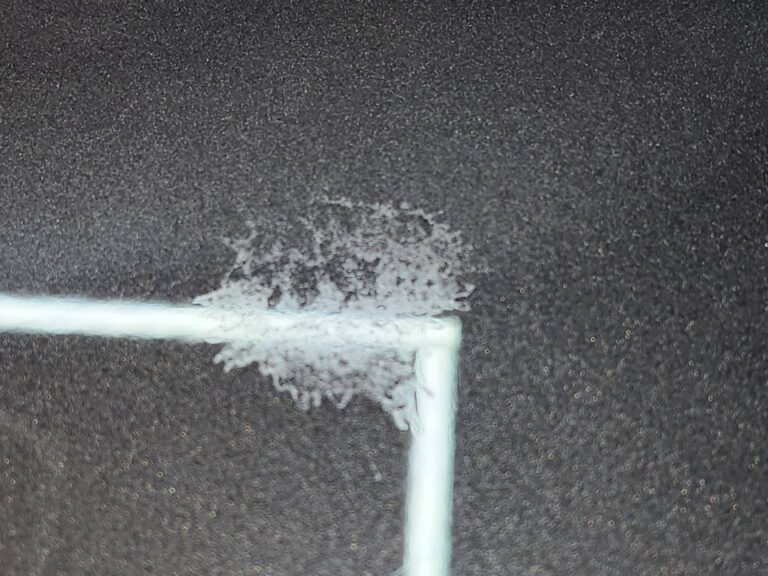
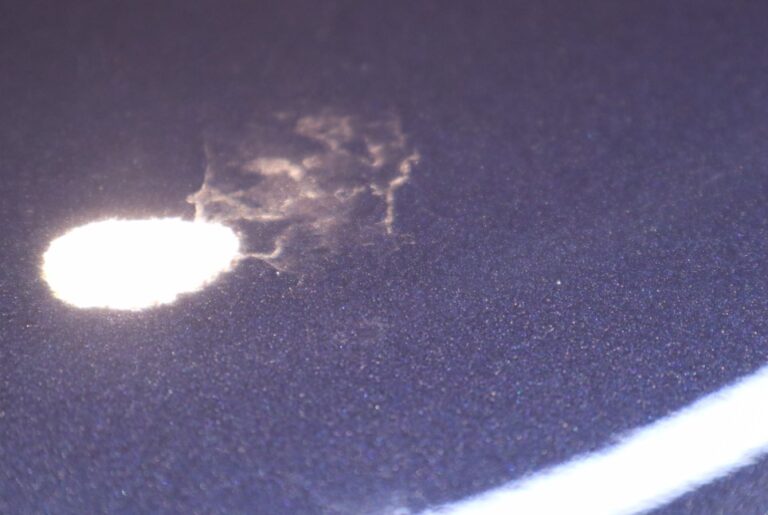
Minerals do not always collect immediately into obvious circular marks. They can spread across the surface as a thin film, slowly reduce paint clarity, and alter water behavior before recognizable water spots appear.
The important question is not simply whether mineral contamination exists. It is how much has accumulated and when you choose to manage it.
Table of Contents
- Why Remove Mineral Contamination Before It Becomes Visible?
- Two Ways to Manage Mineral Contamination
- Frequently Asked Questions
1. Why Remove Mineral Contamination Before It Becomes Visible?
Mineral Buildup Can Accelerate Further Mineral Accumulation
For a deeper explanation of how thin mineral films develop, see why an acidic pre-wash is necessary.
Water normally gathers and drains relatively evenly from a clean, protected surface. Once a thin mineral film develops, however, the original beading and sheeting behavior can become less consistent.
If water no longer leaves the panel efficiently, more of it remains behind and dries on the paint. The water evaporates, but the dissolved minerals stay on the surface.
Even when the mineral concentration in the water remains the same, a larger volume of retained water leaves a greater amount of residue after evaporation.
Mineral buildup
→ disrupted water behavior
→ more water remaining on the panel
→ greater mineral residue after drying
→ faster mineral accumulation
This creates a self-accelerating cycle. Existing mineral contamination changes the surface in a way that makes further mineral buildup easier.
General Contamination Can Also Accumulate More Easily
Rainwater and wash water do not carry minerals alone. They can also transport dust, soot, pollen, and other airborne particles onto the paint.
When water drains quickly, some of those particles move away with it. If the water remains on the surface for longer, more contamination can settle and stay behind.
Mineral film formation
→ longer water residence time
→ increased dust and airborne-particle residue
→ faster general contamination buildup
Mineral contamination therefore affects more than mineral deposits themselves. It can create a surface condition that allows other contamination to accumulate more easily.
This is one reason a vehicle with mineral buildup may become dull again more quickly, even when it receives the same washing frequency as a cleaner, better-draining vehicle.
Paint Clarity Can Drop Before Water Spots Become Visible
A mineral film does not need to form obvious white rings before it affects the appearance of the paint.
When minerals spread across the surface in a thin, uneven layer, they can interfere with clean light reflection. Instead of producing a sharp and clear finish, the paint may begin to look slightly hazy or muted.
After washing, the expected gloss may not return fully. The coating, wax, or sealant can appear to have lost performance, even though contamination may simply be masking its clarity and water behavior.
For that reason, visible water spots should not be the only inspection standard.
Also look for:
- Reduced paint clarity
- Slower sheeting
- Uneven beading
- More water remaining on horizontal panels
- A surface that still appears dull after washing
These changes can appear before distinct mineral marks become visible.
Contamination Buildup Increases Towel Drag and Paint Risk
Mineral contamination rarely remains as a layer of pure mineral residue. Dust, road film, oxidized wax or sealant, and cleaner residue can accumulate over the minerals, forming a mixed contamination layer across the paint.
As this layer builds up, surface roughness and water distribution become less uniform. A drying towel then encounters greater resistance, which can be felt as persistent drag or a heavy pulling sensation.
Brief drag may occur at the beginning of drying before moisture has spread evenly through the towel. Once the towel has absorbed enough water, that moisture helps it move more smoothly across a clean paint surface. If the towel continues to drag under these conditions, mineral buildup and mixed surface contamination may still remain.
Buffing resistance can also increase when contamination remains on the paint. Wax quantity, product condition, and drying time all affect buffing, but a contaminated surface adds further friction and irregular towel movement.
Greater resistance requires more force to keep the towel moving. The user may press harder or make repeated passes, increasing the load placed on the towel, remaining contamination, and clear coat. Mineral and mixed contamination therefore affect more than gloss and water behavior. They also reduce drying and buffing efficiency while increasing the risk of fine scratches.
Persistent towel drag after washing can be a practical sign of mineral buildup and mixed contamination that may not yet be clearly visible.
Repeated Mineral Concentration Makes Removal More Difficult
A thin mineral residue left after one drying cycle may respond to relatively mild maintenance. Repeated drying changes the condition of the contamination.
New mineral deposits can form over the existing residue. Dust, road film, oily contamination, old protection products, and cleaner residue may also become part of the same surface layer.
Over time, the contamination can develop from a light mineral film into a more bonded and complex deposit.
At this stage, a maintenance-strength acidic pre-wash may no longer remove enough contamination.
Increasing chemical strength or dwell time without limit is not a safe solution. Paint, protective layers, exposed metals, panel gaps, trim, and the operator all need consideration.
Early maintenance usually requires less effort. Once the contamination becomes concentrated and bonded, removal often requires stronger chemical treatment and more direct contact with the paint.
2. Two Ways to Manage Mineral Contamination
Mineral contamination can be managed in two different ways.
The first approach reduces buildup gradually during routine washing. The second avoids regular acidic pre-washing and performs a more intensive decontamination once gloss and water behavior have noticeably declined.
Neither approach is automatically correct for every vehicle.
The main difference is whether you divide the workload across multiple washes or accept a larger restoration task later.
1. Routine Maintenance With an Acidic Pre-Wash
An acidic pre-wash can reduce thin mineral buildup before it develops into heavier deposits or bonded water spots.
The goal is not to reset the paint completely during every wash. Instead, the process limits how much mineral contamination remains and slows the rate at which it accumulates.
Routine acidic pre-washing can help maintain:
- More consistent sheeting
- More uniform beading
- Clearer paint reflection
- Lower mineral accumulation
- Reduced general contamination retention
- A lower chance of heavy water-spot buildup
This method divides a larger decontamination task into smaller maintenance steps.
However, an acidic pre-wash does not need to be used during every wash.
The required frequency depends on factors such as:
- Outdoor parking
- Frequent rain exposure
- Hard-water washing conditions
- Repeated natural drying
- Poor drainage from horizontal panels
- Changes in gloss or water behavior
A vehicle stored indoors and dried carefully may need acidic maintenance far less often than one exposed to rain and hard water every week.
The exact dilution, application order, dwell time, and choice between liquid spray and foam belong in a separate practical acidic pre-wash guide.
2. Intensive Maintenance After Gloss Has Declined
Some owners may reasonably ask:
Why should I use an acidic pre-wash when I cannot even see the contamination?
In that case, routine acidic pre-washing does not need to become part of every maintenance wash.
Instead, the vehicle can receive a more intensive treatment when the surface begins to show clear changes.
Possible inspection signs include:
- The paint still looks hazy after washing
- Gloss no longer returns as clearly as before
- Water sheets away more slowly
- Beading becomes irregular
- White mineral marks begin to appear
- Newly applied protection does not make the surface look clean
- The drying towel continues to drag after it has absorbed enough water
- Buffing resistance has increased under the same product and towel conditions
A long interval such as one year may be used as a general inspection point, but it should not become a fixed rule.
Outdoor exposure, local water hardness, rainfall, drying habits, and wash frequency can shorten or extend the appropriate interval.
This approach reduces routine workload. However, once treatment becomes necessary, it usually requires more time, more product, and more contact with the paint.
2-1. Removing Mineral Contamination With a Water Spot Remover
The name “water spot remover” can make the product sound as though it only targets visible circular marks.
That interpretation is too narrow.
A water spot is only one visible form of mineral contamination. The product does not remove the shape of the mark. It targets the mineral deposits that created the mark and the surrounding film.
This means a water spot remover can also be used when no distinct circular spots are present but a broader mineral layer has accumulated across the paint.
A water spot remover does not simply erase visible rings. It removes the mineral deposits responsible for those rings and the surrounding contamination.
In this role, the product becomes a long-interval mineral decontamination treatment rather than a local stain remover.
It can help restore:
- Paint clarity
- More consistent water behavior
- Cleaner surface reflection
- Reduced mineral residue
- Better preparation for protection products
However, not every visible mark will disappear through chemical cleaning.
If the mineral deposit has already been removed but the outline remains, the clear coat may have suffered etching. At that point, the problem is no longer contamination alone. Paint cleansing or polishing may be required.
Water spot removers also vary in acid type, strength, and surface compatibility. Always test a small section first and prevent the product from drying on the paint.
2-2. Cleaning the Remaining Surface Film With a Paint Cleanser
Mineral buildup may not be the only cause of reduced gloss.
The surface can also contain:
- Road film
- Oily contamination
- Oxidized wax or sealant
- Cleaner residue
- Embedded environmental grime
A water spot remover may reduce the mineral component while leaving some of this mixed contamination behind.
A paint cleanser can then help remove the remaining surface film and improve clarity.
Not all paint cleansers work in the same way.
Some rely mainly on chemical cleaning. Others contain very fine abrasives that provide light mechanical refinement as well.
A chemical paint cleanser can help remove:
- Oily residue
- Old protection products
- Mild oxidation
- Cleaner residue
- General surface film
A mildly abrasive cleanser may also improve very light surface defects while cleaning.
A water spot remover and a paint cleanser do not always need to be used together.
- Use a water spot remover first when mineral contamination is the main problem.
- Consider a paint cleanser when oily residue, old protection, or mixed contamination remains.
- If the surface stays dull after mineral removal, evaluate whether paint cleansing or polishing is necessary.
Intensive decontamination can weaken or remove waxes and sealants. Inspect the surface afterward and reapply protection when needed.
Comparing the Two Maintenance Approaches
| Category | Routine Acidic Pre-Wash | Intensive Decontamination |
|---|---|---|
| Treatment timing | During early mineral accumulation | After gloss, water behavior, or towel movement declines |
| Main products | Acidic pre-wash | Water spot remover and paint cleanser |
| Main goal | Slow further buildup | Remove accumulated contamination |
| Work pattern | Smaller tasks across multiple washes | One larger, separate treatment |
| Contact with paint | Relatively limited | Usually greater |
| Maintenance type | Preventive | Corrective |
Both methods can work.
The appropriate choice depends on the vehicle’s exposure, the owner’s maintenance preferences, and how much time can be dedicated to each wash.
Conclusion
Mineral contamination rarely appears as a dramatic problem all at once. It develops through a sequence of changes: faster mineral accumulation, greater general contamination retention, reduced gloss, disrupted water behavior, increased towel drag, and greater removal difficulty. For this reason, paint condition should be judged not only by visible water spots, but also by whether clarity, water sheeting, and smooth towel movement return after washing.
The timing of maintenance therefore changes the workload.
Managing thin buildup with an acidic pre-wash requires consistency but keeps each individual treatment relatively light. Waiting until gloss has declined reduces routine effort, but later correction usually requires more time, stronger products, and additional contact work.
The right approach depends on the vehicle’s environment and the amount of maintenance time available.
The next guide will explain how to use an acidic pre-wash in practice, including application order, dilution strength, dwell time, and when to choose liquid spray or foam.
Frequently Asked Questions
Can mineral contamination exist without visible water spots?
Yes. Minerals can spread across the paint as a thin film before concentrating into visible spots.
Should an acidic pre-wash be used during every wash?
No. Frequency should depend on exposure, water hardness, drying conditions, and changes in sheeting or gloss.
Is a water spot remover only for visible spots?
No. It can also remove mineral deposits that have accumulated as a wider surface film.
Are a water spot remover and a paint cleanser the same product?
No. A water spot remover mainly targets mineral deposits. A paint cleanser removes a broader mixture of surface contamination.
Do both products always need to be used?
No. Start with the product that matches the main contamination. Add a paint cleanser only when mixed residue or dullness remains.
What if a mark remains after mineral removal?
The remaining mark may be clear-coat etching rather than contamination. Paint cleansing or polishing may then be necessary.
Is annual intensive maintenance enough?
One year can be a useful inspection interval, but it is not a fixed rule. Judge the surface by gloss, sheeting, exposure, and water quality.