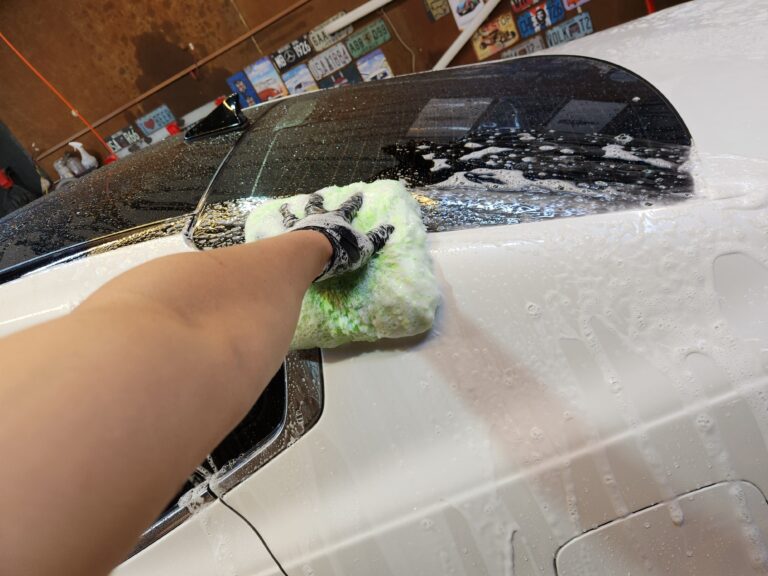
Car washing requires both cleaning chemicals, such as pre-wash cleaners and car shampoos, and tools, such as wash mitts, brushes, and towels.
Cleaning chemicals react with contamination and weaken it. This is chemical cleaning power. Wash mitts and towels, on the other hand, make direct contact with the surface and physically separate weakened contamination. This is physical cleaning power.
In other words, car-wash cleaning power can be divided into two forces:
the force that weakens contamination through chemical reactions, and
the force that separates contamination through physical contact.
The complete process—from the impact and flow of high-pressure water to tool contact, bonded-contamination removal, and polishing—is explained in What Is Physical Cleaning Power in Car Washing?.
This article focuses on the physical cleaning power created by tools such as wash mitts and towels, and explains why greater surface contact increases both cleaning power and scratch risk.
📌 Key Points from This Article (Click to Expand)
- Definition of physical cleaning power
The force created when a tool contacts the surface and separates contamination through pressure, friction, and movement. -
The relationship between surface contact and scratch risk
Greater surface contact increases cleaning power, but it also increases the risk of scratching the paint. -
The standard for controlling surface contact
The amount of contamination remaining on the paint determines how much surface contact can be used safely. As contamination is removed, greater surface contact becomes possible. -
Why chemical support is still necessary
Physical cleaning power also has limits. Contamination must be chemically weakened and friction must be controlled for safe removal.
💡 In one sentence
Use less surface contact when contamination is heavy, and gradually increase it as the surface becomes cleaner.
Table of Contents
- How Surface Contact Creates Physical Cleaning Power
- The Standard for Physical Cleaning in Detailing
- Why Heavy Contamination Requires Less Surface Contact
- Why Greater Surface Contact Becomes Possible as Contamination Is Removed
- Physical Cleaning Power Also Has Limits
- Chemical Action Compensates for the Limits of Physical Cleaning
- Frequently Asked Questions
- Part 2 Conclusion: Adjust Surface Contact to the Condition of the Contamination
1. How Surface Contact Creates Physical Cleaning Power
What is physical cleaning?
Physical cleaning is the process of placing a tool against a surface and using pressure, friction, and movement to separate contamination.
A wash mitt moving across paint, a drying towel absorbing water, a buffing towel removing product residue, and a pad working a paint cleaner or polish all use physical cleaning power.
These tools differ in structure and purpose, but they create cleaning power through the same basic mechanism.
The tool contacts the surface, transfers pressure, creates friction, and moves across the contamination. This movement breaks the contamination away from the surface or collects it inside the tool.
Surface contact is created by pressure, friction, and movement
In this article, surface contact does not mean pressure alone.
It refers to the combined effect of how closely the tool follows the surface, how much pressure it transfers, how much friction is created, and how far or how often it moves.
Increasing pressure allows the fibers or pad to reach the surface more firmly. Friction transfers that force to the contamination, and movement separates or collects it.
For this reason, greater surface contact generally produces greater physical cleaning power.
Physical cleaning power increases as pressure, friction, and movement increase.
However, the same forces that remove contamination can also move hard particles across the paint. Physical cleaning power and scratch risk therefore increase through the same mechanism.
2. The Standard for Physical Cleaning in Detailing
Cleaning power and scratch risk increase together
If paint were covered only with soft, soluble contamination, stronger contact would simply remove it faster.
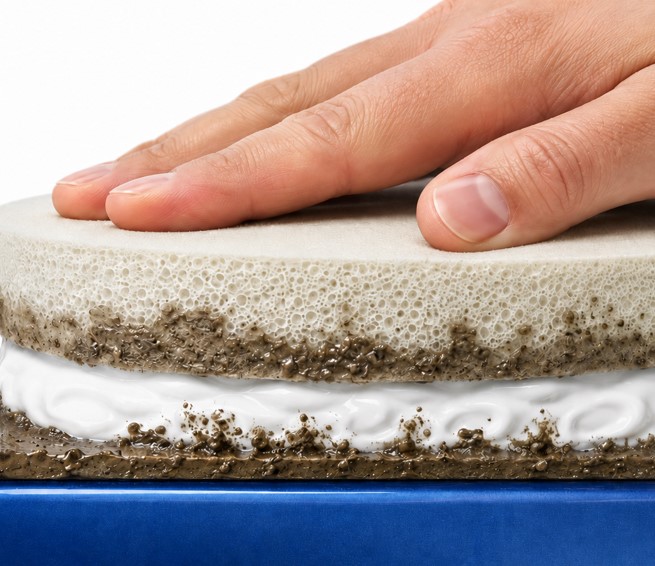
Actual vehicle contamination is different. Dust, sand, brake dust, and other hard particles may remain between the tool and the paint.
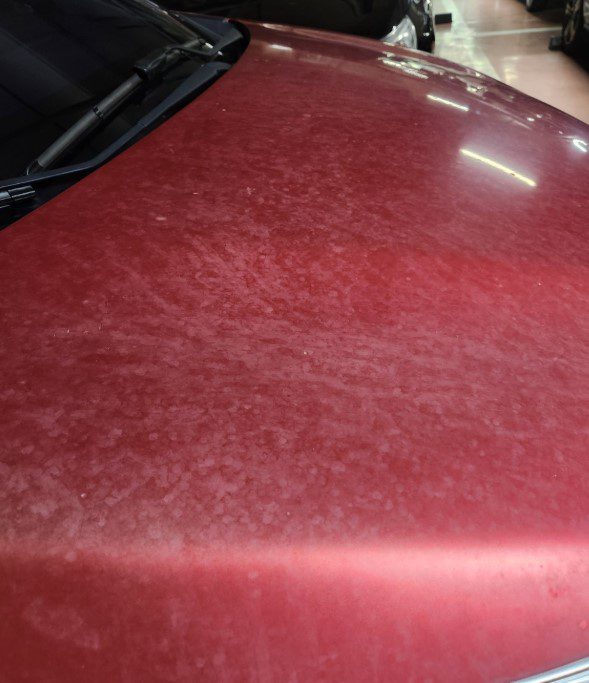
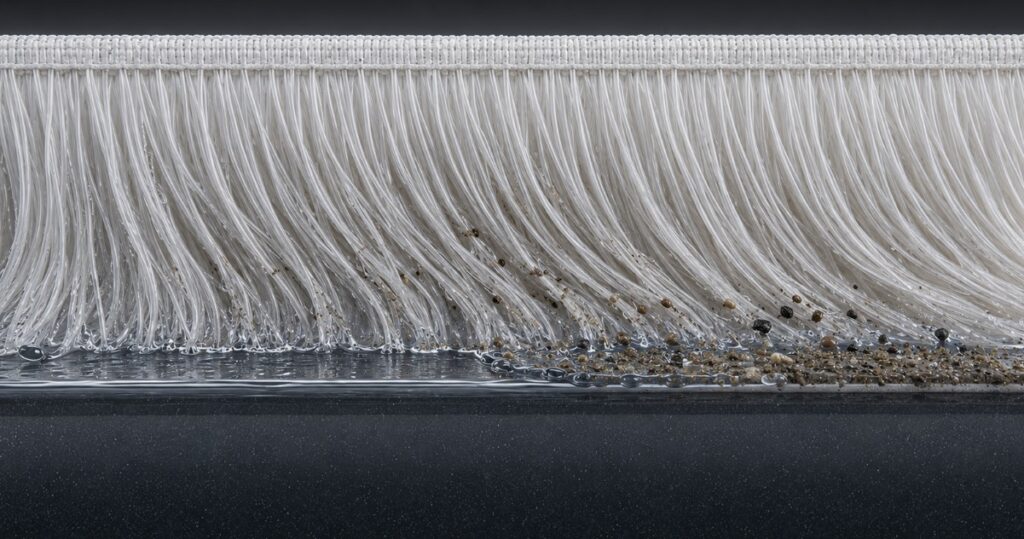
When these particles are pressed against the surface and moved, they can act like abrasives. A soft wash mitt can still cause scratches if hard particles become trapped beneath it.
The risk can be summarized as follows:
Scratch risk = Contamination × Pressure × Friction × Movement
The purpose of this formula is not to calculate an exact number. It shows that scratch risk is created by the interaction of four variables.
Even when pressure is low, risk can increase if a large amount of contamination remains or if the tool repeatedly travels over a long distance. Even a very soft tool can become dangerous when hard particles are trapped at the contact point.
The remaining contamination determines permissible surface contact
The central standard is therefore not simply whether the tool feels soft.
The more particulate contamination that remains on the paint, the more pressure, friction, and movement must be restricted. As those particles are removed, a wider range of physical contact can be used.
The amount of contamination remaining on the paint determines how much surface contact can be used safely.
This is why detailing begins by reducing contamination before increasing contact.
Pre-wash weakens the contamination layer. High-pressure rinsing removes loose particles without placing a tool directly against the paint. Only after the contamination load has been reduced does contact washing begin.
3. Why Heavy Contamination Requires Less Surface Contact
Pre-wash and high-pressure rinsing reduce the contamination load first
At the beginning of a wash, the paint carries the greatest amount of contamination.
This is the stage at which direct tool contact must be minimized. If a wash mitt is pressed against heavily contaminated paint, particles can become trapped under the fibers and travel across the surface.
Pre-wash chemically weakens the film that holds contamination to the vehicle. High-pressure water then uses impact and flow to separate and carry away loosened contamination without the broad, close contact created by a mitt or towel.
High-pressure rinsing is itself a form of physical cleaning, but its force is delivered through water rather than a tool pressed against the paint.
The objective is not to make the vehicle perfectly clean without contact. It is to reduce the contamination that the wash mitt must handle.
A wash mitt must use shampoo water, not pressure, as its first control
Some contamination will remain after pre-wash and rinsing, so a wash mitt is still necessary.
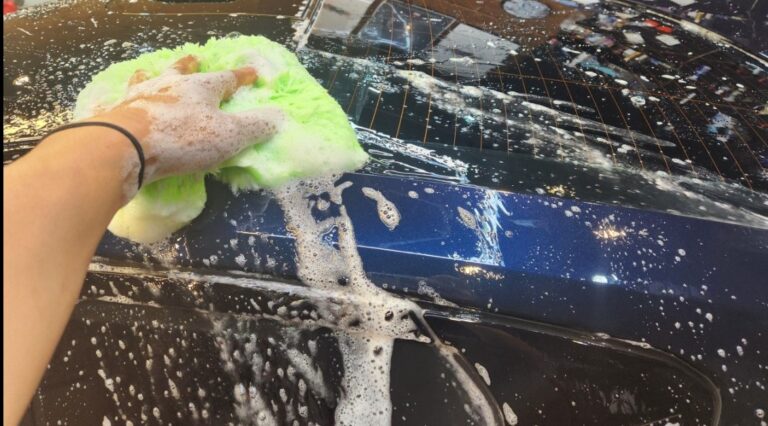
At this stage, however, the mitt should not rely on strong pressure or repeated rubbing. It should hold a large amount of shampoo solution and move lightly across the paint.
A long-pile wash mitt spreads pressure over a wider area. Its fibers provide space for separated contamination to move away from the immediate paint-contact point.
The shampoo solution flowing from the mitt maintains lubrication and carries loosened contamination beyond the contact area. This flushing action reduces the time particles remain trapped between the mitt and the paint.
During contact washing, cleaning should come from abundant shampoo flow, lubrication, and contamination release—not from pressing harder.
If the flow of shampoo weakens or contamination builds up in the mitt, the mitt should be rinsed or replaced and reloaded with shampoo solution before washing continues.
4. Why Greater Surface Contact Becomes Possible as Contamination Is Removed
Tools become thinner and more surface-conforming as the process advances
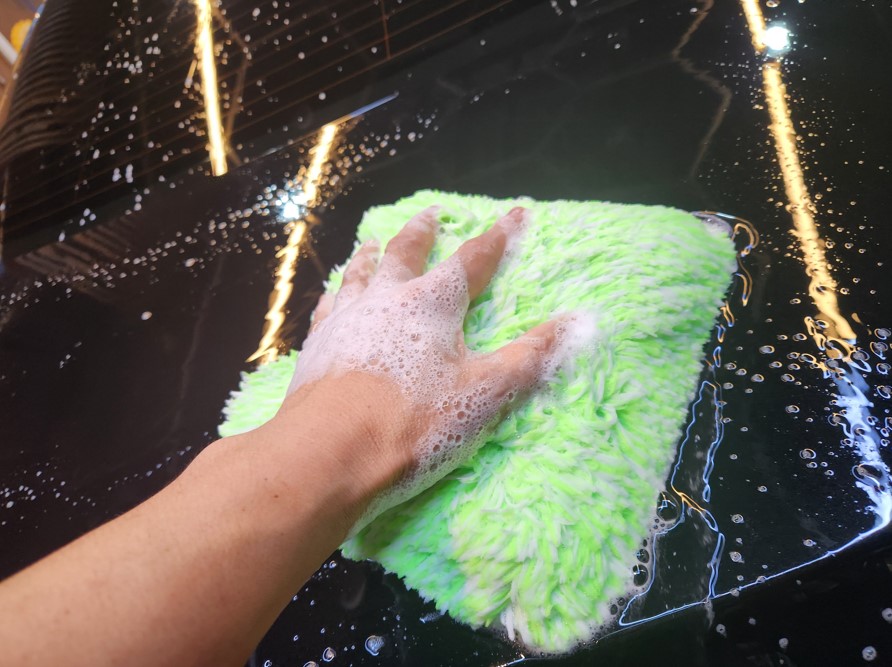
The tools used during detailing change as the paint becomes cleaner.
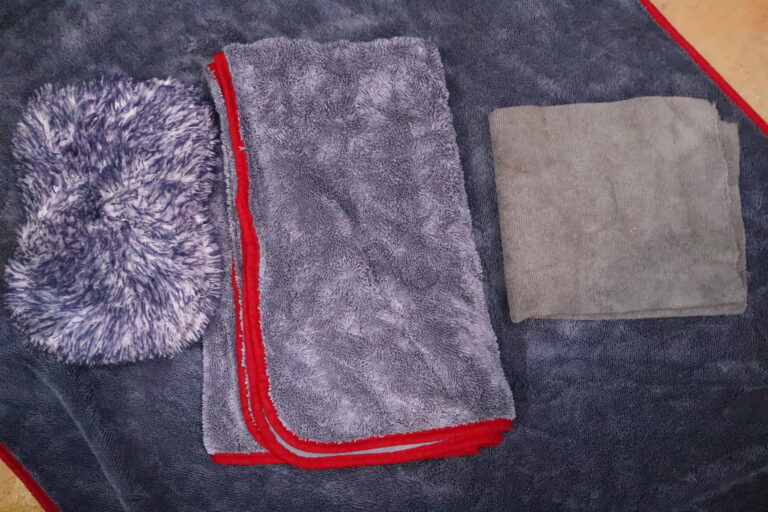
A wash mitt is thick, soft, and able to hold a large amount of shampoo solution. Its long pile spreads pressure and creates space for contamination to move away from the paint.
After washing and rinsing have removed particulate contamination, a drying towel can make broader contact with the surface. Its main purpose is to absorb water, so only the contact needed for water removal should be used.
During buffing, the surface is cleaner still. A thinner, denser towel can follow the paint more closely and remove wax, sealant, or coating residue with greater surface contact.
Paint-cleaner pads and polishing pads use still greater pressure, friction, and repeated movement. They are designed to work closely against the paint and separate bonded contamination or level paint defects.
The progression can be summarized as follows:
Wash mitt → Drying towel → Buffing towel → Paint-cleaner pad → Polishing pad
As the process advances, the tools generally become thinner and denser, and they follow the surface more closely.
Cleaner paint allows greater contact
The reason stronger surface contact becomes possible is not simply that the tool has changed.
It is because particulate contamination has already been sufficiently removed in the preceding steps.
The wash mitt is used only after pre-wash and rinsing have reduced the contamination load. Drying follows contact washing and final rinsing. Buffing takes place after the surface is clean and dry. Paint cleaning and polishing begin only after loose and particulate contamination has been removed.
This sequence reduces the chance that hard particles will be trapped beneath a closely contacting towel or pad.
The progression toward greater surface contact is therefore possible because each preceding step prepares a cleaner surface for the next one.
5. Physical Cleaning Power Also Has Limits
Greater surface contact cannot remove every contaminant safely
Once particulate contamination has been sufficiently removed, greater surface contact can be used. However, physical force alone cannot safely remove every type of contamination.
Mineral deposits strongly bonded to the paint, oxidized or chemically altered contamination, and hardened organic residue may not be removed easily simply by increasing pressure and friction.
If excessive pressure or repeated rubbing is used to remove these contaminants, scratches and friction damage may increase before the contamination is removed.
Just as chemical cleaning cannot increase reactivity without limit because of material safety, physical cleaning cannot increase surface contact without limit because of scratching and paint damage.
Chemical cleaning cannot increase reactivity without limit, and physical cleaning cannot increase surface contact without limit.
6. Chemical Action Compensates for the Limits of Physical Cleaning
Why paint cleaners and polishes also require chemical ingredients
Paint cleaning and polishing use high levels of physical cleaning power, but they still require chemical weakening and lubrication to operate safely.
Solvents and cleaning ingredients in a paint cleaner weaken and loosen bonded contamination. Lubricants control the friction and heat produced as the pad moves.
In polishing, lubricants also control the movement of the pad and abrasive particles while preventing excessive friction and heat.
Chemical action therefore remains important even in the most physically intensive processes.
Chemically weakening contamination and controlling friction makes it possible to use greater physical cleaning power more safely.
Chemical cleaning creates a condition in which physical separation becomes possible. Physical cleaning then removes the chemically weakened contamination from the surface.
Part 3 will examine how the balance between these two forms of cleaning power changes throughout the detailing process.
7. Frequently Asked Questions
Can a soft wash mitt still scratch the paint?
Yes. Even a soft wash mitt can cause scratches if hard contamination particles become trapped between the mitt and the paint. The amount of contamination remaining on the surface and the mitt’s ability to release and flush away collected particles are just as important as the softness of the tool.
Why should a wash mitt be used only after pre-wash?
Pre-wash and rinsing reduce particulate contamination while minimizing direct surface contact. Pressure, friction, and movement from a wash mitt become safer only after the number of particles on the paint has been reduced.
Can surface contact continue to increase once contamination has been removed?
No. Removing particles creates more room to use pressure, friction, and movement, but limits still remain. Paint condition, tool texture, lubrication, working distance, and the number of repeated passes must all be considered. A clean surface does not permit unlimited contact.
Can bonded contamination be removed by scrubbing harder?
Some contamination may come off, but paint damage can increase first. Mineral deposits and oxidized or chemically altered contamination should be weakened with the appropriate cleaning chemistry before being separated through controlled physical contact.
Why do paint cleaners and polishes need lubricants?
Lubricants control friction and heat between the pad and the paint. Without sufficient lubrication, friction marks or paint damage may occur before the contamination or paint defect is removed.
8. Part 2 Conclusion: Adjust Surface Contact to the Condition of the Contamination
Physical cleaning power is created when a tool contacts a surface, transfers pressure, produces friction, and moves to separate contamination.
Greater surface contact produces greater physical cleaning power. However, high surface contact cannot be used while large amounts of particulate contamination remain on the paint. When particles move under pressure, they can act like abrasives and scratch the surface.
The important point in the cleaning power of wash mitts and towels is therefore not to increase surface contact without limit.
The amount of contamination remaining on the paint determines how much surface contact can be used safely.
At the beginning of the wash, chemical cleaning and high-pressure water should reduce the contamination load. During contact washing, a wash mitt holding abundant shampoo solution should maintain lubrication and flush separated contamination beyond the contact point.
As contamination is removed, the process can move to tools that use greater surface contact: drying towels, buffing towels, paint-cleaner pads, and polishing pads.
However, strongly bonded or chemically altered contamination cannot always be removed safely through physical force alone. If surface contact is increased excessively, paint damage may grow before the contamination is removed.
Physical cleaning alone therefore cannot complete the entire cleaning process.
Chemical and physical cleaning do not replace each other. They compensate for each other’s limits.
Part 3 will examine how the balance between chemical and physical cleaning power changes from pre-wash and rinsing to contact washing, drying, buffing, paint cleaning, and polishing.