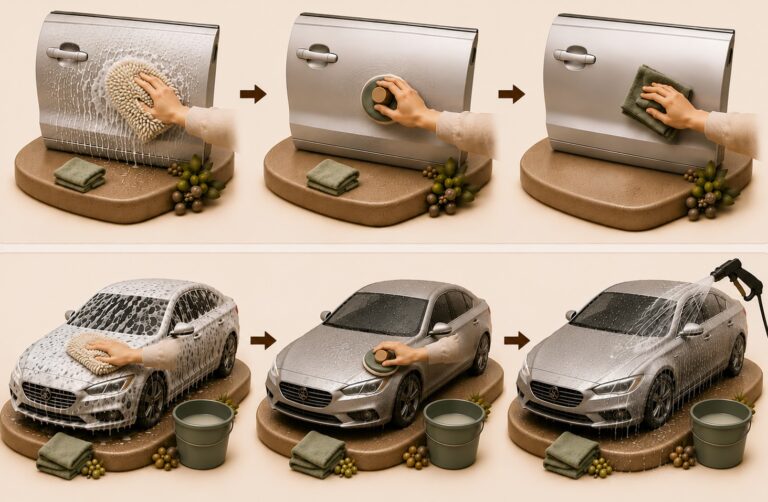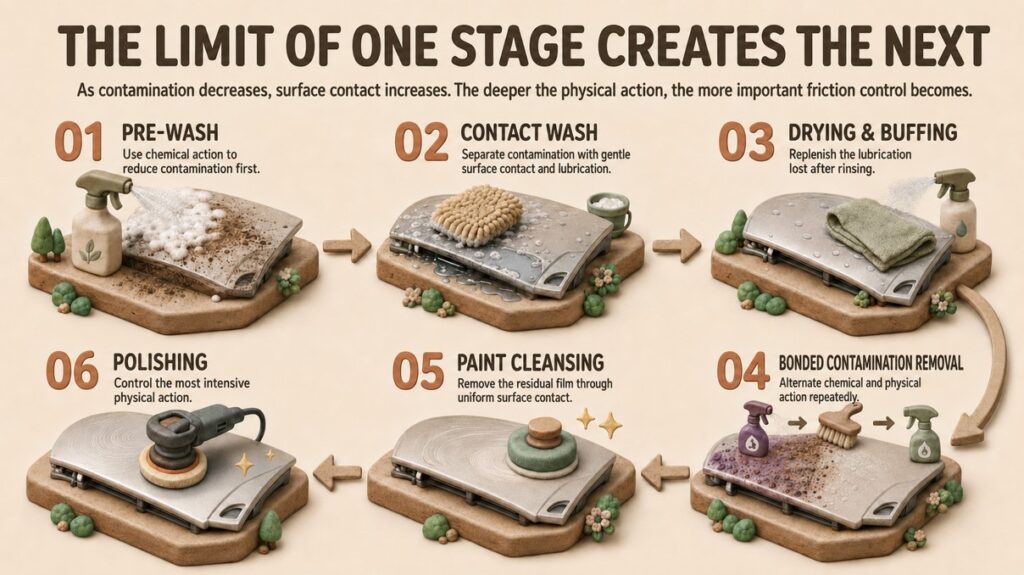
After completing a self-service car wash, we use a paint cleaner. Almost no one questions this order.
Most people explain it in the same way. They say that a paint cleaner offers more cleaning power, so it removes whatever the wash leaves behind. In other words, the process moves from a weaker product to a stronger one.
However, that explanation soon reaches a contradiction.
A paint cleaner cannot perform a full-vehicle wash. You cannot dilute and spray it across the entire car, apply it freely to rubber, plastic, and trim, or treat large areas without contact before rinsing everything away.
A paint cleaner cannot perform the work of a pre-wash cleaner.
A truly stronger version of the same product should perform the easier job as well. Paint cleaners and car wash cleaners do not. They perform different jobs under different conditions.
They do not share one scale of cleaning strength.
The cleaner comes first and the paint cleaner comes later because each product needs different conditions to work.
That difference begins with the raw materials.
Raw materials shape the product, and the product form determines how we use it.
The same chain explains why we do not spray a paint cleaner like a pre-wash, why rinsing alone cannot remove it, why we need an applicator pad, and why we use it after washing.
This article does not explain how to use a paint cleaner. Instead, it follows the conditions that made paint cleaners fundamentally different from ordinary car wash cleaners.
1. Some Contamination Does Not Respond to Alkaline Cleaning
Even after a thorough wash, the paint may still look dull or feel slightly rough.
At first, increasing the pre-wash concentration or dwell time may seem like the obvious solution. However, some residues remain unchanged because the problem does not come from insufficient strength.
The reaction itself does not suit the contamination.
A Chemical Reaction Needs a Suitable Site
An alkaline cleaner reacts with contamination and changes its chemical state. Water can then carry the changed material away during rinsing.
Water also helps the cleaning process before the rinse. It spreads across the surface, penetrates the contamination, and carries ions and cleaning ingredients into the affected area.
This property allows liquid cleaners to treat large panels efficiently.
However, every reaction needs a suitable site.
Hardened wax films, silicone residues, and fully polymerized sealant remains offer few useful sites for an alkaline reaction. More concentration or longer dwell time cannot force a reaction when the required pathway barely exists.
Two residues may both look oily, yet alkaline chemistry may affect only one of them.
The issue does not come from a lack of product. The chemistry simply does not match the residue.
Broad Application Limits Chemical Strength
Even when alkaline chemistry can react with contamination, a pre-wash cannot always push that reaction to its maximum.
A pre-wash touches more than paint. It also reaches rubber, plastic, metal, glass edges, emblems, and exterior trim.
The formula must therefore respect the most vulnerable material on the vehicle.
This creates a clear trade-off:
The wider the product’s application range, the more limits its chemistry must accept.
The ability to cover an entire vehicle and the inability to use unlimited chemical strength come from the same condition.
Pre-Wash and Car Shampoo Cleaning Power: Why Chemical Reactivity Matters explains this relationship in more detail.
When contamination falls outside the alkaline reaction pathway, we need another chemical route.
2. Solvents Follow a Different Route
Alkaline chemistry changes contamination so that water can carry it away.
Solvents take another approach. They penetrate the residue and weaken the forces that hold it together or attach it to the surface.
Solvents Select by Chemical Compatibility
A solvent does not select contamination by name.
It does not identify whether the residue came from wax, silicone, road oil, or an aged protective product. Instead, it interacts according to chemical compatibility, often described through polarity.
Materials with compatible chemical characteristics interact more readily. Materials with incompatible characteristics resist one another, just as oil and water naturally separate.
This allows a solvent to affect several residues that alkaline chemistry cannot effectively address.
The solvent does not need to convert the residue into an ionic or water-soluble material. It only needs to penetrate and weaken it.
The Residue Swells and Loosens
A solvent does not always dissolve contamination into a flowing liquid.
In many cases, it causes the residue to swell, soften, and lose cohesion.
A hardened wax film does not simply melt and disappear. The solvent enters the film, increases its volume, and weakens the forces that hold it together.
The residue remains on the paint, but it no longer holds the same strength.
This explains why a paint cleaner needs working time. The solvent must reach and loosen the film before the applicator can remove it.
Solvent action itself does not require water. However, free water changes how long the solvent remains on the surface and how the product interacts with the pad.
We will return to that difference in Section 6.
3. The Clear Coat Defines the Safe Working Range
The explanation would remain simple if solvents affected only contamination.
They do not.
The clear coat also contains resin, so solvent chemistry may interact with the contamination and the paint film.
Solvent Chemistry Also Reaches the Clear Coat
A cured clear coat contains a tightly cross-linked resin structure. This structure resists dissolution far better than a weak residue or aged protective film.
However, a solvent may still soften or swell the clear coat under certain conditions.
The level of change depends on several variables:
- The type of solvent
- The condition and age of the clear coat
- Surface temperature
- Product quantity
- Contact time
Short and controlled exposure may allow the coating to return toward its previous state as the solvent evaporates.
Longer exposure or higher temperatures can push the coating beyond that recoverable range.
For this reason, the phrase “paint-safe solvent” does not mean that the solvent has no interaction with the paint.
A paint-safe formula acts on contamination within a controlled range while keeping changes to the clear coat within an acceptable limit.
A Narrower Range Allows Different Chemistry
Manufacturers secure this working range partly by narrowing the intended application area.
A pre-wash must work across many exterior materials. A paint cleaner mainly targets painted surfaces.
We do not spray it across every piece of rubber, unfinished plastic, glass, and trim. By reducing the number of materials the formula must protect, the product can use a more specialized chemical system.
A smaller working area also gives the user more control.
When a cleaner covers the whole vehicle, the user must rinse it before any section dries. This limits the available dwell time.
When a paint cleaner treats one small section, the user can monitor the product and remove it at the correct moment.
Moving from a pre-wash to a paint cleaner does not mean moving to a stronger product. It means moving to a narrower working range that allows different chemistry.
4. Raw Materials Shape the Product Form
Once a product relies on solvent action and hand application, its raw materials begin to dictate its physical form.
The familiar paint cleaner bottle, applicator, and wipe-off process do not come from arbitrary instructions.
They come from the formula and the required removal method.
Simple Dilution Changes the Formula
A hand-applied paint cleaner cannot usually keep the same behavior after simple dilution with water.
Adding water changes more than concentration. It also changes:
- Solvent distribution
- Emulsion stability
- Viscosity
- Surface dwell
- Contact with the residue
- Removal behavior
A manufacturer must redesign the entire formula if the product needs to work with a large amount of water.
For this reason, users cannot treat a paint cleaner like an APC or pre-wash and simply adjust its strength through a dilution ratio.
The product must work in the state for which the manufacturer designed it.
Evaporation Limits the Working Area
Solvents evaporate.
If a user spreads a paint cleaner across the entire vehicle before removing it, the first panel may dry before the user reaches it again.
Drying changes the product’s behavior and leaves loosened residue on the surface.
This limits the practical working area.
The user must apply the product to a small section, allow a controlled working time, and remove it before the solvent evaporates completely.
Physical Removal Completes the Cleaning Process
An alkaline cleaner uses water as both a delivery system and a removal system.
Water carries the cleaner to the contamination, and the rinse carries the loosened contamination away.
A hand-applied paint cleaner does not create the same rinsing route.
The solvent weakens the residue, but the residue still remains on the paint. Someone must physically collect it.
This requirement determines the product form:
- Apply a small amount to a pad.
- Spread it across a limited area.
- Allow the solvent to loosen the contamination.
- Use the pad to separate the weakened film.
- Use a towel to remove the product and contamination.
The product cannot finish the job through spraying, dwelling, and rinsing alone.
A paint cleaner became a local hand-applied product because its chemistry loosens the contamination while physical contact completes the removal.
This structure also explains the instruction to wipe off the product before it dries.
When the solvent evaporates, the loosened contamination and remaining product stay on the surface. The instruction follows directly from the formula.
5. Pad Contact Reduces the Work Required from Chemistry
Physical contact does not mean aggressive scrubbing.
A paint cleaner needs controlled and even contact, not concentrated pressure.
Contact Means More Than Force
In this article, surface conformity describes how directly and evenly the tool follows the painted surface.
It combines several physical variables:
- Pressure
- Friction
- Movement
- Contact area
Car Detailing Physics: How F=ma Helps Reduce Swirl Marks explains how these variables affect scratch risk.
The same total force creates different pressure depending on the size of the contact area.
A fingertip concentrates force into a very small area. This sharply increases local pressure.
A broad pad spreads that force over a larger area.
The Applicator Spreads Force Evenly
A paint cleaner requires an applicator because the applicator performs two jobs.
First, it distributes force across the surface. This reduces local pressure and helps the tool follow the panel more evenly.
Second, it keeps the product between the tool and the contamination film.
The applicator does not merely make the job more comfortable. It creates the physical conditions that allow the product to work safely.
Physical Cleaning Power explains how surface conformity creates physical cleaning power.
Chemistry Loosens and the Pad Removes
Once the pad guarantees even contact, the solvent does not need to dissolve the contamination completely.
It only needs to loosen the film enough for the pad to separate it.
This division of work allows the formula to keep solvent strength within a safer range.
Paint cleaners deliberately leave part of the cleaning process to physical contact.
The chemical stage weakens the film. The applicator then separates and collects it.
The result therefore depends on more than the liquid itself.
The following variables also affect performance:
- Pad type
- Clean contact area
- Product quantity
- Working time
- Movement pattern
- Pad and towel replacement
Washing Must Remove Free Particles First
This product design requires a clean surface.
If sand, soil, or other free particles remain between the pad and the paint, the pad can drag them across the clear coat.
The same movement that should remove a contamination film can then create scratches.
This explains why the paint cleaner comes after washing.
It does not come later because it offers more strength. It comes later because washing must first remove the particles that would make direct contact unsafe.
General contamination can also block the solvent from reaching the target film.
When the result looks weak, do not immediately add more hand pressure. More pressure concentrates force and increases risk.
Instead, adjust the product quantity, working time, pad area, movement, and tool cleanliness.
6. Water Changes Removal and Retention
Some paint cleaners work without free water, while others work on a wet surface.
Water changes both the removal route and the way ingredients remain at the contact interface.
A New Rinsing Route
Adding water creates a new way to remove contamination.
Surfactants can disperse the loosened material into water. The rinse can then carry it away from the surface.
This reduces the need to wipe every area individually and allows the product to cover more space.
Wet-use products therefore offer two main advantages:
- Wider coverage
- Lower dependence on towel removal
This structure supports fast removal across a larger surface.
Free Water Reduces Contact Retention
Water also introduces a trade-off.
For an ingredient or abrasive particle to perform physical work, it must remain between the tool and the paint long enough to receive force.
A thick layer of free water makes that harder.
The water moves sideways under pressure and can carry small particles away from the contact point. Instead of holding them between the pad and paint, it disperses and transports them.
Other formula components create retention:
- Thickeners
- Dispersants
- Emulsifiers
- Oily carriers
- Viscous polymers
These components keep active ingredients and particles near the working surface.
Water-Based Compounds Do Not Use Free-Flowing Water
Water-based polishing compounds provide a useful comparison.
They contain water, but their formulas do not allow that water to flow like rinse water.
The product uses viscosity, emulsification, and dispersion to keep abrasive particles evenly suspended and close to the contact area.
The compound works because the formula controls the water.
It does not work simply because water exists in the bottle.
The Same Flow Can Help or Hurt
During washing, water flow provides an important advantage.
It carries separated contamination away from the paint and reduces the chance that the tool will drag the particles again.
How to Prevent Car Scratches: The Ultimate Detailing Guide explains this change in scratch risk.
However, the same flow becomes a disadvantage when the process needs to keep ingredients or particles at the contact interface.
The physical action remains the same, but the purpose changes.
Washing values transport and removal.
A contact-based cleaning or polishing process values retention.
Water therefore gives the product a wide rinsing route while reducing its ability to keep small particles at the working interface.
7. Abrasion Supports the Process but Does Not Define It
Some paint cleaners contain very fine abrasive ingredients.
This can create confusion because abrasion clearly helps remove contamination. However, abrasive ingredients need specific conditions before they can work effectively.
Abrasive Particles Need Contact and Repetition
An abrasive particle must remain between the pad and paint.
It must also receive pressure and repeated movement.
A thick liquid layer can prevent the particle from contacting both surfaces at the same time. As the liquid moves, it may carry the particle away from the working point.
Fine particles face an even greater challenge because flowing water can transport them easily.
Repetition also matters.
A machine passes over the same area many times at a controlled speed and pressure. A few hand movements across a wet panel cannot create the same level of repeated contact.
Wet-Use Products Prioritize Transport
A wet-use paint cleaner usually prioritizes safe contamination removal and easy rinsing.
The same product structure that improves rinsing also makes strong abrasive action difficult.
This produces two results from one cause:
- The product removes loosened contamination easily.
- The product keeps abrasive particles at the contact interface less effectively.
One result helps cleaning and safety. The other limits abrasion.
This does not represent a design failure. The formula simply prioritizes a different purpose.
Fine Abrasives Play a Supporting Role
Some low-water or hand-applied paint cleaners contain fine abrasives.
These particles can help break apart a weakened contamination film and add friction that hand application cannot provide consistently.
Their role differs from the role of abrasives in machine polishing.
Machine polishing removes clear coat material to reduce differences in surface height. It uses controlled pads, pressure, speed, and repetition to level the coating.
A paint cleaner primarily targets the contamination film above the clear coat.
However, fine abrasives may still affect the clear coat. Hand application usually removes less material and produces less uniform correction than machine polishing, but pressure and repeated movement can still create some abrasive action.
For this reason, we should distinguish between:
- Non-abrasive paint cleaners
- Fine-abrasive paint cleaners
- Cleaner polishes
Paint cleaners do not always exclude abrasives. The category simply does not rely on abrasion as its central mechanism.
Frequently Asked Questions
Why Do We Use a Paint Cleaner After Washing?
A paint cleaner requires direct pad contact.
Washing must first remove sand, soil, and other free particles. Otherwise, the pad may drag those particles across the clear coat and create scratches.
Washing also removes general contamination that could block the solvent from reaching the target film.
Does a Paint Cleaner Offer More Strength Than a Car Wash Cleaner?
The two products use different cleaning routes.
An alkaline cleaner reacts with suitable contamination and uses water to cover and rinse a wide area.
A paint cleaner loosens a residue with solvent chemistry and uses physical contact to complete removal.
One product does not simply sit above the other on a single scale of strength.
Can a Stronger Pre-Wash Replace a Paint Cleaner?
Not when the contamination does not suit the alkaline reaction pathway.
Increasing concentration or dwell time may help when a reaction already occurs. It cannot reliably solve a residue that offers few useful reaction sites.
Hardened waxes, silicone residues, and polymerized protection films may require solvent action and direct contact.
Do All Paint Cleaners Contain Abrasives?
No.
Some paint cleaners rely mainly on solvent chemistry and physical wiping. Others contain fine abrasive ingredients.
Check the product formula, instructions, removal method, and abrasive claims rather than relying only on the product name.
Why Does a Paint Cleaner Need an Applicator Pad?
The applicator spreads force across a larger area and reduces concentrated pressure.
It also keeps the product in contact with the contamination film and helps separate the residue after the solvent loosens it.
Conclusion|Different Conditions Created Different Products
Let us return to the original question.
Why does the cleaner come first and the paint cleaner come later?
The cleaner comes first because it can treat a large area without intensive contact. Water carries the cleaning ingredients to the contamination and removes the loosened material during rinsing.
A paint cleaner cannot replace this broad, low-contact process.
The paint cleaner comes later because it needs direct contact. Washing must first remove free particles and general contamination. Only then can the solvent reach the target film and the pad move safely across the paint.
The order does not represent a progression from weaker to stronger products.
Each product works only when the process creates the conditions it needs.
Alkaline chemistry works when the contamination offers suitable reaction sites. Solvent chemistry provides another route when that reaction pathway cannot remove the residue.
A paint cleaner combines chemical and physical cleaning at the same point. The solvent loosens the contamination, and the pad removes the weakened film. Because physical contact completes the process, the solvent does not need to dissolve everything.
The formula creates the familiar instructions:
- Work on a small area.
- Do not let the product dry.
- Use it only on suitable surfaces.
- Wash the vehicle before application.
- Use a clean pad and towel.
These instructions follow directly from the product’s design.
A paint cleaner cannot replace a car wash cleaner, and a car wash cleaner cannot replace a paint cleaner. Each product category developed for a different purpose.
Products vary in solvent balance, water content, removal method, and abrasive content. The product name alone cannot reveal how the formula works.
Is a Paint Cleaner Really the Next Step After an Acid Pre-Wash? explains how acidic cleaning and paint cleaner use differ.
The next article will examine the main types of paint cleaners and how to choose the correct type for each contamination condition.