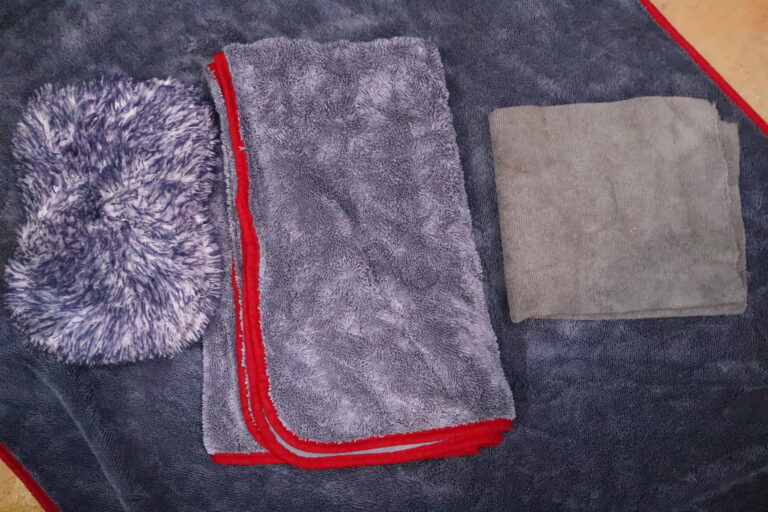
Car wash cleaning power is often judged by the chemical strength of a pre-wash, shampoo or dedicated cleaner. That is only half of the process. Contamination must also be separated from the surface, moved away from the contact area and finally recovered by water or a tool.
This is where physical cleaning begins.
High-pressure water strikes contamination. Rinse water flows across the paint and carries loosened material away. A wash mitt or brush makes controlled contact with what remains. A towel absorbs water and collects residue. When contamination is firmly bonded, clay, a paint cleaner or polishing may provide a deeper level of intervention.
These methods do not all belong in every wash, and they are not a mandatory sequence. They represent different depths of physical intervention. The correct level depends on what remains on the paint and how strongly it is attached.
Cleaning is not simply the act of rubbing contamination. It is the process of separating it from the surface and recovering it safely.
Featured image
- Title: Physical Stages of Car Wash Cleaning Power
- Alt text: Physical stages of car wash cleaning power from high-pressure rinsing and wash mitt contact to bonded contamination removal and paint polishing
Table of Contents
- What Does Physical Car Wash Cleaning Power Mean?
- Water Begins the Removal Process Before Contact
- Direct Contact Separates What Water Leaves Behind
- Bonded Contamination Requires Deeper Intervention
- Polishing Extends Physical Cleaning Into the Paint Surface
- Match the Depth of Intervention to the Surface Condition
- How Chemical and Physical Cleaning Work Together
- Frequently Asked Questions
- Conclusion
What Does Physical Car Wash Cleaning Power Mean?
Physical cleaning is the removal action created when water or a tool transfers force to contamination.
That force may come from:
- water striking the surface
- water flowing across the surface
- a mitt, brush or pad making contact
- a towel absorbing and lifting water or residue
- clay moving bonded contamination
- an abrasive system refining the clear coat
Physical action is therefore much broader than wash-mitt contact. It begins before the mitt touches the vehicle and can continue beyond normal washing into decontamination and paint correction.
Physical cleaning is not simply pressure
More pressure does not automatically create better car wash cleaning power.
The useful question is not how hard a person can press. It is whether the applied force reaches the correct target, creates enough separation and allows the removed material to leave the working area.
During a maintenance wash, excessive loading can trap remaining particles between the mitt and paint. The same additional force that moves contamination can also increase friction and scratch risk.
During bonded-contamination removal or polishing, more deliberate contact may be necessary. Even then, the goal is not uncontrolled force. Contact area, lubrication, tool structure, movement and the condition of the surface must all be controlled.
For a deeper explanation of how force and friction affect clear coat, see Car Detailing Physics: How F=ma Helps Reduce Swirl Marks.
Physical removal has four connected functions
Physical cleaning can be understood through four functions:
Force transfer → separation → movement → recovery
- Force transfer: Water or a tool delivers force to the contamination.
- Separation: The contamination releases from the surface.
- Movement: The separated material travels away from its original position.
- Recovery: Rinse water, a mitt, a pad or a towel removes it from the working area.
If one function is missing, the paint may still appear dirty or the separated contamination may remain available to be dragged across the surface.
Water Begins the Removal Process Before Contact
Water is the first physical cleaning tool used in a conventional car wash.
It does more than wet the vehicle. Its impact, flow and volume determine whether loosened contamination is actually removed or merely redistributed across the paint.
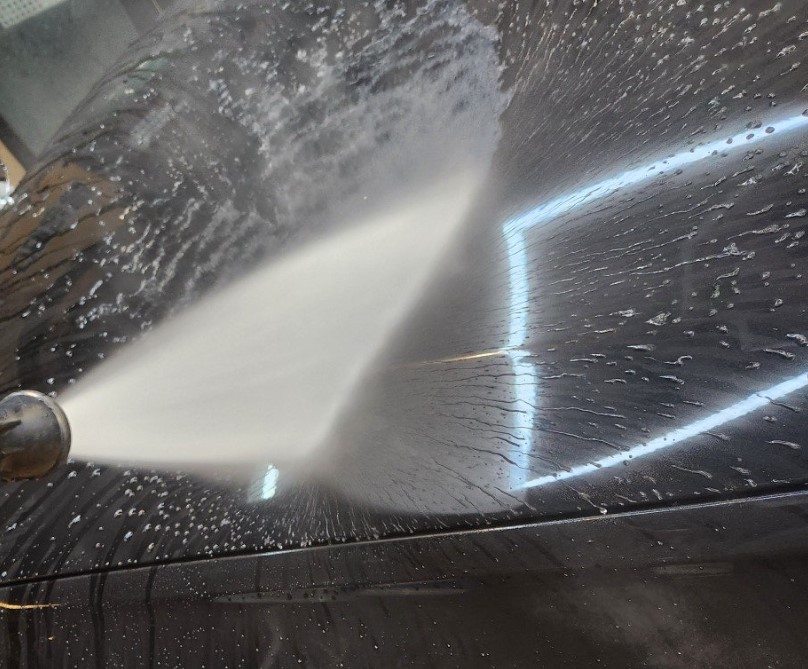
High-pressure water transfers impact force
A concentrated water stream collides with contamination and creates physical separation without a mitt or towel touching the surface.
This can remove part of the loose material and carry away contamination that has already been weakened by a pre-wash. It can also reach panel gaps, emblems, grilles and other areas that a large contact tool cannot follow precisely.
However, pressure alone does not determine the result. Nozzle distance, spray angle, working speed and the path of the water all affect how force reaches the surface and where the loosened material moves.
Rinse flow carries separated contamination away
Impact helps release contamination, but flowing water performs the next job: transport.
Rinse water should continue across the panel in a consistent direction so loosened dirt and cleaner residue move toward the lower edge of the panel and away from the vehicle. A short burst that only scatters water is different from a continuous rinse that clears the working area.
This is why both pressure and water volume matter. Pressure can reach and disturb contamination, while sufficient flow carries it away.
The rinse stage is therefore not an empty pause between chemical and contact cleaning. It is a physical removal and recovery stage in its own right.
Direct Contact Separates What Water Leaves Behind
After pre-washing and rinsing, some contamination may still remain attached to the paint.
Direct contact adds controlled mechanical action. A mitt, brush, pad or towel can conform to the surface and reach contamination that water alone did not separate.
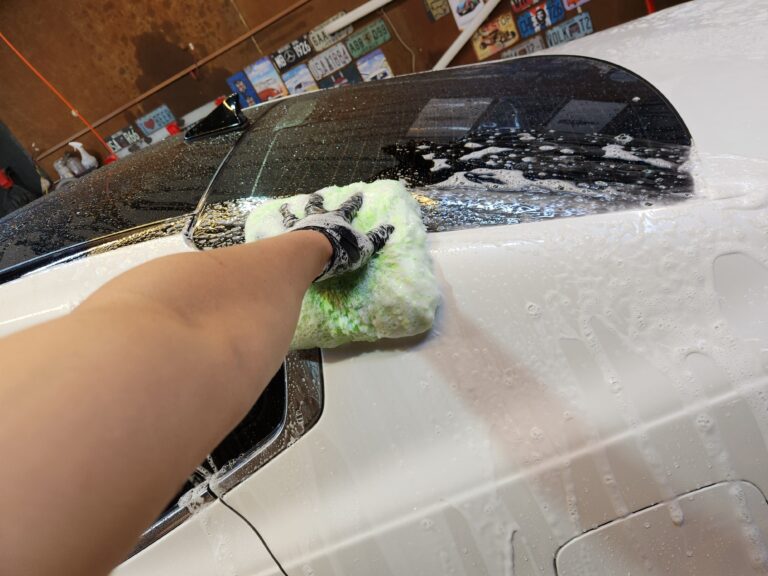
A wash mitt combines contact with shampoo-water flow
A wash mitt should not behave like a dry scrubbing block.
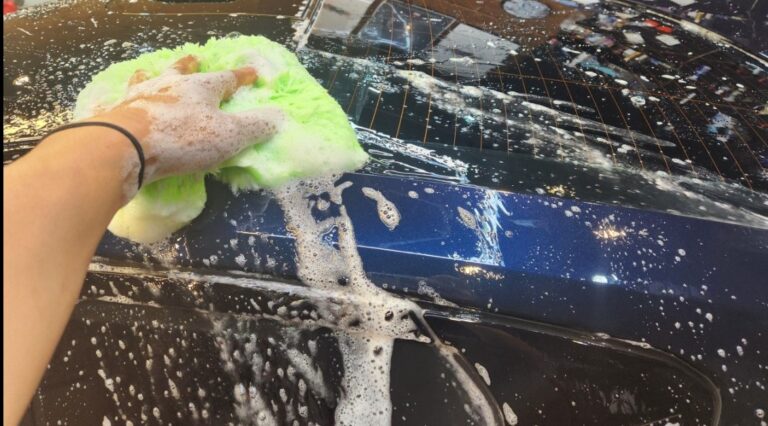
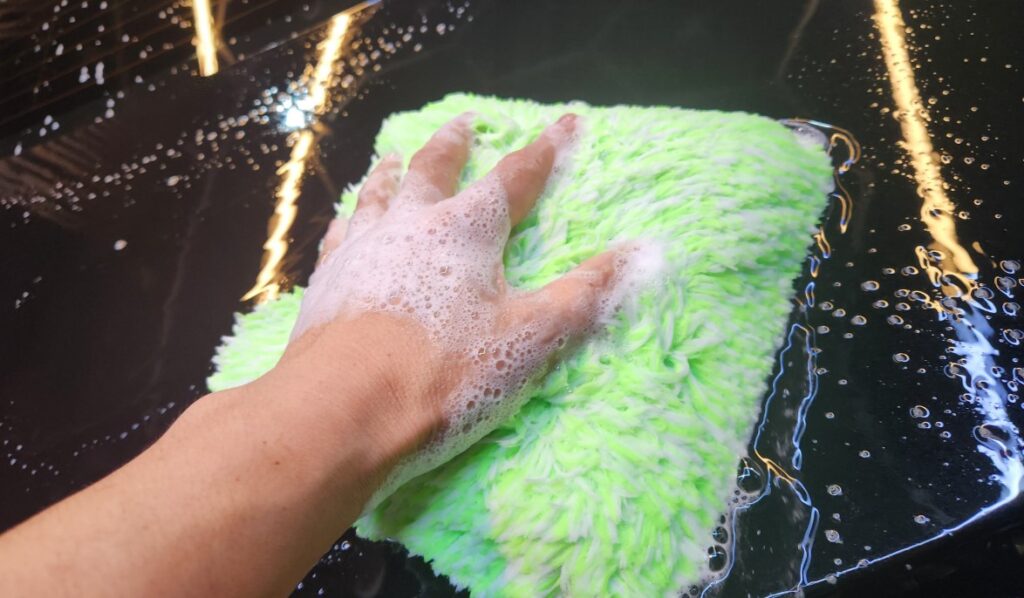
A long-pile microfiber mitt carries shampoo solution from the bucket to the panel. Its fine, flexible fibers conform to the paint while the stored solution supports lubrication and flows through the contact area.
As the saturated mitt moves, shampoo solution should continue to emerge around and ahead of the pile. This flow helps maintain lubrication and gives loosened contamination somewhere to move. When that flow noticeably decreases, the mitt needs to be rinsed and reloaded with shampoo solution.
The important action is therefore not simply “mitt against paint.” It is:
Saturated pile + controlled contact + shampoo-water flow + contamination release
This section only defines the mitt’s place within the wider physical-cleaning system. The detailed structure and handling of a wash mitt are covered separately:
- Why Use a Wash Mitt? 5 Features That Reduce Scratches
- How to Choose a Car Wash Mitt: Water Release and Dirt Control
- Best Wash Mitt for Cars: Fiber Movement and Pile Depth Guide
Brushes extend contact into complex areas
A wash mitt works well across broad panels, but it cannot follow every narrow or recessed shape.
Brushes provide localized agitation around emblems, grilles, trim edges, fuel-filler areas and panel gaps. Their role is not to replace proper chemical weakening or rinsing. They extend controlled contact into structures that a mitt cannot reach effectively.
The brush material, contamination level, surface sensitivity and available lubrication must match the area being cleaned.
Towels recover water and product residue
Towels create another form of physical contact.
A drying towel absorbs rinse water from the surface. A buffing towel collects paint-cleaner residue, polish oils, wax or sealant residue. In both cases, the towel is not simply moving across the paint; it is receiving material into its fiber structure.
Once a towel becomes saturated, its recovery capacity falls. Additional wiping or pressure cannot restore that capacity. A clean face or a second towel is needed.
A drying towel should not be expected to complete an inadequate rinse. Dirt and cleaner residue should be removed before the drying stage whenever possible.
For more on contact risk after washing, see Why Swirl Marks Still Appear During Washing, Drying and Buffing.
Bonded Contamination Requires Deeper Intervention
Normal washing is intended to remove contamination sitting on or loosely attached to the paint.
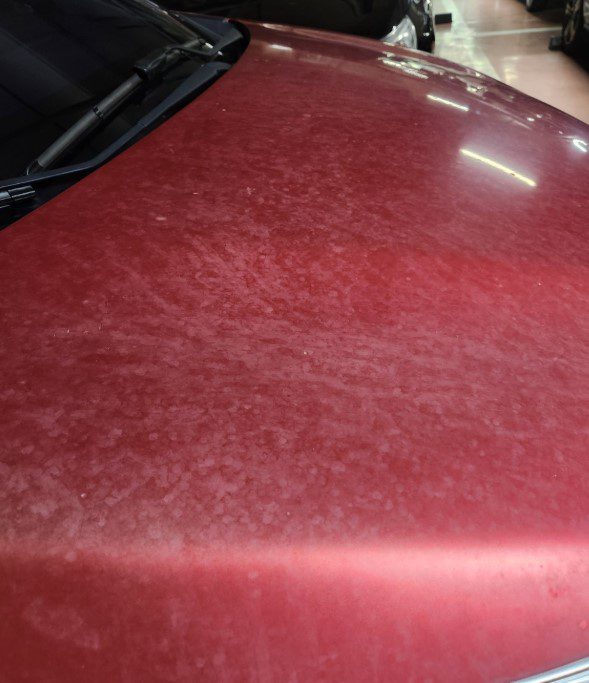
Bonded contamination behaves differently. It may remain as a rough deposit, a thin stain-like film or a residue that has become strongly attached through repeated wetting, drying, heat and exposure.
At this point, repeating normal mitt contact with more pressure is usually the wrong form of intervention. The tool and the removal mechanism must change.
Clay moves raised bonded contamination across the surface
Detailing clay works on contamination that projects from or remains firmly attached to the paint surface.
With sufficient lubrication, clay passes across the panel, catches the exposed contamination and moves it until it separates. The useful force is directed along the surface rather than applied as unnecessary downward pressure.
Clay does not dissolve contamination. It creates controlled physical separation.
The grade of clay, lubrication, surface cleanliness and number of passes all affect marring risk. For a manufacturer example of the contaminants targeted by automotive clay, see Meguiar’s Smooth Surface Clay Kit.
Paint cleaners may use chemical cleaning, fine abrasion or both
Paint cleaners vary widely by product.
Some rely mainly on chemical cleaning to loosen oily residue, old protection and embedded surface film. Others contain fine abrasives. Some combine chemical cleaning with mild abrasive action.
It is therefore more accurate to define the product before defining the mechanism:
Depending on the formula, a paint cleaner may use chemical cleaning, fine abrasion or both methods together.
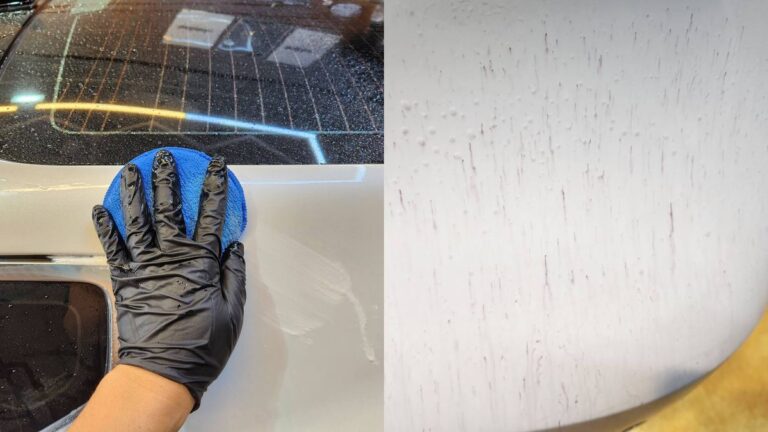
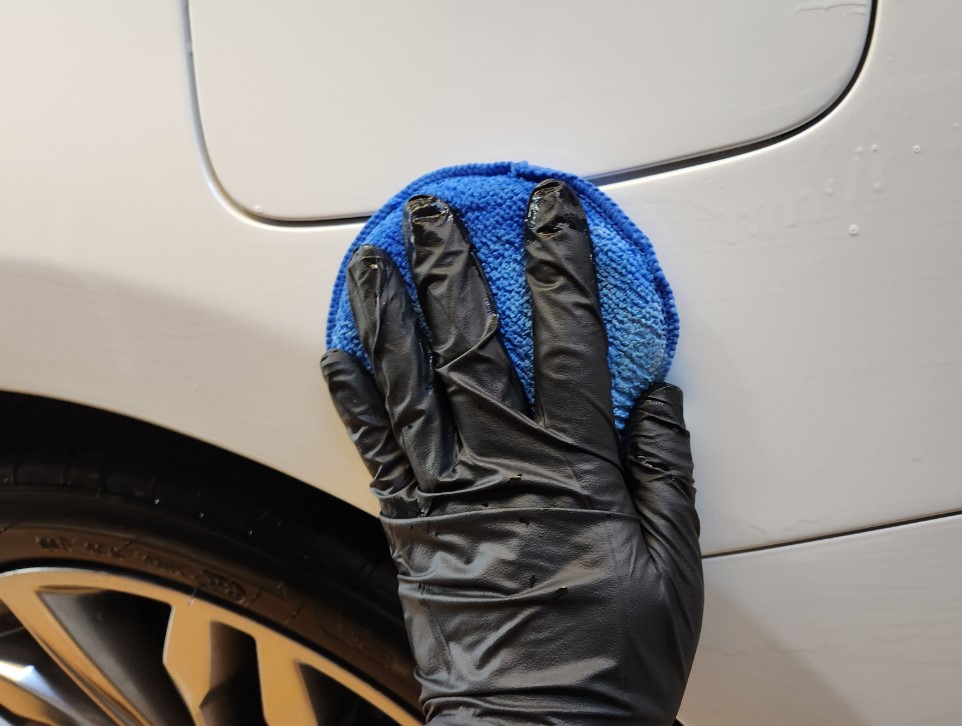
The applicator keeps the product in contact with the paint and moves it across the working area. A towel then recovers the released contamination and product residue.
This is a deeper form of physical intervention than a routine contact wash because the target is no longer ordinary loose dirt. The goal may be to remove a bonded film, restore surface clarity or prepare the paint for protection.
For the difference between mineral deposits and broader paint-cleaner targets, see Mineral Contamination vs. Water Spots.
Polishing Extends Physical Cleaning Into the Paint Surface
Polishing changes the target again.
A wash, clay treatment or non-abrasive cleaner aims to remove material attached to the paint. Abrasive polishing works on the clear-coat surface itself.
Polishing does not remove a scratch by lifting it away
A scratch is an irregularity in the clear coat. It cannot be rinsed away or collected like dirt.
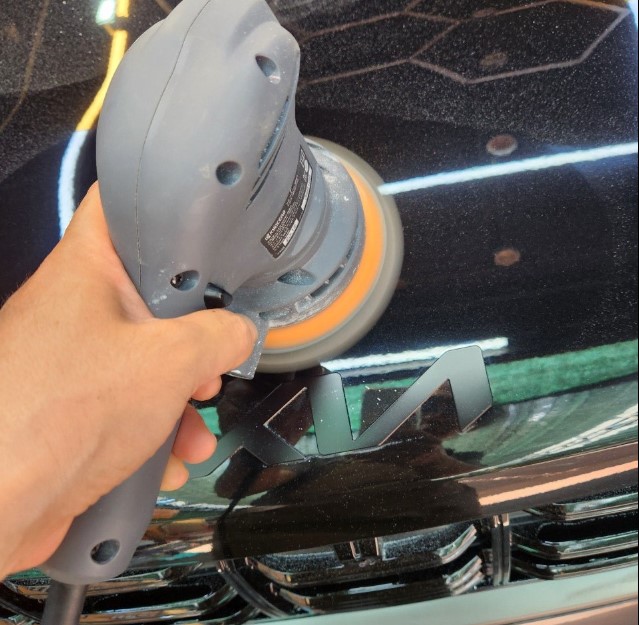
An abrasive pad-and-polish system refines a very small amount of the surrounding clear coat so the height difference around the defect becomes less visible. In other words, the process changes the surface profile rather than extracting contamination from it.
This is why polishing should not be treated as a stronger version of washing. It is surface correction.
The pad, abrasive, machine movement, working time and applied load must be selected as one system. Official paint-finishing systems also separate compounding, polishing and ultrafine finishing into different levels of defect removal; see the 3M Perfect-It Paint Finishing System.
The goal is the minimum necessary removal
More cutting is not automatically a better result.
The correct objective is to remove or reduce the defect while preserving as much clear coat as possible. That requires inspection, a test area and the least aggressive combination capable of producing the required improvement.
Polishing represents the deepest intervention discussed in this article because it no longer acts only on contamination above the paint. It intentionally alters the upper clear-coat profile.
Match the Depth of Intervention to the Surface Condition
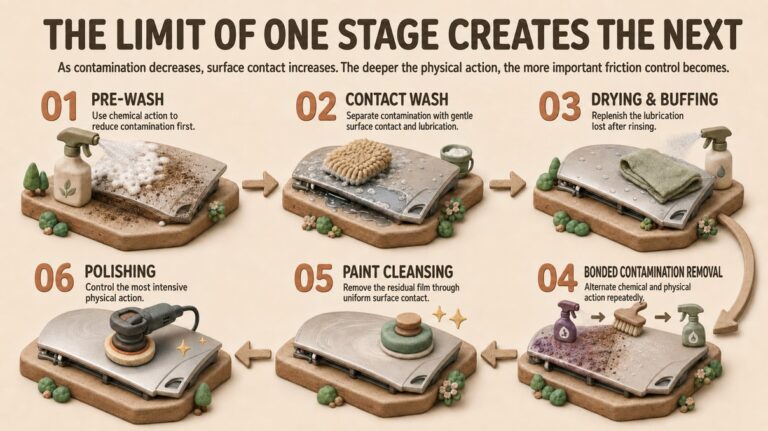
The physical methods described above can be arranged by intervention depth:
- Water impact and rinse flow: Separate and recover loose or chemically weakened contamination.
- Mitt, brush and towel contact: Remove remaining general contamination and recover water or residue.
- Clay and paint-cleaner work: Target material that remains bonded after normal washing.
- Abrasive polishing: Refine defects within the clear-coat surface itself.
This is a decision structure, not a checklist that must be completed from top to bottom.
A vehicle that becomes clean after pre-washing, rinsing and a controlled contact wash does not need clay, a paint cleaner or polishing. Deeper intervention is justified only when inspection shows that the previous level cannot address what remains.
The principle is simple:
Use the least invasive physical action that can separate the target safely and completely.
This approach improves car wash cleaning power without confusing stronger intervention with better maintenance.
How Chemical and Physical Cleaning Work Together
Chemical cleaning and physical cleaning are not competing explanations.
Chemical action can wet, penetrate, dissolve, swell or weaken contamination. Physical action then separates the weakened material, moves it away from the surface and recovers it.
The balance changes with the condition of the paint.
During a routine wash, chemical weakening and rinsing should reduce the contamination load before direct contact. This lowers the force and repetition required from the mitt.
With bonded contamination, chemistry may still weaken or target the deposit, but more deliberate contact may be needed to complete the separation. With polishing, abrasives and pad movement intentionally work on the clear-coat profile.
The complete mechanism can therefore be summarized as:
Chemical weakening → physical separation → movement → recovery
This article has focused on the physical side of car wash cleaning power. Part 2 will examine how chemical action and physical contact should be balanced as contamination becomes more strongly attached.
For the chemical side of the same system, see 3PH Car Wash Cleaning Power: pH, Solvents and Surfactants.
Frequently Asked Questions
Is physical cleaning the same as scrubbing?
No. Scrubbing usually implies repeated contact and increased friction. Physical cleaning includes water impact, rinse flow, controlled tool contact, absorption, bonded-contamination removal and polishing. The objective is effective separation and recovery, not maximum rubbing.
Is high-pressure rinsing a form of physical cleaning?
Yes. The water stream transfers force to contamination, while the following flow moves loosened material away. It is a non-contact physical process because no solid tool touches the paint.
Does more pressure always increase car wash cleaning power?
No. More force can increase removal, but it can also concentrate loading on particles trapped between a tool and the clear coat. The correct amount depends on the contamination, tool, lubrication, contact area and surface condition.
What is the difference between clay, a paint cleaner and polishing?
Clay mechanically separates contamination projecting from or bonded to the paint. A paint cleaner may use chemical cleaning, fine abrasion or both to remove residual surface film. Polishing uses abrasives to refine the clear-coat profile and reduce visible defects.
Why should chemical cleaning come before mitt contact during a wash?
Chemical weakening and rinsing reduce the amount of contamination remaining when the mitt touches the paint. With fewer particles and weaker attachment, the mitt can complete the wash with less force and fewer repeated passes.
Do I need every physical-cleaning stage during each detail?
No. High-pressure rinsing and controlled contact are part of a normal wash, but clay, paint cleaning and polishing are condition-based processes. Stop when the target contamination has been safely removed.
Conclusion
Car wash cleaning power does not come from chemicals alone, and physical cleaning does not mean using the strongest possible force.
Water impact begins the separation. Rinse flow carries loosened contamination away. Mitts and brushes make controlled contact with what remains. Towels absorb and recover water or residue. Clay and paint cleaners address more firmly bonded contamination, while polishing extends the intervention into the clear-coat surface itself.
Each method has a different target and a different depth.
Car washing is not the act of rubbing dirt. It is the process of separating contamination and recovering it. Physical cleaning power is not the use of extreme force; it is the ability to deliver only the force required, where it is required, so the contamination is removed while the surface is preserved.