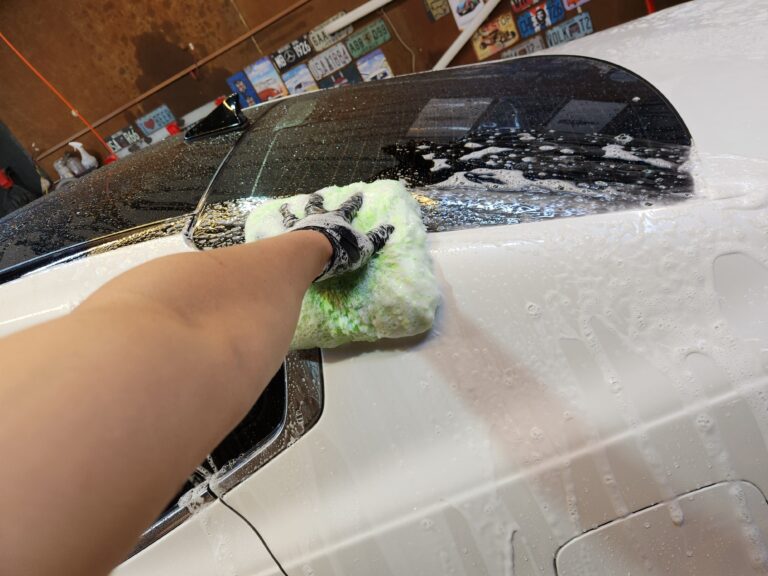
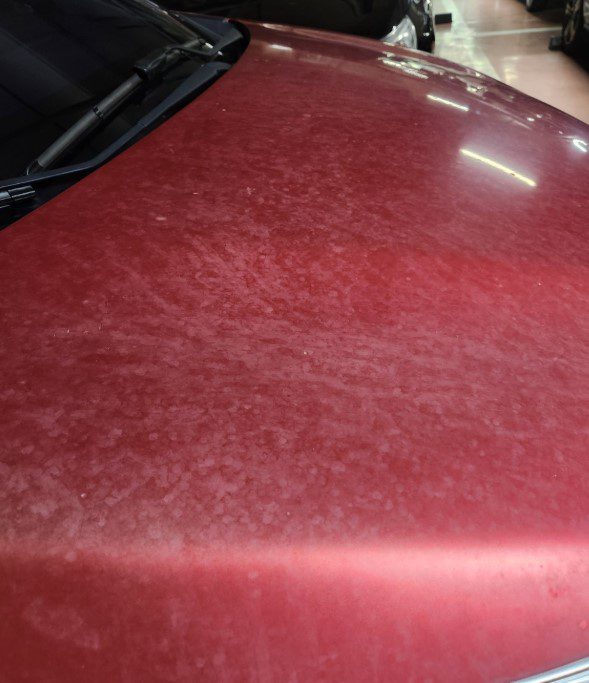
After washing and drying your car, the paint may look clean but still feel rough or gritty when you run your hand across it.
Many people immediately suspect iron fallout and reach for an iron remover.
However, iron fallout represents only one type of particulate contamination. Fine iron particles, hardened traces of tar or tree sap, paint overspray, industrial fallout, and other small contaminants can remain on the paint after washing.
These particles do not all respond to the same removal method. Their composition matters, but the way they remain on the paint matters just as much.
Before choosing a product, check not only what type of particle remains but also what keeps that particle on the surface.
Why Car Paint Can Still Feel Rough After Washing
Why Doesn’t Washing Remove Everything?
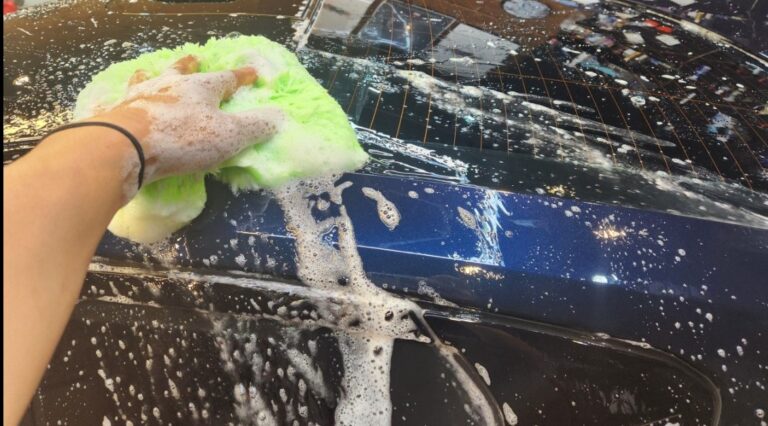
Pre-washing and contact washing remove road film, dust, and other contamination that normal washing can release.
You can usually identify larger tar spots or tree sap visually and treat them with a suitable dedicated cleaner when necessary.
However, very small contaminants can escape visual inspection, especially after they harden on the paint. Iron fallout, hardened traces of fine tar or sap, paint overspray, and industrial fallout can remain in this form.
Excess coating product or coating residue from incomplete buffing can also hold fine particles on the paint. Normal washing may remove loose contamination while leaving these trapped particles behind.
Therefore, roughness after washing can come from particles that resist normal washing on their own, or from particles that another residue keeps attached to the surface.
The paint may look clean to the eye while these tiny raised contaminants still create a rough feel under your fingertips.
Types of Fine Particulate Contamination
- Iron fallout and ferrous particles: Brake dust and airborne iron particles can settle on the paint. As oxidation develops, the iron can become harder to remove with normal washing.
- Hardened fine tar or tree sap: Tiny residues can harden on the surface. They may remain difficult to see while still creating a noticeable bump.
- Paint overspray: Fine airborne paint droplets can settle and harden into small raised particles.
- Industrial fallout: Industrial areas and construction sites can produce mixtures of mineral and metallic particles. Some industrial fallout can also contain ferrous particles.
- Particles held by other contamination: Excess coating product or coating residue from incomplete buffing can hold fine particles that normal washing would otherwise remove more easily.
These contaminants can feel similar to the touch, but their composition and the way they remain on the surface differ. That difference affects the removal method.
Why Remove Particulate Contamination?
- Potential clear-coat damage: Long-term exposure to contaminants such as iron fallout can allow oxidation to progress and may locally affect the clear coat.
- Potential scratch risk: A towel or pad can drag remaining particles across the paint and create fine scratches.
- Reduced slickness: Raised particles and residue reduce the smooth feel of the paint.
- More contamination buildup: Residue and existing particles can give new contamination more places to remain.
- Reduced gloss: Fine particles and contamination films can interfere with clean light reflection and make the finish look duller.
Removing these contaminants does more than restore a smooth feel. It also helps reduce scratch risk, restore slickness and gloss, and create a cleaner surface for the next detailing step.
How to Remove Rough Contamination from Car Paint
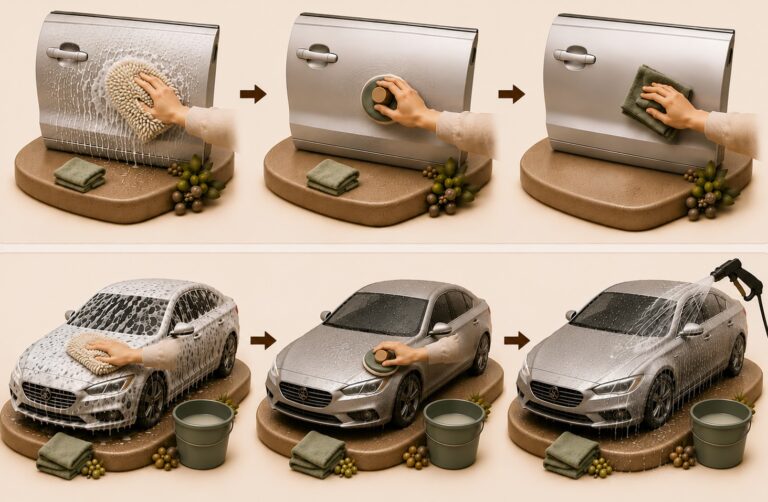
Detailers generally use three methods to deal with this type of contamination:
- Iron remover: Reacts with exposed ferrous contamination and helps release iron from the surface.
- Paint cleaner: Removes contamination films and wax or coating residue that normal washing leaves behind.
- Clay: Physically removes particles that still require mechanical decontamination.
The important point is not to follow these methods in one fixed order. Choose the method and working order according to the contamination that remains on the paint.
However, one basic principle still applies: whenever possible, first check what chemical or cleaning methods can remove, and minimize unnecessary mechanical contact with the paint.
Mixed Contamination Can Change the Correct Starting Point
Particles left after washing do not always sit on the paint independently. Different contaminants can overlap and interact, creating a mixed contamination condition.
For example, old or excess coating residue may remain on the paint while iron particles sit on top of that residue. In this situation, you do not necessarily need to start with an iron remover.
A paint cleaner can remove the coating residue that holds the particles and may release the iron particles at the same time.
The opposite condition can also occur. Wax, coating residue, or another contamination film may cover an iron particle. That covering layer can prevent an iron remover from making effective contact with the iron.
In that case, a paint cleaner can first remove the covering contamination. Once the iron becomes exposed, you can apply an iron remover directly to the remaining ferrous contamination.
If oxidation and the iron particle itself create the main attachment to the paint, an iron remover becomes the more relevant treatment.
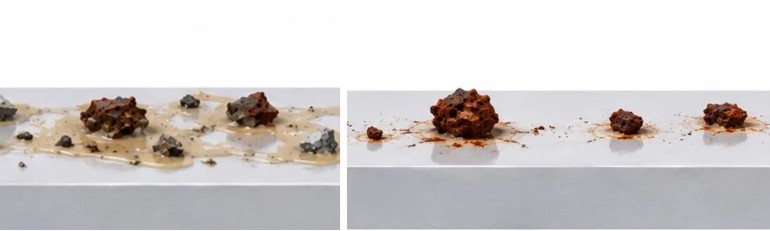
So the choice between an iron remover and a paint cleaner does not simply come down to “iron or non-iron.”
The type of particle matters, but the way that particle remains on the paint determines which removal method and working order make sense.
Coating residue, iron fallout, fine tar, and industrial particles can overlap. One treatment may remove one part of the contamination and reveal another underneath.
After each treatment, check the newly exposed surface and feel the paint again. Then choose the next method according to what still remains.
A Simple Way to Choose a Starting Point
If you are unsure where to begin, use gloss and surface feel as practical clues.
- If the paint looks dull or hazy: A contamination film or coating residue may remain, so a paint cleaner can provide a useful starting point.
- If the paint looks clean and glossy but still feels rough: Exposed ferrous contamination may remain, so an iron remover can provide a useful starting point.
Whichever method you choose first, inspect the paint again after the treatment. If the iron remover no longer produces a reaction but the paint still feels rough, check for another type of residual contamination rather than continuing to treat everything as iron.
If chemical and cleaning methods remove what they can but hard, raised particles still remain, consider clay for those remaining particles.
Gloss and surface feel help you choose a starting point; they do not create a universal sequence. Treat the contamination, reassess the paint, and choose the next step according to what remains.
Using an Iron Remover
How It Removes Contamination
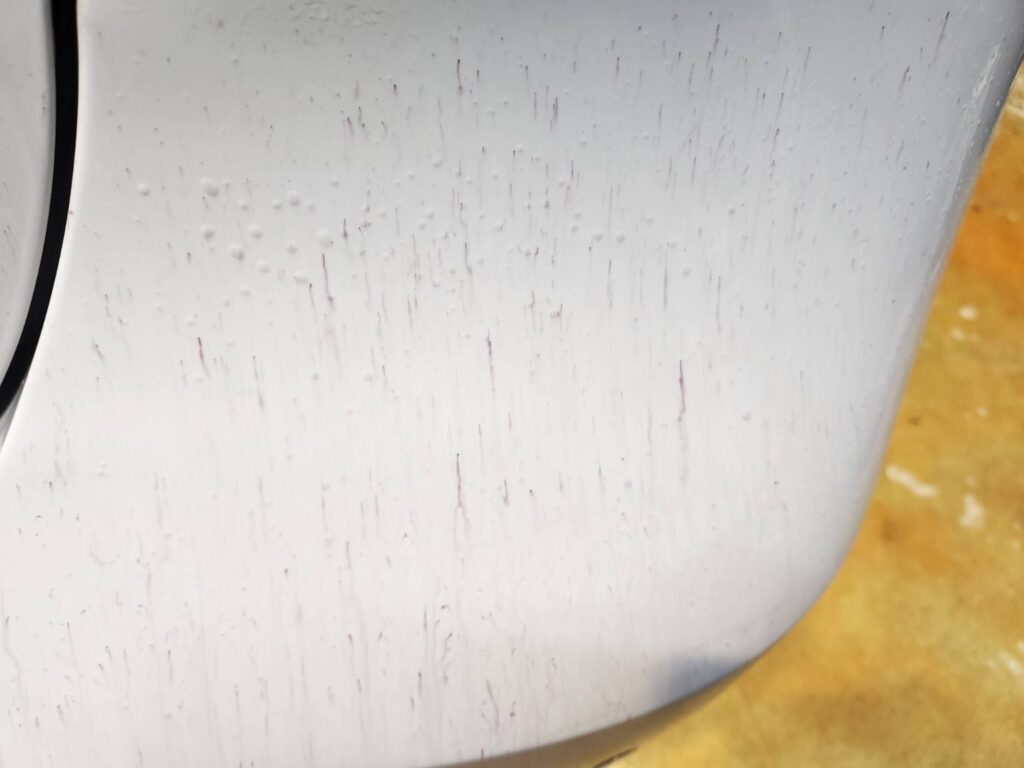
Iron remover works best when the product can directly contact exposed ferrous contamination. It reacts with oxidized iron and helps make the contamination easier to separate from the paint.
Basic Process
1. Spray and allow it to react → Apply the iron remover evenly and give it enough time to react.
2. Lightly work the area if needed → When necessary, use a soft, wet tool with very low pressure.
3. Wash, rinse, and inspect → Lightly wash the area, rinse thoroughly, and check the surface again.
Precautions
Avoid direct sunlight and hot paint. Keep the product from drying on the surface.
Do not scrub iron particles aggressively. After treatment, rinse thoroughly so the cleaner, reaction residue, and released contamination do not remain on the paint, trim, emblems, or panel gaps.
For the reaction mechanism, repeated removal process, and rinsing precautions, see Car Iron Fallout Removal | Iron Remover Process and Precautions.
Using a Paint Cleaner
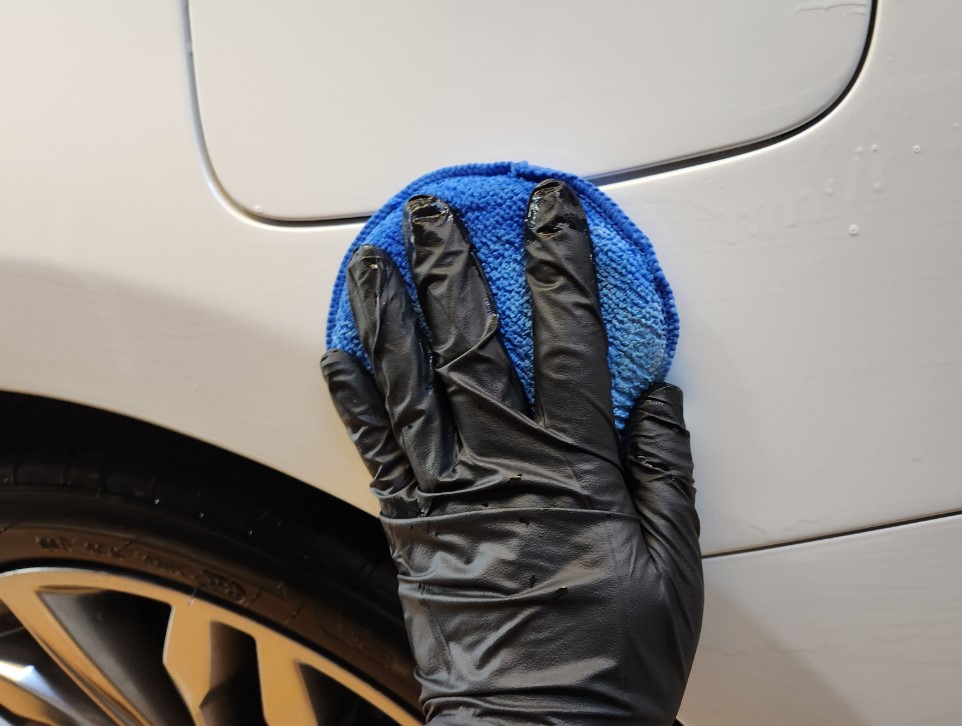
How It Removes Contamination
A paint cleaner targets contamination films and wax or coating residue that normal washing leaves behind.
When those residues hold particles on the surface, removing the residue can release the particles as well. A paint cleaner can also uncover contamination that another layer previously covered.
Basic Process
1. Apply → Apply a small amount of paint cleaner to a limited area.
2. Work with low pressure → Give the cleaner time to act while using controlled, low-pressure pad contact.
3. Remove and inspect → Remove the residue, then check the surface feel, gloss, and any contamination that the process has exposed.
Precautions
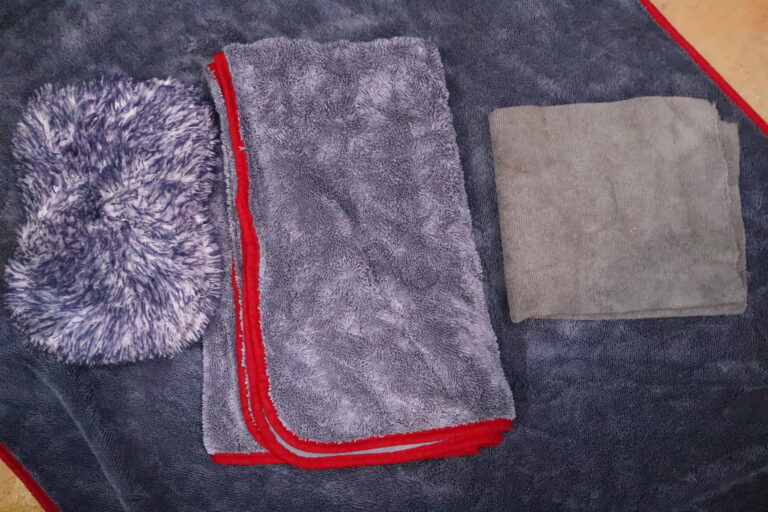
Do not repeatedly scrub the same area with heavy pressure. Switch to a clean section of the pad or towel when contamination builds up on it.
Paint-cleaner work can weaken or unevenly affect existing wax or coating protection, so check the protection after cleaning.
For pad selection, pressure, and dwell time, see How to Use a Paint Cleaner | Pad Choice, Pressure, and Dwell Time. A paint cleaner combines chemical cleaning with pad contact, so pressure and repeated contact require careful control.
For guidance on how far to continue and when to stop, see Paint Cleaner Side Effects | When to Stop Between Gloss Improvement and Scratch Risk.
Using Clay
How It Removes Contamination
Clay physically removes raised particles that still require mechanical removal.
At this stage, the important question is not only what the particle is. Ask whether the remaining particle now requires physical removal.
Do not automatically clay the entire vehicle from the beginning. First reduce contamination that chemical or cleaning methods can remove, then use clay only where raised particles still remain.
Basic Process
1. Lubricate thoroughly → Keep both the paint and clay well lubricated.
2. Remove gently → Use very light pressure and short, straight movements.
3. Recheck the surface → Work in small sections, check the feel repeatedly, and stop when the roughness disappears.
Precautions
Clay creates a relatively high risk of fine scratches or marring because it removes contamination through direct mechanical contact.
Even with good lubrication and low pressure, the process can leave visible working marks depending on the paint and contamination level. Black and other dark-colored vehicles show these marks more clearly.
Inspect the paint under suitable lighting after claying. If the surface shows marring, you may need a finishing polish to refine it.
Check the Protection After Decontamination
Iron removers, paint cleaners, and clay can weaken existing wax or coating protection or leave that protection uneven.
After decontamination, check the surface feel, gloss, and water behavior. If the process reduced the protection, restore it with an appropriate wax, sealant, or coating.
Frequently Asked Questions
Should I use an iron remover first whenever the paint feels rough?
No. Iron fallout can cause roughness, but fine tar or sap residue, paint overspray, industrial fallout, coating residue, and combinations of these contaminants can produce a similar feel.
Check the surface condition, gloss, and the way the contamination remains on the paint before choosing a starting method.
If the paint still feels rough after using an iron remover, does that mean iron still remains?
Not necessarily. If the iron reaction stops but the surface still feels rough, another type of residual contamination or a mechanically attached particle may remain.
Reassess the surface before choosing the next treatment.
Can a paint cleaner remove iron particles?
A paint cleaner does not selectively react with iron. However, an iron particle may sit on or become held by a removable contamination film or coating residue.
When the paint cleaner removes that layer, the iron particle may come away with it.
Should I use clay first because it removes particles quickly?
Clay can remove raised particles effectively, but it also creates more direct mechanical contact and therefore a higher risk of marring or fine scratches.
Whenever practical, first reduce contamination that responds to chemical or cleaning methods. Then decide whether the remaining particles actually require clay.
Which comes first: an iron remover or a paint cleaner?
No single fixed order works for every vehicle.
If the paint looks dull and a contamination film appears likely, a paint cleaner may provide the better starting point. If the finish looks clean and glossy but still feels rough, an iron remover may provide a useful first test.
Whichever method you choose, inspect the paint again afterward and decide what to do next according to the contamination that remains.
Conclusion
Rough paint after washing does not automatically mean that every remaining particle is iron fallout. It also does not mean you should immediately clay the entire vehicle.
Iron fallout, hardened traces of tar or sap, paint overspray, industrial fallout, coating residue, and other contaminants can interact and create a mixed contamination condition.
The key question is not simply which product you should use first.
What remains on the paint, and what keeps it there?
Use gloss and surface feel to choose a starting point. Apply the appropriate treatment, then inspect the paint again.
Assess → remove what you can safely remove → reassess.
This approach reduces unnecessary mechanical contact and helps you remove the contamination progressively instead of treating every rough surface as the same problem.