Why a Clean-Looking Surface Doesn’t Always Mean a Safe Wash
Key Takeaways
Allowing an alkaline pre-wash to dry is more than a cosmetic issue. As moisture evaporates, loosened road film and non-volatile cleaning ingredients can concentrate on the paint instead of being rinsed away. If this happens repeatedly, contamination may gradually build up, reducing paint clarity even when obvious stains are not visible.
During hot weather, cleaning solution can dry surprisingly fast. The safest approach is to rinse while the surface remains evenly wet and the solution is still able to carry loosened contamination away from the vehicle.
Why Drying Is More Dangerous Than Most People Think
Most discussions about alkaline pre-wash safety focus on visible damage.
People commonly worry about:
- White staining on textured plastic trim
- Water spots around chrome trim
- Dried chemical residue
- Possible chemical damage to the clear coat
These concerns are valid because they are easy to recognize.
However, a more common problem often begins before any visible stain appears.
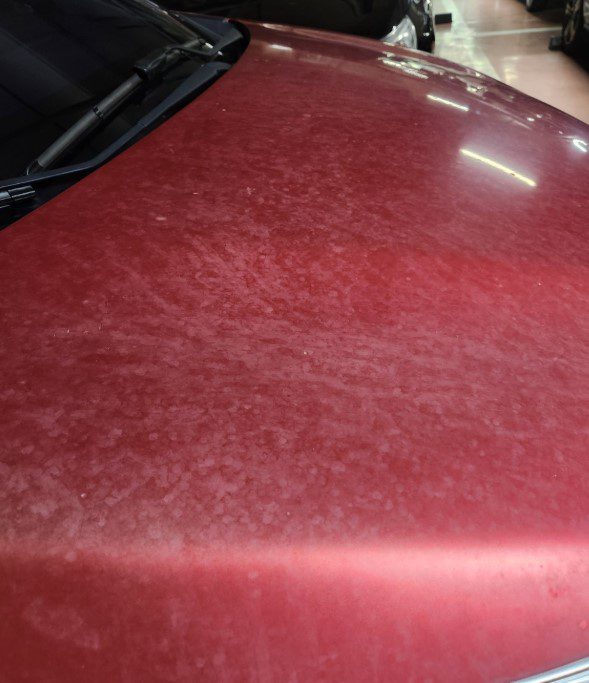
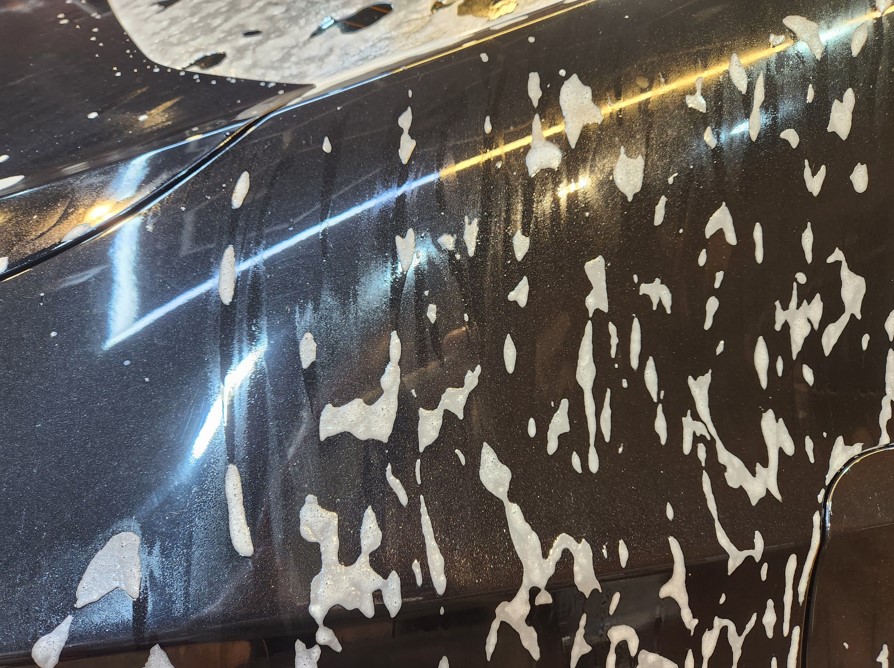
If an alkaline cleaner starts drying before it is rinsed away, the cleaning process changes completely. Instead of carrying loosened contamination off the vehicle with flowing water, evaporation concentrates both the cleaner and the contamination on the paint surface.
As moisture disappears, loosened road film, surfactants, alkaline builders, and suspended particles become increasingly concentrated. Rather than leaving the vehicle during rinsing, part of this mixture can settle back onto the paint as re-deposited contamination.
Unlike obvious chemical residue, this contamination is usually invisible during the wash. Yet repeated drying can gradually reduce paint clarity over time.
In simple terms, the most obvious drying risk is visible residue.
The easiest one to overlook is contamination re-deposition.
An Alkaline Pre-Wash Does Not Remove Contamination by Itself
For a deeper explanation of how pH, surfactants, solvents, dilution, and dwell time affect cleaning performance, read What Determines the Cleaning Power of an Alkaline Cleaner?.
Many people assume an alkaline pre-wash removes road film the moment it touches the paint.
That is not how the cleaning process works.
An alkaline cleaner weakens the bond between organic contamination and the paint surface. It softens oily road film, reduces its adhesion, and makes contamination easier to rinse away.
Rinsing completes the removal by carrying the loosened contamination off the vehicle.
A proper cleaning sequence looks like this:
Apply the cleaner → Loosen contamination → Keep the surface wet → Rinse the contamination away
As long as the cleaning solution remains wet and free to flow across the surface, it continues supporting this process.
However, loosening contamination and removing contamination are two different stages.
The cleaning process ends only when the rinse carries all loosened contamination off the vehicle.
Key Point: Cleaning Ends at the Rinse Stage
An alkaline cleaner does not make contamination disappear.
Its purpose is to loosen contamination so water can carry it away from the paint.
Maintaining a wet, flowing solution until rinsing is what allows the cleaning process to finish properly.
If the solution dries before rinsing, the contamination loses its path off the vehicle and may instead remain on the surface.
When the Cleaner Becomes Part of the Contamination
Problems begin when the alkaline pre-wash starts drying before the rinse stage.
As water evaporates, the liquid film on the paint becomes thinner while the concentration of the cleaning solution increases. Non-volatile cleaning ingredients remain on the surface, and the loosened organic contamination loses the flowing water needed to carry it away.
Instead of being transported off the vehicle, the cleaner and contamination become increasingly concentrated together.
As drying continues, this mixture can settle back onto the paint as a re-deposited contamination film that is more difficult to remove than the original road film.
This situation is very different from allowing unused cleaner to dry on a clean panel.
At this point, the remaining film may contain:
- Non-volatile alkaline cleaning ingredients
- Surfactants that were actively interacting with road film
- Partially loosened organic contamination
- Fine particles originally trapped inside the contamination
- Other dissolved or suspended contaminants carried by the cleaning solution
While the surface remained wet, these materials were simply part of the cleaning process.
Once everything dries together, however, they may become a new layer of contamination that must be removed during future washes.
Why Early Drying Is So Easy to Miss
Severe drying is easy to recognize.
Most detailers can easily recognize white chemical residue, visible streaks, or dried patches.
The early stage of drying is much more deceptive.
A freshly formed contamination film can be extremely thin. It usually has no sharp edges, no obvious texture, and often causes no immediate visual defect under normal garage or self-service wash bay lighting.
After rinsing the rest of the vehicle, the paint may still appear perfectly clean.
Because nothing looks wrong, many people naturally assume the wash was successful.
Typical assumptions include:
- “There are no white stains, so the cleaner never dried.”
- “The pressure washer removed everything.”
- “The contact wash will clean up anything that remains.”
- “The wax or ceramic coating still looks fine.”
Unfortunately, these assumptions are not always correct.
A neutral car shampoo primarily provides lubrication during contact washing and removes ordinary loose contamination.
It should not be expected to consistently remove contamination that has already dried together with concentrated cleaning residue.
For this reason, the absence of visible stains does not necessarily mean the alkaline pre-wash stage was completed correctly.
Why Later Wash Steps Cannot Always Undo the Problem
Multi-step washing systems work well when every stage is completed correctly.
However, later steps cannot automatically reverse problems created during the alkaline pre-wash stage.
Detailers primarily use acidic cleaners to manage mineral contamination.
Neutral car shampoos focus on lubrication and removing contamination that is already loose enough to be safely washed away.
Neither product specifically targets contamination that has dried together with concentrated alkaline residue.
This does not mean every dried spot becomes permanent contamination.
It simply means that once the cleaner and contamination dry together, a normal rinse or routine contact wash may no longer remove everything completely.
Preventing the solution from drying is therefore much easier than trying to correct the problem afterward.
How Repeated Drying Gradually Reduces Paint Clarity
A single brief drying event rarely causes an immediate loss of gloss.
The first contamination film is often so thin that it cannot be seen with the naked eye.
After washing, the vehicle may still appear glossy and perfectly clean.
The real issue develops through repetition.
If small areas repeatedly dry before rinsing, and each event leaves behind a tiny amount of contamination, these nearly invisible films can slowly accumulate over time.
As the contamination layer becomes thicker or more uneven, it begins scattering light instead of allowing it to reflect cleanly from the paint surface.
The result is not necessarily dramatic at first.
Instead, the finish gradually begins to lose the crisp, transparent appearance that healthy paint should have.
Dark-colored vehicles may look slightly flatter.
Reflections become softer.
Depth and optical clarity slowly decrease, even when premium waxes or sealants are regularly applied.
This is not because the clear coat was immediately damaged.
Rather, repeated contamination re-deposition can gradually create a surface that no longer reflects light as cleanly as before.
How Paint Clarity Gradually Declines
Stage 1
Cleaner begins drying before rinsing.
⬇
Stage 2
A thin re-deposited contamination film remains.
⬇
Stage 3
Small amounts accumulate through repeated washes.
⬇
Stage 4
Light scattering increases.
⬇
Stage 5
Paint clarity and gloss gradually decline.
How to Judge the Right Rinse Timing
Many alkaline pre-wash products recommend a dwell time such as “Allow the product to dwell for 3–5 minutes.”
Do not treat that recommendation as an absolute rule.
The safe dwell time depends on many factors, including:
- Panel temperature
- Ambient temperature
- Direct sunlight
- Wind speed and airflow
- Product dilution
- The amount of cleaner applied
- Panel shape and orientation
- The type and severity of contamination
Because these conditions constantly change, the surface—not the clock—should determine when you rinse.
The ideal rinse moment is when the solution is still evenly wet and able to flow across the paint, carrying loosened contamination away.
If the liquid film starts thinning, the edges begin drying, or the solution no longer flows evenly across the panel, it is time to rinse immediately.
Prevent Drying Before It Starts
For practical guidance on choosing between liquid spray and foam and adjusting the application method for different areas of the vehicle, read How to Use an Alkaline Cleaner on a Car: A Practical Guide.
The safest strategy is to prevent contamination re-deposition altogether.
Whenever possible, work on cool panels that are out of direct sunlight.
On hot or windy days, reduce the size of each working section instead of covering the entire vehicle at once.
If there is any chance that the first panel will begin drying before you can rinse it, apply the cleaner one section at a time.
Using both a liquid spray and a wet foam can also help extend safe working time.
A liquid alkaline cleaner penetrates thick or localized road film effectively.
Applying a moisture-rich foam over the liquid can slow evaporation and help maintain a more uniform wet film across the panel.
The objective is not to maximize dwell time.
The objective is to keep the solution fluid until the loosened contamination has been completely rinsed away.
What to Do If the Cleaner Starts Drying
Never begin contact washing with a mitt or towel if the alkaline pre-wash has started drying.
First, thoroughly re-wet the affected area with clean water.
If necessary, apply a small amount of the same cleaner at its normal working dilution to help rehydrate the residue before rinsing.
Once the contamination has been loosened again, rinse the panel thoroughly before proceeding with the contact wash.
Pay particular attention to areas that dry first, including:
- Hood and roof edges
- Upper door sections
- Around side mirrors
- Emblems
- Trim edges
- Panel gaps
- Areas directly exposed to airflow
After the initial pressure rinse, a second rinse using a gentle, high-volume flow of water can help flush diluted cleaner and contamination out of seams, trim, and panel gaps.
During the drying stage, use an air blower to direct trapped water and diluted cleaning solution outward from mirrors, emblems, trim, and panel gaps before they can seep back onto the paint.
When Paint Clarity Doesn’t Return
If the finish still looks dull after several washes, do not immediately assume the clear coat has been permanently damaged.
First determine whether the loss of clarity is caused by surface contamination or by actual paint defects.
Use the following step-by-step approach:
- Thoroughly re-wet and rinse the surface.
- Perform controlled chemical cleaning appropriate for the suspected contamination.
- Test a small area with a non-abrasive paint cleaner.
- Inspect the finish under consistent lighting.
- Consider polishing only if clarity does not improve after contamination has been removed.
If paint clarity returns after chemical cleaning or a non-abrasive paint cleaner, the problem was likely accumulated surface contamination rather than permanent clear coat damage.
Key Terms
Contamination Re-Deposition
When an alkaline pre-wash dries before rinsing, loosened road film and cleaning ingredients can concentrate together and settle back onto the paint instead of leaving the vehicle.
Cumulative Loss of Paint Clarity
One drying event rarely causes noticeable damage.
However, repeated contamination re-deposition may gradually reduce optical clarity and gloss over time.
Safe Rinse Timing
Do not rely solely on dwell time.
Rinse while the surface remains uniformly wet and the cleaning solution is still flowing freely.
Preventing Premature Drying
Work on cool panels, avoid direct sunlight, reduce the working area in hot weather, and rinse before the solution begins losing its wet appearance.
Quick Checklist
- Start only when the paint feels cool.
- Work out of strong, direct sunlight whenever possible.
- Rinse while the cleaner remains evenly wet and able to flow.
- Use an air blower to clear trapped water and diluted cleaner from mirrors, trim, emblems, and panel gaps.
Conclusion
Visible white residue and trim staining are well-known risks of allowing an alkaline pre-wash to dry.
However, they are not the only reason drying should be avoided.
A less obvious problem begins much earlier.
An alkaline pre-wash is designed to loosen organic contamination and prepare it to be rinsed away. If the solution dries before rinsing, part of that loosened contamination may remain on the paint together with concentrated cleaning ingredients.
One brief drying event may produce little or no visible change.
Repeated drying, however, can gradually reduce paint clarity by allowing thin layers of contamination to accumulate over time.
An alkaline pre-wash has completed its job only after the loosened contamination has been rinsed completely off the vehicle. Until then, the cleaning process is not finished.