Using an alkaline cleaner on a car is not as simple as spraying the same product at the same strength over every surface.
A vehicle may look relatively clean overall while the front bumper is covered in bug residue. Lower doors and wheel areas may also carry much heavier grime than the hood, roof, or upper panels.
Alkaline cleaners are widely used not only for whole-vehicle pre-washing, but also as the foundation for bug removers, wheel and tire cleaners, engine bay degreasers, and citrus-based cleaners.
Depending on the intended use, manufacturers adjust the pH, surfactant system, solvent content, functional additives, and product formulation to target a particular type of contamination.
The effects of pH, surfactants, and solvents on alkaline cleaning power were covered in detail in the previous guide, What Determines the Cleaning Power of an Alkaline Cleaner?
This article focuses on the practical side: where alkaline cleaners are used, when liquid spray or foam is more suitable, and how to adjust the process for different areas of the same vehicle.
Where Are Alkaline Cleaners Used on a Car?
Maintenance Alkaline Pre-Wash for the Whole Vehicle
The most common use of an alkaline cleaner is as a whole-vehicle pre-wash before contact washing.
Like an acidic pre-wash, an alkaline pre-wash is a maintenance cleaner applied across a wide range of exterior surfaces.
A vehicle contains more than painted panels. The cleaner may also contact exterior plastic, rubber seals, glass, emblems, trim, and chemically sensitive plated surfaces.
For that reason, a whole-vehicle pre-wash must provide more than strong cleaning power. It also needs a balanced combination of:
- Dilution flexibility
- Foam performance
- Rinsability
- Low residue
- Compatibility with multiple exterior materials
Its purpose is not to aggressively remove one heavily bonded contaminant. Instead, it is designed to manage widespread organic and oily contamination as part of regular vehicle maintenance.
Alkaline Cleaners Can Be Designed for Specific Contaminants
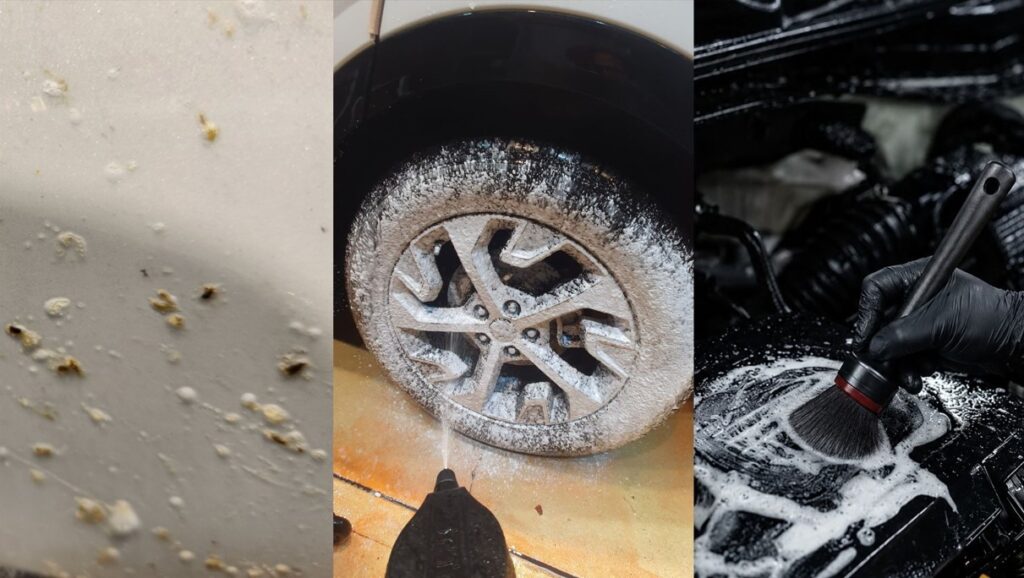
Bug removers, wheel and tire cleaners, and engine bay degreasers may look like completely different product categories.
However, many are alkaline cleaners whose pH, surfactants, and solvents have been adjusted for a particular type of contamination.
Each component plays a different role.
- pH: Indicates how alkaline the solution is and defines the basic cleaning character used to loosen organic and oily contamination.
- Surfactants: Wet the contamination, help separate it from the surface, and keep loosened grime dispersed in water so it can be rinsed away.
- Solvents: Support the removal of sticky oily films that water and surfactants alone may struggle to release.
Purpose-built cleaners may also include additional functional ingredients and changes in viscosity or formulation.
These adjustments are made according to:
- Contamination thickness
- Oil content
- Application area
- Required wetting ability
- Desired surface residence
A specialty alkaline cleaner is therefore not simply a product with a higher pH. It is a cleaner whose chemical composition and physical formulation have been adjusted for a specific cleaning task.
Use a Bug Remover for Heavy Bug Contamination
Bug residue is very different from a thin layer of traffic film.
It collects as thick, localized deposits on the front bumper, grille, mirror caps, and leading edge of the hood. As moisture leaves the residue, it can become harder and more difficult to wet thoroughly.
An alkaline bug remover may be designed to improve:
- Rapid wetting
- Penetration into thick contamination
- Softening of organic residue
- Delivery of enough liquid to a localized area
Some products also use slightly higher viscosity so the cleaner does not run off vertical surfaces too quickly.
The goal is to balance two needs:
The cleaner must wet the bug residue deeply, but it should not disappear from the surface immediately.
This is why two bug removers can feel and perform very differently. Surfactant wetting, viscosity control, solvents, and additional functional ingredients can all affect cleaning performance, ease of use, and product price.
In many cases, direct liquid application works better than simply covering the area with extremely thick foam. The bug residue needs to be thoroughly saturated, not merely hidden under bubbles.
Use a Degreasing Alkaline Cleaner for Wheels and Tires
Wheels and tires carry heavier and more complex contamination than most painted panels.
A tire may hold:
- Road oil
- Dust and soil
- Old tire dressing
- Greasy residue
- Brown or yellow discoloration
This brown appearance is often described as tire browning.
Compounds used to help protect the rubber can migrate toward the surface and react with air and contamination. Road oil and old dressings can then mix with this surface residue, making the tire appear dull, brown, or dirty.
An alkaline tire cleaner may emphasize:
- Surface degreasing
- Removal of old tire dressing
- Cleaning of contamination associated with browning
- Dispersion of loosened grime during brushing
The cleaner mainly removes the surface layer of road oil, dressing residue, and contamination associated with the brown appearance.
On wheels, alkaline cleaners help loosen traffic film and oily grime that hold brake dust against the surface.
However, alkaline cleaning does not necessarily remove all embedded metallic particles. Strongly bonded iron contamination may still require a dedicated iron remover.
Use an Alkaline Degreaser for Engine Bay Oil and Grease
Engine bays and fuel filler areas often contain contamination with a much higher oil content than normal exterior traffic film.
Engine oil, grease, fuel residue, and old dust can combine into a sticky layer that water and ordinary surfactants may struggle to remove efficiently.
An alkaline engine bay degreaser may place more emphasis on:
- Strong degreasing surfactants
- Penetration into oil and grease
- Dispersion of loosened contamination
- Solvents that help weaken oily films
Not every engine bay cleaner uses the same solvent system.
Products differ in pH, surfactant composition, solvent type, and intended surface compatibility. Always follow the product dilution guidance and confirm that it is suitable for the materials being cleaned.
Citrus Alkaline Cleaners for Tobacco Odor and Similar Oily Films
Odor does not always remain only in the air.
Tobacco smoke can leave nicotine and sticky residue on glass, dashboards, door panels, vinyl, and interior plastics. Similar oily odor films may also come from:
- Cooking grease
- Factory oil
- Work clothing
- Skin oils
- Greasy airborne contamination
These residues can continue releasing odor even after the cabin has been ventilated.
A citrus cleaner may combine alkaline cleaning, surfactants, and a citrus-derived solvent such as d-limonene to loosen sticky oily contamination.
The citrus fragrance itself is not the main cleaning mechanism.
The important step is to release and physically recover the oily film that is holding the odor.
Citrus alkaline cleaners should therefore be understood as specialty products for tobacco odor and similar oily contamination—not simply as pleasant-smelling all-purpose cleaners.
How Should You Use an Alkaline Pre-Wash?
Contamination Varies by Area
Before choosing a pre-wash method, remember that contamination rarely develops evenly across a vehicle.
Bug residue collects on the front bumper and mirrors, while heavier traffic film builds up around lower panels and wheel areas. The roof and upper doors may carry only a thin, widespread layer of contamination.
Even a regularly maintained vehicle can have heavily contaminated local areas.
This means a clean-looking vehicle does not always need the same mild treatment everywhere. It also means one dirty area does not justify using a strong mixture across the entire vehicle.
An alkaline pre-wash should therefore be adjusted according to:
- Application method
- Cleaner concentration
- Dwell conditions
Key Principle: Treat the general vehicle condition with a mild pre-wash, then strengthen only the areas where contamination is thicker or more heavily bonded.
Choose the Application Method According to the Contamination
Liquid Spray Saturates Thick Contamination
Applying alkaline cleaner as a liquid delivers more actual water and cleaning solution than an equal visible volume of foam.
The liquid contacts the contamination directly and wets thicker deposits from the outside toward the inside.
This makes liquid spray suitable for:
- Bug residue on bumpers and mirrors
- Bird droppings
- Thick lower-panel grime
- Greasy contamination around wheel areas
- Localized contamination in crevices
- Deposits that need a large amount of liquid
The cleaner should not be applied like a light disinfectant mist.
The goal is to apply enough product to fully wet the contamination.
Because liquid cleaner has high fluidity, it runs down vertical panels relatively quickly.
Liquid application is therefore not mainly a way to create a long dwell time. Its main strength is the ability to deliver the required concentration and enough cleaning solution in a short period.
Foam Keeps Cleaner on Widespread Contamination
Although it may appear thick and abundant, the same visible volume of foam may contain less actual liquid than a thoroughly wetted surface treated with a pump sprayer.
Foam contains air in addition to water and cleaning solution.
Foam may therefore be less effective at deeply saturating thick deposits.
Its advantage is that it moves more slowly across the surface.
This allows the cleaning solution to remain over a broad area, making foam suitable for:
- Thin traffic film across the whole vehicle
- General maintenance contamination
- Widespread oily films
- Fine dust mixed with road residue
- Contamination that benefits from longer surface residence
The key is not foam thickness.
Extremely thick and dry foam may look impressive while delivering relatively little moisture to the paint.
A more useful foam is wet, mobile, and able to maintain surface contact without drying too quickly.
Key Principle: Use liquid where contamination needs more cleaning solution. Use foam where widespread contamination needs longer surface contact.
Liquid Spray and Foam Can Be Used Together
A single vehicle may have several different types of contamination.
Liquid cleaner can first be applied to bug residue, lower panels, and heavily contaminated wheel areas.
Foam can then be applied across the whole vehicle to address widespread contamination while helping the previously treated areas remain wet.
There is no single mandatory alkaline pre-wash sequence.
The user must decide whether the contamination needs:
- More liquid
- More surface residence
- A higher local concentration
- A mild whole-vehicle treatment
The basic principle is simple:
Use liquid where thick contamination needs more cleaning solution. Use foam where widespread contamination needs the cleaner to remain on the surface.
Different Areas of the Same Vehicle May Need Different Strengths
A vehicle does not have one uniform contamination level.
Even a regularly maintained vehicle can have heavy bug residue on the front and much heavier traffic film around lower panels and wheel areas.
The whole vehicle should not be treated according to its dirtiest section.
Use a mild alkaline solution on normally contaminated panels, while applying a stronger local mixture where thicker contamination requires it.
For example:
- General paintwork: mild alkaline pre-wash
- Front bumper and mirrors: stronger local liquid treatment
- Lower panels and wheel areas: stronger local treatment where required
Using a stronger solution on a local area does not mean that the entire vehicle needs the same concentration.
If a stronger liquid is applied first and a milder spray or foam is then used over the whole vehicle, the original high-concentration treatment begins to mix and dilute.
The purpose is not to keep a strong chemical concentration on the surface for a long period.
It is to deliver more initial cleaning power to the contaminated area while keeping the rest of the vehicle under a milder treatment.
Adjust Concentration and Dwell Conditions to the Contamination
A stronger concentration or longer dwell time does not always produce a better result.
Light contamination may respond well to a mild mixture. Thick bug residue or heavy lower-panel grime may require a stronger local solution and more liquid.
However, one heavily contaminated area does not mean the entire car should receive the same strong concentration.
Dwell time should also be judged by surface condition rather than by the clock alone.
As surface temperature rises, cleaning reactions may become faster, but water also evaporates more quickly. This increases the chance of the cleaner drying on the surface.
The practical rule is:
Match the concentration to the contamination and manage dwell time according to temperature, airflow, and application method. Never allow the cleaner to dry.
Alkaline Pre-Wash Examples for Different Vehicle Conditions
1. Maintained Vehicle With Heavy Bug Residue
A regularly washed vehicle may still collect heavy bug residue after highway driving.
There is no need to apply a strong alkaline mixture across the entire vehicle.
First, saturate the affected bumper, grille, mirrors, and hood edge with an appropriate liquid alkaline cleaner.
Do not apply a light mist. Use enough product to wet the bug residue thoroughly.
Then apply a mild foam or mild liquid pre-wash to the rest of the vehicle.
As the whole-vehicle pre-wash reaches the bug-treated areas, the original stronger solution begins to dilute.
This method provides the bug residue with the initial cleaning power it needs while keeping the rest of the paint under a milder treatment.
2. Thin Traffic Film Spread Across the Whole Vehicle
A vehicle may have little visible mud or bug residue but still look dull because a thin traffic film has spread across most panels.
In this situation, coverage is more important than heavy local saturation.
If there are no heavily contaminated lower areas, apply a mild, wet foam across the vehicle.
Foam helps keep the cleaning solution on the wide contaminated surface.
A mild liquid spray can also be used to wet the whole vehicle. If it runs off too quickly, a mild foam may be added afterward.
For thin, widespread contamination, the priority is not maximum concentration. The priority is even coverage and keeping the surface wet until rinsing.
3. Heavy Grime on Lower Panels and Wheel Areas
The hood, roof, and upper panels may be relatively clean while lower doors, rocker panels, and areas behind the wheels carry heavy grime.
Apply an appropriate liquid alkaline cleaner directly to these heavily contaminated areas first.
Use enough product to wet the thicker contamination.
The rest of the vehicle can then receive a mild foam or mild liquid pre-wash.
As the general pre-wash reaches the lower panels, the original stronger solution begins to dilute while the surface remains wet.
This approach strengthens the process only where necessary instead of applying a strong mixture to the entire car.
4. Heavy Widespread and Localized Contamination
A vehicle that has not been washed for a long time may have widespread traffic film, dried bugs on the front, and heavy grime around the lower panels and wheels.
In this situation, both application method and concentration can be adjusted in stages.
- Apply a stronger liquid cleaner to the bug-covered front, lower panels, and heavily contaminated wheel areas.
- Apply a milder alkaline liquid across the whole vehicle.
- Cover the vehicle with a wet, mild foam.
- Rinse thoroughly before any section begins to dry.
The first local treatment does not remain at the original concentration throughout the process.
The later mild spray and foam gradually lower the concentration while maintaining a wet reaction environment.
This is not a better process simply because it has more steps.
It is an expanded process for a vehicle that contains both thick localized contamination and widespread general contamination.
Quick Alkaline Pre-Wash Summary
| Vehicle condition | Local pretreatment | Whole-vehicle pre-wash |
|---|---|---|
| Regular maintenance | None unless needed | Mild foam or liquid spray |
| Heavy bugs on the front | Local liquid treatment | Mild foam or liquid spray |
| Heavy lower-panel and wheel grime | Stronger local liquid treatment | Mild foam or liquid spray |
| Heavy widespread and local contamination | Stronger treatment on bugs and lower areas | Mild liquid spray followed by mild foam |
Choose Only the Process Your Vehicle Needs
An alkaline pre-wash is not a fixed process that always requires foam.
It also does not always require liquid spray followed by foam.
A maintained vehicle with light contamination may need only a mild foam or mild liquid spray.
A mostly clean vehicle with bug residue or heavy lower-panel grime may need local pretreatment before a mild whole-vehicle pre-wash.
The number of steps is not what makes the process effective.
The correct approach is to separate whole-vehicle contamination from localized heavy contamination, then choose the application method and concentration required for each area.
Safety Tips for Using Alkaline Cleaners
Use alkaline cleaners on a cool surface and out of direct sunlight.
Hot paint and strong airflow can make both liquid and foam dry much faster.
Always remain within the manufacturer’s recommended dilution range, and test sensitive surfaces before wider use.
Pay particular attention to:
- Repainted panels: Test in an inconspicuous area because chemical resistance may differ from factory paint.
- Matte finishes: Use only products confirmed as suitable for matte surfaces.
- PPF and vinyl wraps: Start with a neutral cleaner. If contamination is severe, use a mild alkaline cleaner at a low concentration within the manufacturer’s guidance.
- Aged rubber and plastic: Begin with a mild concentration and test before wider use.
- Sensitive metals and plated surfaces: Confirm compatibility before applying alkaline cleaner.
After cleaning, rinse not only the painted panels but also:
- Mirror housings
- Emblems
- Grilles
- Trim edges
- Fuel doors
- Panel gaps
Cleaner and loosened contamination can remain in these areas and cause residue or staining if not thoroughly rinsed.
The practical rule is simple:
Use only the concentration and dwell time required, and rinse thoroughly before the cleaner dries.
Final Takeaway: The Best Pre-Wash Matches the Vehicle
Neither a foam lance nor a pump sprayer is always the better tool.
- Liquid spray: Best for thick, localized contamination that needs more cleaning solution and moisture.
- Foam application: Best for thin, widespread contamination that benefits from longer surface residence.
Cleaner concentration also does not need to remain the same across the whole vehicle.
Use a mild solution on general paintwork and strengthen only the areas that need additional cleaning, such as bugs, lower panels, and wheel areas.
Before choosing the process, ask:
- What type of contamination is present?
- How thick is it?
- Where is it concentrated?
- Does it need more liquid or more surface residence?
- Can the cleaner remain wet until rinsing?
The strongest cleaner and the most complicated process are not automatically the best choices.
The correct way to use an alkaline cleaner is to inspect the actual condition of the vehicle, then match the product, application method, concentration, and dwell conditions to the contamination.