Key Takeaways
As the washing process progresses, the amount of contamination left on the paint decreases. However, once washing transitions into drying, the towel’s weight, wet contact, and movement resistance continue to change.
The basic conditions behind a drying scratch are:
Hard particle + pressure + movement
A particle may remain on the paint, become trapped inside the towel, or settle back onto the vehicle from the surrounding environment. If that particle is harder than the clear coat, it can become a scratch agent when it is pressed against the surface and moved.
The towel also becomes heavier as it absorbs water. Its wet fibers may spread across a wider section of paint, increasing the resistance felt through the hand and wrist.
When the towel becomes difficult to move, do not pull harder.
Allow excess water to drain, give a dry towel time to begin absorbing water, and slightly lift the leading edge of the towel when resistance increases.
The goal is gliding, not wiping: keep the towel moving under controlled load rather than pressing it into the paint and forcing it through resistance.
Why Can Scratches Still Occur During Drying?
As a vehicle is washed, contamination is gradually removed from the paint.
Pre-washing, pressure rinsing, and contact washing remove most of the larger particles that could damage the clear coat. By the end of the wash, the vehicle appears clean, and the risk of scratching may seem much lower.
However, clean paint is not the same as risk-free paint.
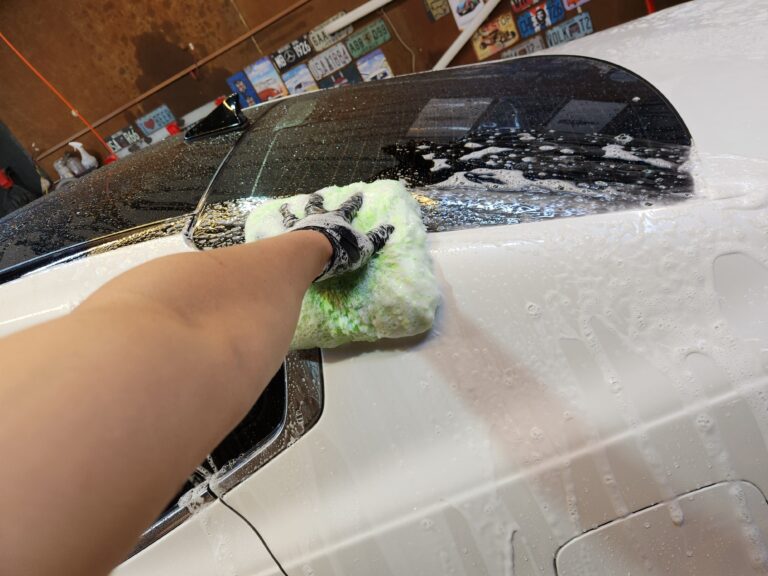
During the contact-wash stage, water and car shampoo remain between the wash mitt and the paint. The cleaning solution is continuously supplied as the mitt moves, helping it travel with relatively low resistance.
The conditions change during drying.
As the drying towel moves across the vehicle, it collects the water remaining on the surface. At the same time, the towel becomes heavier, and more of its wet fibers may settle against the paint.
Although contamination decreases toward the end of the wash, contact resistance can become more difficult to control.
The transition from washing to drying is not the point where scratch risk disappears. It is the point where the form of that risk changes.
A drying towel is not intended to remove contamination. Its main purpose is to collect the water left after a proper wash.
However, if small hard particles remain on the paint or inside the towel, those particles may still damage the clear coat when pressure and movement are added.
Why Can a Clean Vehicle Still Be Scratched?
Where Do the Remaining Particles Come From?
Even after a thorough wash, neither the paint nor the drying towel can be assumed to be completely free from particles.
Contamination may remain between the towel and the paint in several ways.
First, fine sand, mineral particles, or road dust may remain on the surface. Contamination hidden around grilles, trim, emblems, mirrors, and panel gaps may also flow back onto the paint with water.
Second, particles may already be trapped inside the towel. A towel that has touched the ground, lower body panels, wheels, or heavily contaminated areas may contain hard particles that are difficult to see.
Particles may also remain inside the fibers when heavily contaminated towels are washed together without proper separation.
Third, new contamination may settle onto the vehicle during drying. Wind, airborne dust, and debris from the surrounding work area can return to the paint or towel.
The location of the particle may be different, but the scratch mechanism remains the same.
What Turns a Particle Into a Scratch?
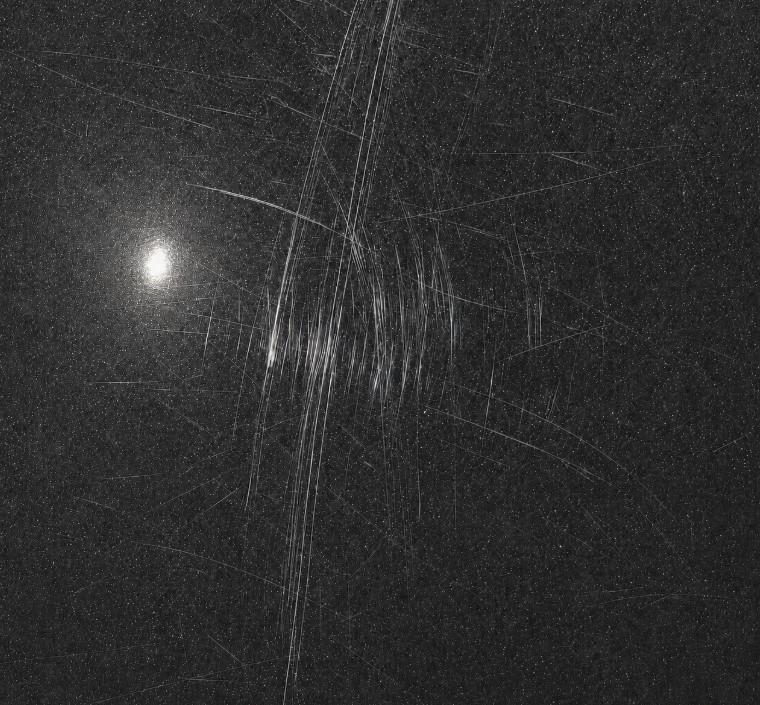
Even a microscopic particle can become a potential scratch agent if it is harder than the clear coat and becomes trapped between the towel and the paint.
The presence of a hard particle does not always produce the same level of damage.
The risk increases when the particle is pressed more firmly into the surface and dragged over a longer distance. Its hardness, size, and shape also affect the type and severity of the mark it may leave.
The basic scratch conditions can therefore be summarized as:
Hard particle + pressure + movement
Reduce any one of these conditions, and the risk also decreases.
Begin with a thorough wash to reduce the particles remaining on the paint. Use a clean, properly maintained towel to reduce contamination inside the fibers.
Because it is difficult to guarantee that every microscopic particle has been removed, you must also control the pressure applied to the towel and the distance it travels under resistance.
This leads to the next question: why do pressure and movement resistance increase during drying?
The Physics of Drying: How Pressure Builds
Pressure during drying does not come from one source alone.
It is created by both the condition of the towel and the way the towel is handled.
The most direct source is hand pressure.
When you press the towel with your palm or fingertips to remove water faster, that force travels through the fibers and into the paint. If a hard particle is underneath, the same force presses it more firmly against the clear coat.
The weight of the wet towel can also contribute.
A towel does not automatically become unsafe simply because it absorbs water. However, when the full weight of a water-loaded towel rests on a horizontal panel, the load acting on the paint may increase.
Folding and bunching can concentrate this load further.
When the towel remains flat, its weight is distributed across a wider area. When one section folds over or gathers into a thicker part, more of the load may become concentrated in a smaller area.
If a hard particle is underneath that section, it may be pressed more firmly against the clear coat as the towel moves.
The main sources of pressure during drying are therefore:
- Pressure applied directly by the hand
- The added weight of a water-loaded towel
- Localized load caused by folding or bunching
Do not focus only on “using less force.”
The more important objective is to prevent the towel’s load from becoming concentrated on one small section of paint.
Keep the towel spread evenly, avoid pressing down, and stop when a folded section begins dragging across the panel.
Why Does a Wet Towel Become Harder to Pull?
When a large drying towel is spread across a vehicle immediately after rinsing, it may absorb a significant amount of water at once.
Water moves into the microfiber structure through capillary action. It also wets both the towel and the paint, creating a broader connected contact zone between them.
As the towel absorbs more water, its mass increases. At the same time, more wet fibers may settle closely against the paint.
Together, these changes can increase the resistance felt when the towel is pulled.
The individual cohesive or adhesive properties of water do not become stronger simply because more water is present.
Instead, a greater amount of water can involve more fibers, create a wider wet contact area, and add more weight to the towel.
The initial condition of a completely dry towel can also affect how it feels.
Depending on its construction, washing history, and drying condition, a dry towel may initially feel firmer or less flexible. If you place it on the vehicle and pull immediately, before it has begun absorbing water, the first movement may feel uneven or resistant.
Movement resistance during drying is influenced by several changing factors:
- The amount of water remaining on the paint
- The amount of water absorbed by the towel
- The weight of the wet towel
- The area of wet fiber contact
- Folding or bunching within the towel
- The initial condition of a completely dry towel
These factors continue to change throughout the drying process.
Water itself does not scratch the paint, and resistance alone does not create a scratch.
The problem begins when a resistant towel is forced across the paint while hard particles remain trapped underneath.
Why Drag Is an Important Warning Sign
What the Hand and Wrist Can Feel
The movement resistance felt when pulling a drying towel can be described as drag.
However, drag itself is not the direct cause of a scratch.
When the towel glides smoothly, very little effort is required from the hand or wrist. A light pull on the leading edge is enough for the rest of the towel to follow.
Sometimes that feeling changes suddenly.
A towel that was moving smoothly may become tense, as though it has caught on something for a moment. The wrist may feel as though it is being pulled backward, or the towel may seem to stick to the panel instead of following naturally.
Maintaining the same speed now requires more effort.
This sensation is not simply an inconvenience. It may indicate that:
- The towel has absorbed a large amount of water
- Wet fibers have spread across a wide section of paint
- Part of the towel has folded or bunched
- An edge has caught on a panel shape or trim section
- The towel has become difficult to control
Why Pulling Harder Increases the Risk
The danger comes from the way the user reacts when the towel becomes difficult to move.
The natural response is often to pull harder, grip the towel more tightly, or press down.
This adds force to the system.
If the towel folds or bunches at the same time, the load may become concentrated on a smaller section of paint. Any particles trapped underneath may then move under greater pressure.
Continuing to pull also increases the distance those particles can travel.
A resistant towel therefore creates two related problems.
First, the user may apply additional pressure in an attempt to keep the towel moving.
Second, the towel and any particles beneath it may continue travelling farther across the panel.
This is why drag should be treated as a warning rather than something to overcome.
When to Stop and Reset the Towel
Treat the following sensations as warning signs:
- A towel that was following lightly suddenly becomes tense
- Resistance pulls backward through the wrist
- The towel sticks instead of following in one smooth movement
- More effort is needed to maintain the same speed
- One section feels folded, caught, or anchored to the panel
When these sensations appear, do not add more force.
Slow down and check whether the towel has folded, absorbed too much water, or spread across too much of the wet surface.
When a smoothly moving towel suddenly becomes tense, adjust the load and contact instead of pulling harder.
Drag is not the scratch itself. It is a warning that a hard particle may be exposed to greater pressure and movement.
First Solution: Allow Excess Water to Drain
Do not place the drying towel on the vehicle immediately after the final rinse.
Allow the vehicle to sit briefly so gravity can remove some of the freely moving water.
Water on vertical panels will flow downward. Larger pools on the hood and roof will begin to move along panel slopes, curves, and body lines.
Do not wait until the remaining water starts drying.
The vehicle should not be left long enough for mineral residue or water spots to form. The goal is simply to allow the heaviest excess water to drain before introducing the towel.
Even a short pause reduces the amount of water the towel must absorb during its first contact.
This helps prevent the towel from becoming suddenly heavy and spreading over the paint under a large wet load.
A blower or drying aid may remove additional water, but extra equipment is not required to use this principle.
Let gravity remove the excess water before asking the towel to absorb it.
Reducing the initial amount of water lowers both towel load and movement resistance.
Second Solution: Let a Dry Towel Begin Absorbing Before You Move It
A completely dry microfiber towel has not yet absorbed any water.
Depending on its condition, some fibers may also feel slightly compressed or firm before they become wet.
Do not place the towel on the paint and immediately begin pulling.
There is also no need to pre-soak it in a sink or bucket. Water is already present on the vehicle.
Place the towel flat on a wet horizontal panel, such as the hood or roof, and allow it to rest briefly.
Water will begin moving into the microfiber structure. As the towel wets naturally, its fibers and overall movement will change.
There is no requirement to begin with the glass simply to dampen the towel.
Place the towel, allow it to begin absorbing, and only then start the movement.
This avoids forcing a completely dry towel across the paint before its fibers have begun collecting water.
Third Solution: Lift the Leading Edge Instead of Pulling Harder
A large drying towel does not need to remain completely flat against the paint throughout the entire movement.
When the towel begins to resist, do not overcome that resistance with more force.
Slightly lift the leading edge of the towel.
The leading edge is the section held by your hand and moving first across the panel.
How Lifting the Leading Edge Changes the Load
Lifting the leading edge changes the physical conditions in two important ways.
First, your hand begins supporting part of the towel’s wet weight. Less of that weight rests directly on the paint.
Second, the direction of the pulling force changes.
Instead of pulling only horizontally across the panel, part of the force now acts upward. This allows the broad wet contact between the towel and the paint to release progressively from the leading edge.
The towel can then continue moving with less resistance and less need for additional hand pressure.
This benefit cannot be explained only by saying that a smaller contact area automatically creates less friction. In basic dry-friction models, the apparent contact area alone does not determine the total friction force.
What matters here is that your hand supports part of the wet towel while reducing both the load and the wet contact against the paint.
Lift the leading edge, reduce the load, and let the towel follow.
Gliding, Not Wiping
The entire towel does not need to remain in contact with the paint.
The portion that is still touching the panel can continue absorbing water. Any moisture left behind can be collected during the next controlled pass.
Do not try to remove every trace of water with one long, forced movement.
The goal is gliding, not wiping.
Gliding does not mean the towel is floating above the surface. It means allowing the towel to move under a controlled load, without pressing down or forcing it through resistance.
The priority is not removing all the water in one pass. It is keeping pressure, movement, and towel contact under control.
Fourth Solution: Judge the Towel by Control, Not Weight Alone
A drying towel becomes heavier as it absorbs water.
On wide horizontal panels such as the hood or roof, the size and absorbency of a large towel can be useful. It can collect a significant amount of water with relatively few movements.
The same towel may behave differently on vertical panels.
On doors and fenders, a large wet towel can sag, fold, or hang toward the wheels and lower body. Its edge may touch contaminated trim, tires, wheel arches, or even the ground.
This does not mean every large or thick towel is unsafe.
Judge the towel according to whether you can still control its shape, contact area, and direction after it becomes wet.
The towel may be reaching its practical control limit when:
- It sags too much to remain evenly spread
- Wet and unused sections become difficult to distinguish
- Folded sections keep dragging even when the leading edge is raised
- Changing direction or stopping becomes slow and awkward
- The towel begins pushing water instead of absorbing it
Do not replace a towel simply because it has become heavier.
Replace or reposition it when its contact area and movement can no longer be controlled reliably.
No technique can make an uncontrollable towel safe to use indefinitely.
When drag continues to increase and the towel becomes difficult to manage, switch to a clean section or use another towel instead of applying more force.
The Basic Principles of Safer Car Drying
Reducing drying scratches does not require memorizing a complicated technique.
Control the same conditions that create the scratch.
First, reduce hard particles through thorough washing and proper towel care.
After the final rinse, allow freely moving water to drain from the vehicle. Place the dry towel on a wet panel and give it a moment to begin absorbing.
Do not press the towel into the paint, and do not repeatedly rub the same section.
Pay attention to the feedback transmitted through your fingertips and wrist.
When the towel begins to resist, do not try to overpower it. Slightly lift the leading edge, support part of the towel’s weight, and reduce the wet contact against the paint.
When the towel becomes difficult to shape or control, change to another section or use a fresh towel.
The safety of the drying process is not determined by towel softness alone.
Reduce hard particles, limit the pressure applied to them, and prevent them from travelling a long distance when movement resistance increases.
As the vehicle becomes cleaner, visible contamination decreases. However, the towel’s weight, wet contact, and movement resistance continue to change as it absorbs water.
For this reason, do not dry a clean vehicle by force.
Let the towel absorb, feel the resistance through your hand, and adjust the load before continuing the movement.