The microfiber towel vs wash mitt debate often focuses on one simple advantage: microfiber towels provide multiple clean contact surfaces during a car wash.
Once one towel face becomes dirty, you can turn it over or replace it with a fresh towel. The contaminated towel does not need to return to the clean wash solution, so dirt collected from one panel is less likely to move to the next.
This is one of the main reasons many detailers use the multi-towel rinseless method.
However, a clean towel face solves only one part of the problem.
A fresh towel face reduces cross-contamination. It does not eliminate abrasive contact or guarantee protection from wash-induced marring.
💡Quick Answer
Yes, microfiber towels can replace a wash mitt under the right conditions, but not every towel is suitable for contact washing.
A thick, long-pile, edgeless plush towel performs much closer to a flexible wash mitt than a thin utility towel. However, heavily contaminated vehicles still benefit from a thorough pre-wash and rinse before any towel contacts the paint.
The paint may still contain sand, road grit, or other particulate contamination before the towel touches it. The towel may also be thin, hold little solution, conform tightly to the paint, or transfer hand pressure more directly than a dedicated wash mitt.
Therefore, the real question is not simply whether microfiber towels feel soft.
The more important question is:
Can the towel hold enough wash solution, move contamination away from the contact surface, and distribute pressure while it travels across the paint?
Rinseless Wash, Waterless Wash, and Conventional Washing
Before comparing towels and wash mitts, the wash methods need to be clearly separated.
What Is a Rinseless Wash?
A rinseless wash uses a diluted wash solution in a bucket.
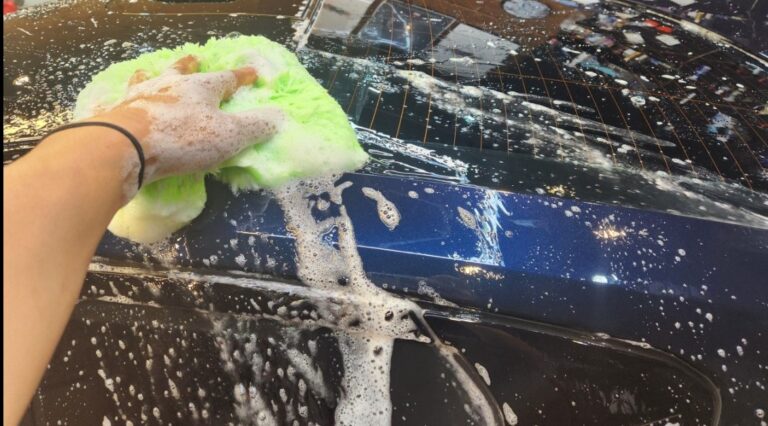
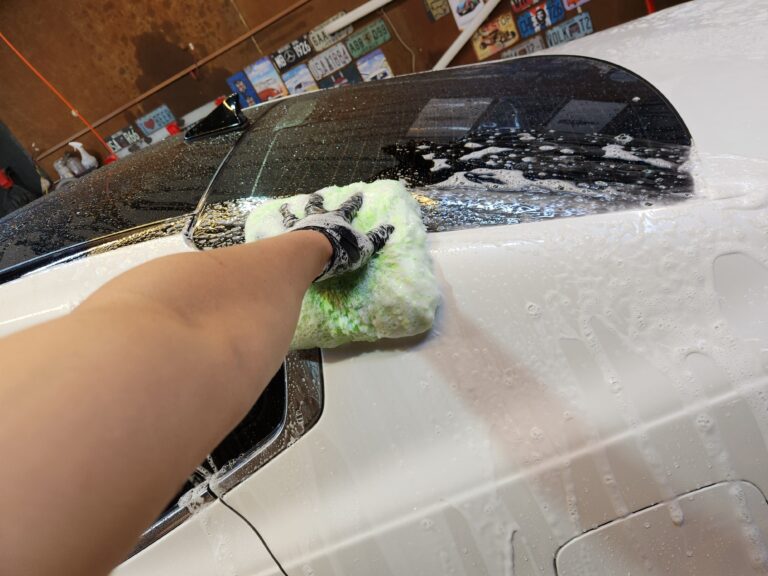
The user cleans one section with a sponge, wash mitt, or microfiber towel and then dries that section without performing a conventional final hose rinse.
It uses much less water than a traditional wash, but it is not literally waterless.
Depending on the product and technique, detailers may also pre-spray each panel before contact washing.
What Is a Waterless Wash?
A waterless wash usually involves spraying a ready-to-use cleaner directly onto a lightly contaminated panel.
The panel is then wiped with one microfiber towel and finished with a separate clean towel.
Unlike rinseless washing, this method does not normally use a bucket of diluted wash solution or fully saturated wash media.
Because the amount of liquid and flushing action are more limited, waterless washing is generally better suited to very light dust, fingerprints, or small touch-up areas.
What Is a Conventional Rinse-Based Wash?
A conventional wash uses running water to rinse the vehicle before and after the contact wash.
A two-bucket method is one specific version of this process. It uses one bucket for shampoo solution and a second bucket for rinsing the wash media.
Not every conventional bucket wash is a true two-bucket wash. For that reason, this guide uses the broader term conventional rinse-based wash when comparing the overall processes.
What Does “Wash Media” Mean?
In detailing, wash media refers to the tool that physically contacts the paint during washing.
Examples include:
- Microfiber wash mitts
- Wool wash mitts
- Wash sponges
- Microfiber towels
The material name alone does not determine safety.
The structure of the wash media, the amount of contamination on the vehicle, and the pressure applied during contact are equally important.
Why Detailers Use Multiple Towels
The strongest argument for using multiple towels is the reduction of cross-contamination.
In a traditional bucket wash, a used mitt may return to the rinse bucket or wash bucket. If the collected dirt is not fully released, some contamination can remain in the wash media or enter the bucket solution.
The multi-towel method takes a different approach.
- Several clean towels are soaked in rinseless solution.
- One clean towel or towel face is used at a time.
- A visibly contaminated surface is not used again.
- Used towels are placed in a separate container.
- Dirty towels do not return to the clean solution.
This system gives the user a predictable supply of clean contact surfaces.
It also avoids relying on a single mitt to release all collected contamination between panels.
That is a real advantage.
However, the method does not reduce the contamination that was already sitting on the paint before contact. It also does not change the towel’s pile depth, solution capacity, flexibility, or pressure distribution.
The Clean-Towel Myth
A clean towel is safer than a contaminated towel.
But this does not mean every clean towel provides the same mechanical safety as a well-designed wash mitt.
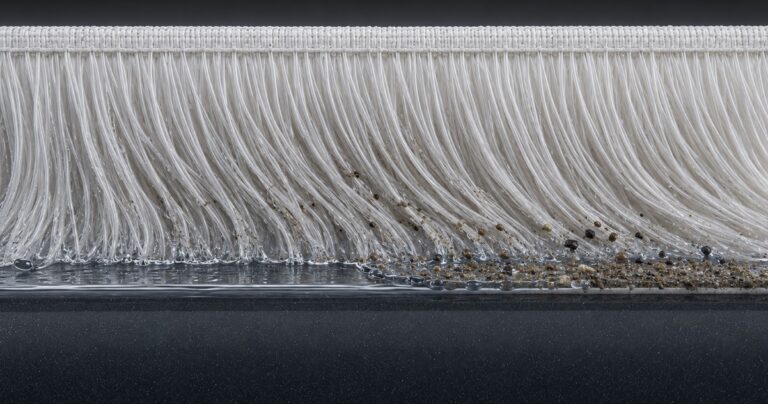
Imagine a panel with fine sand or road grit still attached to the surface.
The towel may be perfectly clean when it first touches the panel. Once it begins moving, however, the particles already on the paint enter the contact zone.
What happens next depends on several factors:
- How tightly the towel conforms to the paint
- How much solution remains between the towel and the surface
- How deeply particles can move into the pile
- Whether the fibers can move independently
- How much pressure passes from the hand to the paint
- Whether loosened contamination will later be rinsed away
A fresh towel face reduces contamination carried over from the previous section.
It does not eliminate particle-induced abrasion.
When contamination already on the panel moves under pressure, it can create wash-induced marring, micro-marring, or fine scratches in the clear coat.
Friction, Abrasion, and Marring Are Not the Same Thing
These terms are related, but they describe different parts of the process.
Friction is the resistance created when two surfaces move against each other.
Abrasive contact occurs when harder particles or rough contact points move between the wash media and the clear coat.
Mechanical abrasion describes the actual wear or damage produced by that contact.
Marring is the visible result. It may appear as faint haze, micro-marring, fine wash marks, or shallow swirl-like defects under direct lighting.
The process can be summarized as follows:
Friction creates resistance. Particles under pressure create abrasive contact. The visible result may be wash-induced marring or fine scratches.
This is why soft material alone is not enough.
A soft towel can still cause marring if hard contamination becomes trapped underneath it and moves across the paint under pressure.
Five Structural Qualities of Safer Wash Media
A wash mitt is not useful simply because it fits over the hand.
Its main advantages come from the way its fibers, solution capacity, and outer pile work together during contact washing.
The same five qualities can be used to evaluate microfiber towels.
1. Wet-State Softness
A towel may feel extremely soft when dry but become flat, compacted, or stiff after absorbing water.
Safer wash media should remain flexible when fully saturated.
The fibers should follow the shape of the panel without forming hard contact points or dragging stiff fiber bundles across the paint.
2. Wash-Solution Retention
The wash media should hold enough solution to keep the contact area wet throughout the pass.
A large solution reserve helps maintain lubrication and allows the wash liquid to move through the pile.
Thin towels can begin fully saturated but lose fluid quickly as they travel across a large panel.
3. Flushing Action
Flushing is the movement of wash solution through and around the contact surface.
When saturated media is moved or lightly compressed, some of the retained solution flows between the fibers and across the paint.
This movement can help prevent loosened contamination from remaining in one fixed contact point.
Solution retention and flushing are related, but they are not identical.
A towel may absorb a large amount of liquid without releasing it through the contact area in the most useful way.
This is why flushing action in a wash mitt can matter as much as softness or total solution capacity.
4. Pile Freedom
Individual fibers or fiber bundles should remain free to move after becoming wet.
When the pile stays flexible, contamination has more opportunity to move between the fibers instead of remaining directly beneath a flat contact surface.
If the fibers clump, twist together, or collapse into a dense pad, this movement becomes more limited.
5. Effective Outer-Pile Depth
Folding a towel makes the towel feel thicker in the hand, but it does not necessarily increase the depth of the pile touching the paint.
The important measurement is the effective outer-pile depth between the paint and the towel’s backing.
A deeper, flexible outer pile provides more space for contamination and distributes hand pressure over a larger area.
The same criteria also apply when choosing a wash mitt based on pile structure, flexibility, and solution retention.
Which Microfiber Towel Structure Works Best?
Not every microfiber towel performs the same way during washing.
The following ratings compare three general towel structures. They describe structural tendencies rather than guaranteeing the performance of every product.
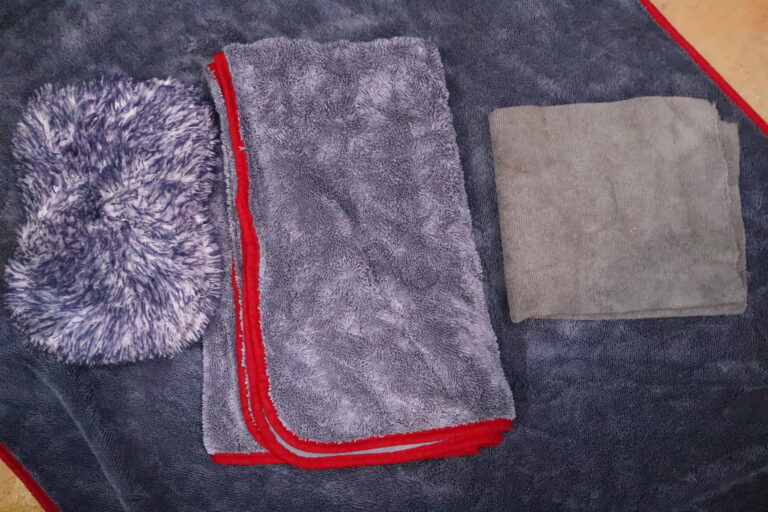
Long-Pile Side of a Utility Towel
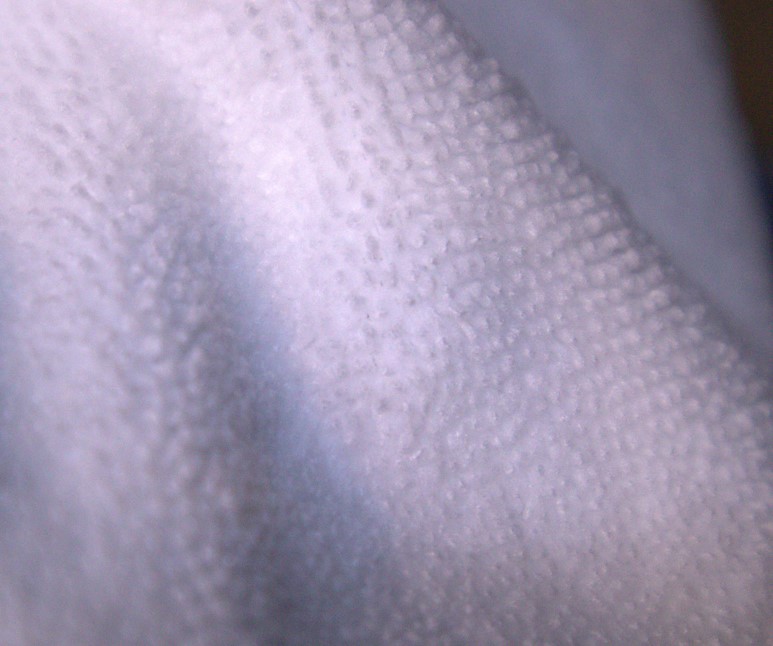
Many dual-pile utility towels have a short, dense side and a slightly longer side.
When used for washing, the longer side is generally the better contact surface. It feels softer, offers slightly more space for particles, and allows the towel to be folded into several clean sections.
However, most utility towels are relatively thin and hold less solution than a wash mitt or thick plush towel.
1. Wet-State Softness — ★★★★☆
The long-pile side remains softer and more flexible than the short side.
However, short or densely packed fibers can collapse when wet and conform tightly to the paint.
2. Wash-Solution Retention — ★★☆☆☆
A utility towel holds less solution than a thick plush towel or wash mitt.
It may lose moisture quickly, so each towel face should cover only a small section.
3. Flushing Action — ★★☆☆☆
Some solution moves between the fibers, but the thin construction limits the fluid reserve.
As moisture decreases, tight contact and drag can increase quickly.
4. Pile Freedom — ★★★☆☆
The longer side offers more fiber movement than the short side.
Still, the shallow pile can flatten easily when pressure is applied.
5. Effective Outer-Pile Depth — ★★☆☆☆
Folding increases the total thickness in the hand, but the outer pile touching the paint remains shallow.
Hand pressure can therefore pass through the towel relatively directly.
Overall Rating — ★★★☆☆
The long-pile side of a utility towel can work on a pre-washed or lightly contaminated maintenance vehicle.
It should be fully saturated, used over small sections, and moved with minimal pressure.
Thick Long-Pile Plush Towel
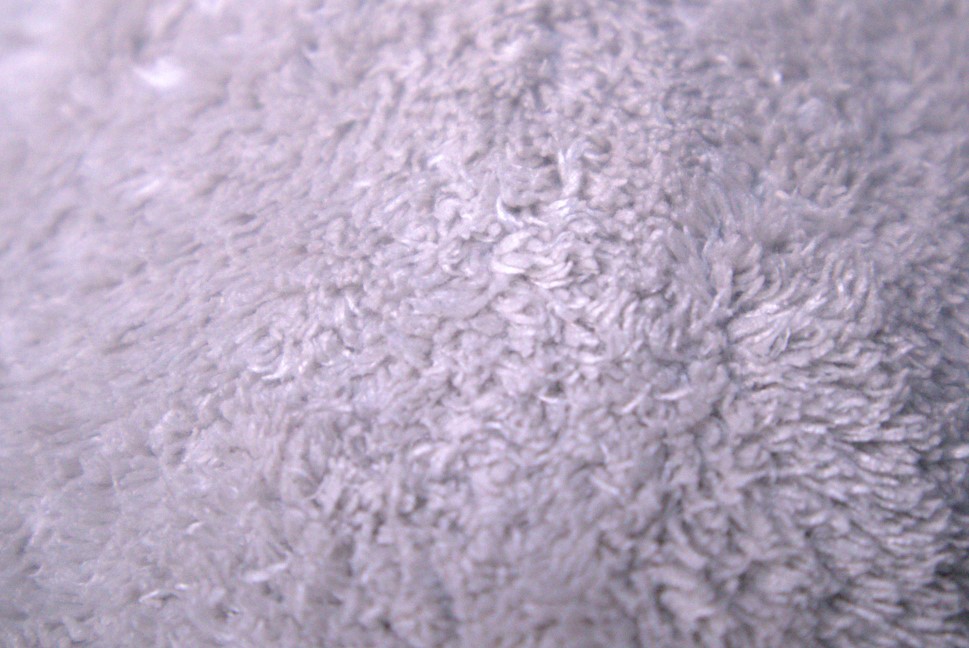
A thick, long-pile plush towel has the closest external structure to a soft microfiber wash mitt.
Its depth helps retain solution, while long flexible fibers provide space for contamination and distribute pressure.
The best examples remain loose and floppy when wet instead of becoming matted or tangled.
Dry softness alone is not enough. A very dense towel may feel luxurious when new but lose pile freedom after repeated use.
1. Wet-State Softness — ★★★★★
Long, fine fibers remain flexible while saturated and adapt smoothly to panel contours.
The pile should still separate freely after repeated washing.
2. Wash-Solution Retention — ★★★★☆
The thick structure holds substantially more solution than a typical utility towel.
It provides a good balance between retaining fluid and releasing it into the contact area.
3. Flushing Action — ★★★★★
The combination of solution capacity and open pile space supports strong fluid movement.
Wash solution and loosened contamination are less likely to remain fixed in one contact point.
4. Pile Freedom — ★★★★★
Long fibers can move relatively independently when they remain untangled.
This gives particles more opportunity to migrate into the pile rather than remaining trapped under a flat towel surface.
5. Effective Outer-Pile Depth — ★★★★★
The deep outer pile creates space for contamination and distributes hand pressure more effectively than a thin utility towel.
Overall Rating — ★★★★★
A thick, long-pile, edgeless plush towel offers the best-balanced towel structure for contact washing.
Among the towel types compared here, it is the closest alternative to a flexible microfiber wash mitt.
Compact Twist-Loop Drying Towel
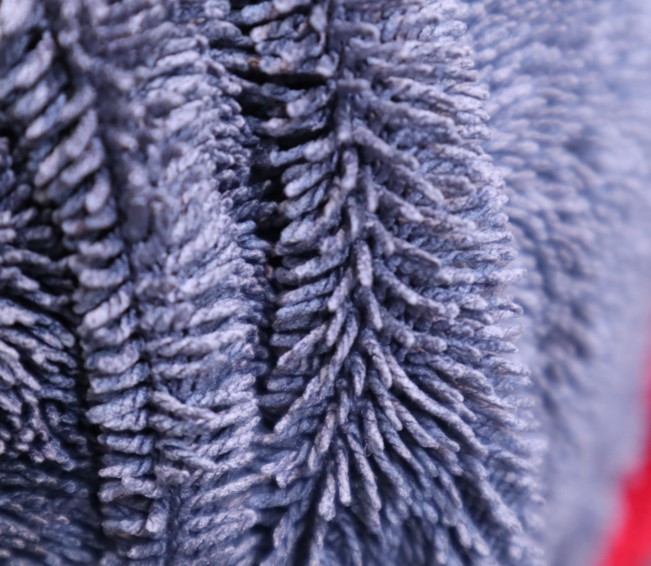
A small twist-loop drying towel may appear suitable for washing because it is thick and can hold a large amount of liquid.
Those qualities provide excellent solution retention and pressure distribution.
However, water absorption and particulate management are not the same function.
Twist-loop towels use thicker twisted fiber bundles. These bundles do not move as independently as fine, open plush fibers.
1. Wet-State Softness — ★★★★☆
A quality twist-loop towel remains reasonably soft when wet.
Because it contacts the surface through thicker bundles, pressure may become concentrated at fewer contact points.
2. Wash-Solution Retention — ★★★★★
This is the structure’s strongest advantage.
A thick twist-loop towel can retain a large amount of solution and keep the panel wet.
3. Flushing Action — ★★★★☆
The large fluid reserve can create substantial solution movement.
However, high fluid movement does not necessarily mean that fine particulate contamination is collected evenly.
4. Pile Freedom — ★★☆☆☆
Each twist loop consists of multiple fibers formed into a larger bundle.
The contact structure therefore has less independent fiber movement than an open plush pile.
5. Effective Outer-Pile Depth — ★★★★★
The thick structure distributes hand pressure well.
Still, large spaces between the loops may limit how closely the towel contacts and recovers very fine contamination.
Overall Rating — ★★★☆☆
A compact twist-loop towel offers excellent fluid retention and thickness, but its coarse bundled structure is less balanced for particulate management.
It is more reasonable in a conventional wash followed by a thorough rinse than in a process where the towel must recover nearly all contamination before drying.
Why Edges and Stitching Matter
Warning: Check the Edges Before Using a Towel on Paint
A towel may have a soft pile but still contain a firm stitched border or quilting seam.
If that edge folds under the towel, it can concentrate pressure into a narrow contact point and increase the risk of localized marring.
For contact washing, an edgeless, non-quilted towel is generally the more forgiving choice.
A folded and stitched border is usually firmer than the center of the towel.
If the towel rotates or folds during washing, the edge may contact the paint and focus pressure into a narrow area.
Quilted or internally stitched towels also require caution.
When stitching fixes multiple layers together, the towel may stop behaving like several flexible layers and begin acting like one thick pad.
This can cause several problems:
- Solution may be pushed away from the contact area when pressure is applied.
- The towel layers cannot move independently.
- Contamination may remain beneath the contact surface.
- The towel may conform to the paint as one flat unit.
- Stitch lines may create localized pressure points.
For paint contact, an edgeless, non-quilted towel is generally the safer and more forgiving construction.
Microfiber Towel Structure Comparison
| Towel structure | Overall rating | Best use |
|---|---|---|
| Long-pile utility towel | ★★★☆☆ | Lightly contaminated maintenance vehicles |
| Thick long-pile plush towel | ★★★★★ | Best-balanced towel alternative |
| Compact twist-loop drying towel | ★★★☆☆ | High fluid capacity with limited fine-particle recovery |
For washing paint, a thick, long-pile, edgeless plush towel provides the best overall balance of softness, solution retention, flushing, pile freedom, and effective outer-pile depth.
How the Wash Process Changes the Risk
The same towel can perform very differently depending on the wash process.
The key questions are:
- How much contamination remains before contact?
- What must the towel remove by itself?
- Is loosened contamination rinsed away afterward?
- How many additional contact steps follow the wash?
Pre-Wash → Rinse → Towel Contact Wash → Final Rinse
This process loosens contamination during the pre-wash and removes part of it with running water before the towel touches the paint.
After the contact wash, a final rinse carries away shampoo and contamination released by the towel.
This provides the largest safety margin of the three processes.
A thick plush towel can work reasonably well under these conditions because it does not need to manage the vehicle’s entire contamination load by itself.
The towel is still thinner than most wash mitts, so the user should avoid pressing beyond the towel’s own wet weight.
Direct Towel Contact Wash → Final Rinse
In this process, the saturated towel contacts the vehicle before a separate pre-wash and rinse.
The final rinse is still useful because it removes shampoo and contamination released during washing.
However, the first contact takes place while the original particle load is still present on the paint.
This approach may be acceptable on a frequently maintained vehicle with only light contamination.
It becomes less forgiving when the vehicle carries sand, dried mud, heavy road film, or grit around the lower panels.
A final rinse can remove contamination after the contact wash.
It cannot reverse particle-induced abrasion or marring that occurred during the first contact.
Multi-Towel Rinseless Wash → Drying
In a multi-towel rinseless wash, several towels are soaked in rinseless solution.
Each clean towel or towel face is used once and then removed from the process. The vehicle is dried without performing a conventional final hose rinse.
This method has a clear advantage:
Contamination collected by one towel is less likely to return to the clean solution or move to another panel.
Its limitation is equally important:
The wash towel must remove and retain nearly all loosened contamination before the drying stage begins.
There is no final rinse to carry away particles that the towel loosened but failed to collect.
The Wash Stage Must Recover the Contamination
During a conventional wash, the final rinse provides another method of particle removal.
In a rinseless process, the wash media carries more responsibility.
It must loosen contamination, move it away from the paint, and retain it within the media or the used towel.
This is why towel structure matters.
A thick twist-loop towel may carry a large amount of solution, but its coarse and relatively open contact structure may be less effective at closely recovering fine particulate contamination than a long, flexible plush pile.
A thick plush towel is not automatically safe either.
It must remain saturated, move freely, and be replaced before the contact surface becomes contaminated or begins to drag.
Drying Creates Another Contact Stage
The absence of a final rinse means that drying begins immediately after the wash solution is wiped from the panel.
If fine particles remain, the drying towel can move them again and create additional abrasive contact.
The available liquid also decreases during drying.
As the panel becomes drier, the protective fluid layer becomes thinner and pressure control becomes increasingly important.
Applying a drying aid can improve slickness, but it does not remove particles that remained on the surface after the wash pass.
Buffing May Add Yet Another Contact Stage
Some rinseless routines include a drying aid, spray sealant, or wax.
If the product requires a second towel for final leveling or buffing, the paint receives another mechanical contact cycle.
The risk does not come from buffing itself.
It comes from buffing a surface that may still contain residual contamination.
For this reason, the complete process should be evaluated as:
Wash contact → drying contact → optional buffing contact
not simply as one safe wash pass with a clean towel.
Wash-Process Comparison
| Wash process | Overall rating | Main condition |
|---|---|---|
| Pre-wash → rinse → towel wash → final rinse | ★★★★☆ | Largest particle-removal margin |
| Direct towel wash → final rinse | ★★★☆☆ | Best for lightly contaminated maintenance vehicles |
| Multi-towel rinseless wash → drying | ★★☆☆☆ | Requires low contamination and careful drying |
The ratings compare the processes when using a similar microfiber towel.
They do not imply that every rinseless wash causes marring or that every conventional wash is safe.
Poor pressure control, contaminated media, unsuitable towel structure, or heavy particle loading can damage paint in any process.
When Is the Multi-Towel Rinseless Method Reasonable?
The method can be practical when:
- The vehicle is washed frequently.
- Contamination is light and loosely attached.
- There is no visible sand or heavy grit.
- Running water is unavailable or inconvenient.
- Thick, soft, edgeless towels are available.
- Each towel face is used over a small section.
- Used towels are removed from the clean solution.
- Drying is completed with minimal pressure.
It becomes less forgiving when:
- The vehicle has dried mud or sand.
- Heavy road film covers the lower panels.
- The vehicle has been driven through winter salt or construction dust.
- Contamination has remained on the paint for a long period.
- Thin utility towels are expected to handle large panels.
- The user applies pressure to improve cleaning.
- Drying and buffing require repeated passes.
When running water and a thorough pre-rinse are available, especially on a heavily contaminated vehicle, a conventional rinse-based wash provides a larger particle-removal margin.
This does not make rinseless washing an invalid method.
It means the wash process should match the contamination level.
Practical Multi-Towel Technique
For a lightly contaminated maintenance vehicle, the following approach provides a more controlled process:
- Inspect the vehicle for sand, mud, and heavy lower-panel contamination.
- Pre-spray the panel with properly diluted rinseless solution.
- Fully saturate several thick, long-pile, edgeless plush towels.
- Fold each towel into multiple clean contact surfaces.
- Work one small section at a time.
- Move the towel with its own wet weight rather than pressing down.
- Turn to a fresh surface before the towel becomes visibly contaminated.
- Never return a used towel to the clean solution.
- Use separate towels for lower panels and heavily contaminated areas.
- Dry with a clean, soft towel using the least possible pressure.
- Avoid repeated dry buffing when the panel may still contain contamination.
If the towel begins to drag, loses solution, or becomes heavily contaminated, replace it rather than adding pressure.
Final Verdict
Microfiber towels can replace a wash mitt under the right conditions.
Their main advantage is the ability to provide multiple clean contact surfaces and reduce cross-contamination.
Their main limitation is that most towels are thinner, conform more tightly to the paint, and transfer pressure more directly than a dedicated wash mitt.
Among the towel structures compared here, a thick, long-pile, edgeless plush towel offers the best balance for contact washing.
For a conventional rinse-based wash, a flexible wash mitt remains the simpler choice because it is designed to hold solution and distribute pressure during contact washing.
For detailers using a multi-towel rinseless method, a thick, long-pile, edgeless plush towel can be a legitimate alternative—but only when the vehicle is lightly contaminated and each contact surface is used carefully.
However, towel selection cannot compensate for a heavily contaminated panel.
A fresh towel face prevents dirt from the previous section from returning to the paint.
It does not remove the sand, grit, or road film that was already present before contact.
The number of clean towel faces matters, but the amount of contamination on the panel, the wet structure of the towel, and the pressure applied to the paint matter more.