Why Does Contamination Remain After Washing?
An acidic pre-wash is needed when mineral residue remains after normal alkaline cleaning and contact washing.
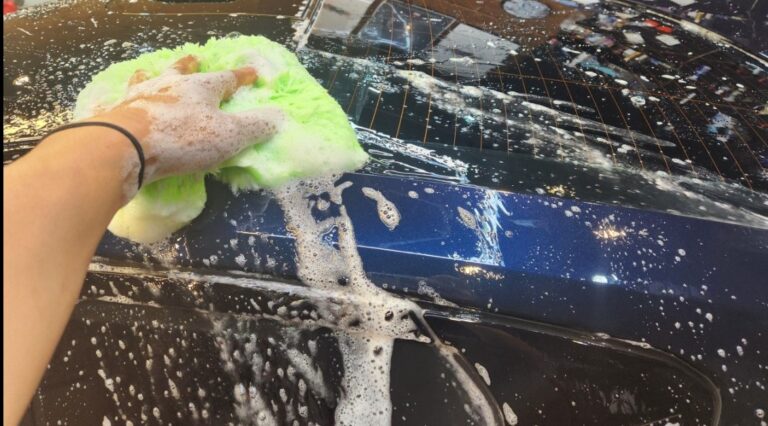
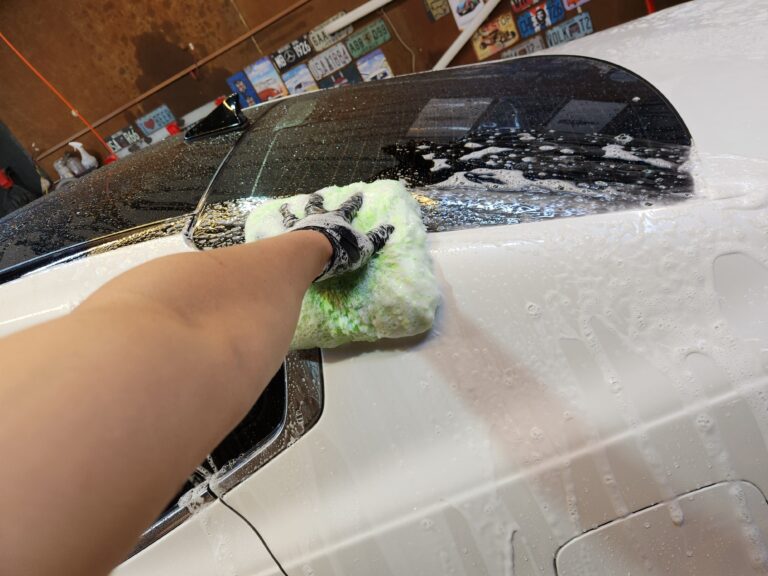
An alkaline pre-wash followed by a contact wash with car shampoo can remove a significant amount of road film and oily contamination.
As a result, the surface looks cleaner and much of the rough contamination disappears.
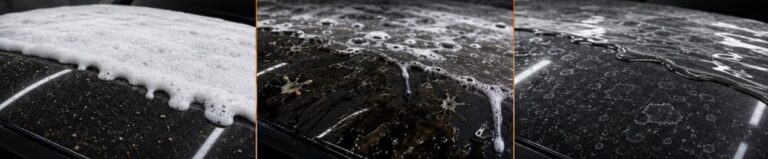
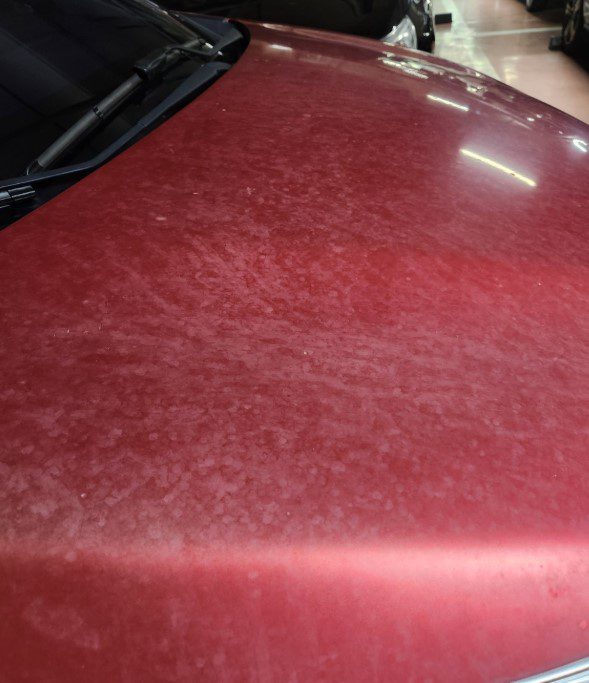
However, the finish may still appear slightly dull after the wash. Some areas may look slightly hazy, water may drain unevenly during the final rinse, or faint marks may remain across the panel.
At this point, many people assume that the cleaner was too weak. They may increase the alkaline concentration or apply more pressure with the wash mitt.
However, not everything left after washing is oily road film.
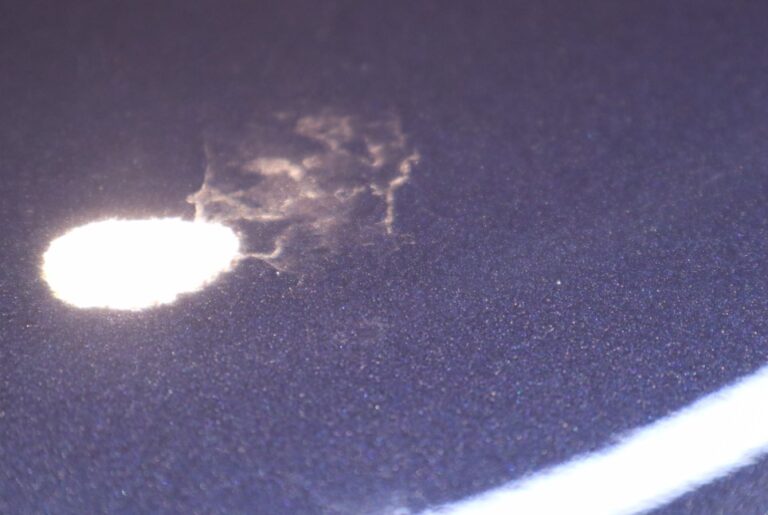
As water dries, dissolved minerals can remain as a thin mineral residue. Some of that residue may form at the boundary between the paint and the contamination layer, inside small gaps in the film, or near the paint surface.
If the paint does not regain its full optical clarity after washing, the problem may not be insufficient cleaning power. The remaining contamination may simply require a different type of cleaner.
To understand why an acidic pre-wash is needed, we first need to examine how mineral contamination forms and accumulates on automotive surfaces.
This is Part 1 of the Complete Acidic Pre-Wash Guide. It explains the structure of mineral contamination and why a low-concentration acidic pre-wash can be useful before deposits become clearly visible.
Table of Contents
- The Structure of Mineral Contamination on Automotive Paint
- Why an Acidic Pre-Wash Is Needed
- Frequently Asked Questions
The Structure of Mineral Contamination on Automotive Paint
How Does Mineral Contamination Form?
Automotive paint collects more than dust and soil.
While driving, the vehicle picks up oily road contamination, tire residue, exhaust particles, soot, and fine airborne particles. These materials combine with oils and form the thin contamination layer commonly called road film.
Rain, dew, road spray, and wash water can also introduce dissolved minerals. In addition, water may pick up mineral particles and inorganic residue that were already present on the surface.
Road film is already on the vehicle before it rains.
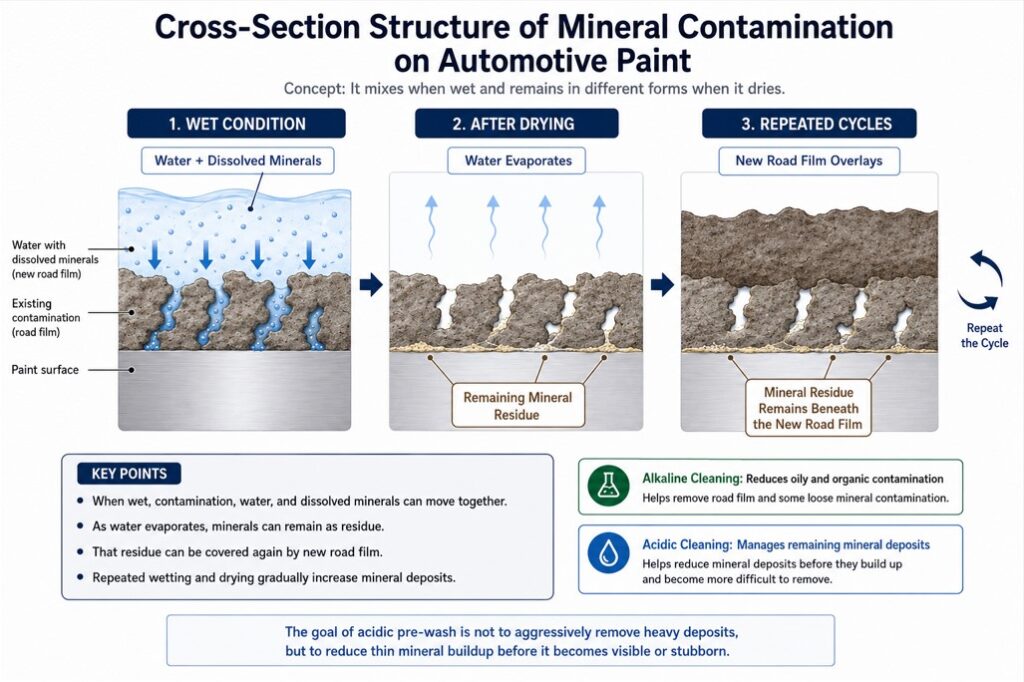
When the surface becomes wet, this contamination layer softens. Some of the contamination moves, spreads, or becomes suspended in the remaining water.
Road film does not form a perfectly sealed and uniform coating. Instead, oils and fine particles create an irregular film with small gaps and spaces.
Therefore, water can wet the surface of the film and enter parts of its internal structure.
Later, the water evaporates. However, the dissolved minerals do not evaporate with it.
As the amount of water decreases, the mineral concentration rises. Eventually, a thin mineral residue remains on the surface and within the small spaces previously occupied by water.
Therefore, washing a vehicle after rain is not only about removing visible water marks. It also reduces the chance that re-wetted contamination and dissolved minerals will dry into more persistent residue.
How Does Mineral Residue Remain Within the Contamination Layer?
Automotive contamination is not arranged like clearly separated geological layers.
However, it is not a perfectly uniform milkshake either.
While wet, road film, particles, and minerals can move together. During drying, however, each component can remain in a different form.
Loose minerals and particles trapped inside road film may leave during alkaline cleaning and rinsing.
In contrast, the situation changes when water carrying dissolved minerals seeps into small gaps within the contamination layer in the contamination layer and dries there.
The water disappears, but the minerals remain.
Residue may form at the boundary between the paint and the contamination layer. It may also remain inside microscopic spaces or in positions near the paint surface.
Not every mineral deposit forms in the same location.
Some residue stays within or above the road film. Loose particles may also leave during the next wash.
However, mineral deposits that form deeper within the contamination structure can remain after the water has disappeared.
Later, new oily contamination, soot, and dust collect on the vehicle. As a result, fresh road film can gradually overlay the existing mineral deposits from above and fill the surrounding spaces.
Fresh road film can gradually overlay and surround mineral deposits remaining near the paint surface.
In other words, contamination can mix and move while wet. During drying, however, its components may remain in different forms.
Therefore, removing the upper road film can reveal mineral residue that was previously hidden beneath it.
How Can a Small Amount of Mineral Residue Accumulate?
Only a small amount of water normally remains across the entire painted surface.
Therefore, a single rain event or wash leaves very little mineral residue over the wider panel.
This is why the entire vehicle does not suddenly turn white or hazy after one drying cycle.
However, the situation changes where water remains for longer or forms a large droplet.
More water and dissolved material occupy the same small area. Therefore, evaporation can concentrate minerals within a narrow region.
If the residue follows the outline or edge of the droplet, it can form a visible circular water spot.
By contrast, the thin water film across the wider panel leaves only a small amount of residue at one time.
That small amount spreads irregularly over a much larger area.
New road film later covers the surface. When rain or wash water wets it again, more minerals may remain around the previous residue after drying.
The cycle repeats:
Thin water remains
→ A small amount of mineral residue solidifies
→ Fresh road film overlays and surrounds the remaining residue
→ The surface becomes wet and dries again
→ Additional mineral residue remains
Each cycle leaves very little contamination.
However, repeated wetting-and-drying cycles allow mineral deposits to gradually accumulate. Over time, the deposits can affect light reflection, paint clarity, and color depth.
Water that remains in one area can produce a visible water spot. In contrast, thin water across the panel can leave small amounts of residue that gradually reduce gloss and optical clarity through repeated accumulation.
Why Acidic Pre-Wash Is Needed
Alkaline cleaning works well on oily and organic road contamination.
Once alkaline chemistry loosens the oily portion of road film, rinsing and contact washing can remove the particles held within it more easily.
However, bonded mineral deposits do not respond in the same way as oily contamination.
Some loose minerals may leave during washing. Nevertheless, alkaline cleaning may not adequately loosen mineral deposits that have already formed within the contamination structure.
Therefore, a different type of contamination requires a different cleaning approach.
In other words, stronger alkaline chemistry and additional mechanical pressure are not always the correct solution.
Why Is Mineral Contamination Difficult to See?
Mineral contamination across an entire vehicle does not form all at once.
A very small amount spreads over a wide area and increases slowly with each wetting and drying cycle.
In addition, there may be no clear boundary between a clean section and a contaminated section. This makes a thin mineral film much harder to notice than a visible circular water spot.
Drivers who see the same vehicle every day may notice the change even later.
Paint gloss and color do not suddenly disappear. Instead, they lose clarity very gradually.
At first, the paint may not look noticeably hazy. After more residue accumulates, light reflections may begin to look less defined. Dark paint may also appear slightly less deep or saturated.
Therefore, the surface may already be changing before the human eye notices a clear loss of gloss.
Water Can Reveal the Change Before the Human Eye
Thin mineral residue may affect water behavior before it creates an obvious visual change in the paint.
However, water behavior before washing is not a reliable guide. Road film, dust, and oily contamination already interfere with drainage and beading.
Therefore, complete the alkaline pre-wash and contact wash first.
Then observe how the water moves and remains during the final rinse.
A clean and relatively uniform surface should produce reasonably consistent water behavior across the same panel.
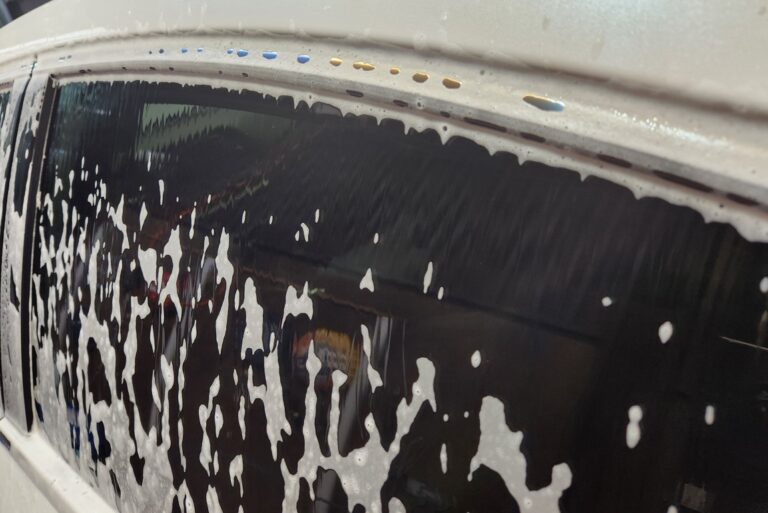
In contrast, an uneven surface may show several changes:
- Water drains quickly from one area but remains longer in another.
- Droplet size and shape vary across the same panel.
- One section beads while another holds a thin water film.
- Irregular water boundaries remain after most of the water drains.
- Water behaves differently around glass, chrome, and painted areas.
Changes in water behavior often appear before visible changes in gloss.
Water responds to very small changes in surface wettability. Therefore, even subtle surface differences can alter beading, sheeting, and drainage.
A person may notice the problem only after the paint begins to look dull. Water, however, can reveal the change earlier through variations in movement and the pattern it leaves behind.
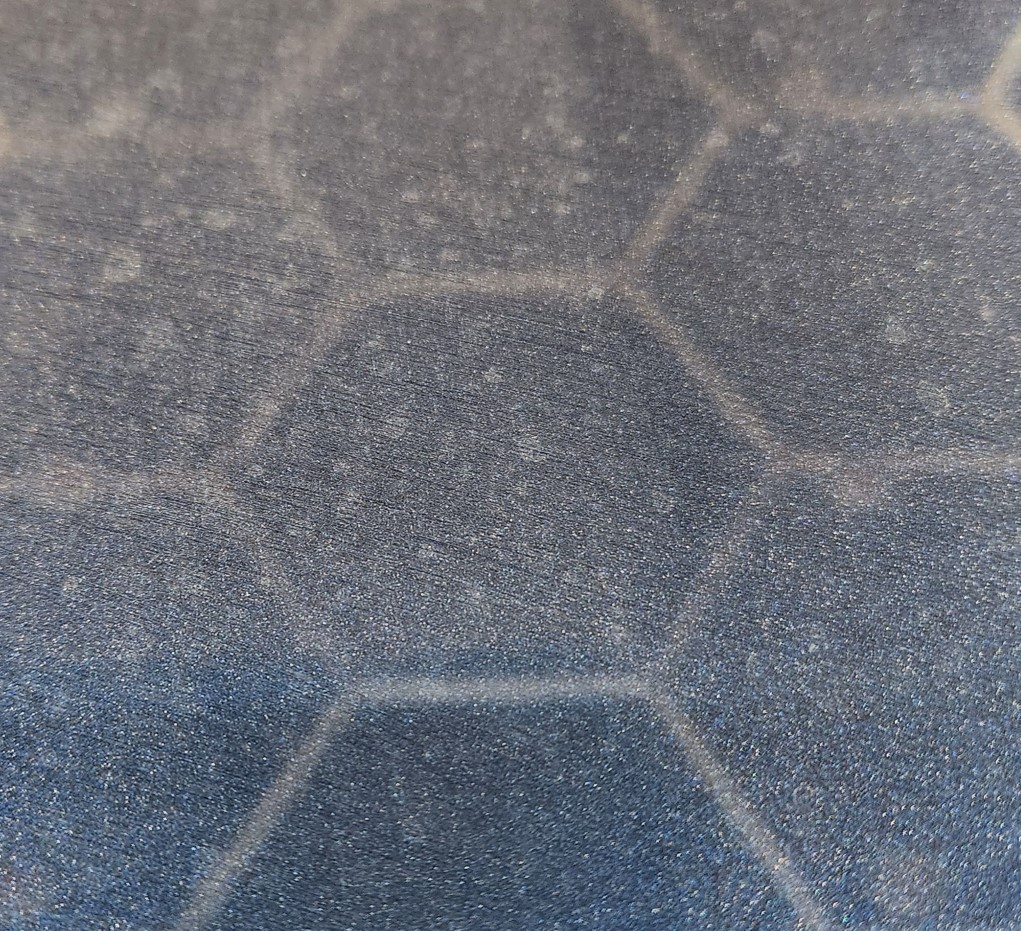
Water behavior alone cannot confirm mineral contamination.
Nevertheless, if the final rinse remains uneven after the basic wash, it provides an important reason to inspect the surface for mineral residue.
Why Use Acidic Pre-Wash Before Mineral Residue Becomes Visible?
Contamination does not need to be clearly visible before it begins affecting the surface.
A thin mineral residue may first change beading and drainage. As the deposits continue to build, they can gradually reduce gloss, optical clarity, and color depth.
By the time a driver notices haze or white marks, the surface may already have experienced many wetting and drying cycles.
The minerals may also have accumulated and become more firmly attached.
At that stage, a routine acidic maintenance wash may no longer remove them easily.
Therefore, mineral care should not focus only on removing obvious spots after they appear. It should also reduce gradual accumulation while the deposits remain thin.
Changes in final-rinse water behavior provide one practical clue for deciding when this maintenance may be useful.
Why Use a Low-Concentration Acidic Pre-Wash?
An acidic cleaner is designed to react with mineral contamination.
However, acidic chemistry does not react only with the unwanted deposit.
An unnecessarily high concentration may affect exposed metal components or certain sensitive materials. Long dwell times can increase the risk, especially when a pre-wash cleaner is allowed to dry on the surface.
In addition, repeated strong acidic cleaning may reduce the durability of some waxes and sealants.
Therefore, routine maintenance should not depend on repeatedly using a strong water-spot remover.
Instead, a lower-concentration acidic cleaner can reduce thin mineral residue before it becomes heavily attached.
This is the basic concept of an acidic pre-wash.
An acidic pre-wash is not designed to dissolve heavily bonded mineral deposits in a single treatment. It is a low-concentration maintenance step used to reduce the repeated accumulation of early mineral contamination.
An acidic cleaner and an acidic pre-wash are not the same concept.
Acidic cleaner describes the chemical nature of the product.
Acidic pre-wash describes how that chemistry is applied as part of a maintenance process.
In this context, the product is used at a relatively low concentration to reduce thin mineral residue without increasing mechanical contact.
The goal is not stronger cleaning.
Instead, the goal is to reduce small amounts of mineral residue before they develop into visible, firmly bonded deposits.
Why Acidic Pre-Wash May Not Remove Visible Water Spots
When pale outlines or visible water spots appear, mineral contamination may already be firmly attached.
Repeated accumulation may also have created a thicker deposit.
At this stage, a low-concentration maintenance pre-wash may not provide enough cleaning action.
An acidic pre-wash is intended to reduce thin, early contamination. It is not a restoration process for thick mineral scale or damaged paint.
If minerals have etched the paint itself, cleaning alone cannot return the surface to its original condition.
Depending on the severity, the vehicle may require a dedicated water-spot remover. A paint cleaner or polishing may also become necessary.
The role of acidic pre-wash is not to remove mineral contamination after it becomes obvious. Its role is to reduce accumulation before the deposits become clearly visible.
Therefore, the presence or absence of visible water spots should not be the only reason for considering acidic maintenance.
Final-rinse water behavior and the vehicle’s drying environment should also guide the decision.
Frequently Asked Questions
Can a Stronger Alkaline Cleaner Remove Mineral Contamination?
It is not the most effective solution.
Alkaline cleaning and rinsing may remove loose minerals trapped within road film. However, bonded mineral deposits behave differently from oily contamination.
Increasing alkalinity or contact pressure has limits. It may also reduce wax or sealant durability and increase the risk of micro-marring.
Does the Absence of Circular Water Spots Mean There Is No Mineral Contamination?
No.
Water that remains in one area can concentrate minerals and create a visible circular water spot.
In contrast, a thin water film leaves only a small amount of residue over a wide area. Repeated accumulation can change paint clarity and water behavior without producing obvious circular marks.
How Can I Detect Mineral Contamination Before the Paint Looks Hazy?
First, complete the alkaline pre-wash and contact wash.
Then observe the water during the final rinse.
If water drains unevenly across the same panel, or one section beads while another holds a thin film, the surface may no longer be uniform.
Repeated behavior after a proper wash provides a reason to inspect for mineral residue.
Does Uneven Water Behavior Always Mean Mineral Contamination?
No.
Water behavior alone cannot identify the exact contamination.
Road film and dust can also affect water movement before washing. Therefore, evaluate the surface only after completing the basic wash.
This article focuses specifically on mineral contamination caused by repeated wetting, drying, and residue accumulation.
Is an Acidic Pre-Wash the Same as a Water-Spot Remover?
No. They serve different purposes.
An acidic pre-wash uses relatively mild chemistry to manage thin, early mineral residue.
Visible water spots and heavier mineral scale may require a stronger dedicated remover or a separate restoration process.
Can an Acidic Pre-Wash Be Used on a Coated Vehicle?
Yes, mineral contamination can also form on coated vehicles.
However, contamination often bonds less strongly to a well-maintained coating. Therefore, a weaker dilution and shorter dwell time may be sufficient.
Always follow the product manufacturer’s instructions. Avoid hot panels and direct sunlight, and rinse thoroughly before the cleaner dries.
Should I Use an Acidic Pre-Wash During Every Wash?
Not necessarily.
Periodic use may help vehicles that often dry naturally after rain or use hard water or well water during washing.
It may also be useful when the final-rinse water behavior remains uneven after a complete wash.
However, the correct frequency depends on the vehicle’s contamination level, protection system, and maintenance environment.
Conclusion
Mineral contamination does not usually appear because a large amount suddenly covers the vehicle.
Instead, small amounts may remain each time a thin layer of water dries.
The residue can form at the boundary between the paint and contamination layer, inside small spaces within the film, or near the painted surface.
Fresh road film may then cover and surround that residue. Repeated wetting and drying gradually increase the buildup.
At first, a person may not notice any reduction in gloss.
However, water can react earlier.
Even subtle surface changes can alter water flow, beading, and drainage. Therefore, final-rinse water behavior can provide an early clue.
An acidic pre-wash is not simply a stronger step after alkaline cleaning.
It is not designed to aggressively remove visible or firmly bonded water spots. It is a low-concentration maintenance wash used to reduce thin mineral buildup before it becomes obvious.
Once mineral contamination becomes visible and firmly attached, an acidic pre-wash may no longer be enough.
For that reason, an acidic pre-wash is closer to preventive maintenance than restoration. Its greatest benefit comes from addressing mineral buildup before it becomes visible or difficult to remove.
In Part 2, we will examine how acidic cleaners react with mineral contamination. We will also explain how to understand pH, concentration, and dwell time.