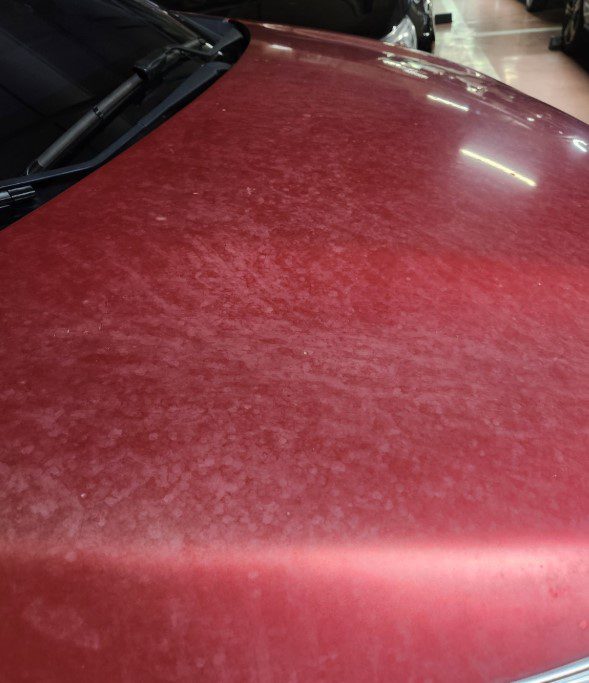
Car wash dwell time can change the cleaning result even when the same cleaner and dilution ratio are used. Rinsing immediately after application does not produce the same result as allowing the solution to remain on the surface for sufficient time.
Applying a cleaner does not mean the cleaning process is complete. Immediately after application, the solution has only reached the outer surface of the contamination.
So, what exactly are we waiting for after applying a cleaner?
To answer that question, we first need to understand the condition of the contamination remaining on the vehicle.
💡 Key Point
Car wash dwell time is not simply time spent waiting for a chemical reaction. It gives the cleaning solution time to remain wet, spread across the contamination, and expand its contact area before rinsing.
Table of Contents
- Why Dwell Time Is Needed
- What Happens During Dwell Time
- Why Dwell Time Differs by Contaminant
- How to Judge Sufficient Dwell Time
- Frequently Asked Questions
- Conclusion — Sufficient Contact Reduces Mechanical Force
1. Why Dwell Time Is Needed
The easiest material to remove leaves first
Vehicle contamination is not one uniform substance. It is a complex mixture of dust, soil, oils, organic matter, and particles generated by roads, tires, and vehicle traffic.
When a vehicle is exposed to rain or driven on wet roads, some water-responsive or loosely attached material may be carried away by flowing water. Material that is not completely removed may also move with the water and settle elsewhere on the vehicle.
This does not mean that the entire road film dissolves and flows away. Some rewetted or loosened components may move, while water-resistant oils and strongly attached residues remain on the surface.
For a closer look at how different cleaning chemistry acts on mixed road contamination, see Alkaline Pre-Wash: Why It Comes First for Mixed Contamination.
The remaining contamination becomes more compact
When water evaporates, the moisture disappears but the contaminants remain.
Organic contamination such as bug residue and bird droppings may harden as it loses moisture. Oils and other residues can hold particles together, while newly transported contamination may settle on top of the existing layer.
As wetting and drying repeat, the easier-to-remove components may gradually decrease. The proportion of more resistant material can therefore increase, creating a denser and more compositionally complex layer.
In other words, material that is easily removed leaves first. What remains may become concentrated, redistributed, and layered with other contaminants, making it harder for water and cleaning solution to spread through the contamination.
Spraying is only the beginning of contact
When a cleaner is applied, the solution first reaches the outer surface of this compact contamination.
However, touching the contamination is not the same as wetting it sufficiently.
The cleaning solution needs time to remain on the surface, wet the contamination, and gradually reach gaps, particle boundaries, and the interface between the contamination and the paint.
Car wash dwell time is necessary because the solution cannot establish sufficient contact with a dense, complex contamination layer immediately after application.
2. What Happens During Dwell Time
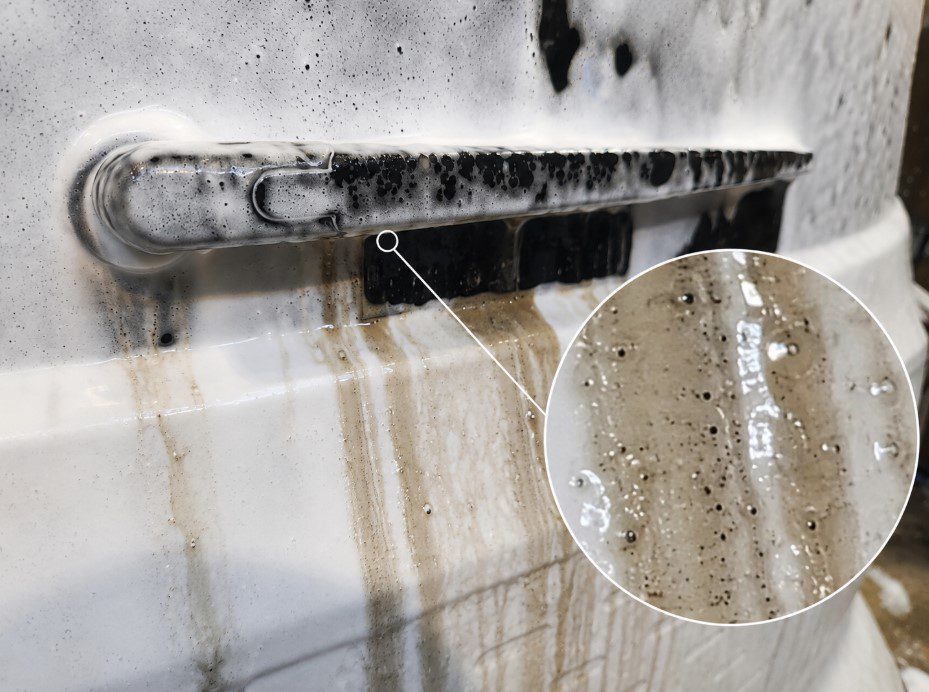
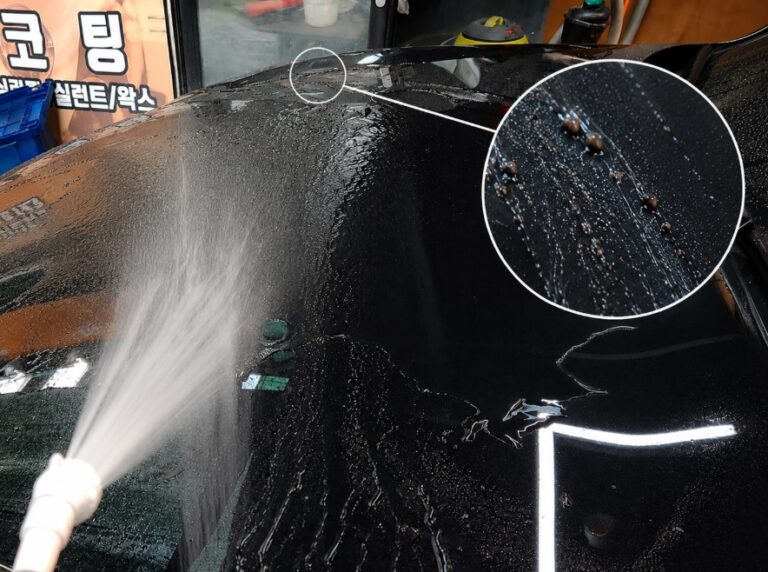
Pre-wash solution remaining on the panel while wetting road film and particulate contamination.
Retention and wetting
First, a sufficient amount of cleaning solution must remain on the contaminated surface. If too little is applied or the solution drains away too quickly, both the contact area and the available contact time are reduced.
While it remains on the panel, the solution spreads across the contamination and increases the area it can contact. Surfactants help this process, particularly when oily material is present within mixed road contamination.
Wetting does not mean that the solution immediately travels through the entire contamination layer. It begins by spreading across and evenly wetting the exposed surface.
For more detail on wetting and water movement, see The Role of Water in Car Washing.
Expanding contact area and rehydration
The solution spreads along the wetted surface and gains access to spaces between particles, microscopic irregularities, and exposed boundaries.
Over time, its contact area may extend into places that were not reached immediately after application, including parts of the interface between the contamination and the painted surface.
This does not mean that the cleaner completely penetrates every contamination layer. It means that while the solution remains wet, the area available for contact gradually expands.
Dried organic contamination such as bug residue and bird droppings may also absorb water again and become softer. The word “soaking” is often used to describe this rehydration and softening in simpler terms.
Cleaning action and preparation for detachment
Once the solution has sufficiently wetted the contamination and expanded its contact area, the cleaning ingredients can act where they are needed.
Chemical action is therefore not necessarily the starting point of dwell time. Conditions for adequate contact must first be established.
Dwell time does not directly carry contamination away from the vehicle. It wets, softens, and weakens the contamination so that pressure rinsing or light contact can detach it more easily.
The sequence can be summarized as follows:
Retention → Wetting → Expanded contact area → Rehydration and softening → Cleaning action → Preparation for detachment
The detached material must still be carried away by water. The difference between pressure and water volume is explained in Car Wash Water Pressure vs Flow Rate.
3. Why Dwell Time Differs by Contaminant
| Contaminant | Why dwell time is needed | Limits and judgment |
|---|---|---|
| Bug residue and bird droppings | Restores moisture and softens dried organic material | Existing paint etching cannot be repaired by soaking |
| Road film | Wets the surface and expands contact with the cleaning ingredients | Water alone may not fully remove the oily portion |
| Soil and dust | Allows solution to reach between particles and loosen their cohesion | The loosened contamination must still be removed by thorough rinsing |
| Oil, tar, and tree sap | Gives a compatible specialist cleaner time to contact the contamination | Waiting longer will have limited effect if the cleaner is unsuitable |
| Mineral contamination | Allows an appropriate acidic cleaner to contact and act on the deposits | The contaminant and material compatibility must be identified first |
Car wash dwell time does not mean soaking every contaminant for the same length of time. Its purpose depends on the contaminant and the cleaning action required.
For a broader comparison, see How Water Removes Different Types of Contamination from Car Paint.
4. How to Judge Sufficient Dwell Time
Check the condition, not only the clock
There is no single dwell time that applies to every cleaner and every vehicle.
For ordinary pre-wash products, keeping the solution wet is generally more important than reaching an arbitrary number of minutes. Strong alkaline or acidic cleaners, however, may have defined contact limits that must be followed.
| Factor | Effect on dwell time | Working guideline |
|---|---|---|
| Product characteristics | Ordinary pre-wash products and strong cleaners have different contact limits | Follow the manufacturer’s instructions, especially for strong alkaline or acidic products |
| Contamination condition | Thick or dry contamination may require longer wet contact | Reapply before drying to maintain wetness and contact time |
| Panel temperature | Hot panels cause the solution to dry faster | Cool the panel or work on a smaller area |
| Sunlight and wind | Increase evaporation and encourage partial drying | Work in the shade whenever possible |
| Application amount | Insufficient solution reduces coverage and wet contact time | Cover the surface evenly and adequately |
| Cleaner and dilution ratio | Affect wetting, cleaning strength, and material safety | Use the manufacturer’s recommended dilution |
A hot panel or strong wind does not reduce the amount of contact the contamination needs. It reduces the amount of time the solution can safely remain wet.
The practical standard for car wash dwell time is therefore not simply how many minutes have passed. The important question is whether sufficient wet contact has been maintained without exceeding the product’s instructions.
Keeping it wet matters more than waiting longer
With an ordinary pre-wash product used at the correct dilution on a cool panel, slightly longer wet contact is not usually the main risk. Drying is the more immediate concern.
When the solution dries, water evaporates while cleaning ingredients and loosened contamination become concentrated on the surface. This can leave residue, create uneven marks, and increase the rinsing required.
If a thick or dried contaminant needs more contact time, the same diluted solution can be reapplied before the surface dries. Once sufficient contact has been achieved, rinse thoroughly.
Strong alkaline or acidic products are an exception. Prolonged contact may affect sensitive surfaces even while the product remains wet, so the manufacturer’s stated contact time takes priority.
Reassess if one application is not enough
Do not immediately increase dwell time or mechanical force simply because the contamination was not removed in one attempt.
- Check whether the solution was applied evenly.
- Confirm that the surface remained wet.
- Rinse and inspect whether the contamination changed.
- If it softened or partially released, repeat the same process within the product’s directions.
- If there was little or no change, reconsider the cleaner or cleaning method.
If repeated applications produce little change, insufficient dwell time may not be the problem. The cleaning chemistry may be unsuitable for that contaminant.
🛠️ Practical Tip: Prevent Drying
Watch the condition of the solution rather than relying only on the clock. If panel temperature or wind causes it to begin drying, reapply the same diluted solution before it dries.
For the overall order and purpose of pre-washing, see What Is a Car Pre-Wash? Types, Methods, and Wash Order.
5. Frequently Asked Questions
How many minutes should car wash dwell time be?
There is no universal number. Follow the product instructions and maintain wet contact for as long as the product and working conditions safely allow. On hot, sunny, or windy days, work on smaller sections to prevent drying.
Can I reapply the cleaner before it dries?
For an ordinary pre-wash product used at the correct dilution, reapplying the same solution before it dries can extend the wet contact period. Strong products or cleaners with a defined contact limit should be used strictly according to the manufacturer’s instructions.
Does long-lasting foam mean the dwell time is sufficient?
Not necessarily. Visible foam does not prove that the solution has evenly wetted the contamination or expanded its contact area. Check whether the surface remains uniformly wet and whether any areas are beginning to dry.
Does longer dwell time continually increase cleaning power?
No. Additional time can help while wetting, rehydration, and contact expansion are still occurring, but cleaning performance does not increase indefinitely or at a constant rate. Once sufficient contact has been achieved, rinse before the solution dries.
Can dwell time alone remove contamination?
No. Dwell time prepares and weakens the contamination. Pressure rinsing, water flow, or controlled physical contact is still required to detach and remove it from the vehicle.
⚠️ Caution: Strong Chemicals and Sensitive Materials
Strong alkaline or acidic cleaners may affect aluminum, chrome, trim, coatings, or other sensitive materials even while still wet. Always prioritize the product instructions and material compatibility.
6. Conclusion — Sufficient Contact Reduces Mechanical Force
The contamination remaining on a vehicle is no longer in the same condition as when it first arrived. Easier-to-remove material may already have left, while the remaining components become concentrated, redistributed, and combined with new contamination.
This compact contamination does not become fully wetted the moment a cleaner is applied. The solution needs time to remain on the surface, wet the contamination, and expand its contact area into gaps and exposed interfaces.
Contamination that has not been sufficiently wetted is harder to detach. This can lead to greater pressure, stronger contact, or repeated wiping.
When sufficient contact lowers the contamination’s resistance to removal, less force and fewer repeated passes may be needed.
Dwell time does not replace mechanical force. It prepares the contamination so that it can be separated with less mechanical force.
For the relationship between contact, movement, and paint damage, see How to Prevent Car Scratches: The Ultimate Detailing Guide.
What we are waiting for is not simply the completion of a chemical reaction.
💡 Dwell Time Definition: Car wash dwell time is the period in which the cleaning solution remains wet, thoroughly wets the contamination, and expands its contact area into gaps and interfaces so the contamination becomes easier to remove.