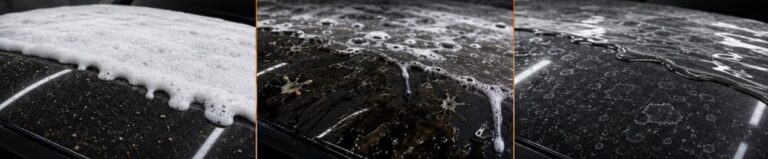
An alkaline cleaner is not something every car needs at every wash. The basic starting point for car washing is still a neutral wash.
If your car is washed regularly and the dirt has not had time to bond heavily to the paint, a pressure rinse and a pH-neutral car shampoo may be enough.
However, some cars behave differently after washing.
Dirt may still remain on the lower panels. The surface may look clean, but new swirl marks or micro-marring may become more visible. In those cases, the question is not simply, “Should I use a stronger product?”
The better question is:
When is neutral washing no longer enough, and how should an alkaline cleaner be used based on the level of contamination?
This guide explains two key signs that an alkaline cleaner may be needed, and how to choose between an alkaline pre-wash, an alkaline shampoo, or a combination of both.
Why Neutral Shampoo Comes Before an Alkaline Cleaner
A neutral car shampoo should be the baseline for regular maintenance washing.
It provides lubricity during contact washing and helps remove light dirt without adding unnecessary chemical strength. For vehicles washed frequently, this approach is often enough.
Short wash intervals also matter. When dirt is removed before it hardens into road film, a pressure rinse and neutral shampoo can manage most of the contamination safely.
Because of that, stronger cleaning should not be the default choice.
An alkaline cleaner is a problem-solving tool, not a product that must be used on every wash.
The goal is to match the cleaning method to the actual condition of the vehicle.
Two Signs You May Need an Alkaline Cleaner
Before looking at pH numbers or product strength, look at the car after washing.
The vehicle usually tells you whether neutral washing is enough.
| What happens after washing? | What it means | What to consider |
|---|---|---|
| Dirt still remains after the wash | Neutral shampoo may not be loosening oily or organic road film enough | Consider an alkaline cleaner |
| The car looks clean, but swirl marks increase | Particulate dirt may have moved during contact washing | Consider an alkaline pre-wash |
These two signs may look similar, but they point to different problems.
The first is a cleaning power issue.
The second is a pre-contact contamination issue.
Dirt Still Remains After Washing
If black road film remains on the lower doors, side skirts, rear bumper, or areas behind the wheels, neutral shampoo may not be enough.
In many cases, the problem is not simple dust.
Road oil, exhaust residue, tire grime, bug residue, and organic contamination can form a thin film on the paint. Once this film builds up, it can hold dirt more firmly than water and neutral shampoo can easily remove.
A stronger chemical approach may be needed at this point.
Alkaline cleaners help loosen oily and organic contamination that neutral shampoo may leave behind.
This does not mean every wash needs to be aggressive. It simply means the cleaning method should match the type of dirt on the vehicle.
Swirl Marks After Washing: What Does It Mean?
Sometimes the car looks clean after washing, but swirl marks or micro-marring become more noticeable.
This situation is different.
The dirt may have been removed, but it may not have been removed safely. If particulate contamination was still sitting on the paint during contact washing, the wash mitt could have pressed and moved those particles across the surface.
That is where scratch risk increases.
Particulate dirt + pressure + movement = scratch risk
A clean-looking car does not always mean the wash process was low-risk.
When this happens, the solution is not to scrub harder. Instead, more contamination should be removed before the mitt touches the paint.
That is where an alkaline pre-wash becomes useful.
What Types of Dirt Does an Alkaline Cleaner Remove?
An alkaline cleaner does not dissolve sand, grit, or mineral particles.
Its main role is different.
This type of cleaner works on the oily and organic film that holds particulate dirt on the surface. By loosening that film, it helps more contamination rinse away before or during the contact wash.
Real vehicle dirt is usually a mixture of several things:
- Road oil
- Exhaust residue
- Tire and rubber grime
- Bug remains
- Bird droppings
- Lower-panel grime mixed with moisture and dust
Once these materials combine, dust and particles are no longer sitting loosely on the paint. They become trapped inside road film.
That is why pressure washing alone may not remove everything.
The purpose of an alkaline cleaner is not to melt particles.
It is to loosen the contamination film that holds those particles in place.
When the film is weakened, more dirt can be removed by rinsing. As a result, the wash mitt has less contamination to push across the paint.
Alkaline Cleaner Methods: Pre-Wash vs. Alkaline Shampoo
Alkaline cleaning can be used in two main ways.
One method is used before contact washing. The other is used during the hand wash itself.
Both can be useful, but they do not serve the same purpose.
Use a Pre-Wash Before Contact
An alkaline pre-wash is applied before the wash mitt touches the paint.
Its role is to loosen oily and organic road film before physical contact begins. After a proper dwell time, the product is rinsed away with water.
The goal is not to completely wash the car without touching it.
A better way to understand pre-wash is this:
It reduces the amount of dirt the wash mitt has to move.
If more contamination is removed before contact, the risk of dragging particles across the paint becomes lower.
For cars that look clean after washing but develop more swirl marks, this step can be especially important.
Choose an Alkaline Shampoo During Contact Washing
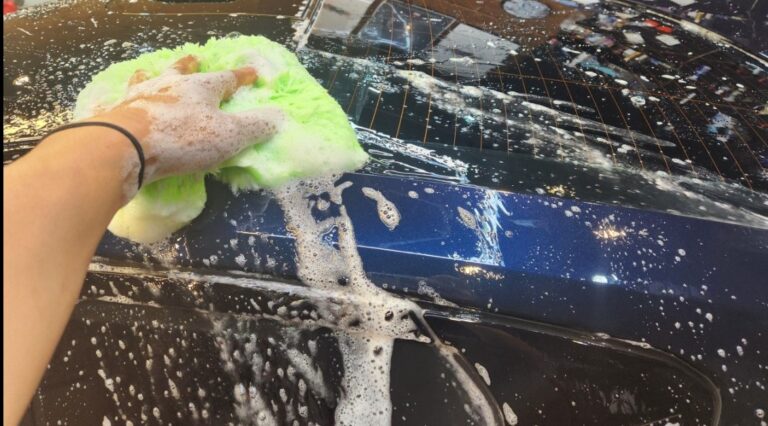
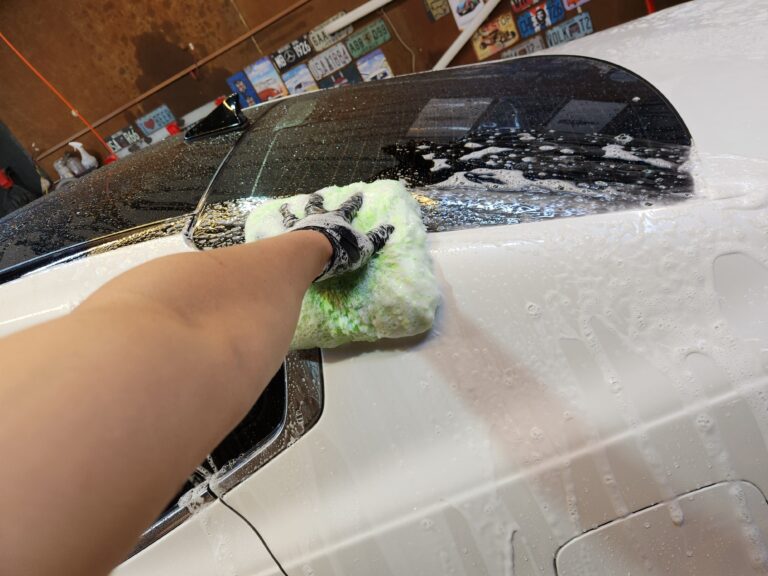
An alkaline shampoo is used during the hand wash stage.
Here, chemical cleaning and physical contact happen together.
Alkaline shampoo = chemical cleaning + mechanical contact
This can be useful when road film or organic grime is too stubborn for neutral shampoo alone.
However, the mitt is already touching the paint at this stage. For that reason, lubrication, mitt condition, and hand pressure still matter.
Using an alkaline shampoo does not mean you should scrub harder.
The product should loosen the grime, while the wash mitt gently collects what remains.
How to Use an Alkaline Cleaner by Contamination Level
The right method depends on how dirty the vehicle is.
An alkaline cleaner should not be used the same way on every car. The heavier the contamination, the more carefully the wash process should be adjusted.
| Contamination level | Cleaning method | Example |
|---|---|---|
| Light dirt | Neutral wash | Pressure rinse + neutral shampoo |
| Dirt should be reduced before contact | Chemical cleaning | Alkaline pre-wash |
| More cleaning power is needed during washing | Chemical cleaning + mechanical contact | Alkaline shampoo |
| Severe grime or old protection needs resetting | Chemical cleaning → chemical cleaning + mechanical contact | Alkaline pre-wash, rinse, then alkaline shampoo |
Light Dirt: Is Neutral Washing Enough?
For a regularly maintained car, neutral washing is often enough.
A pressure rinse removes loose contamination, and neutral shampoo provides the lubricity needed for safe mitt movement. If the vehicle is not heavily soiled, adding stronger chemistry may not provide much benefit.
In this case, staying with a neutral wash is the right choice.
Neutral maintenance should remain the default when the vehicle is already easy to clean.
Road Film on Lower Panels: Should You Add a Pre-Wash?
If road film remains after washing, especially on lower panels, an alkaline pre-wash may be useful.
Lower doors, side skirts, rear bumpers, and areas behind the wheels collect heavier contamination. Road oil, water, tire grime, and dust often mix in these areas.
Before contact washing, a pre-wash can loosen that film and help more dirt rinse away.
This step is especially helpful when the vehicle is not extremely dirty, but the dirt is bonded enough that neutral shampoo struggles to release it.
Heavy Organic Grime: Is Alkaline Shampoo More Effective?
For heavier contamination, an alkaline shampoo may be the better choice.
This applies when grime remains during the contact wash stage and neutral shampoo does not provide enough cleaning power. In that case, alkaline shampoo can help loosen oily and organic dirt while the mitt physically removes it.
Still, pressure should not increase just because the shampoo is stronger.
The safer approach is to let the chemistry do more of the work, while the mitt moves gently over the surface.
The cleaner should reduce the need for force, not justify more force.
Severe Contamination: Can You Use Both Steps?
For very dirty vehicles, using both an alkaline pre-wash and an alkaline shampoo can make sense.
This approach may be useful when the car has:
- Long wash intervals
- Heavy lower-panel road film
- Old bug residue or bird dropping marks
- Strong exhaust or traffic film
- Repeated black contamination on towels after washing
- Old wax or sealant layers mixed with dirt
In this case, the order matters.
Alkaline pre-wash → rinse → alkaline shampoo contact wash
First, the pre-wash loosens the contamination before the mitt touches the paint. Then, the rinse removes as much dirt as possible. Finally, the alkaline shampoo helps clean what remains during the hand wash.
This method is not about washing more aggressively.
It is about placing chemical cleaning before physical contact so the mitt has less dirt to move.
Why Cleaning Order Matters More Than Cleaning Strength
If we only compare cleaning power, the order may look simple.
Chemical cleaning + mechanical contact > chemical cleaning ≥ mechanical contact
A cleaner combined with mitt contact can remove more dirt than either method alone.
However, safe washing is not about choosing the strongest method first. The order of the process matters more.
When particulate dirt remains on the paint, increasing physical contact too early can move that dirt across the surface. Even if the car becomes clean, the process may increase swirl marks or micro-marring.
For lower scratch risk, chemical loosening should come before unnecessary contact.
First, loosen oily and organic film with the right cleaner. Next, rinse away as much contamination as possible. After that, use the mitt only as much as needed.
Loosen first. Rinse more. Touch less.
That is the safer direction.
Can an Alkaline Cleaner Remove Old Wax or Sealant Layers?
Alkaline cleaning can also help reset old and weakened protection.
Wax, sealant, and spray wax layers do not last forever. Over time, they can become weak, contaminated, or mixed with road film and oily residue.
If new protection is repeatedly applied over that surface, the finish may look less clear. Instead of looking sharp and clean, the paint can appear slightly cloudy or muted.
In that situation, protecting the old layer is not always the best goal.
A better approach may be to remove contamination and weaken old protection first, then apply fresh protection afterward.
Alkaline cleaners can help clean up old, weakened wax or sealant layers, especially when they are mixed with oily road film.
This does not mean every coating will be stripped. It mainly applies to waxes, sealants, and spray wax products that are relatively weak or already degraded.
Ceramic coatings and professional long-term coatings should not be treated the same way.
Is It Safe to Use an Alkaline Cleaner on Coated Cars?
Coated cars still need the same basic question:
Can neutral washing reduce the dirt enough before contact washing?
If the answer is yes, neutral washing may be enough.
If road film remains, towels turn black after washing, or the mitt feels grabby on the surface, an alkaline cleaner may still be useful.
The important point is not to avoid alkaline cleaning blindly. Leaving dirt on the paint and repeatedly touching it is also not ideal.
However, the type of protection matters.
Wax and Sealant Vehicles: Clean First, Protect Again
Wax, sealant, and spray wax vehicles are often reprotected after washing.
Because these products are reapplied regularly, removing old contamination can be more important than trying to preserve every bit of the previous layer.
If dirt and old protection are layered together, the surface may lose clarity.
For this type of vehicle, a reset wash can be useful.
Clean the contamination first, then apply fresh protection to a cleaner surface.
Ceramic-Coated Cars: Manage the Variables Carefully
Ceramic coatings and glass coatings are different.
These are long-term protective layers, so the goal is usually to preserve the coating while cleaning the surface. An alkaline cleaner can still be used when needed, but the process should be controlled carefully.
Dilution, dwell time, surface temperature, and drying are the key variables.
The product should not dry on the surface, and the manufacturer’s instructions should always guide the process.
For coated cars, the decision is not simply “alkaline or no alkaline.”
A better question is:
How much cleaning strength is needed, and how can it be used without unnecessary stress on the coating?
Checklist Before You Use an Alkaline Cleaner
Use this checklist before adding alkaline cleaning to your wash routine.
- Dirt remains on the paint after a normal neutral wash.
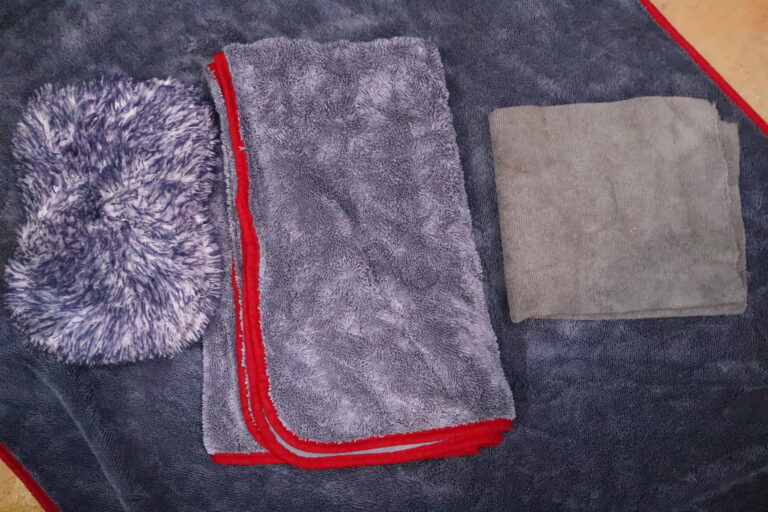
- Black contamination appears on a clean towel after washing.
- Road film keeps returning on lower doors, side skirts, or rear panels.
- The mitt feels grabby or rough during contact washing.
- More pressure is needed to remove dirt.
- Swirl marks or micro-marring become more visible after washing.
- Wash intervals are long, so dirt sits on the vehicle for extended periods.
- Wax or sealant looks cloudy, weak, or contaminated.
- Old protection feels mixed with road film instead of sitting cleanly on the paint.
If You Check 0–1 Items
Neutral washing is probably enough for your current maintenance routine.
In this case, an alkaline cleaner does not need to be used every time.
If You Check 2–4 Items
Neutral shampoo may not be loosening the contamination film enough.
An alkaline pre-wash is usually the first method to consider because it reduces dirt before contact washing.
If You Check 5 or More Items
The vehicle may have heavier road film, organic grime, or old weakened protection mixed with dirt.
In this situation, an alkaline pre-wash may help. For more severe contamination, an alkaline shampoo can also be considered after rinsing.
Even then, product instructions matter.
Always manage dilution, dwell time, surface temperature, and drying.
Final Takeaway: Use Alkaline Cleaning When Neutral Washing Is Not Enough
An alkaline cleaner is not necessary for every wash.
The default method is still a neutral wash.
However, stronger cleaning becomes useful in two situations.
First, dirt remains after washing because neutral shampoo cannot loosen the oily or organic film enough. Second, the car becomes clean but swirl marks increase because contamination was not reduced enough before contact.
From there, the method depends on the contamination level.
Use a neutral wash for light dirt. Add an alkaline pre-wash when dirt needs to be reduced before contact. Choose an alkaline shampoo when more cleaning power is needed during the contact wash. For severe grime or old protection that needs resetting, both steps may be used in the right order.
The key is not to wash harder.
The key is to loosen contamination first, rinse more away, and reduce the amount of dirt the mitt has to move.
That is when alkaline cleaning becomes useful.