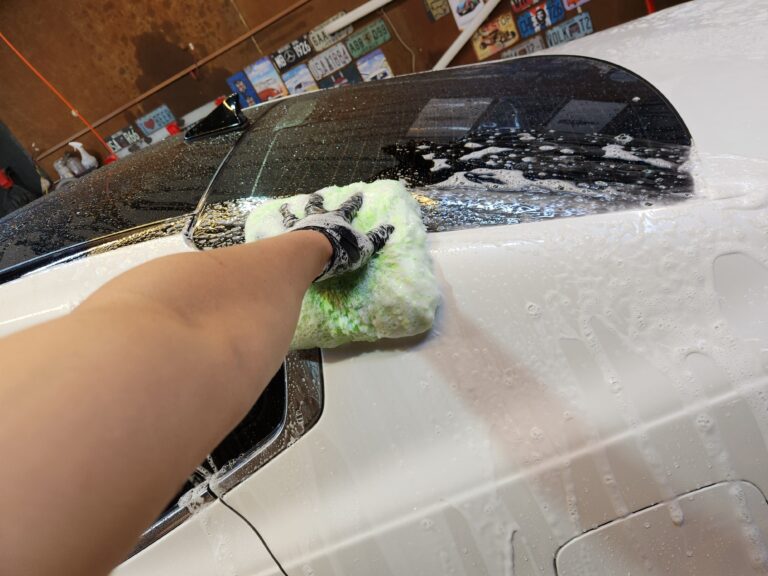
Many people choose a wash mitt by checking softness, thickness, water capacity, or brand reputation.
Those qualities matter, but they do not fully explain how safely a mitt handles contamination during the wash stage.
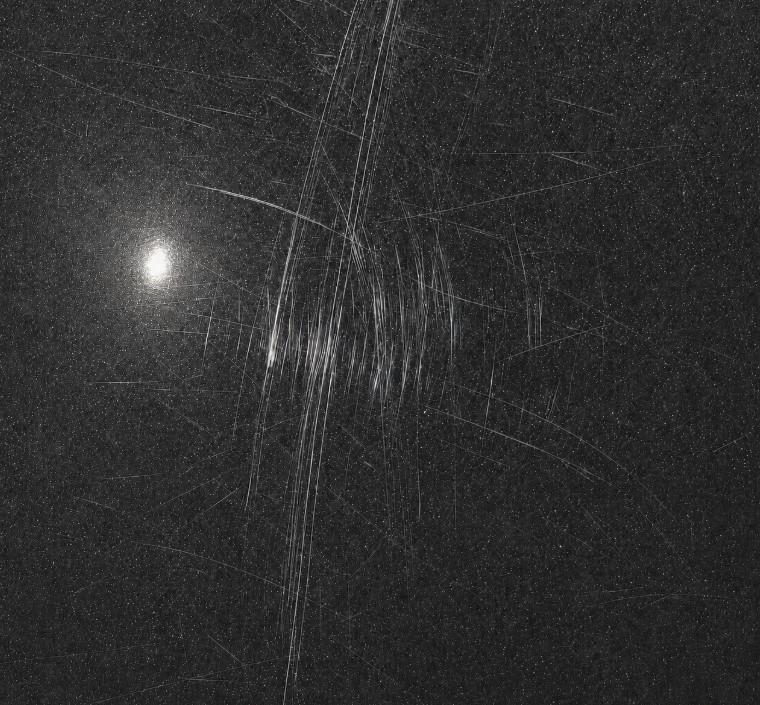
Even after a thorough pre-wash and rinse, some particulate contamination can remain on the paint. If a hard or sharp particle becomes trapped between the wash tool and the clear coat, pressure and movement can turn it into a scratch risk.
The basic relationship is simple:
Residual contamination + pressure + movement = scratch risk
A good wash mitt therefore needs to do more than feel soft.
It should help move loosened contamination away from the immediate contact surface while reducing the pressure transferred to those particles.
Two structural qualities matter most:
- Free movement of the outer fibers
- Enough effective depth in the outer pile layer
Shampoo Solution Activates the Wash Mitt Structure
A wash mitt must first carry enough shampoo solution to the paint.
How a mitt holds that solution, releases it during washing, and flushes contamination during rinsing is covered in the previous guide on [ash mitt solution capacity and flushing].
This article focuses on what happens within the outer contact layer.
Shampoo solution does more than wet the mitt. It keeps the pile saturated, supports smoother fiber movement, and creates a lubricated environment in which loosened contamination can move away from the paint.
It also helps the wet pile deform under load rather than behaving like a dry, compact contact surface.
In practical terms, shampoo solution supports two functions:
- It allows the fibers to move more freely.
- It helps the wet outer pile distribute pressure.
1. Free Fiber Movement and Contamination Management
When the outer pile is fully saturated, the fibers can move and separate more easily. Open space between them is also more likely to remain available.
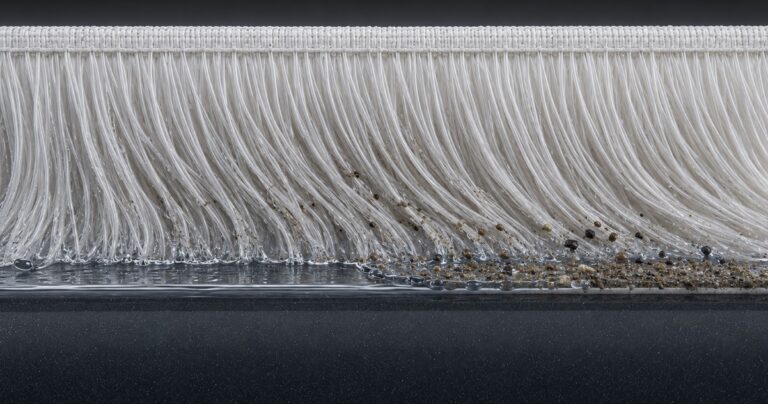
Contamination movement: Freely moving fibers can receive loosened particles into the spaces between the pile, reducing the chance that the particles remain directly between the mitt and the paint.
Friction reduction: Shampoo solution held within the pile maintains lubrication and helps reduce direct rubbing between contamination and the clear coat.
The goal is not to trap contamination permanently.
A safer wash mitt should support this sequence:
Loosen contamination → move it away from the immediate contact surface → hold it temporarily within the pile → release it during rinsing
The key question is not simply whether the fibers are long.
It is whether the fibers can still move independently and maintain space for contamination while saturated with shampoo solution.
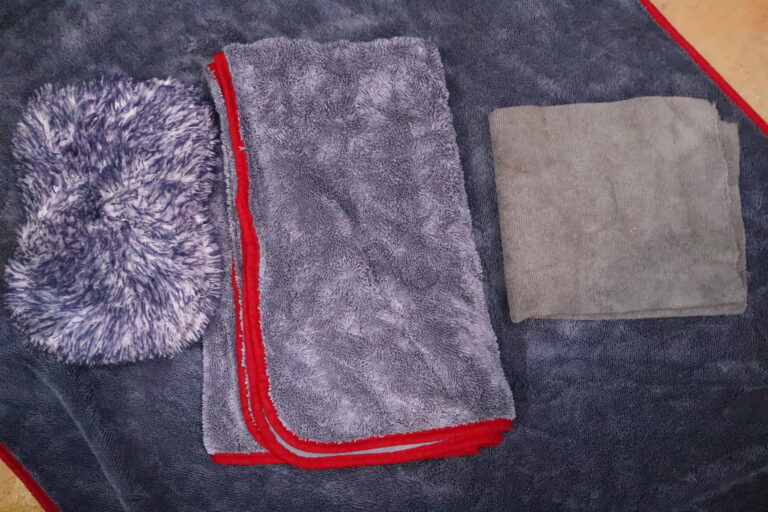
Long, Floppy Microfiber Pile
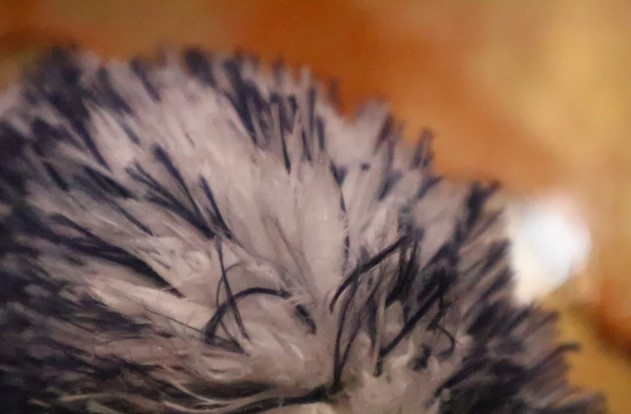
The main advantage of a long, floppy microfiber pile is not softness alone.
Individual fibers can move with some independence, allowing the pile to adapt to paint contours and create space between the paint and the mitt body.
This structure can help loosened particles move deeper between the fibers instead of remaining at the immediate contact surface.
However, long pile does not automatically make a mitt safer.
Its advantage decreases when:
- The pile density is excessive.
- The fibers tangle together.
- The wet pile collapses into a flat layer.
- Repeated use causes the fibers to mat.
When several fibers begin moving as one compressed mass, the structure loses much of the freedom that made it useful.
The better question is therefore:
Does the pile remain open and mobile when wet?
Chenille Wash Mitts

A chenille mitt uses thick microfiber fingers or bundles rather than a continuous layer of fine, independently moving pile.
This structure can hold a generous amount of shampoo solution and provide a soft initial contact.
However, the movement occurs mainly at the bundle level. Fine contamination must move through the spaces between those larger bundles rather than through numerous independent fibers.
If the chenille fingers lie flat or stick together when wet, the available pathways may become smaller.
This does not make every chenille mitt unsuitable. It means that chenille handles contamination differently.
Its performance depends more heavily on:
- The spacing between the bundles
- How easily the bundles separate when wet
- Whether they remain upright or collapse
- How effectively contamination leaves those spaces during rinsing
Sponge Wash Tools
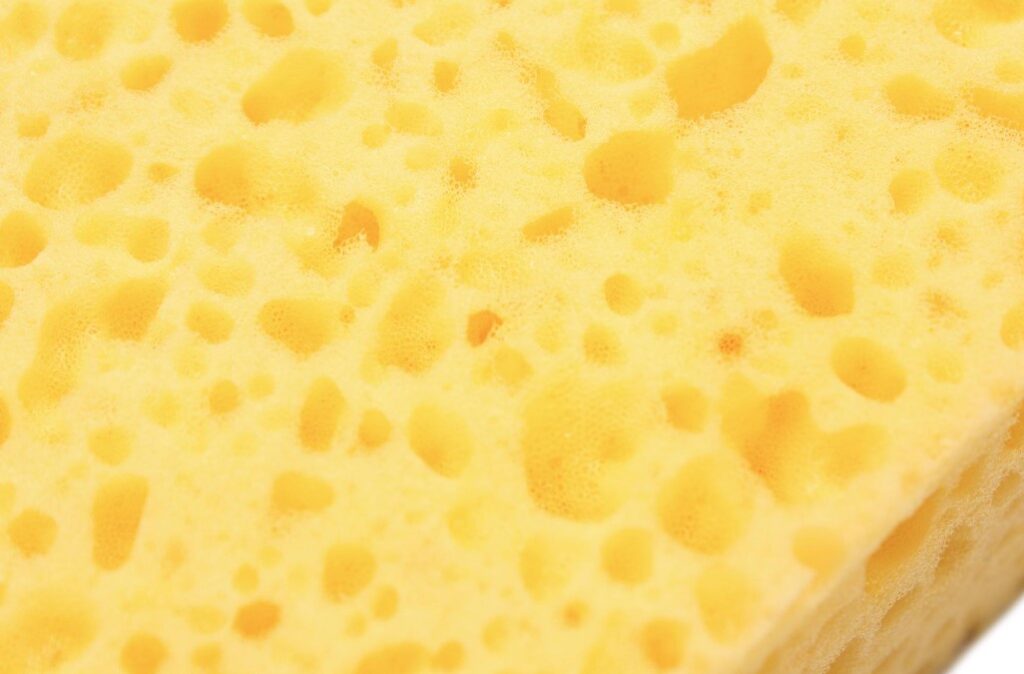
A sponge can store a large amount of shampoo solution inside its internal pores.
However, internal porosity and outer contact freedom are not the same thing.
Unlike long-pile microfiber, a sponge does not have thousands of individual fibers that move independently around contamination. Its outer face acts more like a continuous contact surface, while the internal body compresses under load.
The existence of visible pores does not automatically prove that particles will move safely away from the paint.
The more useful questions are:
- Can particles leave the immediate contact surface?
- Do they move into the internal pores without additional pressure?
- Does the structure remain open when compressed?
- Can the contamination rinse out easily afterward?
What matters is not simply whether the sponge contains holes, but how freely water and contamination can move during actual contact.
Comparing Structural Freedom
| Structure | Moving unit | Relative freedom |
|---|---|---|
| Long, floppy pile | Fine individual fibers | High, with suitable density |
| Chenille | Thick fiber bundles | Moderate |
| Sponge | Continuous outer surface and body | Limited |
A finer moving unit can adapt more precisely around paint contours and contamination. As the moving unit becomes larger, the contact structure becomes less individually responsive.
This is a structural tendency, not an absolute product ranking. Density, wet behavior, matting, and maintenance can change how any mitt performs.
2. Wet Pile Depth and Pressure Distribution
Giving contamination somewhere to move is only half of the problem.
A particle can still damage the paint if too much pressure is applied while it moves.
A good wash mitt should therefore reduce concentrated loading at the contact surface.
This is where effective pile depth becomes important.
A shampoo-saturated mitt does not behave like a thin, dry piece of fabric. Its wet outer layer can form a flexible contact zone between the hand, the contamination, and the paint.
Load distribution: Hand pressure is shared across multiple fibers rather than concentrated at one small point.
Reduced pressure concentration: A flexible outer pile can conform to the surface and help prevent one particle or small area from carrying the full load.
The important thickness is not the total thickness of the mitt.
It is the depth of the outer layer that actually contacts the paint.
Effective depth is the depth of the outer pile that directly manages contamination and pressure at the paint surface.
Effective Depth Is Not the Same as Overall Thickness
A mitt can feel thick because it contains a large internal foam core.
That does not necessarily mean it has a deep working contact layer.
A useful outer pile depth can:
- Spread hand pressure across many fibers
- Keep the mitt body farther from the paint
- Provide space for contamination to move away from the surface
- Hold shampoo solution within the working layer
- Adapt to small surface changes without requiring additional pressure
In other words, effective depth is not just cushioning.
It is the working space in which contamination, shampoo solution, and pressure are managed together.
Internal Foam and Outer Pile Serve Different Roles
Some wash pads and mitts use a thick foam core.
That internal layer may improve water storage, hand comfort, and shape retention. However, it does not replace the job of the outer pile.
A mitt with short, dense fibers over a thick foam core may hold plenty of solution while still providing limited effective depth at the paint surface.
There is also a practical pressure issue.
If the stored solution must be squeezed out by pressing the tool against the paint, the user may increase contact load at the same moment more lubrication is being released.
That creates an important distinction:
- Internal foam thickness: mainly supports storage and shape
- Outer pile depth: directly affects pressure distribution and contamination movement
A structure that stores a large amount of solution is not automatically the same as a structure that uses it effectively under low pressure.
How Long, Floppy Pile Distributes Pressure
Long, flexible fibers create depth within the outer contact layer.
Because individual fibers can bend and shift, hand pressure can be distributed across a wider working area.
This structure may provide:
- Greater separation between the mitt body and the paint
- Lower localized pressure on residual particles
- More space for shampoo solution within the contact layer
- Better adaptation to curved panels and small contours
Again, excessive density and fiber matting can reduce these benefits.
Once the pile compresses into a flat mass, both structural freedom and effective depth decrease.
How Chenille Distributes Pressure
Chenille mitts distribute load through their thick projecting bundles.
Those bundles can create a useful cushioning layer when they remain saturated, separated, and flexible.
However, the deformation occurs at a larger scale than it does with fine individual pile.
If the chenille fingers collapse or stick together, the contact area may become broader and flatter. Pressure distribution then depends more on bundle shape and resilience than on individual fiber movement.
How a Sponge Transfers Pressure
A sponge responds to load by compressing through much of its body.
This can create a soft initial feel, but the outer contact surface and internal pores compress together as pressure increases.
If the user presses the sponge to release more solution, the load applied to the paint may also rise.
That does not mean every sponge will produce damage. It means its pressure-control mechanism is structurally different from a pile-based mitt.
- A pile structure deforms through many individual contact points.
- A sponge deforms through compression of the larger body.
This distinction becomes more important when hard residual particles remain near the contact surface.
Fiber Freedom and Effective Depth Work Together
These two properties are not separate stages.
They operate at the same time during washing.
When enough shampoo solution fills the pile, the fibers can move around loosened contamination while the wet outer layer distributes hand pressure.
A structure with good freedom but insufficient depth may allow particles to move, yet provide limited protection from concentrated load.
A thick outer layer with poor fiber freedom may spread pressure but still keep contamination too close to the contact surface.
A safer wash mitt therefore needs both:
Free fiber movement creates space for contamination to move. Effective outer pile depth reduces the pressure applied while that contamination moves.
What to Check Before Choosing a Wash Mitt
Fiber Movement
- Do the fibers still move individually when wet?
- Is there enough space between them for contamination to move?
- Is the pile excessively dense?
- Does it tangle after repeated use?
- Does the surface collapse into a flat, matted layer?
Effective Outer Pile Depth
- Is the working pile layer deep enough to spread pressure?
- Does the visible outer pile create the thickness, or is most of the bulk hidden in a foam core?
- Can the pile stay saturated without being pressed firmly against the paint?
- Is there enough working depth for contamination to move away from the contact surface?
- Does the structure retain its depth when wet?
Conclusion
The safest wash mitt is not automatically the softest, thickest, or most absorbent product.
The real question is how the structure handles the contamination that remains after pre-washing.
A good mitt should allow the outer fibers to move freely so particles can leave the immediate contact surface. It should also provide enough wet outer pile depth to distribute pressure across a larger working area.
Shampoo solution enables both functions.
Sufficient shampoo solution supports free fiber movement, the moving fibers create space for contamination, and the effective outer pile depth reduces pressure on those particles.
Choose a wash mitt by its working structure, not by softness or overall thickness alone.
The two most important qualities are a freely moving outer pile and enough effective depth to control pressure at the paint surface.