Trapped Residue, Reduced Paint Clarity, and Metal Corrosion
By bbdetailing1988 / July 18, 2026
Reducing acid pre-wash risks requires more than avoiding strong dilution ratios and preventing the product from drying during application.
An acid pre-wash is not an aggressive chemical designed to remove heavily bonded water spots in a single treatment. It is a maintenance cleaner used at controlled concentrations to manage thin mineral contamination that gradually accumulates on automotive paint.
Why, then, can corrosion sometimes appear around wheels, underbody components, panel joints, and other metal areas after an acid pre-wash?
People usually blame one of three conditions:
- Excessively strong concentration
- Overly long dwell time
- Allowing the cleaner to dry during the pre-wash stage
These conditions can certainly increase the risk associated with acidic cleaners.
But are they the only causes?
This guide examines an often-overlooked acid pre-wash risk: cleaner that remains trapped in gaps and hidden structures because the vehicle was not rinsed thoroughly enough.
Table of Contents
- The Overlooked Acid Pre-Wash Risk Is Inadequate Rinsing
- Surface Rinsing and Flushing Hidden Gaps Are Different
- How to Rinse an Acid Pre-Wash Correctly
- Even a Diluted Acid Cleaner Can Become Concentrated as It Dries
- Why Trapped Cleaner May Increase Localized Corrosion Risk
- Residue Can Reduce Paint Clarity and Gloss
- Avoid Inhaling Acid Pre-Wash Mist
- Frequently Asked Questions
- Conclusion
⚠️ The Overlooked Acid Pre-Wash Risk Is Inadequate Rinsing
An acidic cleaner reacts with mineral contamination on the paint.
However, this reactivity does not act selectively on contamination alone.
Depending on the product formulation, dilution, type of metal, surface condition, and contact time, the cleaner may also affect exposed metal or damaged painted and plated surfaces.
The problem is that diluted cleaning solution can remain inside hidden gaps even when the visible surface appears completely clean.
Surface Rinsing and Flushing Hidden Gaps Are Different
Rinsing the entire vehicle until the visible foam disappears does not necessarily mean the rinsing process is complete.
Acidic solution can flow across the paint and enter areas such as:
- Panel joints and overlapping seams
- Behind trim and emblems
- Gaps around side mirrors and door handles
- Wheel-bolt holes and the backs of spokes
- Wheel arches and underbody structures
Open exterior surfaces receive direct pressure from the rinse water, so they usually become clean quickly.
Narrow and recessed areas behave differently. Diluted cleaner may remain inside even after the visible foam has disappeared.
Rinsing is not simply the process of removing foam from the surface. It must also flush trapped cleaning solution out of hidden structures.
When the pressure-washer nozzle is held too far from the vehicle, the water spreads over a wider area. As a result, it may lose the focused force needed to push cleaner out of narrow gaps.
Stopping the water stream halfway through a panel joint can also create a problem.
The rinse may move diluted cleaner deeper along a gap, but if the water stream stops before reaching an exit point, some of that liquid may remain trapped inside.
Once you begin rinsing in one direction, continue until the water reaches a natural drainage point.
Do not think only about wetting the surface. Think about pushing the cleaning solution into the gap, through the structure, and back out again.
🚿 How to Rinse an Acid Pre-Wash Correctly
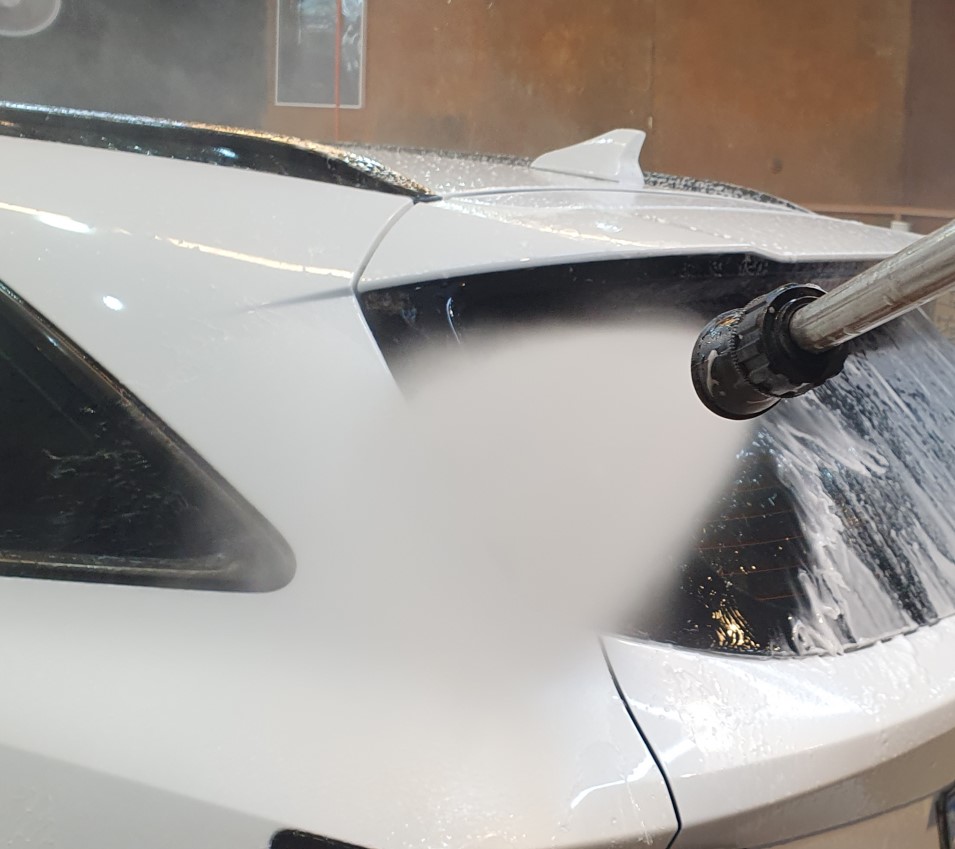
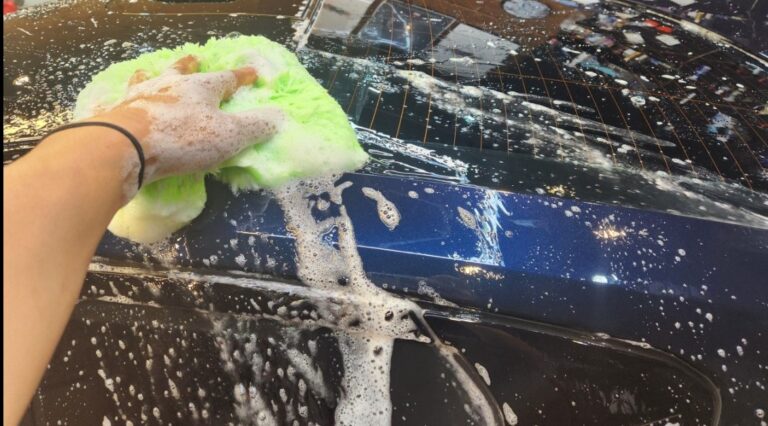
Use the following basic rinsing approach:
- Begin at the roof and work downward.
- Move slowly, as though sweeping water off the vehicle.
- Keep the nozzle approximately 30–50 cm from the surface.
- Maintain a consistent distance instead of constantly moving closer and farther away.
- When rinsing gaps, keep the water moving in one direction until the trapped solution reaches an exit point.
- Pay extra attention to wheels, mirrors, handles, trim, emblems, panel joints, and the underbody.
The exact working distance will depend on the pressure washer, nozzle angle, and condition of the vehicle.
The goal is not to place the nozzle as close as possible. It is to maintain enough focused water flow to remove cleaner from recessed areas without damaging sensitive components.
Acid Pre-Wash Risk: Even a Diluted Cleaner Can Become Concentrated as It Dries
An acidic cleaner can dry in two different ways.
The first occurs when the product dries directly on the visible surface during the pre-wash stage.
This can happen when someone applies the cleaner to the entire vehicle and then moves on to another task. Sunlight, warm paint, airflow, and long application times can cause the first treated panels to begin drying before rinsing starts.
The second occurs after rinsing, when diluted cleaner remains trapped in a hidden gap and dries later.
This situation is more difficult to detect because the cleaner is no longer visible from the outside. All visible foam may have disappeared while a small amount of diluted solution remains inside a joint or recessed area.
In both cases, water gradually evaporates.
As the amount of water decreases, the remaining cleaning ingredients and dissolved contamination become concentrated within a smaller area.
The product may have been applied at a mild maintenance dilution, but the conditions at the point of contact can change significantly during drying.
Cleaner that dries directly on the paint still requires careful attention.
However, when discussing corrosion around wheels, underbody parts, and panel gaps, it is also important to consider cleaner that was not completely flushed out and later dried inside the structure.
Why Trapped Cleaner May Increase Localized Corrosion Risk
Many exterior components that appear to be made entirely from plastic or rubber contain hidden metal clips, brackets, screws, or mounting points.
Areas where acidic cleaning solution may remain include:
- Wheel-bolt holes and wheel-nut recesses
- The backs of wheel spokes
- The inner barrel of the wheel
- The contact area between the wheel and hub
- Brake components and wheel arches
- Underbody bolts and fasteners
- Panel seams and folded edges
- Metal clips beneath exterior trim
- Areas where paint or plating has already been damaged
This does not mean the plastic trim itself will corrode.
The concern is that acidic solution may become trapped near metal fasteners, exposed panel edges, or damaged protective finishes behind the trim.
The same principle applies to wheels.
The front face may appear fully rinsed, while diluted cleaner remains inside wheel-bolt holes, behind the spokes, or around the hub.
The process may develop as follows:
Cleaner enters a recessed area
→ Rinsing fails to remove it completely
→ Diluted solution remains trapped
→ Water evaporates
→ Residue becomes concentrated locally
→ Contact time with metal increases
If this situation occurs repeatedly, the possibility of localized corrosion may increase.
This does not mean that corrosion begins immediately when an acidic cleaner touches metal.
The outcome depends on several variables, including:
- Type of metal
- Existing surface protection
- Damage to paint or plating
- Product chemistry
- Concentration
- Temperature
- Moisture
- Total contact time
However, when cleaning solution remains inside a hidden gap, the intended short dwell time can become much longer than expected.
For that reason, saying that corrosion occurs only because “the acidic cleaner dried” leaves out an important part of the process.
Drying during application is a risk.
In wheels, underbody structures, and panel joints, insufficient rinsing and trapped cleaner may be just as important.
Residue Can Reduce Paint Clarity and Gloss
It would be inaccurate to claim that every acid pre-wash directly reduces paint gloss.
The more relevant concern is residue.
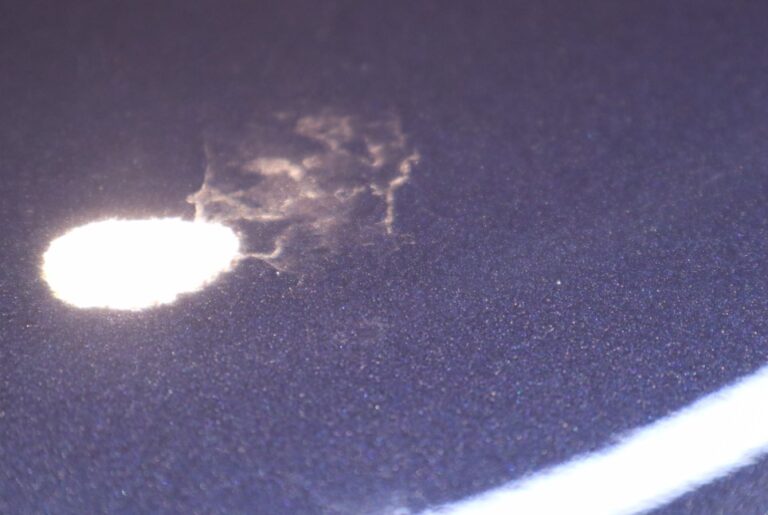
Cleaning ingredients, loosened minerals, dissolved contamination, and minerals contained in the rinse water may remain on the surface when rinsing is incomplete.
An acid pre-wash loosens thin mineral contamination or changes it into a form that can be carried away more easily by water.
During this process, the solution may contain both the cleaning ingredients and minerals that have been separated or partially dissolved from the paint.
When the surface is not rinsed thoroughly, some of this material may remain behind.
A very thin residue layer may not appear as an obvious stain immediately.
After a single wash, the change may be too subtle to identify.
However, if incomplete removal occurs repeatedly, cleaning residue and displaced mineral material may continue to accumulate. After drying, these substances may form a mixed residue layer depending on the product formulation, water quality, and rinsing conditions.
Possible symptoms include:
- Reduced paint clarity
- Softer or less defined reflections under lighting
- Gradual loss of overall gloss
- Uneven water sheeting and drainage
- A surface that still feels visually unfinished after washing
These symptoms do not prove that acid-cleaner residue is the only cause.
Existing mineral buildup, oily film, hard water, and residue from other detergents can create similar effects.
When the paint does not appear clearer after an acid pre-wash, do not immediately increase the concentration or dwell time.
First, examine the rinsing process and the possibility that residue remains on the surface or inside panel gaps.
After using an acid pre-wash, it is not enough to confirm that the cleaner reacted with the contamination.
You must also make sure that the reacted contamination and cleaning solution were fully removed from the vehicle.
😷 Avoid Inhaling Acid Pre-Wash Mist
Spraying a liquid acid pre-wash can release fine droplets into the air.
This is not simply a matter of noticing the product’s smell.
Fine cleaning mist may travel toward the operator’s nose, mouth, eyes, and surrounding skin.
Exposure can increase in situations such as:
- Spraying while facing into the wind
- Working in an enclosed or poorly ventilated space
- Using a fine spray close to the face
- Repeatedly spraying the entire vehicle for an extended period
- Allowing airborne mist to drift back toward the operator
Outdoor use does not automatically eliminate the risk.
Wind direction can change during application and carry sprayed mist back toward the user.
Before spraying, check the airflow and plan the direction of movement around the vehicle.
Position the spray so the mist travels away from your body. When ventilation is limited, use appropriate personal protective equipment.
Acid pre-wash products can contain different types and concentrations of acids.
Required protective measures may also vary by product.
Always follow:
- The product label
- The Safety Data Sheet, or SDS
- The manufacturer’s usage instructions
- The recommended personal protective equipment requirements
🔍 Frequently Asked Questions
Can a Maintenance-Strength Acid Pre-Wash Still Contribute to Metal Corrosion?
It may create additional risk if the solution remains in contact with metal for an extended period.
Even when the product was initially diluted, cleaner trapped inside a gap may dry and become concentrated locally. Repeated exposure under these conditions may increase the possibility of localized corrosion.
Is Rinsing Complete Once All Visible Foam Has Disappeared?
Not necessarily.
Removing visible foam from open surfaces is different from flushing cleaner out of wheel recesses, panel joints, trim, mirrors, and underbody structures.
The rinse should continue until the solution has been carried out of hidden areas.
In What Order Should I Rinse After an Acid Pre-Wash?
Begin at the roof and move downward slowly.
Maintain a nozzle distance of approximately 30–50 cm, adjusting for your equipment and the condition of the vehicle.
When rinsing panel gaps or recessed structures, keep the stream moving in one direction until the water and trapped cleaner reach an exit point.
Is Drying During Application Different From Drying Inside a Gap?
Yes.
Cleaner that dries directly on the paint may leave visible staining or residue.
Cleaner that dries inside a hidden gap is harder to detect and may remain in contact with metal components for much longer.
Both situations matter, but they create different types of risk.
Is Acid Pre-Wash Residue Immediately Visible?
Not always.
A thin residue layer may be difficult to see at first.
If cleaning ingredients and displaced minerals are not removed completely, they may eventually affect surface clarity, gloss, and water behavior.
Should I Increase the Acid Pre-Wash Concentration When the Paint Looks Dull?
Not immediately.
First inspect the rinsing process, water quality, and the possibility of residue.
Existing mineral contamination, oily film, hard-water deposits, and residues from other cleaning products can also reduce clarity.
Increasing concentration without identifying the cause may add unnecessary risk.
What Should I Check Before Spraying an Acid Pre-Wash?
Check wind direction, ventilation, and the intended spray path.
Avoid spraying into the wind or allowing the mist to return toward your face.
Follow the product label, SDS, and manufacturer instructions when selecting gloves, eye protection, respiratory protection, or other safety equipment.
Conclusion
Strong dilution ratios, excessive dwell time, and allowing the cleaner to dry during application are well-known acid pre-wash risks.
However, the job is not complete simply because the visible foam has disappeared.
Diluted cleaning solution can remain around wheels, underbody structures, trim, emblems, mirrors, and panel joints.
When this solution dries inside a hidden area, the remaining material can become concentrated locally and remain in contact with metal for longer than intended.
On the paint, incomplete removal of cleaning ingredients and displaced mineral contamination may also affect surface clarity and gloss.
The spraying process requires attention to operator safety as well.
Acid pre-wash safety is not determined only by how mildly the product was diluted.
It also depends on how completely the cleaner and reacted contamination were removed from both visible surfaces and hidden gaps.
Related Guides
- Why Acid Pre-Wash Is Necessary: Managing Invisible Mineral Contamination
- How to Use an Acid Pre-Wash: Application Order and Safe Rinsing