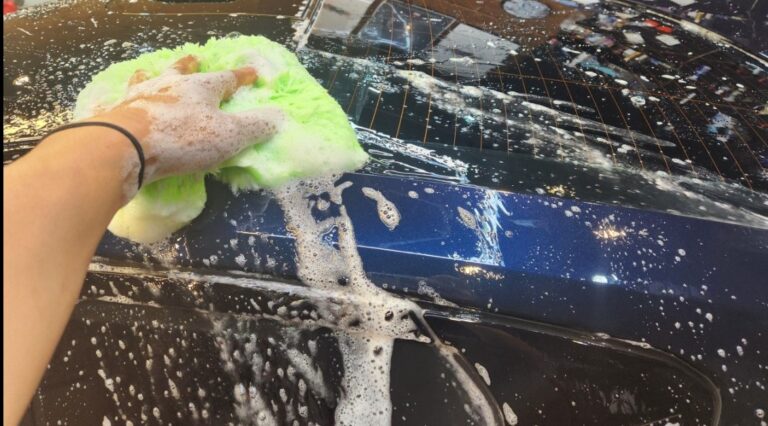
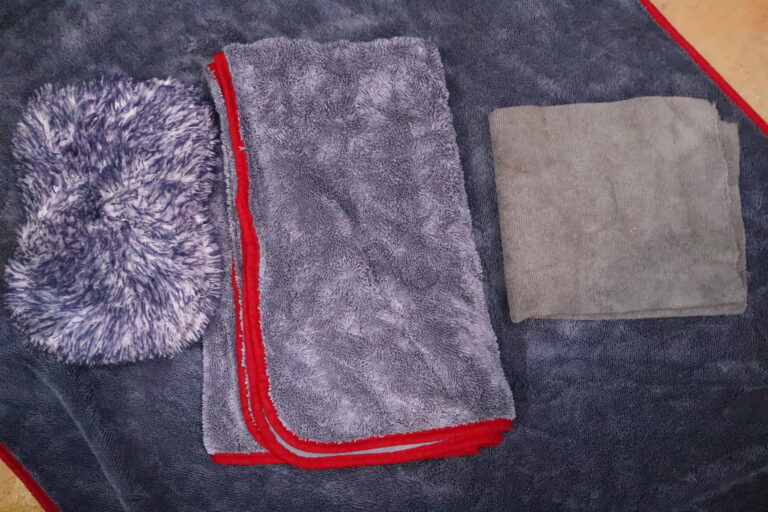
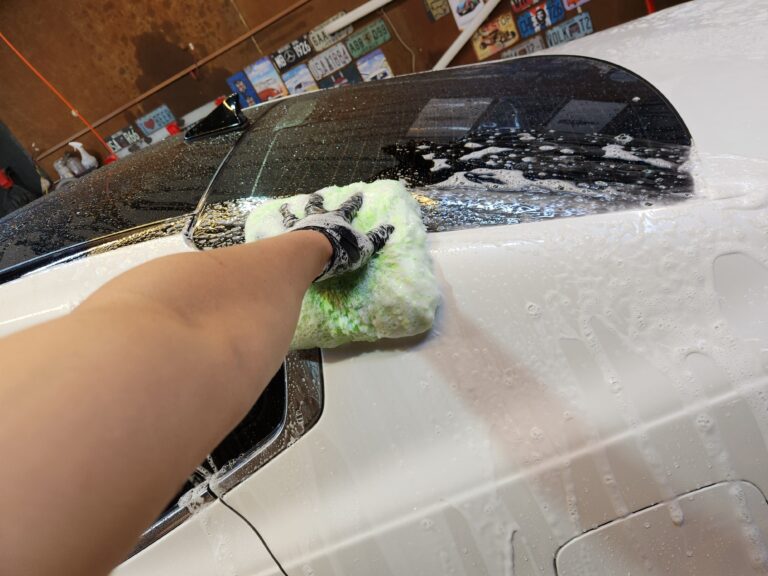
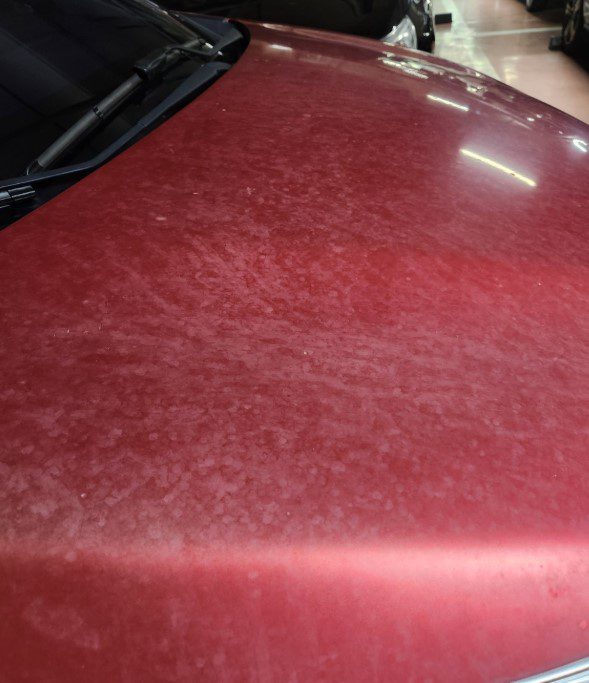
A wash mitt is one of the few tools that directly touches automotive paint during washing.
That is why many car owners worry about dirt becoming trapped inside the mitt and being dragged across the next section of paint.
The same questions appear repeatedly in detailing communities:
- Does a used wash mitt become clean enough after being rinsed in a bucket?
- Can a grit guard remove every particle trapped inside the fibers?
- Would it be safer to use several wash mitts or towels and never reuse a contaminated one?
These concerns have led to multiple-wash-mitt methods, multi-towel washing, and separate mitts for the upper and lower sections of a vehicle.
All of these methods can reduce the transfer of contamination during washing.
However, using more wash mitts does not reduce the contamination already sitting on the paint. It mainly prevents dirt collected by one mitt from being carried to the next section.
That leads to a more practical question:
How much additional protection do multiple wash mitts provide, and is that protection worth the extra cost, washing, drying, and storage?
In this guide, the term wash mitt includes both traditional glove-style mitts and handheld wash pads. Their shapes are different, but they perform the same basic task: holding wash solution and removing contamination through direct contact with the paint.
Why Do People Use Multiple Wash Mitts or Towels?
The traditional two-bucket method uses one bucket for shampoo solution and another for rinsing the wash mitt.
After cleaning part of the vehicle, the mitt is rinsed before being returned to the shampoo bucket.
This method depends on one basic assumption:
The used wash mitt becomes clean enough in the rinse bucket to be safely used again.
The problem is that it is difficult to confirm how much contamination has actually left the fibers.
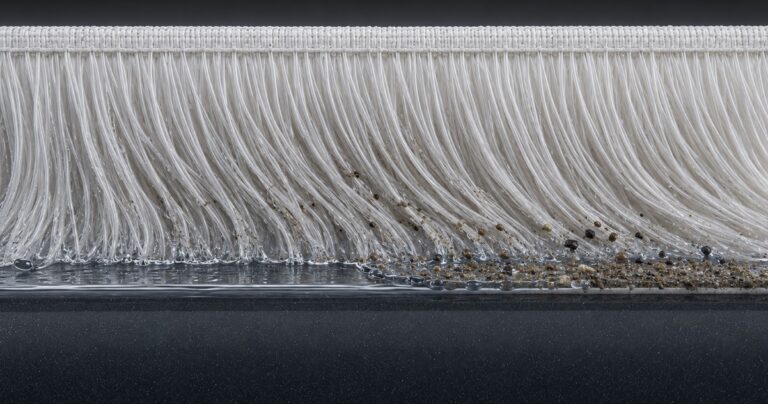
Sand, road grit, and fine dirt do not remain only on the outer surface of a wash mitt. They can move between the fibers or remain trapped where the pile has become compressed, twisted, or tangled.
Oily road film mixed with fine particles may also stay inside the mitt even after it has been moved through the rinse water several times.
A grit guard cannot remove every contaminant trapped inside the wash mitt.
Its main purpose is to help larger particles settle toward the bottom of the bucket and reduce the chance of the mitt contacting them again.
It cannot guarantee that every fine particle or deeply trapped contaminant has been released.
That is why some detailers follow a simpler rule:
If you cannot confirm that the wash mitt is clean, do not reuse it during the same wash.
This is the basic principle behind multiple-mitt and multi-towel washing methods.
What Actually Makes a Wash Mitt Risky?
Using a single wash mitt does not automatically create swirl marks.
The risk increases when several conditions occur together:
- Too much contamination remains after pre-washing.
- The wash mitt collects dirt but cannot release it effectively.
- The mitt does not hold enough shampoo solution.
- Too little water is used in the bucket.
- Larger particles return to the contact surface.
- Flushing decreases, but the mitt continues moving across the paint.
- Additional pressure is applied when the mitt begins to drag.
The real problem is therefore not simply the number of wash mitts.
The greater risk comes from continuing to use a contaminated mitt without enough water, rinsing, or flushing.
A one-mitt method can still work when the paint has been properly pre-washed, the mitt can release collected contamination, and enough shampoo solution is available for repeated rinsing and reloading.
The relationship between contamination, pressure, movement, and repeated contact is explained in the previous guide, Why Swirl Marks Still Appear During Washing, Drying, and Buffing.
This article focuses on the practical decisions made during the contact-wash stage.
Are Multiple Wash Mitts a Good Solution?
Using several high-quality wash mitts is a safe and reasonable method.
Once a mitt has been used, it does not need to return to the wash bucket. There is no need to judge whether it has been rinsed thoroughly enough.
Using a fresh mitt for each panel or section can reduce:
- contamination transfer between panels
- movement of lower-body dirt to cleaner sections
- repeated use of a contaminated mitt
- uncertainty about rinsing effectiveness
A proper wash mitt also retains its original advantages:
- high water and shampoo retention
- stronger flushing during contact
- wider pressure distribution
- more space for contamination to move away from the paint
The main question is not whether the method is safe.
The main question is efficiency.
Using six or seven wash mitts means:
- purchasing more mitts
- washing more items after every wash
- requiring more drying space
- increasing storage requirements
- spending more time preparing and sorting equipment
For a heavily contaminated vehicle or a situation where thorough pre-washing is difficult, multiple wash mitts may provide meaningful additional protection.
However, on a regularly maintained vehicle that has already been properly pre-washed, the difference between one well-managed mitt and several fresh mitts may be smaller than expected.
The practical question is:
Does the reduction in risk justify the additional preparation, washing, drying, and storage?
This is also why separating the upper and lower sections with two mitts is a useful compromise.
The roof, hood, and upper doors are usually cleaner than the rocker panels, lower doors, and rear bumper.
Using one mitt for the cleaner upper sections and another for the dirtier lower areas provides much of the benefit without making the wash process unnecessarily complicated.
Can Multiple Towels Replace a Wash Mitt?
A multi-towel method should not be evaluated in exactly the same way as a multiple-wash-mitt method.
Both approaches reduce the reuse of contaminated surfaces, but a towel and a wash mitt do not perform identically during contact washing.
In rinseless-wash circles, the multi-towel approach is often associated with the Garry Dean Method: several clean microfiber towels are soaked in wash solution, used one section at a time, and kept out of the wash bucket once contaminated.
The multiple-wash-mitt method follows a similar contamination-control principle. However, it retains the greater water capacity, flushing, and pressure distribution of a wash mitt.
Towels are relatively inexpensive and easy to fold into several clean working surfaces. They can also conform well around narrow areas, edges, and complex body contours.
However, compared with a wash mitt, a towel may:
- hold less shampoo solution
- produce less flushing during contact
- provide less space for contamination to move into
- concentrate finger pressure when folded too tightly
For this reason, using multiple towels reduces the reuse of contaminated surfaces, but it does not automatically improve the towel’s ability to handle a large contamination load.
What Type of Towel Should Be Used?
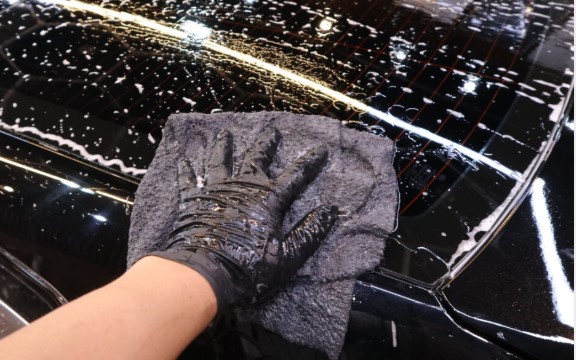
Not every microfiber towel is suitable for contact washing.
A better choice is:
- edgeless
- soft and floppy
- long-pile microfiber
An edgeless towel avoids a firm stitched border that may concentrate pressure on a narrow area.
A soft, floppy towel follows the contours of the vehicle more naturally and reduces the chance of pressure building along a stiff edge.
Long microfiber fibers provide more space for light contamination to move away from the immediate contact surface.
Even with a suitable towel, it must be fully saturated before use.
Use it only for a short section before switching to a clean side or replacing it with a fresh towel.
In a multi-towel method, the structure and saturation of the towel matter as much as the number of towels.
When Is a Multi-Towel Method Effective?
A multi-towel method works best on vehicles that are:
- washed frequently
- well protected
- carrying only light dust or a thin contamination film
- thoroughly cleaned during pre-washing
- maintained through rinseless washing
Under these conditions, the towel does not need to handle a large contamination load.
The benefit of using a fresh surface repeatedly becomes more important, while the limitations in water retention and flushing are less noticeable.
What Changes on a Heavily Contaminated Vehicle?
A fresh towel becomes contaminated as soon as it touches a dirty panel.
Even when a new towel is used for every panel, particles can still be dragged across that individual panel.
When water retention and flushing are limited, and pressure becomes concentrated through the fingers, contamination may remain close to the paint instead of moving deeper into the fibers.
The important question is therefore not only:
Is the towel clean?
It is:
Can the towel safely handle the amount of contamination remaining on the vehicle?
For a heavily contaminated vehicle, increasing the number of towels should not replace proper pre-washing.
One Mitt, Multiple Mitts, or Multiple Towels?
These methods are better compared by working conditions than by declaring one universally superior.
| Method | Main advantage | Main limitation | Best suited to |
|---|---|---|---|
| One mitt, one bucket | Simple preparation, washing, and storage | Requires effective pre-washing, good rinsing, and plenty of water | Properly pre-washed and regularly maintained vehicles |
| Separate upper and lower mitts | Keeps cleaner and dirtier sections apart | Requires one additional mitt | Normally contaminated vehicles with dirtier lower panels |
| Multiple wash mitts | Used mitts are not returned to the wash bucket | Higher cost and greater washing, drying, and storage requirements | Vehicles with higher remaining contamination or limited rinsing conditions |
| Multiple towels | Provides many clean working surfaces | Lower water retention, flushing, and pressure distribution | Lightly contaminated or rinseless-washed vehicles |
The most important factor is not the number of wash mitts or towels.
The first consideration is how much contamination remains on the paint and whether the selected tool can safely manage it.
What Type of Wash Mitt Should You Choose?
The structure of the wash mitt matters as much as the number being used.
Coarse chenille mitts and simple sponge-style wash tools are not my first choice for paintwork.
Their thicker structures may create more direct contact, provide less space for contamination to move between fine fibers, and distribute pressure less evenly than a long-pile microfiber mitt.
A practical choice is a long-pile microfiber wash mitt made with fine, separated fibers.
Merino wool mitts offer excellent water retention, but they are generally weaker in flushing and can become tangled, making drying and maintenance more demanding. Purpose-built wash sponges are easier to handle, but they provide less fiber depth for moving contamination away from the paint and also offer less flushing than a long-pile microfiber mitt. For this reason, this guide uses long-pile microfiber as the practical baseline: it provides the most balanced combination of water retention, flushing, contamination capture, pressure distribution, and ease of maintenance.
This structure can:
- receive contamination between the fibers
- hold a large amount of shampoo solution
- release water toward the contact surface
- distribute pressure across a wider area
- allow water to move through the fibers during rinsing
A good wash mitt is not simply one that feels soft when dry.
It must collect contamination, supply water to the contact area, and release contamination when rinsed.
The relationship between water retention, flushing, contamination capture, and contamination release is explained in Wash Mitt Flushing: A Guide to Safe Car Washing.
This guide focuses on applying those principles during an actual wash.
The Root Solution Is Pre-Washing, Not More Mitts
Using multiple wash mitts or towels prevents a contaminated tool from being used again.
However, if a large amount of contamination remains on the paint, a fresh wash mitt becomes contaminated immediately.
Even when one fresh mitt is used per panel, particles can still move across the paint during the first pass.
Before increasing the number of wash mitts, it is more important to reduce how much contamination each mitt must handle.
Pre-washing removes or loosens loose dirt, grit, and larger particles before direct contact begins.
It does not remove every contamination film, but it reduces the load placed on the wash mitt.
The first question should therefore not be:
How clean is my wash mitt?
It should be:
How clean is the paint before the wash mitt touches it?
Whether you use one mitt or several, pre-washing is the foundation of a safer contact wash.
A separate guide will explain which types of contamination pre-washing can reduce and why it affects the safety of the contact-wash stage.
Why I Use a One-Mitt, One-Bucket Method
I use one wash mitt and one bucket for most contact washes.
This does not mean that one mitt is automatically safe.
The method works because contamination is reduced before contact, the mitt can release collected dirt, and a large volume of shampoo solution is available for repeated rinsing and reloading.
1. Reduce Contamination Before Contact
A suitable pre-wash product is applied and allowed to work before being rinsed away under pressure.
The goal is to remove or loosen sand, soil, road dirt, and larger particles before the wash mitt touches the surface.
When pre-washing is incomplete, the wash mitt must handle more contamination. The risk increases regardless of whether one mitt or several are used.
2. Use Plenty of Water in the Bucket
A common mistake at self-service car washes is using only a small amount of water while focusing mainly on shampoo concentration and foam.
In a one-bucket method, water does more than dilute the shampoo.
It also:
- fully saturates the wash mitt
- flows through the fibers
- helps release collected contamination
- dilutes contamination in the bucket
- provides space for larger particles to settle
A large volume of properly mixed shampoo solution is more useful than a small volume of overly concentrated shampoo.
The wash mitt needs enough water to open fully, rinse effectively, and become saturated again.
3. Use a Long-Pile Microfiber Wash Mitt
The fibers should be fine, long, and separated rather than twisted, compressed, or tangled.
This provides space for remaining contamination to move between the fibers and allows water to pass through the mitt during rinsing.
A mitt may still feel soft after its pile becomes tangled, but its ability to receive and release contamination will be reduced.
4. Fully Saturate the Wash Mitt
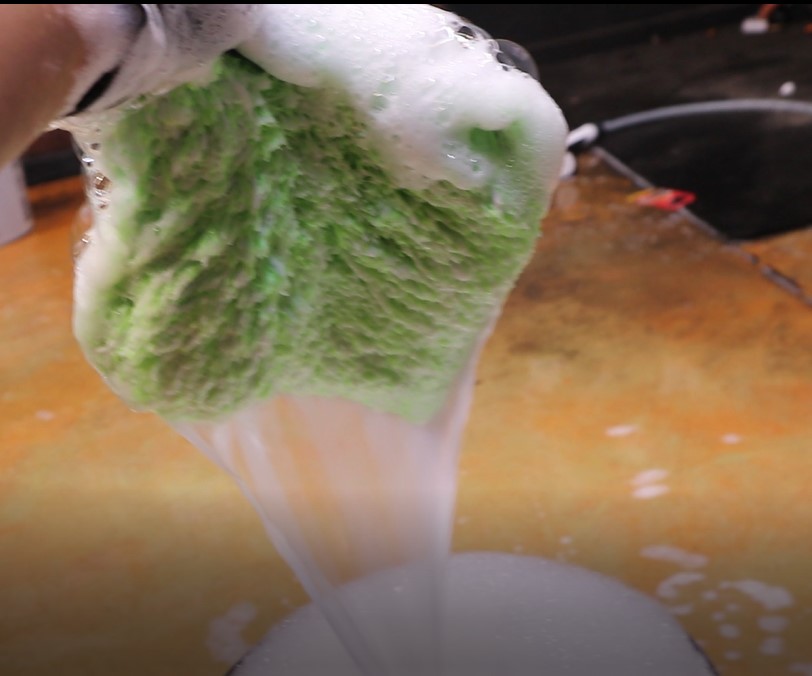
The wash mitt should contain enough shampoo solution that water continues to drip from it.
When the mitt is placed on the paint and lightly compressed, shampoo solution is released toward the contact surface.
This flow helps maintain lubrication and reduces the chance of contamination being pressed into one point and dragged across a long distance.
5. Rinse as Soon as Flushing Stops
There is no need to rinse the wash mitt according to a fixed number of panels.
The standard is simple:
When shampoo solution no longer flows freely from the wash mitt, rinse and reload it.
During contact washing, water should continue moving from the mitt toward the paint.
When the mitt becomes noticeably lighter, stops releasing solution, or begins to drag, flushing has decreased.
Do not press harder or continue wiping.
Rinse the wash mitt thoroughly, allow contamination to leave the fibers, and fully reload it with shampoo solution before continuing.
When flushing stops, the washing pass stops.
6. Use a Grit Guard to Separate Larger Particles
A grit guard does not remove every fine contaminant from the wash mitt.
However, it helps larger sand and grit particles remain near the bottom of the bucket and reduces the chance of the mitt contacting them again.
This is especially useful for reducing the risk of deeper scratches caused by larger, harder particles.
7. Work from Cleaner Areas to Dirtier Areas
Start with the roof, hood, and cleaner upper sections.
Then move downward toward the doors and lower panels.
Rocker panels and the rear bumper should be cleaned last.
When one area is excessively contaminated, using a separate wash mitt or tool for that section is a reasonable exception.
Using a one-mitt method does not mean refusing to adapt to the actual condition of the vehicle.
Conclusion: Wash-Mitt Safety Begins Before Contact
Using multiple wash mitts is a safe and reasonable approach.
Because a used mitt is not returned to the wash bucket, uncertainty surrounding trapped contamination is reduced.
However, increasing the number of wash mitts does not remove contamination from the paint.
A fresh wash mitt still becomes contaminated as soon as it touches a dirty panel.
The Garry Dean-style multi-towel approach also provides many clean working surfaces, but a towel does not automatically provide the same water retention, flushing, and pressure distribution as a proper wash mitt.
I use a one-mitt, one-bucket method because I reduce contamination before contact, use a long-pile microfiber wash mitt, keep it fully saturated, rinse it when flushing decreases, and use enough water for effective contamination release.
The safety of this method is not a magical property of a single tool. It is an engineered outcome created by controlling contamination, water flow, flushing, and pressure.
Ultimately, the safety of a one-mitt, one-bucket method does not begin with the number of wash mitts
It begins with how much contamination has already been removed before the wash mitt touches the paint.