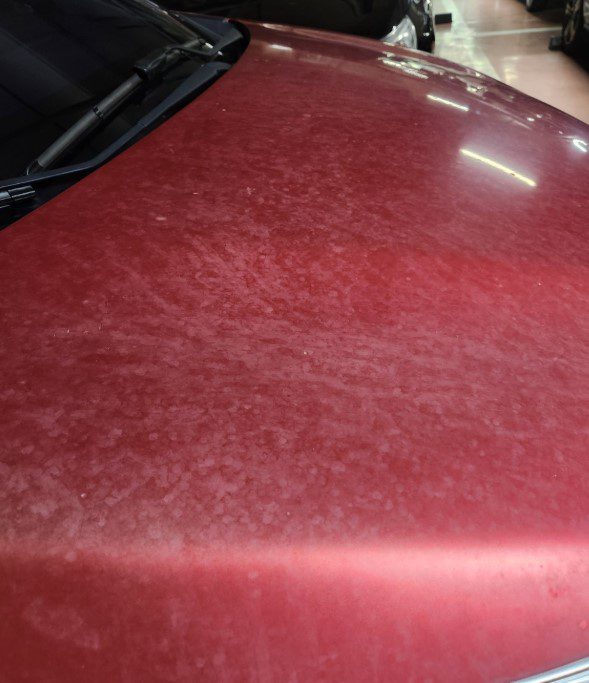
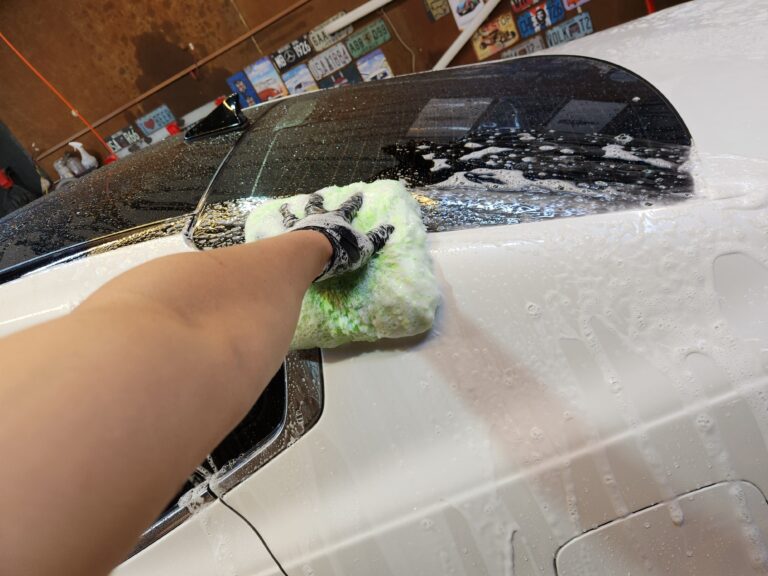
Car paint etching is the mark that remains after bird droppings, bug residue, or a water-spot deposit has been cleaned from the paint.
Many drivers assume that some contamination is still stuck to the surface. They apply more cleaner or rub the area harder. A remaining loss of gloss, depression, or wrinkle can indicate that the clear coat surface has already changed.
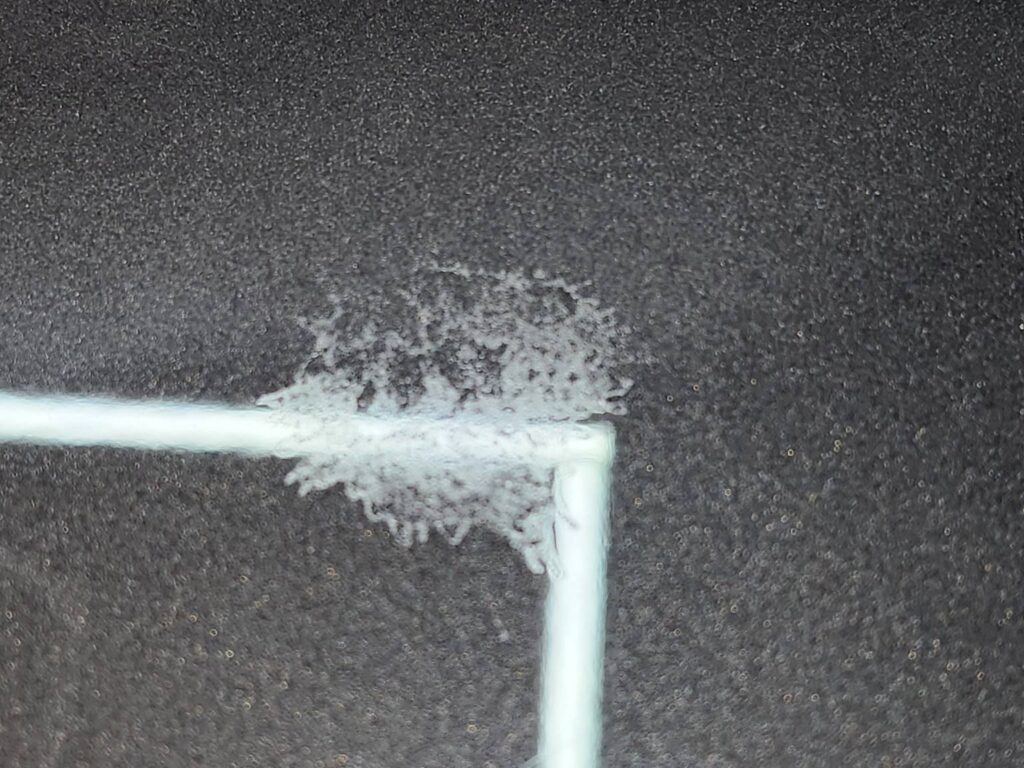
Etching is clear coat damage. Cleaners and contamination removers cannot return a deformed film to its original condition. Mild etching may be improved by polishing with a compound. Deep etching may require localized sanding or refinishing.
Repeated use of strong cleaners and aggressive rubbing can remove healthy clear coat unnecessarily. Remove the contamination safely first, dry the paint, and check whether a mark remains.
The same contaminant does not produce the same depth or shape of etching on every vehicle. The result depends on both the contaminant and the materials and properties of the clear coat receiving it. Heat, moisture, and time add further stress to the film.
The severity of etching therefore depends on what the contaminant contained, how hot the panel became, how long it remained, and how the clear coat was designed.
To understand these differences, we will begin with the vehicle’s outermost paint-protection layer: the clear coat.
Car Paint Etching: Key Points
Clear coat is the thin, transparent final paint layer over the base coat. It produces gloss and protects the color coat from weather, contamination, and washing friction.
Etching is clear coat damage that remains after the contaminant or deposit has been removed.
Contaminant reactivity × heat, moisture, and time × clear coat sensitivity determines how quickly etching develops and what it looks like.
Bird droppings and cement runoff may cause damage quickly. Near-neutral water can also produce etching when repeated drying concentrates minerals on the paint.
Remove the contamination first and inspect the dry paint under good lighting. Polish mild etching. Consider spot sanding or refinishing for deep damage.
The best prevention is to remove contamination before it dries and concentrates on a hot panel.
Contents
- PART 1. What Is Automotive Clear Coat? Paint Structure, Thickness, and Properties
- PART 2. What Is Car Paint Etching? Why Bird Droppings, Bugs, and Water Spots Leave Marks
- PART 3. How Should Car Paint Etching Be Treated?
PART 1. What Is Automotive Clear Coat? Paint Structure, Thickness, and Properties
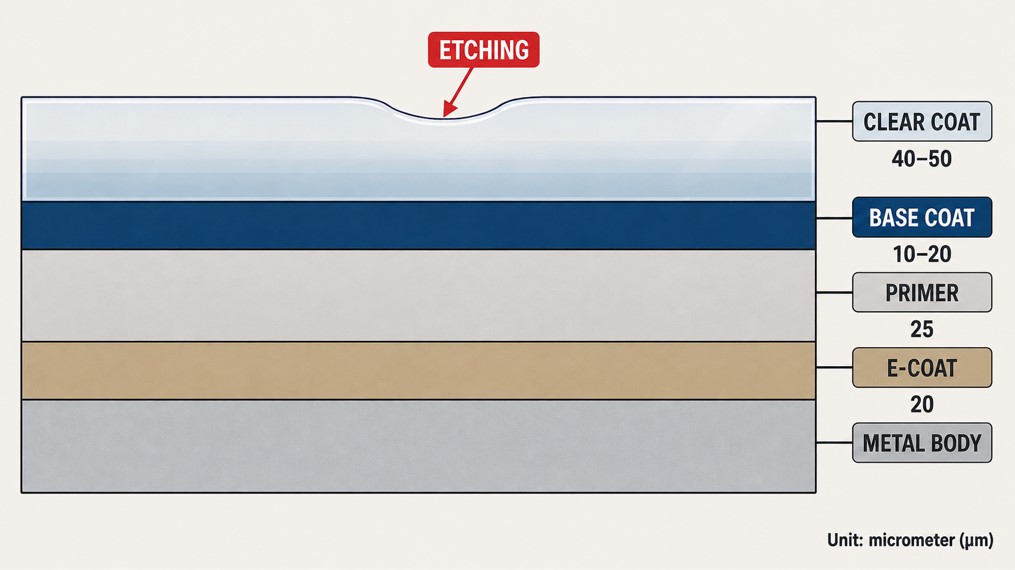
Most vehicle bodies are made from steel or aluminum. These metals are strong, but they need protection from water, oxygen, road salt, and other corrosive materials.
Automotive paint provides that protection through several layers, each with a different role.
- E-coat and primer: These foundation layers help prevent corrosion and improve adhesion. They also help level the surface and manage impact through the paint system.
- Base coat: This layer provides the vehicle’s color, including pearl and metallic effects. Its direct resistance to the outside environment is limited.
- Clear coat: This transparent final layer covers the base coat. It receives sunlight, rain, temperature changes, bird droppings, bug residue, minerals, and washing friction first. Its smooth surface also creates the depth and gloss associated with modern automotive paint.
Most matte-finish vehicles also use a transparent clear coat. Matting agents and a microscopically textured surface scatter light, producing the soft, low-gloss appearance.
Typical thickness: On a conventional factory four-layer paint system, the clear coat is often around 40–50 μm thick. That is roughly half the thickness of a sheet of copy paper. Some vehicles may have clear coat in the 30 μm range, and actual thickness varies by model, panel, color, and paint system.
A clear coat has to balance several properties at the same time.
- Hardness and scratch resistance: resistance to washing friction and surface scratching
- Flexibility and impact resistance: the ability to accommodate stone impacts and small movements of the body panel
- Weathering and chemical resistance: resistance to UV exposure, temperature changes, acidic contamination, and alkaline contamination
The balance among these properties gives each clear coat its working characteristics. It also helps explain why the same contaminant produces different damage on different vehicles.
Hard vs. Soft Clear Coat: How Each Responds to Scratches and Impact
A clear coat needs enough hardness to resist scratching and enough flexibility to absorb movement and impact.
A hard clear coat usually resists fine marring from wash mitts, towels, and automatic car-wash brushes. This can help preserve the original gloss for longer.
A more flexible clear coat can absorb part of a sudden load through deformation. That flexibility may help under some stone-impact conditions. Repeated washing friction, however, may produce swirls or fine haze more easily.
Hardness alone does not determine stone-chip resistance. Primer performance, intercoat adhesion, total film thickness, paint age, stone speed, and impact angle also affect whether the coating cracks or detaches.
German vs. Japanese Car Paint Hardness: General Trends Seen During Polishing
Automotive clear coats do not all use the same transparent paint. Manufacturers combine different resins, crosslinkers, additives, and curing conditions to balance hardness, flexibility, scratch resistance, chemical resistance, and appearance.
Japanese Clear Coats: Acid and Etching Resistance
Japan has a humid, rainy climate and many coastal areas. Repeated wetting and drying can leave salts and minerals on the paint. Acid rain also became an important paint-durability concern. Japanese manufacturers therefore pursued clear coats with improved acid and environmental etching resistance.
Toyota’s official paint-technology history records an acid-rain-resistant clear coat for Lexus in 1991, a silane-type acid-rain- and scratch-resistant clear coat in 1994, and an acid-epoxy clear coat in 1995. See Toyota’s painting and rustproofing technology history.
European Nano Clear Coats: Scratch Resistance
Some European premium manufacturers have developed clear-coat technologies that combine conventional resin with inorganic or nano-scale structures to improve scratch resistance. Mercedes-Benz has documented nano clear-coat technology with higher scratch resistance than conventional paint in its SL-Class environmental certificate.
What Detailers Commonly Observe During Polishing
These material and design choices help explain why German vehicles often feel relatively hard under a polishing pad while many Japanese vehicles feel softer. These remain broad tendencies, with many exceptions.
- German vehicles: Swirls and sanding marks may correct slowly with the same pad and compound. High polishing resistance and scratch resistance can help maintain gloss. Under conditions where the coating system cannot distribute an impact, cracking or chipping may become more likely.
- Japanese vehicles: Defects may correct more quickly, while a soft towel or finishing pad can sometimes leave fine haze. A more flexible film may accommodate impact through deformation. Chemically stable crosslinking systems can also combine a soft polishing response with strong chemical resistance.
Nissan’s high-elasticity Scratch Guard clear coat is one example of how a manufacturer can tune flexibility and scratch recovery together. Nissan describes the technology in its official Scratch Guard Coat announcement.
Vehicle model, color, production year, assembly plant, paint supplier, and repair history can all change the result. A refinished panel may also respond differently from factory paint because of the materials, curing conditions, and application quality.
Hardness and chemical resistance are related parts of clear-coat performance, but they are not the same property. Material selection and coating design help explain why the same contaminant can leave different etching depth and shape on different vehicles.
Clear Coat Crosslinking: How Materials Shape Film Properties
Inside cured clear coat, long polymer molecules are connected into a network. These connections are called crosslinks.
Crosslinking turns liquid paint into a transparent polymer film. The resin, crosslinker, additives, and curing conditions influence hardness, flexibility, scratch resistance, and chemical resistance.
The stability of each chemical connection also matters. A dense coating can still be affected when part of its chemistry is sensitive to acid, alkali, or moisture. A clear coat that feels soft during polishing can therefore still resist acidic contamination well.
Automotive clear coats have used several crosslinking systems over time.
- Acrylic-melamine: widely used for its balance of appearance, hardness, and production efficiency; some linkages can be sensitive to acid and moisture.
- Acid-epoxy: developed to improve resistance to acid rain and environmental etching; it appears in the development history of Japanese acid-resistant clear coats.
- Acrylic-urethane: can be formulated across a wide range of hardness and flexibility.
- Silane or silicate hybrid: combines an organic resin with an inorganic structure to improve scratch resistance and surface performance; nano clear coats on some European premium vehicles are a representative example.
The word “acid” in acid-epoxy refers to a component used in the curing reaction. It does not mean that the finished coating is acidic. The final hardness and flexibility still depend on the full formulation.
PART 2. What Is Car Paint Etching? Why Bird Droppings, Bugs, and Water Spots Leave Marks
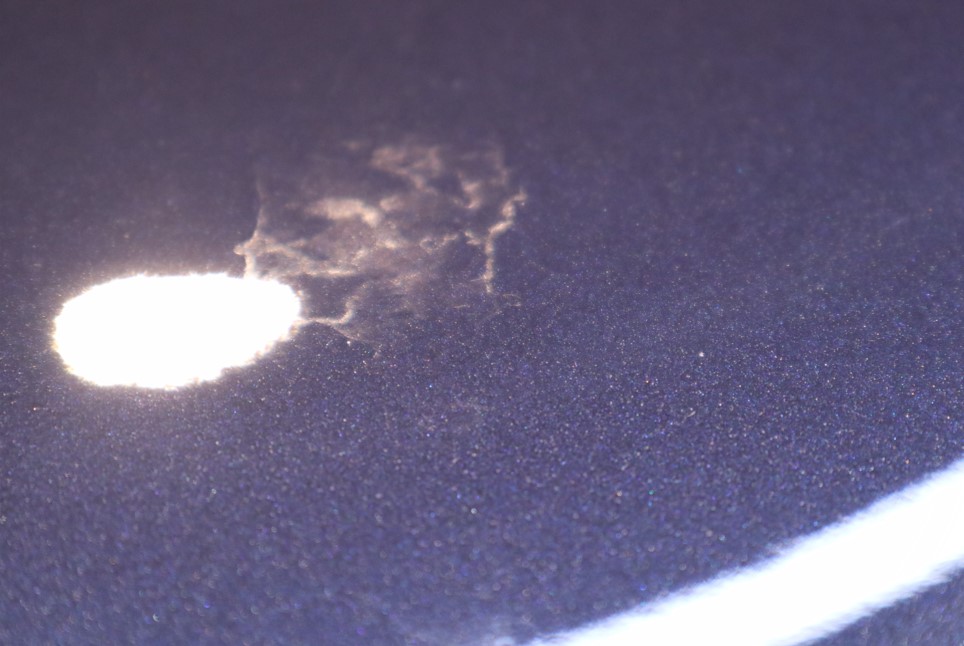
Etching develops through the combined effect of contaminant chemistry, clear-coat resistance, current paint condition, exposure time, heat, and moisture.
Why Heat, Moisture, and UV Accelerate Clear Coat Etching
Clear coat is a strong barrier, but it is not completely impermeable. Moisture and some small molecules can influence the film.
A wet clear coat may swell microscopically or become temporarily softer. In ordinary conditions, much of this change reverses as the film dries. Contamination, heat, and long exposure can leave a lasting surface change.
Hydrolysis Is One Possible Chemical Mechanism
Paint etching can involve several chemical reactions and physical changes. Hydrolysis is one of them. It is a reaction in which water participates in weakening or breaking a chemical bond.
When water remains with reactive acids, alkalis, enzymes, or salts, the clear coat’s chemical bonds or surface structure may change. The affected area can then show different hardness or flexibility from the surrounding paint.
Clean water in brief contact with healthy paint causes these changes very slowly. Bird droppings and bug residue contain a more complex mixture of enzymes, salts, organic material, and moisture. Heat and time can accelerate several reactions, including hydrolysis.
When Do Water Spots Turn Into Etching? How Mild Reactions Accumulate Over Time
Bird droppings contain a mixture of reactive organic material, salts, and enzymes. Cement runoff can be strongly alkaline. On a hot panel, these contaminants may begin damaging the clear coat in a relatively short time.
Tap-water or groundwater droplets may be close to neutral pH. As the water evaporates, minerals and salts become concentrated. Rain or dew can wet the same deposit again, followed by another drying cycle.
An early deposit may still be a removable water spot. With enough time and repeated wet-dry cycles, it can contribute to clear-coat deformation. The difference between a broad mineral film and a distinct water ring is explained in our mineral contamination vs. water spots guide.
pH alone cannot predict etching. Highly reactive contamination may cause damage quickly, while near-neutral mineral water can cause damage through long residence time and repeated concentration.
Heat Accelerates Both Paint Response and Contaminant Concentration
A panel exposed to direct summer sun can become very hot. At elevated temperature, the clear coat may respond more softly while diffusion and chemical reactions proceed faster.
At the same time, moisture in bird droppings, bug residue, and water droplets evaporates quickly. Acids, alkalis, salts, enzymes, and organic compounds become concentrated in a small area.
Heat therefore accelerates two processes at once: the response of the clear coat and the concentration of the contaminant.
Compare two situations:
A contaminant removed quickly in cool shade may leave only a light stain.
The same contaminant dried all day on a hot hood is more likely to leave gloss loss or a depression after removal.
UV Exposure Gradually Ages Clear Coat
UV exposure produces cumulative changes over a long period. As the clear coat ages and loses part of its protective performance, it can become more sensitive to the same contaminant, heat, and moisture.
How Car Paint Etching Forms: Why Marks Remain After Cleaning
People often say that a bird dropping or water spot has “eaten into the paint.” In practical terms, moisture and small reactive components affect the surface while the clear coat changes or loses a microscopic amount of material. The remaining depression can look as though the contaminant physically penetrated the paint.
- Contaminant residence: A moisture-containing contaminant remains in contact with the clear coat. Longer residence time provides more opportunity for interaction.
- Concentration: As water evaporates, acids, alkalis, salts, enzymes, and organic material become concentrated. Mineral movement and deposition can make the outer edge of a water spot more visible.
- Faster reaction from heat and time: A hot surface speeds evaporation and clear-coat response. Even mild reactions can accumulate during a long exposure.
- Clear-coat change: The surface condition changes. Depending on the contaminant, chemical damage and small material changes may occur together.
- A permanent mark remains: After removal, the area may show gloss difference, depression, wrinkling, whitening, or fine cracking.
Contaminant reactivity × heat, moisture, and time × clear coat sensitivity = the speed and appearance of etching
The contaminant determines the type of chemical challenge. Clear-coat chemistry affects resistance. Hardness and flexibility can also influence the shape of the remaining defect.
PART 3. How Should Car Paint Etching Be Treated?
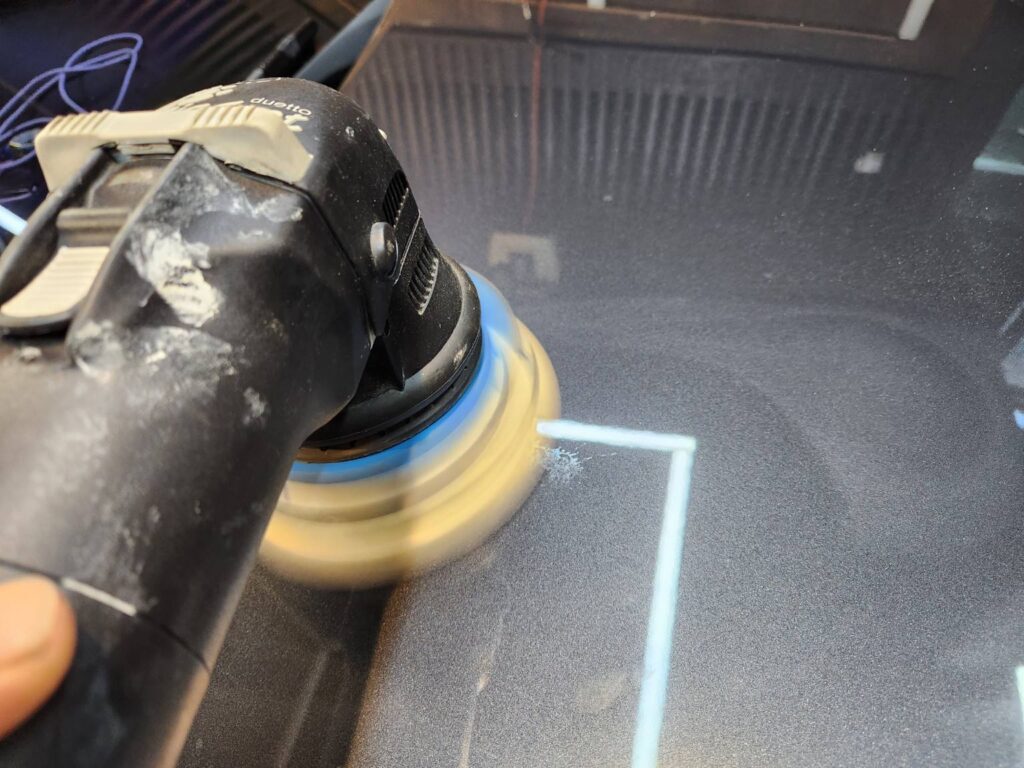
Treatment starts by separating removable contamination from a permanent change in the clear coat. Repeating cleaners or compounds before checking the defect depth can remove healthy paint unnecessarily.
Remove the Contamination and Inspect the Paint First
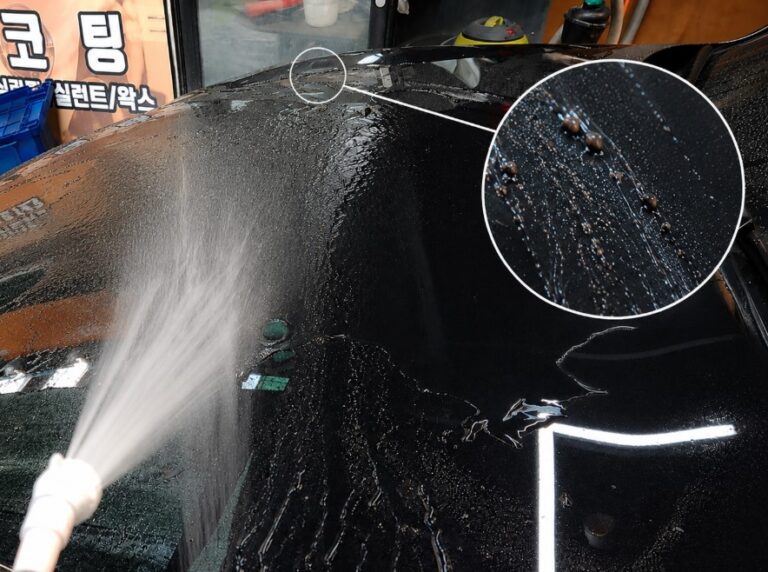
Allow the panel to cool. Wash away loose dirt before touching the affected area.
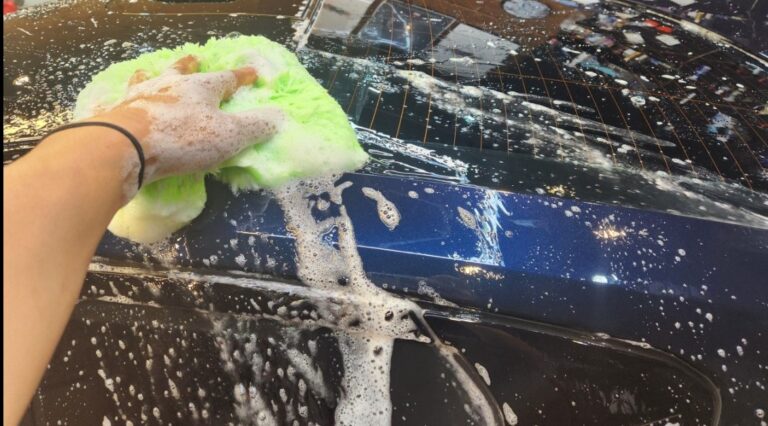
Soften dried bird droppings or bug residue with water and a suitable cleaner. Lift the material gently instead of scrubbing it dry.
Water rings may still contain mineral deposits. Follow the least aggressive steps in our water spot removal guide before judging the paint.
Rinse and dry the panel fully. Inspect it under clear, focused lighting.
- If the mark disappears, it was removable contamination or mineral deposition.
- If gloss loss, a depression, wrinkling, whitening, or fine cracking remains, clear-coat damage is likely.
A paint cleaner can help remove remaining mixed contamination and expose the real surface condition. Its ability to restore a deformed clear coat is limited. See our complete paint cleaner guide for its role and limitations.
Check Paint Condition Before Abrasive Work
Before polishing or sanding, measure several points on the panel with a paint thickness gauge (PTG).
A conventional PTG usually reports the combined thickness of e-coat, primer, base coat, and clear coat. It does not isolate the clear coat by itself.
| Paint Layer | Representative Thickness | Main Role |
|---|---|---|
| E-coat | About 20 μm | Corrosion protection for the metal body |
| Primer | About 25 μm | Surface leveling, adhesion, and impact-resistance support |
| Base coat | About 10–20 μm | Color, pearl, and metallic appearance |
| Clear coat | About 40–50 μm | Gloss and protection from scratches and contamination |
| Total factory paint | About 90–120 μm | The combined value commonly shown by a PTG |
Actual numbers vary by vehicle, color, panel, and production process. Some vehicles have clear coat in the 30 μm range.
If the lower layers are estimated at roughly 55–65 μm, the total reading can provide a rough indication of the clear-coat range.
Example: 110 μm total paint − approximately 60 μm of lower layers = an estimated 50 μm of clear coat.
This calculation is an estimate, not a direct clear-coat measurement. Compare the affected panel with several normal areas and adjacent panels. Measurement variation, repair history, and previous polishing history all matter.
Mild Etching: Surface Change and a Shallow Depression
Mild etching can often be improved by polishing the surrounding clear coat until the height difference is less visible.
Start with a test spot using a finishing pad and mild polish or compound. Increase cut only when the paint hardness and defect depth require it.
Abrasive correction lowers the surrounding clear coat. Monitor the result and preserve as much remaining film as possible.
Treatment target for mild etching: Reduce the outline and gloss difference until they are difficult to notice under inspection lighting. Complete removal is not always the safest target.
Severe Etching: Deep Wrinkles, Whitening, or Fine Cracks
Repeated machine compounding over a large area removes healthy clear coat around a small, deep defect. Localized sanding can focus correction on the raised edge and height difference around the etched area.
After sanding, compound and polish the area to remove sanding marks and restore gloss.
Spot sanding removes paint faster than compound. Grit selection, pressure, sanding range, and remaining film thickness require experience. An inexperienced owner should have the area assessed by a professional.
Stop if whitening or cracking remains, or if the clear-coat margin appears insufficient. Deep damage may need to remain partially visible or require refinishing.
Glaze can temporarily reduce a small gloss difference. It cannot rebuild a deep wrinkle or crack. Wax, sealant, and coating products are most useful after correction, when they can support future contamination management.
Treatment target for severe etching: Correct only the affected area where appropriate. Seek professional assessment when sanding experience or paint-thickness information is limited.
Key Prevention Principles
Prevention depends on ending contact before the contaminant dries and concentrates. This matters most on a hot panel.
- Remove bird droppings, bug residue, cement runoff, and water droplets before they dry.
- Do not leave a wet vehicle to dry in direct sun.
- Avoid chemical removal work on a hot panel.
- Soften dried contamination with water and a suitable cleaner before wiping.
- Avoid repeated use of strong chemicals and excessive rubbing.
Bird droppings, bug residue, tree sap, mineral water spots, and cement runoff have different chemistries and adhesion patterns. Each needs its own removal method.
For related maintenance steps, continue with our water spot removal guide and acidic prewash guide.
Frequently Asked Questions
How can I tell contamination from etching?
Remove the surface residue with the least aggressive suitable method. Rinse, dry, and inspect the paint under focused lighting. A mark that disappears was contamination or deposition. A remaining depression, gloss difference, wrinkle, white patch, or crack indicates clear-coat change.
How quickly should bird droppings or bug residue be removed?
Remove them as soon as practical. There is no universal safe number of hours. Panel temperature, sunlight, contaminant composition, moisture, and clear-coat condition all change the reaction rate. A hot panel can develop damage much faster than a cool shaded panel.
Can near-neutral water cause etching?
Yes. As water evaporates, dissolved minerals and salts remain and become concentrated. Repeated wetting and drying can turn a removable deposit into a persistent water spot and eventually contribute to clear-coat etching.
Does ceramic coating completely prevent etching?
No coating provides unlimited protection. A coating adds a sacrificial barrier and can make contamination easier to remove. Heat, long exposure, strong alkali, concentrated minerals, or neglected bird droppings can still overwhelm it.
Can water spot remover or paint cleaner remove etching?
These products can remove mineral deposits and mixed surface contamination. They help reveal whether a permanent defect remains. True etching usually requires abrasive correction because the clear coat itself has changed.
The boundary between removal and polishing is explained in the water spot removal guide. The paint cleaner guide explains what a paint cleaner can and cannot do.
Are all German clear coats hard and all Japanese clear coats soft?
No. These descriptions are broad tendencies observed in detailing work. Model, color, production year, plant, paint supplier, curing, repair history, and previous polishing can produce major differences even within the same brand.
Conclusion
Car paint etching is a permanent change in the clear coat left after contamination or mineral deposits have been removed.
The outcome comes from several factors working together: contaminant chemistry, clear-coat resistance, heat, moisture, UV aging, and exposure time.
Reactive contamination can cause damage quickly. Mild mineral water can also become harmful after repeated concentration and long residence time.
Remove the contamination first. Then inspect the dry surface and choose treatment according to defect depth. Polish mild etching conservatively. Use localized sanding only when the paint condition and operator experience support it.
The most reliable strategy remains simple: remove contamination before it dries on a hot panel, and preserve the clear coat you still have.